Reviewed by Elena P. · How we review
Worker honey bees usually die after stinging a person or another thick-skinned animal, but most other bees do not. A worker’s barbed stinger lodges in skin and tears free of her body, which is fatal. Queens, bumble bees, carpenter bees and most other bees can pull out their stingers and sting again, and so can most wasps. Male bees cannot sting at all.
Honey bees are a sliver of bee diversity: University of Wollongong researchers put Apis bees at 0.04% of bee species. The wasp side holds a twist most guides miss.
Key Takeaways
- A worker honey bee’s barbed stinger, venom sac and part of her abdomen tear away in thick skin, and she dies.
- Queens have reduced barbs and survive; drones have no stinger.
- Female bumble bees, carpenter bees and mason bees survive stings. Male carpenter bees and over 500 stingless bee species cannot sting.
- Hornets and paper wasps almost never lose their stingers, but common yellowjackets often do, per a 2021 study of 51 wasp species.
- A honey bee stinging an insect can usually pull free and live.
This is educational information about insect biology, not medical advice. If you were just stung, see our first-aid guide for bee and wasp stings.
Table of Contents
- Which Bees Die After Stinging? Species by Species
- Why a Worker Honey Bee Dies
- A Honey Bee Can Survive Stinging an Insect
- Queens and Drones
- Bumble Bees, Carpenter Bees and Other Bees That Survive
- Wasps and Hornets: Mostly No, With Exceptions
- How Long Does a Honey Bee Live After Stinging?
- Frequently Asked Questions
- The Bottom Line
Which Bees Die After Stinging? Species by Species
| Insect | Dies after stinging a person? | Why |
|---|---|---|
| Honey bee worker | Usually | Barbed stinger lodges in skin and tears away |
| Honey bee queen | No | Barbs reduced; mostly used on rival queens |
| Honey bee drone | Cannot sting | No stinger |
| Bumble bee (female) | No | Stinger pulls out; can sting repeatedly |
| Carpenter bee | No | Males cannot sting; females seldom do |
| Mason bee | No | Stinger is not barbed |
| Mining and leafcutter bees | No | Many cannot sting or cannot pierce skin |
| Stingless bees | No | No working stinger; they bite |
| Yellowjackets | Sometimes | Stinger lost “often” in common species |
| Hornets, paper wasps | Almost never | Fewer, weaker barbs |
| Swarm-founding tropical wasps | Often to usually | Stronger barbs than most wasps |
Why a Worker Honey Bee Dies
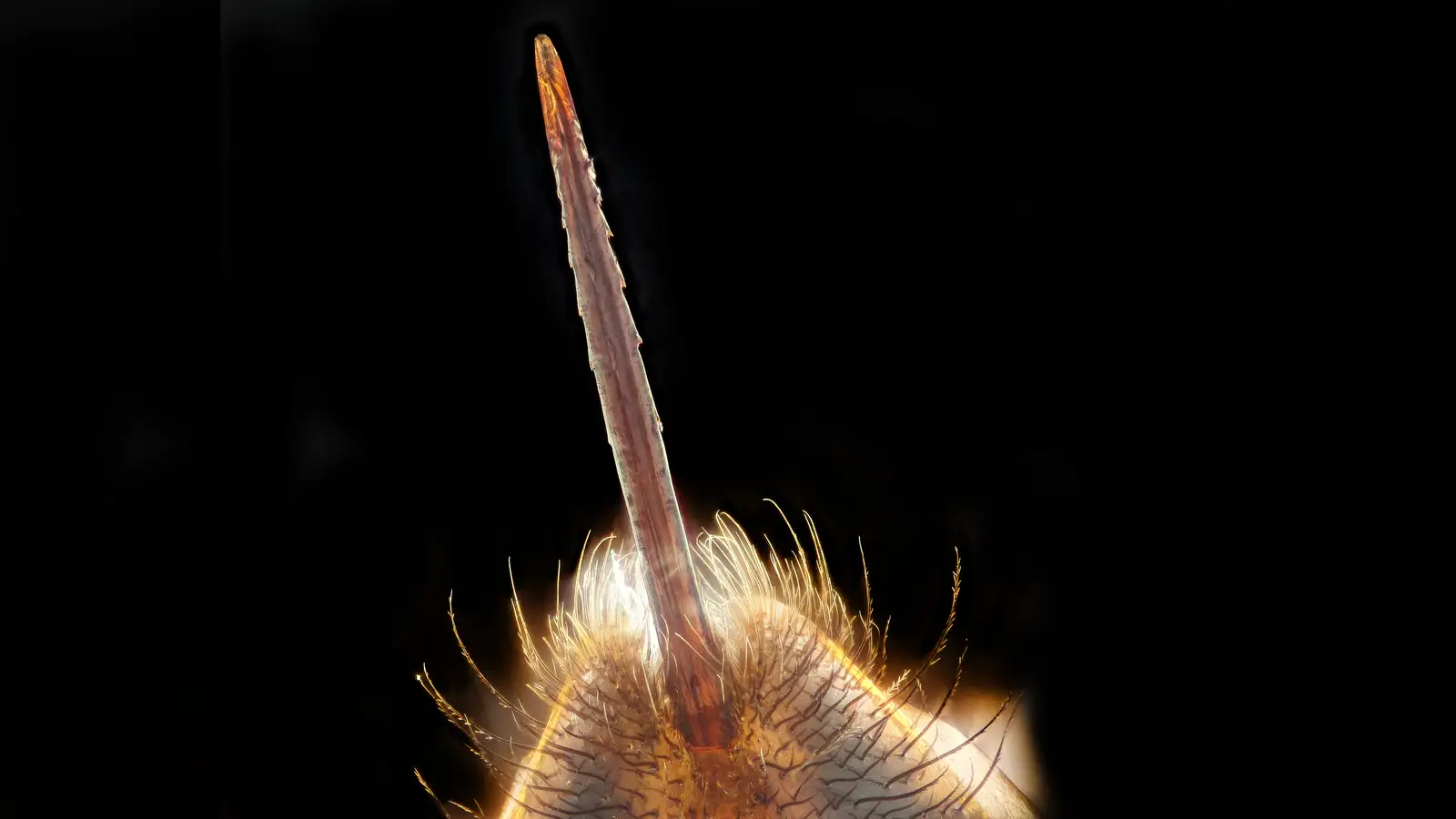
In thick skin, the barbed lancets anchor. A 2014 PLOS ONE study from Tsinghua University found that a honey bee stinger rotates in a helix as it enters, a motion tied to the spiral arrangement of its barbs. Electron microscopy by Mulfinger and colleagues (Journal of Medical Entomology, 1992) shows why wasps differ: a wasp’s smooth stylet shields the barbs of its retracted lancets, while a honey bee’s stylet is too narrow and carries rows of barbs of its own.
When the bee pulls away, she loses the stinger and more:
“Workers have a barbed stinger that is torn, with the poison sac, from the end of their abdomen when they deploy the sting into a tough-skinned victim. This results in the worker bee’s death.”
The Wollongong researchers add that the stinger stays lodged, pumping more venom.
A Honey Bee Can Survive Stinging an Insect
The fatal part is the target’s skin. Live Science reports that honey bees do not tend to die when stinging other insects or spiders, because the stinger can generally pierce a thin exoskeleton and come out undamaged. So “a bee can sting only once” holds for mammal skin, not every target. For how colonies use stings, alarm pheromone and guards, see how honeybees defend the colony.
Queens and Drones
Only females sting, because the stinger is a modified egg-laying organ. UF/IFAS says of the queen: “The queen also has a stinger but its barbs are reduced. Consequently, she does not die when she uses it.” Sources vary on whether her stinger is smooth or only smoother. University of Arizona Cooperative Extension says queens generally use theirs only to kill rival queens. Drones have no stinger.
Bumble Bees, Carpenter Bees and Other Bees That Survive
Bumble bees. Allyson Ray of Penn State told Live Science that bumble bees have a “smooth stinger” and can sting multiple times without dying. See our bumblebee guide.
Carpenter bees. Penn State Extension says the male cannot sting and the female “is capable of stinging but seldom does.” See carpenter bee identification.
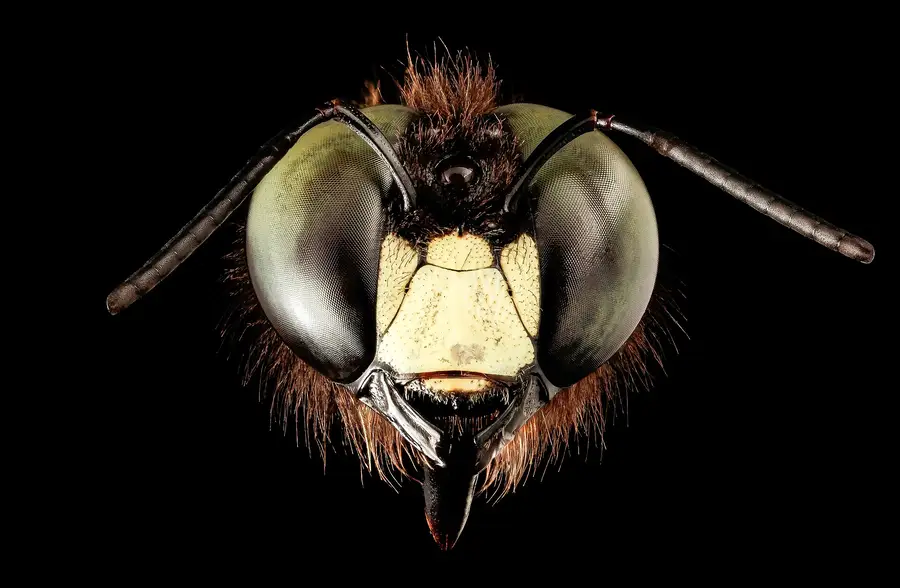
Mason, mining and leafcutter bees. Per Britannica, mason bees lack barbed stingers; most mining bees and certain leafcutters cannot sting or cannot pierce human skin.
Stingless bees. More than 500 species have no working stinger and defend by biting; see Australia’s sugarbag bees.
“Smooth” is shorthand. A survey by Packer (2003), summarized in the 2021 wasp paper below, found barbs in most solitary bees and all social bees whose stinger is not greatly reduced. Barb number and strength matter.
Wasps and Hornets: Mostly No, With Exceptions
Many guides say wasps have smooth stingers. A 2021 comparison of 51 wasp species found distinct, acute barbs on the lancets of all but the hover wasps. What differs is how many barbs there are and how strong. The authors’ rule of thumb:
“autotomy is not expected where there are fewer than eight barbs, and common or almost certain with eight or more barbs.”
By their table of literature reports, hornets and paper wasps almost never lose a stinger in human skin. The surprise is the common North American yellowjackets: the eastern, western and German species are coded “often.” A few swarm-founding wasps, whose big colonies start with many queens and workers together, lose it “usually”; one, Epipona tatua, has barbs much like a honey bee’s.
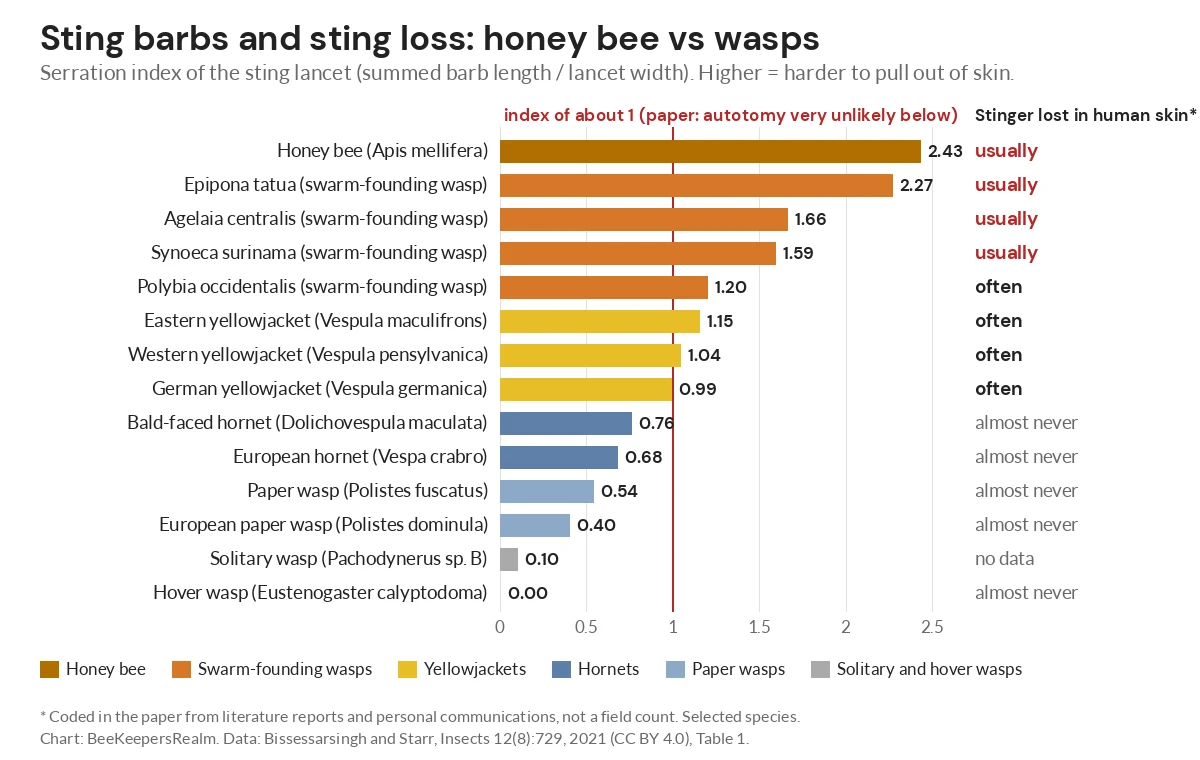
Treat the codes with care: they come from literature reports, not field counts. Mulfinger and colleagues found clinical sting challenges showed certain yellowjackets losing stingers with “surprisingly high frequency,” yet a survey of wasp collectors suggested it is rarer in the field. A yellowjacket that stings you may live; a hornet nearly always will. For which hurts more, see bee sting vs wasp sting.
How Long Does a Honey Bee Live After Stinging?
Sources disagree. Washington State University molecular biologist Nicholas Naeger told Live Science a stung bee might live several hours before dying of fluid loss and organ failure; Discover Wildlife says a few minutes. His marking test is the hard evidence:
“I marked and returned over 200 bees that had stung [the target], and I never witnessed a single case of a bee being alive the following morning.”
If you were stung, see what happens to the swelling over the next week.
Some bees cannot sting at all; see how stingless bees defend their nests.
For more measured numbers on stings, flight and colonies, see bee facts with named sources.
Frequently Asked Questions
How soon do bees die after stinging you?
A worker honey bee lives from a few minutes to several hours, depending on the source. None of Naeger’s marked bees was alive the next morning.
How many times can a bee sting before it dies?
A worker honey bee stings a person once. Bumble bees, queens, female carpenter bees and most wasps can sting repeatedly.
Do bees know they’ll die if they sting someone?
Probably not. Naeger told Live Science he does not think honey bees understand they will die, but that they are “very willing to give up their lives” for the colony.
Do wasps die after they sting you?
Usually not. Hornets and paper wasps almost never lose the stinger, but common yellowjackets sometimes do, and some tropical wasps usually do.
Do queen bees die after stinging?
No. A queen’s barbs are reduced, so she survives, and she mostly stings rival queens.
Do killer bees die after stinging?
Yes, like other honey bees. Britannica describes Africanized “killer” bees as honey bee hybrids that are more defensive. See our Africanized bee guide.
What sting is worse, bee or wasp?
Often a tie on pain: the honey bee scores 2 out of 4 on the Schmidt scale, per the Wollongong researchers. Our bee versus wasp sting comparison covers venom and danger.
The Bottom Line
Whether a bee dies depends on who stung and what she stung. The worker honey bee is the famous exception, not the rule, and a few wasps share her fate. Header photo: USGS Bee Inventory and Monitoring Lab, public domain, via Wikimedia Commons.