Reviewed by Thomas B. · How we review
Are wasps pollinators? Yes. Adult wasps drink nectar, and pollen that sticks to their bodies travels with them from flower to flower. Most wasps are less hairy than bees and carry less pollen, but not always: in a 2024 study, a paper wasp left about as much pollen on goldenrod in one visit as a bumble bee. Some plants depend on wasps entirely, including almost 1,000 kinds of fig and several hundred Australian orchids.
Key Takeaways
- Wasps pollinate as a side effect of feeding: adults drink nectar, while their larvae eat insects or spiders, not pollen.
- Without the branched hairs bees use, most wasps carry less pollen, yet one paper wasp matched a bumble bee per goldenrod visit.
- A 2021 review found stinging wasps visiting 960 plant species, 164 of which depend on them completely. Fig wasps come on top of that.
- Figs, orchids that pose as female wasps, a yellowjacket-pollinated orchid and some African milkweeds all need wasps.
- Wasps and honey bees share fall flowers such as goldenrod.
Table of Contents
- Are Wasps Pollinators? What the Evidence Says
- How Wasps Compare With Bees as Pollinators
- Four Ways Wasps Pollinate
- Plants That Need Wasps: A Sourced Reference
- Do Yellow Jackets and Hornets Pollinate?
- What Wasp Pollination Means for Beekeepers
- Wasps in the Garden
- Frequently Asked Questions
- The Bottom Line
Are Wasps Pollinators? What the Evidence Says
The USDA Forest Service calls wasps “very important pollinators.” The same page adds the usual caveat:
“Wasps look like bees, but are generally not covered with fuzzy hairs. As a result, they are much less efficient in pollinating flowers, because pollen is less likely to stick to their bodies and to be moved from flower to flower.”
The broadest count comes from a 2021 Biological Reviews paper by Ryan Brock, Alessandro Cini and Seirian Sumner on aculeate wasps, the stinging lineage that includes paper wasps, yellowjackets and hornets. Per the University of East Anglia’s summary, they found wasps visiting 960 plant species, 164 of them completely dependent on wasps for pollination. Fig wasps belong to a separate, non-stinging lineage, so figs come on top of that number. Because many wasps visit a wide range of flowers, the authors suggest they could serve as backup pollinators.
“Wasps are understudied relative to other insects like bees, so we are only now starting to properly understand the value and importance of their ecosystem services.”
This three-minute BBC Ideas animation imagines a world without wasps: more unchecked pests, the loss of more than 100 kinds of orchids and figs that rely on them, and trouble for the many tropical birds and mammals that eat figs. It also notes that only about 1% of wasp species are the picnic-raiding kind.
How Wasps Compare With Bees as Pollinators
Bees are wasps that switched from hunting prey to collecting pollen; see how bees evolved from hunting wasps.
| Trait | Bees | Most wasps |
|---|---|---|
| Larvae eat | Pollen and nectar | Insects or spiders (pollen wasps excepted) |
| Adults visit flowers to | Feed and gather pollen | Drink nectar |
| Body hair | Branched, pollen-trapping | Generally not fuzzy |
| Pollen transport | Packed deliberately on hairs or leg baskets | Sticks to the body by accident |
| Typical flowers | Wide range, including deep tubes | Open, shallow; most have short tongues |
| Pollen per visit | Usually more | Varies; one paper wasp matched a bumble bee |
| Plants that need them | Many crops and wildflowers | 164 species, plus almost 1,000 figs |
Sources: USDA Forest Service; University of Maryland Extension; Borchardt et al. 2024; Brock, Cini and Sumner 2021.
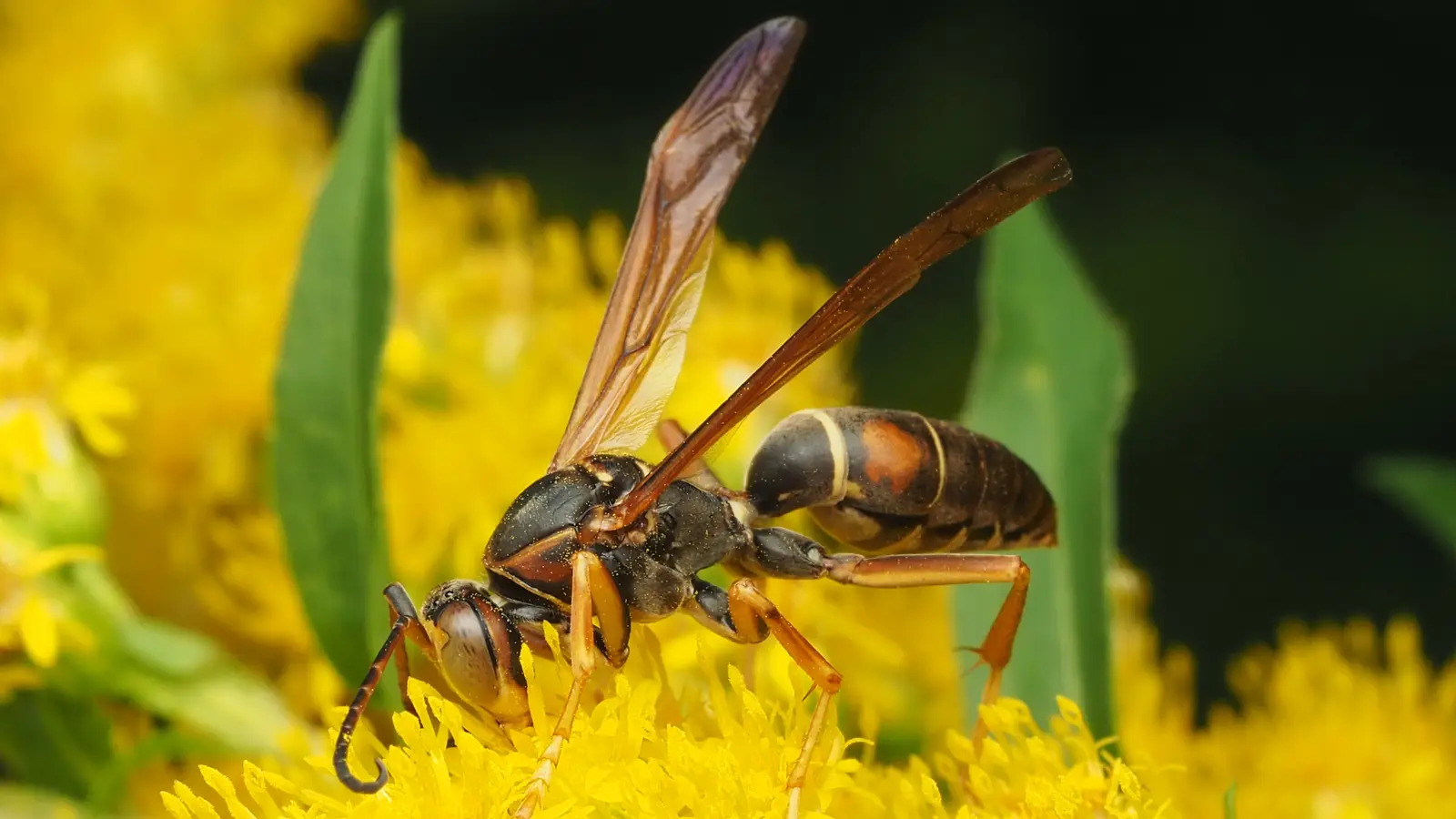
In a 2024 Ecological Entomology study, Kate Borchardt, Danielle Holthaus, Paola Soto Méndez and Amy Toth compared bees and wasps three ways. Wasps visited a distinct community of early-blooming, non-native plants but overlapped with bees on late-blooming natives. Body pollen density and pollen fidelity in four and five of the six wasp families studied matched or beat Colletidae, a bee family. In a direct single-visit test on goldenrod (Solidago canadensis), the northern or dark paper wasp, Polistes fuscatus, deposited about as many pollen grains as the common eastern bumble bee, Bombus impatiens, an efficiency the authors call surprisingly high and in need of more study. For this species, see our paper wasp guide.
“Bees are kind of vegetarian wasps. Wasps use prey as their protein source and to raise their offspring — bees use pollen”
So the average wasp is a weaker pollinator than the average bee, but some wasps on some plants rival a bumble bee.
Four Ways Wasps Pollinate
1. Nectar feeders
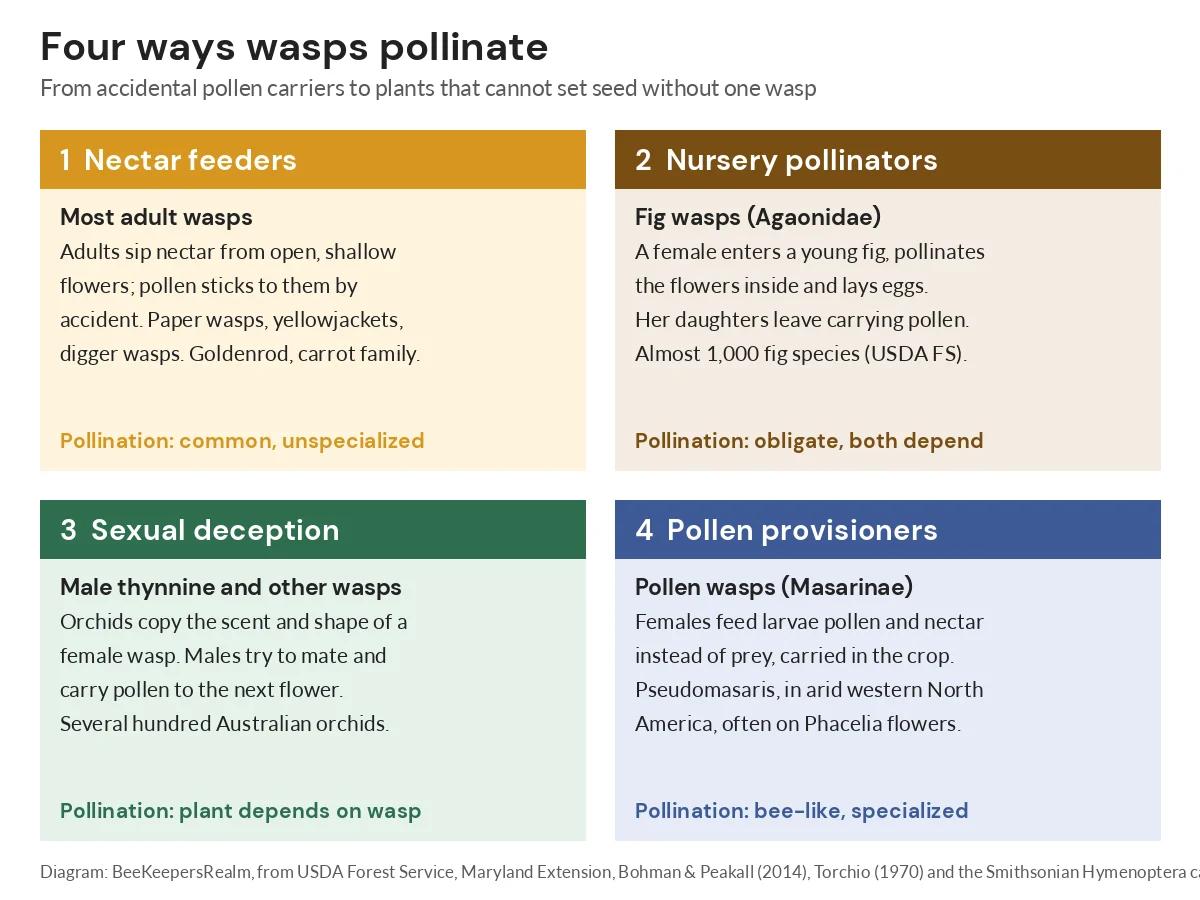
University of Maryland entomologist Anahí Espíndola notes that predatory wasps still need sugar, so they visit flowers all season, especially in fall. Most have short tongues and cannot see red, though they see ultraviolet, so they favor open, shallow, white or yellow flowers, such as the carrot family.
2. Fig wasps
Fig flowers sit inside the young fruit. Fig wasps pollinate almost 1,000 fig species, entering through a tiny pore to mate, lay eggs and pollinate. Some cultivated figs ripen without them; see our fig wasp guide.
3. Orchids that pose as female wasps
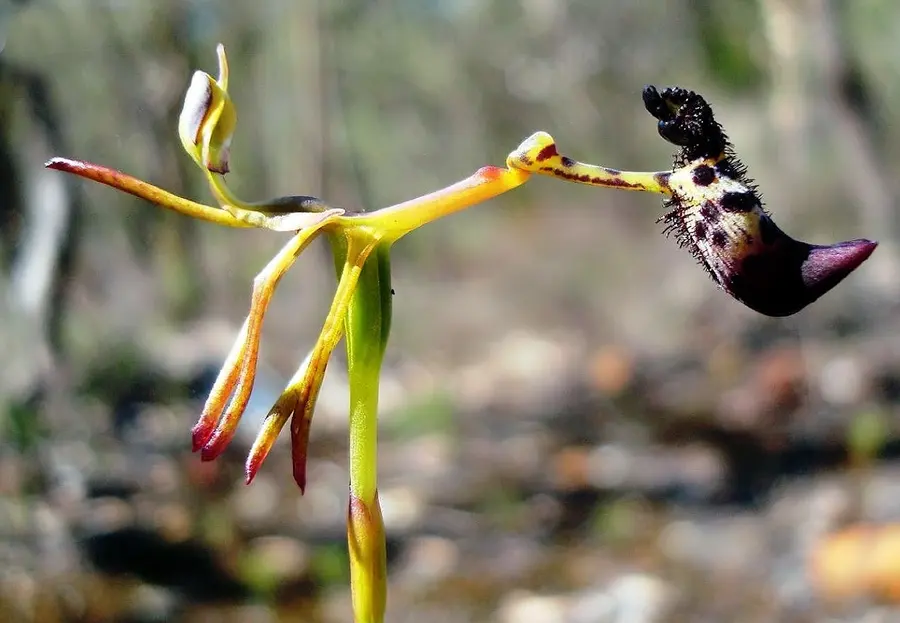
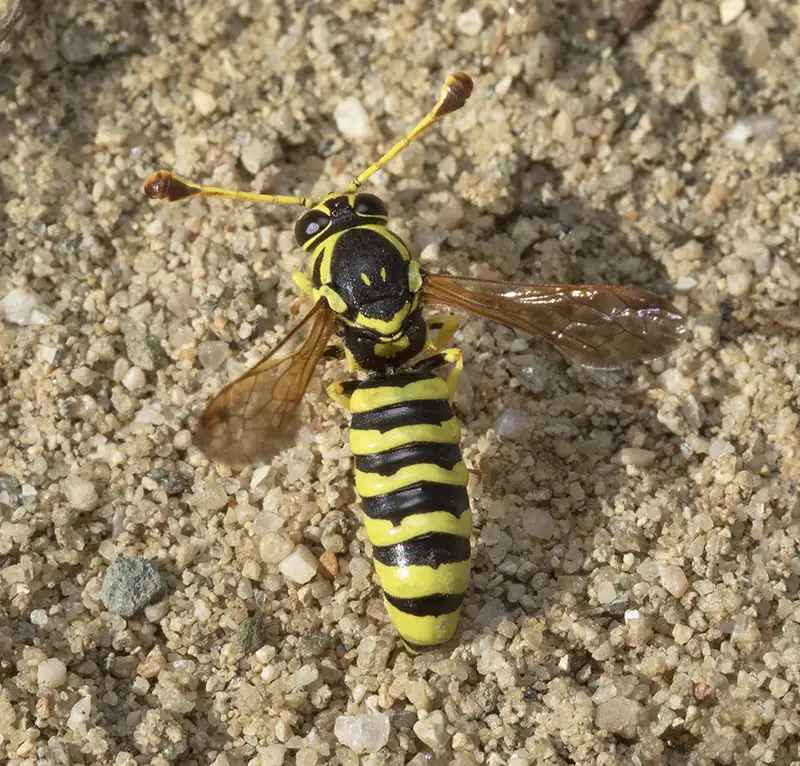
Several hundred Australian ground orchids are pollinated by sexually deceiving male thynnine wasps, Bohman and Peakall wrote in Insects in 2014. In hammer orchids (Drakaea), a male trying to fly off with the hinged, wasp-sized lip is tipped into the column, where pollen changes hands. Scent does the long-range luring. The European bee orchid plays a similar trick on bees.
4. Pollen wasps
Pollen wasps (Masarinae) feed their larvae pollen and nectar, as bees do. Pseudomasaris lives in arid western North America, many species favoring Phacelia. Watching P. edwardsii nest in a greenhouse, Utah State University entomologist Philip F. Torchio found females carried Phacelia pollen and nectar home in the crop, not on their bodies.
Plants That Need Wasps: A Sourced Reference
Most lists stop at figs. These are the best-documented cases, with reliance as each study describes it.
| Plant | Wasp | Trick or reward | Where | Reliance | Source |
|---|---|---|---|---|---|
| Figs, almost 1,000 species | Fig wasps (Agaonidae) | Breed inside the fig | Mainly tropics | Total in the wild | USDA Forest Service |
| Hammer orchids, Chiloglottis, many Caladenia | Male thynnine wasps | Fake female scent and shape | Australia | Total | Bohman and Peakall 2014; Phillips et al. 2024 |
| Broad-leaved helleborine | German and common yellowjackets | Nectar; scent like caterpillar-chewed leaves | Europe; introduced in Illinois | Mainly wasps | Brodmann et al. 2008 |
| Dendrobium sinense orchid | Hornet Vespa bicolor | Honey bee alarm-pheromone compound | Hainan, China | Its pollinator | Brodmann et al. 2009 |
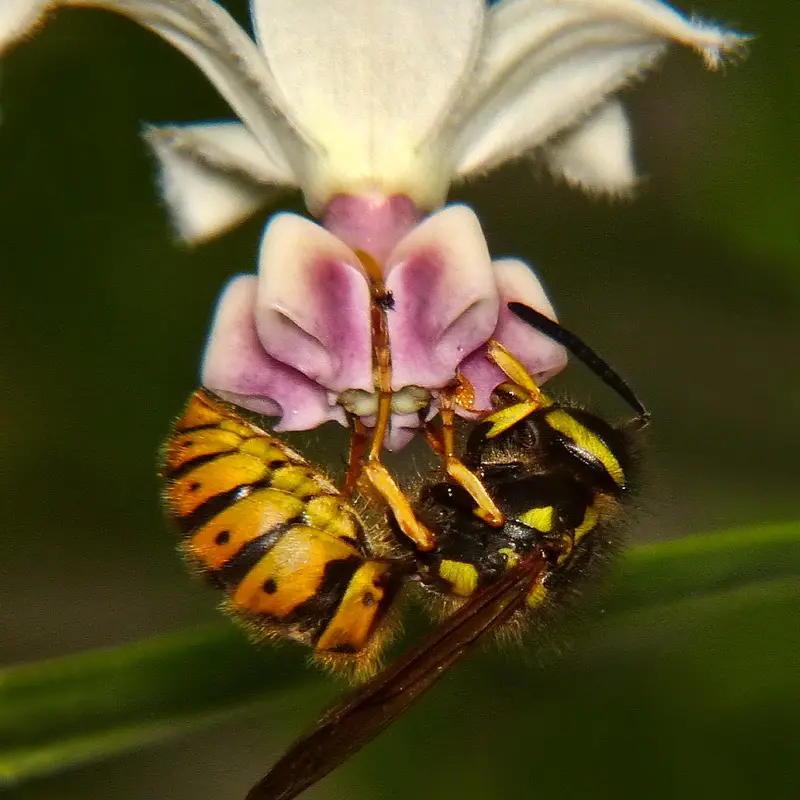
| Balloon plant (Gomphocarpus physocarpus) | Vespid wasps | Nectar with cardenolides that deter honey bees | Africa and invasive range | Almost exclusively wasps | Burger et al. 2024 |
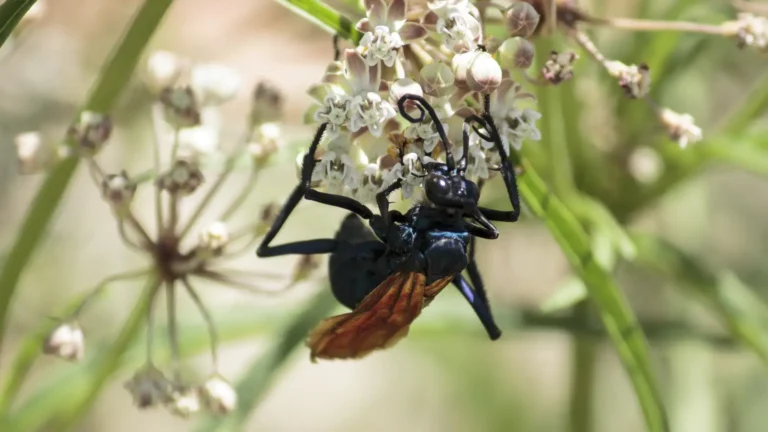
| 17 South African milkweeds in 7 genera | Hemipepsis spider wasps | Nectar | South Africa | Specialized | Ollerton et al. 2019 |
| Figworts (Scrophularia nodosa, S. umbrosa) | Social wasps | Leaf-like scent plus visual cues | Europe | Mainly wasps | Brodmann et al. 2012 |
Many more plants count wasps among several pollinators; see pollination syndromes for how flower traits match pollinator groups.
Do Yellow Jackets and Hornets Pollinate?
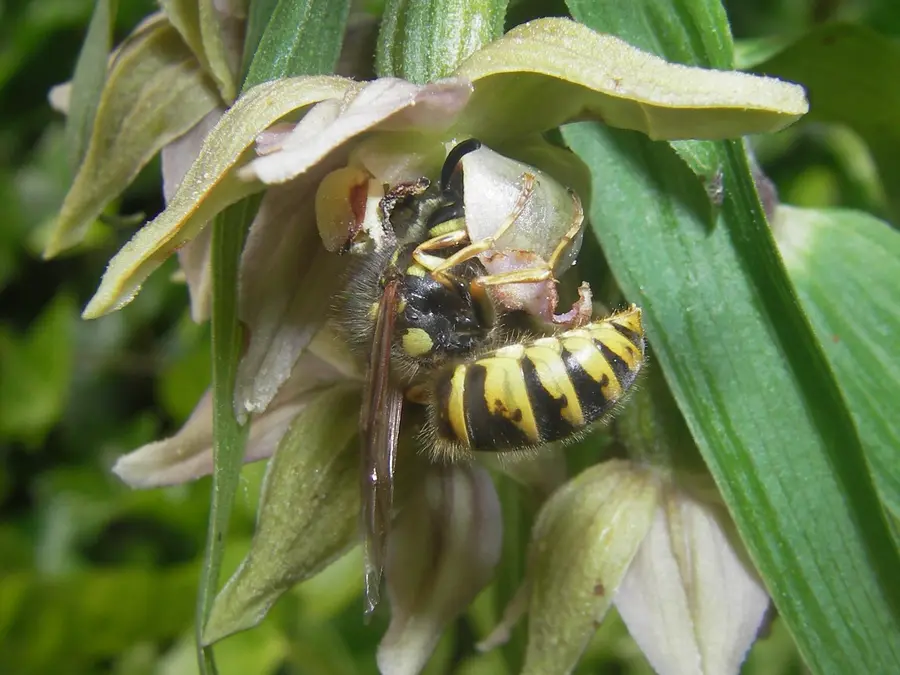
Yes, and two orchids exploit their hunting instincts to make sure of it. Broad-leaved helleborine, a “typical wasp flower,” emits green-leaf volatiles that attract German and common yellowjackets, Brodmann and colleagues reported in 2008 (National Geographic summary). Several matched compounds given off by caterpillar-infested cabbage leaves, where wasps hunt. Other insects largely ignore the orchid despite its nectar. It is native to Europe and recorded as introduced in Illinois.
In 2009 the same team found that the orchid Dendrobium sinense releases (Z)-11-eicosen-1-ol, a major compound in honey bee alarm pheromone. Its pollinator, the hornet Vespa bicolor, hunts honey bees, and hornets were drawn to the synthetic compound alone. The European beewolf uses the same compound to find prey. Most yellowjacket and hornet visits, though, are ordinary nectar stops.
What Wasp Pollination Means for Beekeepers
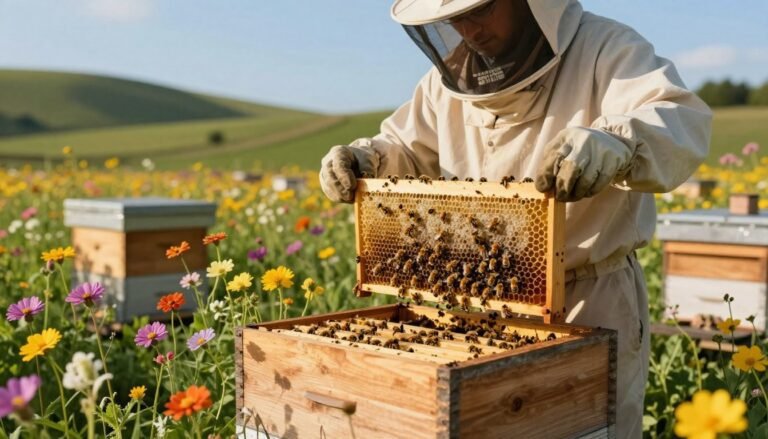
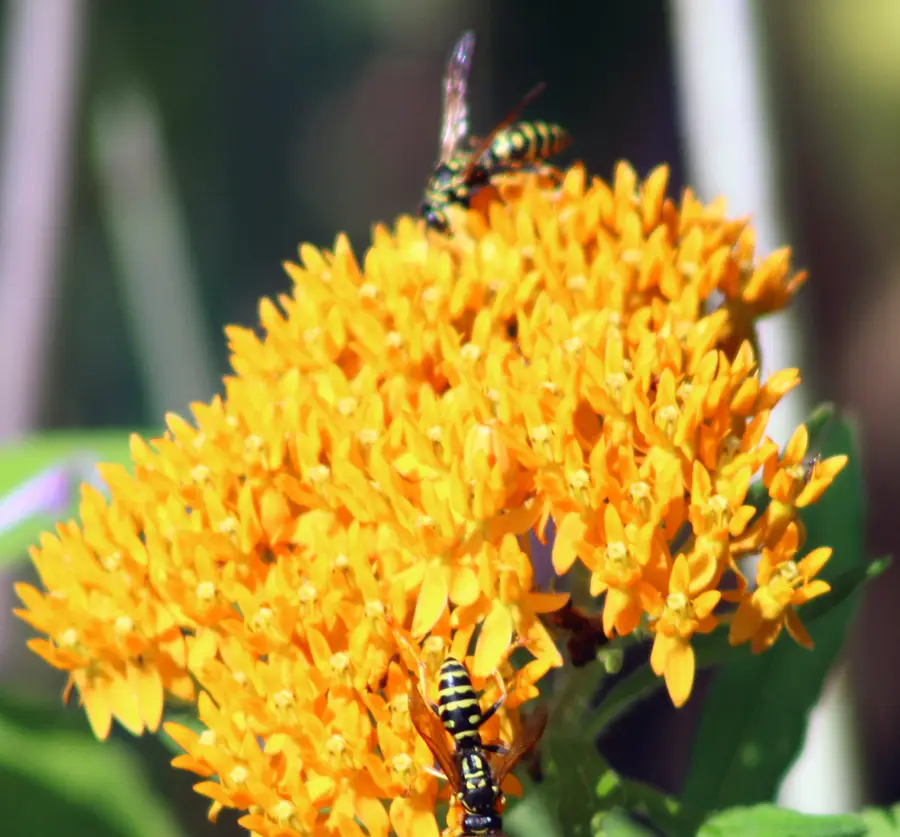
Borchardt’s team found wasps and bees overlapping on late-blooming native plants and ran their single-visit test on goldenrod, a major fall nectar source; see goldenrod honey and the fall flow. Paper wasps and yellowjackets on goldenrod beside your bees are normal.
Some wasp flowers shut honey bees out. Hannah Burger and colleagues found in 2024 that the balloon plant, an African milkweed pollinated almost exclusively by vespid wasps, has easy-to-reach nectar containing cardenolides that were more toxic to honey bees than to German yellowjackets and cut honey bee feeding. A flower busy with wasps is not necessarily bee forage.
Pollination does not change hive defense. Late-summer yellowjackets also scavenge for sugar and protein, so reduce entrances on weak colonies when wasp numbers peak.
Wasps in the Garden
To watch wasps pollinate, plant flowers they can reach. Maryland Extension points to the carrot family. In Wild Seed magazine, horticulturist Reeser Manley lists goldenrods, New England aster, spotted bee balm, golden Alexanders and Queen Anne’s lace, plus winterberry holly, summersweet and meadowsweet. The same wasps hunt caterpillars, so they help twice.
A nest by a door, a play area or a hive is different, especially if anyone is allergic to stings. Borchardt and Missouri entomologist Emily Althoff told KBIA that a nest that must go is best removed in late May or June, while small, and at night or in rain. See wasp nest removal, and first make sure it is a wasp, not a bee.
Frequently Asked Questions
Are wasps better pollinators than bees?
Not on average; bees carry more pollen. But a paper wasp deposited as much pollen per goldenrod visit as a bumble bee in a 2024 study.
Do wasps and yellow jackets pollinate flowers?
Yes. Yellowjackets carry pollen between the flowers they drink from, and broad-leaved helleborine relies mainly on them.
Are hornets pollinators?
Occasionally. The orchid Dendrobium sinense is pollinated by the hornet Vespa bicolor, lured by a honey bee alarm-pheromone compound.
Are wasps pollinators in the US?
Yes. Paper wasps, yellowjackets and digger wasps work goldenrod, milkweed and carrot-family flowers, and pollen wasps in the arid West feed their young pollen.
Are wasps beneficial to have around?
Usually. Besides pollinating, most hunt caterpillars and other insects for their larvae, which Borchardt calls free pest control.
Should I get rid of wasps?
Only if a nest sits by doors, paths or hives, or someone is allergic. Otherwise it can stay.
The Bottom Line
Wasps are real, if usually less efficient, pollinators, and for figs, some orchids and some milkweeds they are the ones that matter. Watch a goldenrod patch on a sunny fall afternoon and count who visits.
Image credits: Featured photo of a dark paper wasp on goldenrod by Nosferattus, via Wikimedia Commons, CC0 (public domain dedication), cropped.