Reviewed by Elena P. · How we review
A sawfly is a plant-eating insect in the order Hymenoptera, the group that holds bees, wasps and ants. Its larva looks like a caterpillar but has six or more pairs of abdominal prolegs, while a true caterpillar has five or fewer. Adult sawflies cannot sting. The name comes from the saw-like egg-laying organ (ovipositor) the female uses to cut slits in leaves, needles and stems. Wikipedia counts about 8,000 described species, and in US yards it is the larvae, not the adults, that do the damage.
Facts below come from named universities; the sighting figures are our own pull of iNaturalist records. We make no claim of personal field experience with sawflies.
Key Takeaways
- Sawflies do not sting. University of Minnesota (UMN) Extension calls the adults “non-stinging,” and the “stinger” people notice is an ovipositor, which Wikipedia says can be mistaken for one.
- Count abdominal prolegs: caterpillars have 2 to 5 pairs, sawfly larvae 6 or more (UMN, Ohio State, Purdue, UC IPM). Sources vary on exact ranges, and slug-type larvae have small prolegs that are easy to miss.
- Other clues: sawfly larvae lack the tiny hooks (crochets) on their prolegs, have a single pair of eyes, and often feed in groups and rear up in an S-shape when touched.
- Bt, the caterpillar-specific bacterial insecticide, does not kill sawfly larvae. Check identification before spraying anything.
- Most species have one generation a year and eat one host group, which is why names include the plant: pine, rose, elm, dogwood, columbine.
- Healthy deciduous plants usually tolerate one season of feeding (UMN). Conifers matter more, because most do not regrow eaten needles.
- In our pull of US iNaturalist records, conifer sawflies peak in August, club-horned sawflies (elm sawfly) in May, and roseslug records fall almost entirely in March to June.
Table of Contents
- What Is a Sawfly?
- Do Sawflies Sting?
- Sawflies vs Wasps and Bees
- Sawfly Larvae vs Caterpillars
- Why Bt Does Not Work on Sawfly Larvae
- Common US Sawflies by Host Plant
- Sawfly Life Cycle and Generations
- When Sawflies Are Recorded in the US
- How to Get Rid of Sawfly Larvae
- Frequently Asked Questions
- Sources
What Is a Sawfly?
A sawfly is a wasp-like insect in the suborder Symphyta of the order Hymenoptera. It is not a fly: the University of Wisconsin-Milwaukee Field Station notes that sawflies have the two pairs of membranous wings required of the order, not the one pair of a true fly. UC IPM says the abdomen is broadly attached to the thorax, while most other adult wasps have a narrow “waist.” Wikipedia says that missing waist (the petiole) is the main feature separating sawflies from the Apocrita, the group of ants, bees and wasps, and that the name Symphyta comes from a Greek word meaning “grown together.”
The “saw” is the ovipositor. UMN Extension says the name comes from the saw-like ovipositor of adult females, and the University of Wisconsin-Madison describes females cutting slits in stems or leaves to lay eggs. The group dates to the Triassic, about 250 million years ago, with roughly 8,000 species in about 25 families worldwide (Wisconsin). iNaturalist shows research-grade US records for 363 taxa in the suborder, a count that includes horntails and wood wasps.
Adults are rarely noticed. UC IPM gives a length of one-half inch or less, usually blackish or brownish with orange, red or yellow marks. Wisconsin says they eat pollen and nectar, live only a few days to a week, and that many species reproduce without mating, so males are rare.
Video: “Slaying Sawflies with the Purdue Plant Doctor” (Purdue Extension Entomology, 5:20). Purdue’s own description says it explains what sawflies are, the threat they pose to plants and why it matters to tell them from caterpillars, then gives tips on managing them. We could not retrieve a transcript, so this summary is from that description.
Do Sawflies Sting?
No. Adult sawflies do not sting, and every source we read agrees. The thing that looks like a stinger is an egg-laying tool for cutting plant tissue.
“Adult sawflies are small, stout-bodied, non-stinging wasp-like insects, although they are seldom noticed in the landscape.”
- Stings. Wisconsin says adults “look somewhat like wasps but do not sting,” and UConn Extension calls them “heavy bodied, thick-waisted wasps that do not sting.” The UWM Field Station says they “have no stinger.” Wikipedia adds that some sawflies mimic wasps and bees and that the ovipositor “can be mistaken for a stinger.”
- Bites. We found no extension source describing sawfly adults or larvae biting people.
- Defense. Wisconsin says spitfire larvae regurgitate a distasteful, irritating liquid when bothered, and Michigan State University says pine sawfly larvae dab gut resin on ants. Both are aimed at predators; none of our sources describe an effect on people.
The larvae can still wreck a rose or pine. For a true sting, see bee sting vs wasp sting. This is general information, not medical advice.
Sawflies vs Wasps and Bees
Sawflies are the plant-feeding branch of the same order as bees and wasps. For the stinging side, see our bee vs wasp guide.
| Feature | Sawfly (Symphyta) | True wasps and bees (Apocrita) |
|---|---|---|
| Waist | Broad join between thorax and abdomen (UC IPM, Wisconsin) | Narrow “wasp waist” (UC IPM, Wikipedia) |
| Egg-laying organ | Saw-like ovipositor that cuts plant tissue; no stinger | In stinging species the ovipositor became a stinger (UWM, Stokes) |
| Social behavior | Larvae feed in “non-social groups” (UMN); no colonies | Some species form colonies (UWM, Stokes) |
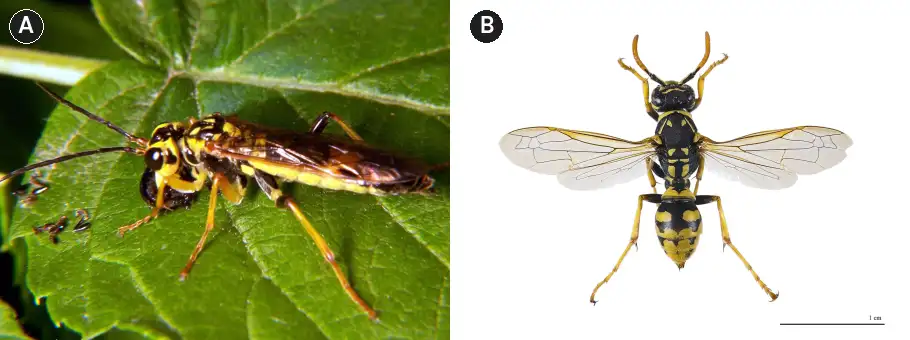
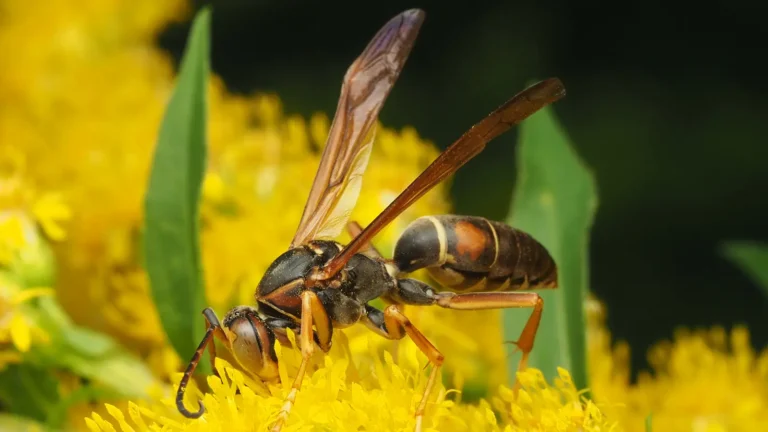
Look-alikes: bee flies and hover flies are true flies with one pair of wings. Stinging look-alikes include paper wasps, yellow jackets, mud daubers and potter wasps. Horntails, the wood-boring sawflies, are covered in our ichneumon wasp guide. For a honey bee’s body parts, see honeybee anatomy.
Sawfly Larvae vs Caterpillars
This is the practical question, because the larva is the stage you see. Both have three pairs of true legs on the thorax, so those do not help (Wisconsin, Ohio State). The tell is on the abdomen.
| Feature | Sawfly larva | Moth or butterfly caterpillar | Source |
|---|---|---|---|
| Pairs of abdominal prolegs | 6 or more | 2 to 5 | UMN, Ohio State, Purdue, UC IPM |
| Hooks (crochets) on proleg tips | Absent | Present | Wisconsin, UConn, Wikipedia |
| Eyes (stemmata) | One pair of tiny eyes | 4 to 6 on each side of the head | Wisconsin, Wikipedia |
| Head capsule | Color varies by species: black in the European pine sawfly, red to reddish-orange in the redheaded pine sawfly | Varies | UMN, UF/IFAS |
| Body surface and size | Smooth, little or no hair; UMN says no more than 1 in, but elm sawfly larvae reach 1.5 to 2 in | Smooth, hairy or spiny; often over 1 in | UMN, Wisconsin |
| Behavior | Feed in groups; raise the rear (or both ends) in an S-shape or tap the abdomen when disturbed | Do not show the S-shaped display | UMN, Purdue, Wisconsin |
| Bt (Btk) insecticide | Does not work | Works | UMN, UC IPM, Wisconsin |
The head-capsule row is a gap, not a rule. The head color helps name a species, but none of the extension sources we read use it to separate sawflies from caterpillars. Eye count, by contrast, is a real difference, but you need a hand lens, and the S-shaped display is the easier field clue.
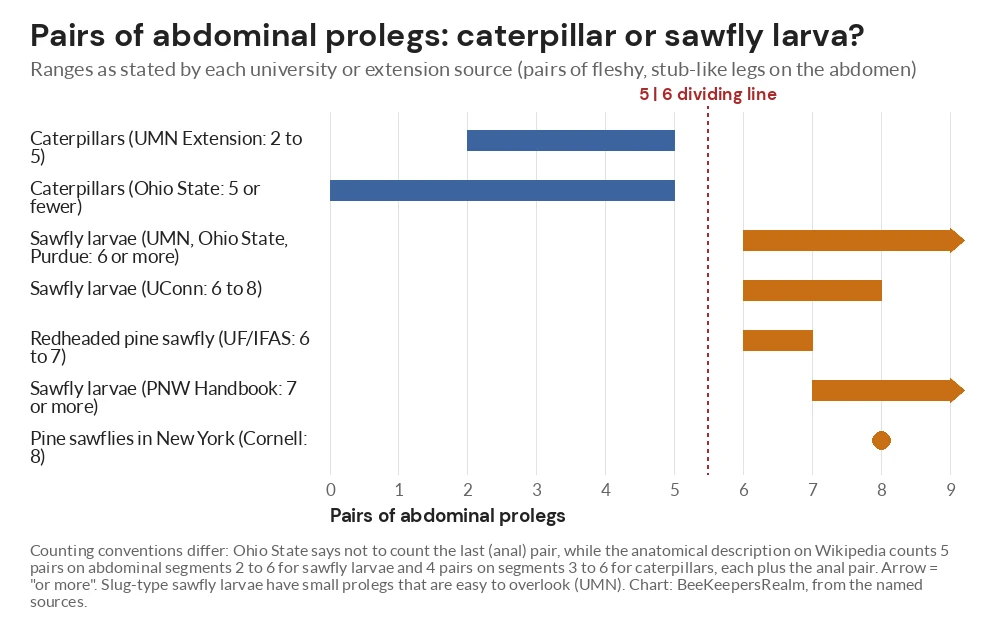
Do not trust the proleg number blindly. The Ohio State method counts only abdominal prolegs and says not to count the last pair, the anal prolegs. Wikipedia’s anatomical account gives sawfly larvae five pairs on abdominal segments 2 to 6 and caterpillars four pairs on segments 3 to 6, each plus the anal pair, so counting conventions differ. Ranges also differ by source: UConn gives 6 to 8 pairs, the Pacific Northwest Insect Management Handbook says seven or more, and Cornell counts eight on pine sawflies.
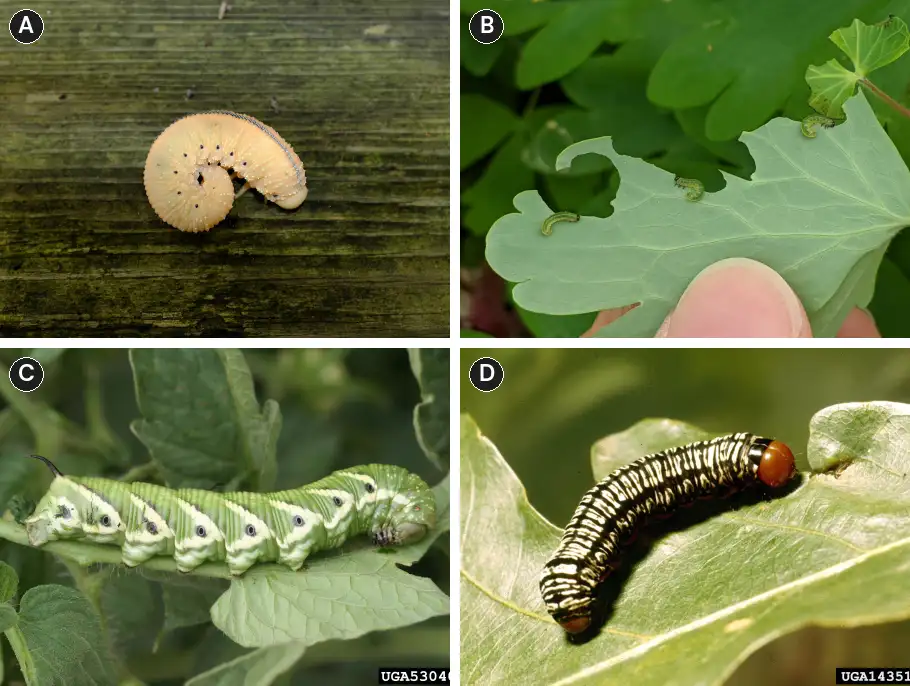
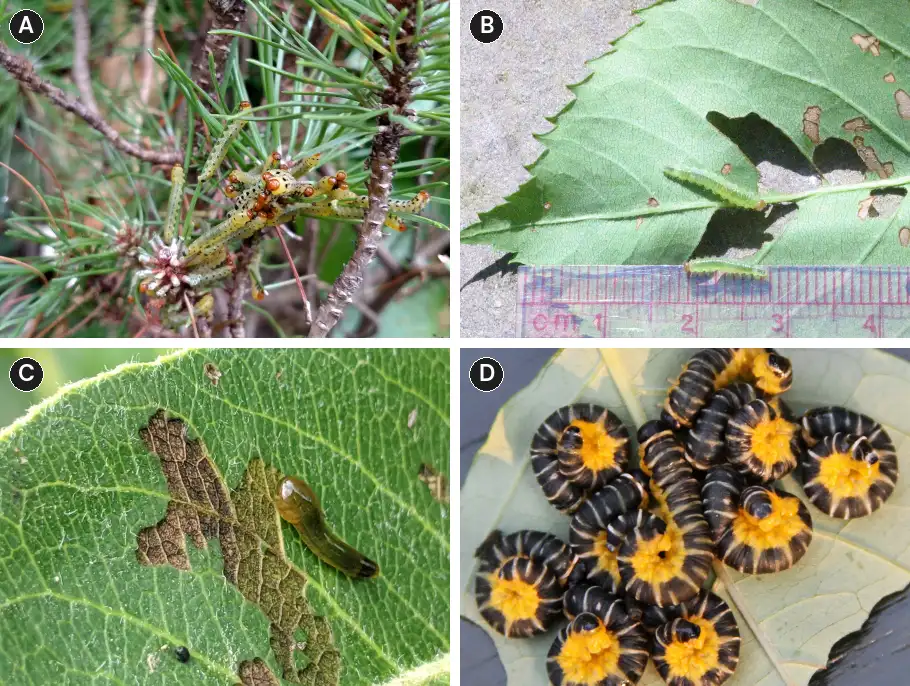
There are exceptions. Ohio State’s Joe Boggs notes that some caterpillars, such as the zebra caterpillar, look like sawfly larvae (panel image D). UMN says the prolegs of slug sawflies are small and may be overlooked. Size is also unreliable: Maryland Extension gives sawfly larvae as usually 1 to 2 inches, while UMN says no more than one inch for most species.
Why Bt Does Not Work on Sawfly Larvae
Bt (Bacillus thuringiensis var. kurstaki, or Btk) is a bacterium used against the larvae of moths and butterflies, and it is specific to them. A sawfly larva is a wasp relative, so the usual Bt treatment fails.
“Bacillus thuringiensis (Bt) is not effective against sawfly larvae because they are not caterpillars, the larvae of butterflies and moths (Lepidoptera).”
The same point appears across UMN, Wisconsin, UConn, Maryland Extension and Washington State University. Washington State’s PLS 64 sheet adds that Bt is selective for the insect group named on the package. Ohio State says that when Btk seems not to be killing “caterpillars,” the first thing to check is whether they are really sawfly larvae. Purdue puts it simply: products labeled for caterpillars do not always work on sawflies.
Common US Sawflies by Host Plant
Sawflies are named for what they eat, so the plant is the fastest way to a name. These are the ones our sources cover most often. Dates are from northern states (mostly Minnesota and Wisconsin); southern gardens run earlier.
| Sawfly | Host plant | Larva appearance | When | Damage | Source |
|---|---|---|---|---|---|
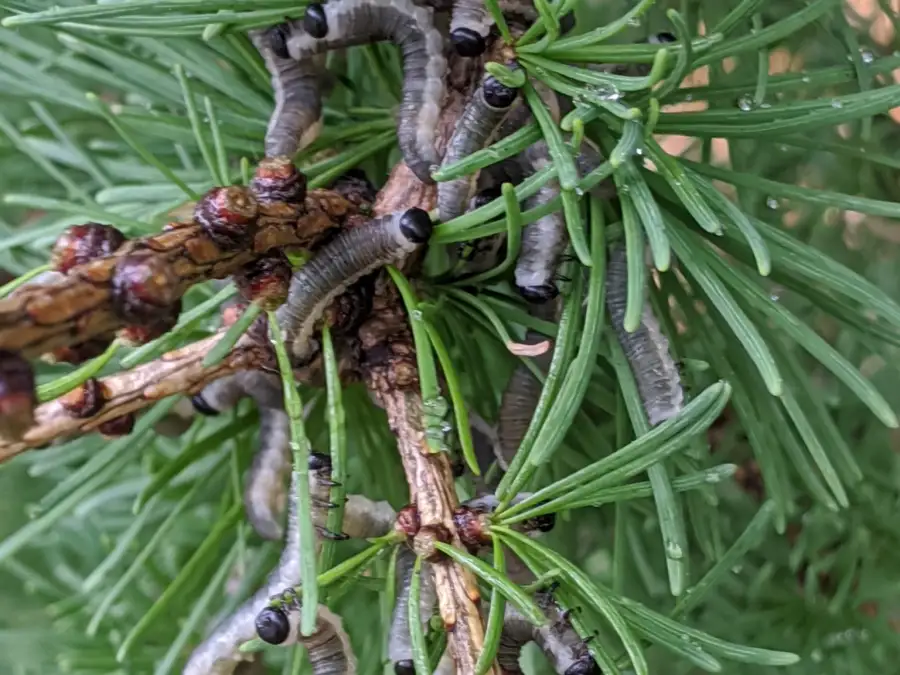
| European pine sawfly (Neodiprion sertifer) | Mugo, Scots, red, jack pine | Gray-green, black head and legs, stripes; up to 1 in | Larvae mid-May to June; one generation; eggs overwinter in needles | Eats old needles only, a branch at a time; rarely kills | UMN, Cornell |
| Redheaded pine sawfly (N. lecontei) | Red, jack and many other pines; young trees preferred | Red head, yellow-white body with six rows of black spots; to 1 in | Mid-June to late July in Minnesota; 1 to 3 generations by region | One of the most damaging; can strip and kill small pines | UMN, UMD, UF/IFAS |
| Roseslug (Endelomyia aethiops) | Roses | Light green, orange-brown head, slug-like; about 1/2 in | Mid-May to June; one generation | Windowpane feeding on the upper leaf | UMN, Wisconsin |
| Bristly roseslug (Cladius) | Roses | Greenish-white with long bristles; about 5/8 in | Two to six generations a year | Skeletonizes from below, later chews holes | Wisconsin, UMD |
| Pear slug or cherry slug (Caliroa cerasi) | Pear, plum, cherry, hawthorn, cotoneaster | Shiny olive green, slimy, slug-like; about 1/2 in | Late June to July, second brood in early August | Windowpane feeding; leaves turn brown and can look scorched | UMN, Wisconsin |
| Elm sawfly (Cimbex americana) | Elm, willow; sometimes maple, birch, poplar | Largest in North America, 1.5 to 2 in, pale with a dark back stripe; coils up | Larvae into late summer; one generation | Defoliation, rarely serious; control seldom needed | UMN, Wisconsin |
| Dogwood sawfly (Macremphytus tarsatus) | Dogwoods, especially gray and redosier | Black and yellow, often covered in white waxy powder; about 1 in | July to September; one generation | Group feeding to the midrib; may bore into soft wood or siding to overwinter | UMN, Wisconsin, UMD |
| Columbine sawfly (Pristiphora) | Columbine | Green, no stripes or spots, green head; about 1/2 to 3/4 in | May to June; one generation | Eats to the midrib; plants usually regrow | UMN, Wisconsin |
| Imported currantworm (Nematus ribesii) | Currant, gooseberry | Whitish, then green with black spots and a black head; to 1/2 in | Look for shotholes in April; sources differ on one or two generations | Shotholes, then edge feeding; can strip a bush and cut yield | WSU Hortsense, Colorado State |
| Hibiscus sawfly (Atomacera decepta) | Hibiscus, hollyhock, mallow | Pale green, black head, tiny spines | June to August; several generations | Lacy leaves; groups of larvae | UMD, UConn |
| Birch leafminer (Fenusa pusilla) | European, white, gray, paper birch | Small, flattened, white; lives inside the leaf | 3 to 4 generations a year | Brown, papery blotches; usually cosmetic | Wisconsin |
Caveats. UMN and UConn spell the columbine sawfly Pristophora aquiligae while Wisconsin gives Pristiphora rufipes (iNaturalist’s choice), so we list the genus only. The imported currantworm is now often written Euura ribesii. Colorado State says the currantworm has one generation, while Washington State says a second may appear in June or July. For the redheaded pine sawfly, UMN lists one feeding window, Cornell says more than one generation is possible, Maryland Extension says two a year, and UF/IFAS says up to three in Florida. Check your state’s extension service.
Conifer sawflies
The eaten needles are the problem. UMN says that with the exception of tamarack, conifers do not regrow needles once they are consumed. The European pine sawfly is the gentler case: it feeds only on old needles, and UMN says it commonly feeds in groups, so a spot treatment can reach a colony. The redheaded pine sawfly can kill small trees. Adults are small and easy to miss; UF/IFAS says redheaded pine sawfly females are mostly black with a reddish-brown head.
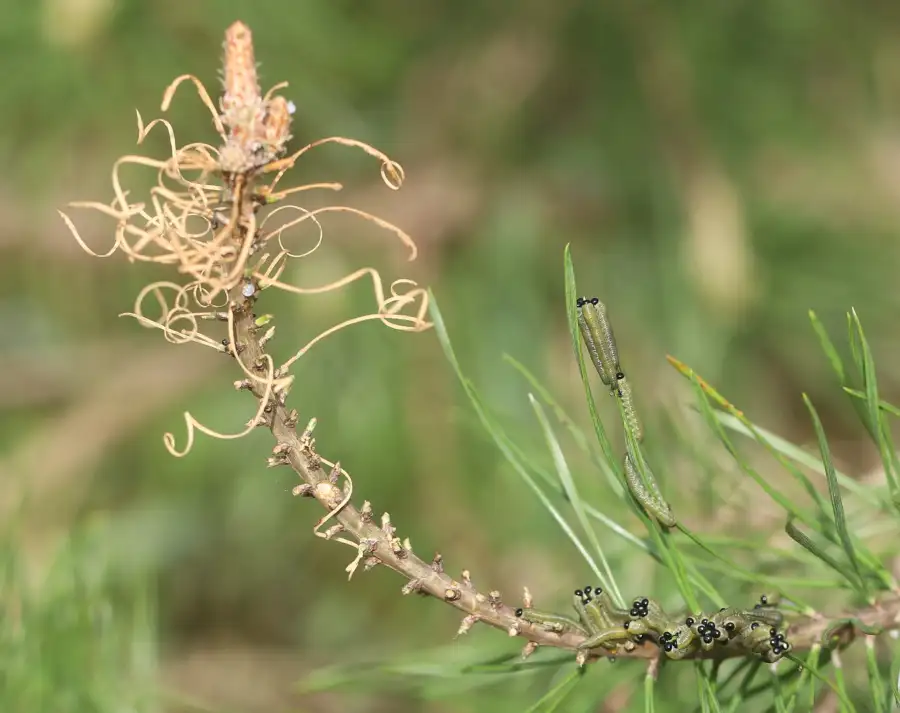
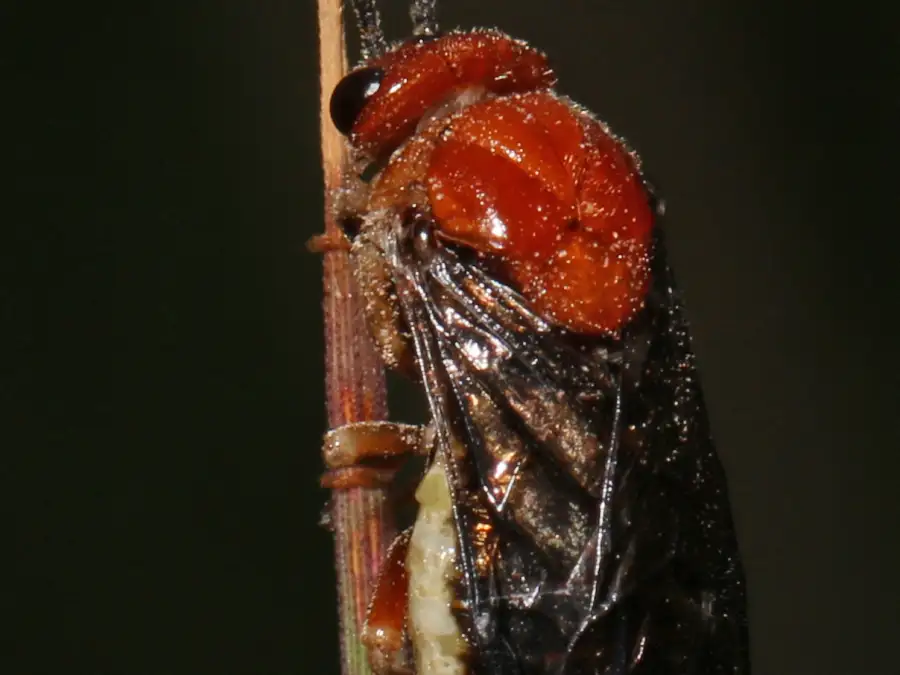
UMN also lists the larch sawfly, whose gray-green larvae with black heads feed on tamarack and other larches, where it says repeated heavy feeding thins foliage and slows growth.
Garden and landscape sawflies
On roses, fruit trees and shrubs the pattern is “windowpane” feeding: UMN says slug sawflies chew one leaf surface between the veins, leaving whitish, then brown, patches. Perennials such as columbine can be stripped fast, but Wisconsin says plants usually put out a second flush of leaves.
Sawfly Life Cycle and Generations
Sawflies go through four stages: egg, larva, pupa and adult (UC IPM). UMN says adult females cut slits into needles, leaves or tender shoots to lay eggs. Wisconsin adds that eggs may be laid singly or in groups of 30 to 90 and hatch in 2 to 8 weeks. UMN says larvae feed for about four to six weeks, often in groups, then most overwinter in the soil as prepupae or pupae in cocoons, with some species overwintering as eggs or larvae.
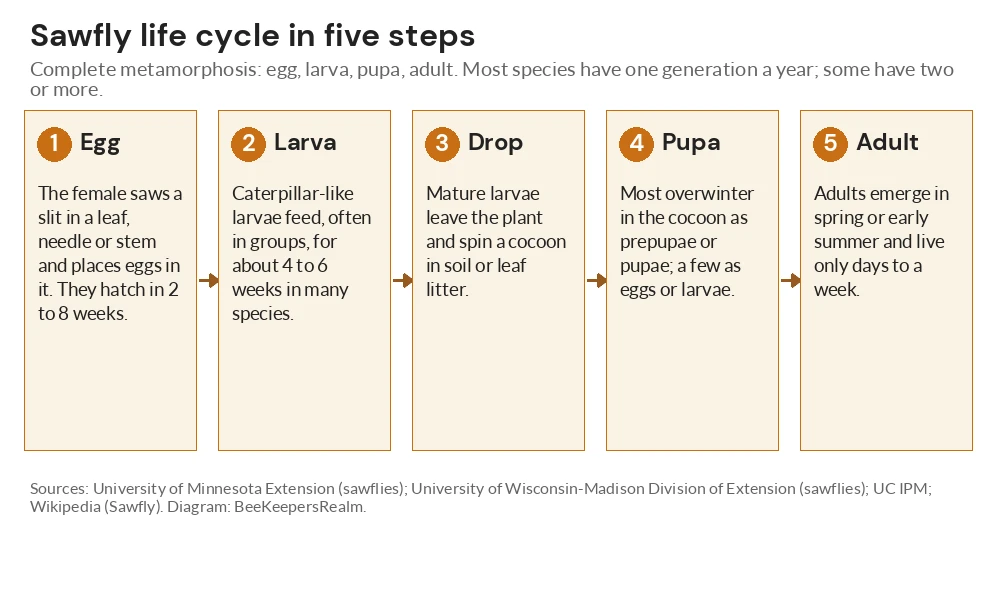
Generations vary. UMN says most Minnesota sawflies have one a year, with some having two. Wisconsin says some species take two years to complete one generation, while the bristly roseslug can have two to six a year and birch leafminer three to four. The Pacific Northwest handbook says one to five or more in a season. Natural enemies help: UC IPM lists fungal and viral diseases, birds, parasitic wasps, predaceous beetles and small mammals, and Wikipedia says wasps in the families Ichneumonidae and Braconidae attack sawflies, though the ichneumon species are usually rare. See our braconid wasp guide.
When Sawflies Are Recorded in the US
We pulled every research-grade US iNaturalist record for the suborder Symphyta: 29,361 records, which include adults, larvae, horntails and wood wasps. Looking at plant-feeding families, the season depends on the group. Conifer sawflies (Diprionidae, 3,977 records) peak in August, with 70.9% of records in July to September. Club-horned sawflies (Cimbicidae, 3,118 records, mostly the elm sawfly) peak in May, with 67.4% in March to June. The large family Tenthredinidae (10,455 records) is spread across spring and summer, with 88.2% in April to September.
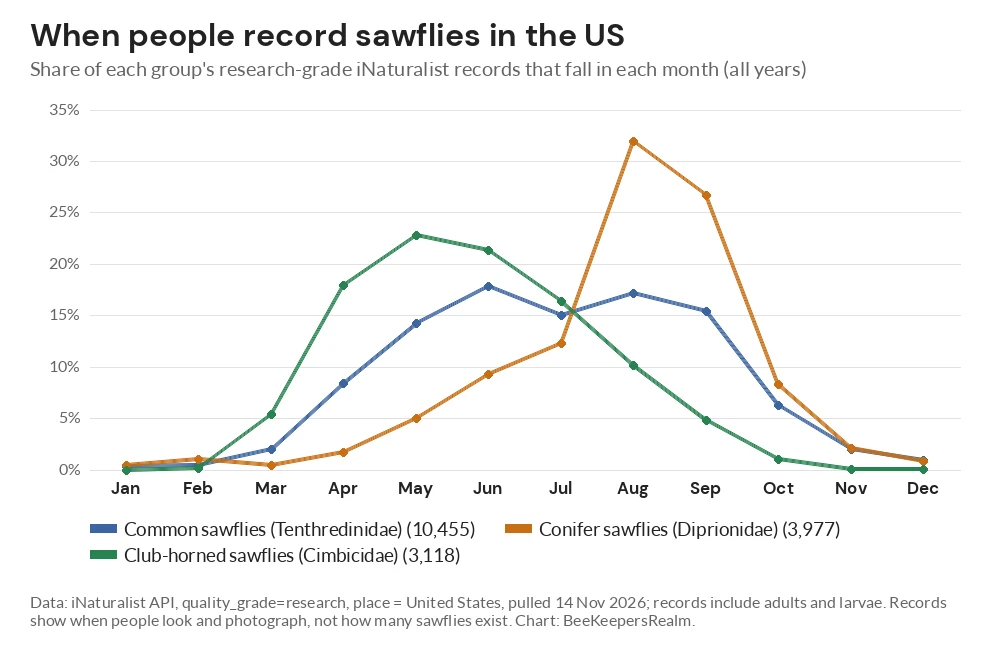
Species records line up with the extension dates above. Of 186 roseslug records, 99.5% fall in March to June (UMN larvae: mid-May to June). Of 164 European pine sawfly records, 69.5% are in May. Of 409 dogwood sawfly records, 93.6% are in July to September, the window UMN gives. Records show when people look and photograph, not how many sawflies exist.
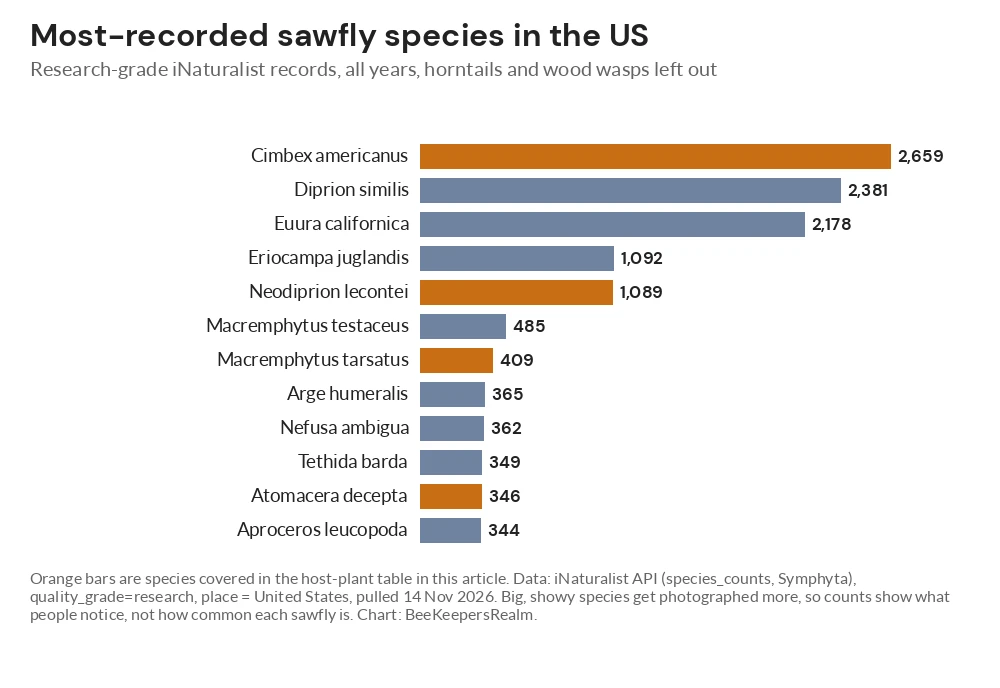
The most-recorded sawfly is the elm sawfly (2,659 records), then the introduced pine sawfly (2,381) and the redheaded pine sawfly (1,089). Horntails and wood wasps are excluded from the chart.
How to Get Rid of Sawfly Larvae
Start with identification, then match the response to the plant. This summarizes extension advice and recommends no product or brand. Always read and follow the label of any pesticide, as UMN stresses: the label is the law.
Decide whether to act
“Healthy, mature deciduous plants can typically tolerate sawfly feeding in one season.”
UC IPM agrees that healthy trees and shrubs generally tolerate moderate defoliation, and Washington State says management is unwarranted unless 20% or more of the foliage is threatened. UMN warns that recently transplanted plants, and plants stripped several years in a row, are more at risk. Conifers are the exception, so scout pines in spring.
Pick, prune and wash off
- Hand-pick. UMN says small numbers can be dropped into a pail of soapy water, crushed, or knocked off with a high-pressure spray. Maryland Extension notes that dislodged larvae cannot climb back.
- Prune. UC IPM says to clip off infested foliage if larvae are on a small part of the plant. Cornell says to hand-pick or prune off and destroy conifer colonies.
- Find eggs early. Purdue suggests looking for egg slits in early spring and crushing the eggs or pruning that tissue before hatching.
- Cover. Washington State says floating row cover may help on currants and gooseberries.
Let natural enemies work
UC IPM says natural enemies keep many populations low and can end outbreaks. Purdue advises pruning, shaking off larvae, or spraying a biorational material “so as not to disturb natural enemies,” which prevents a later pest outbreak.
When insecticides are used
UMN says to treat larvae while they are young, at half their full size or less, because treating full-grown larvae is ineffective once the damage is done. It lists insecticidal soap and horticultural oil as low-impact options for small numbers of young larvae with minimal effect on natural enemies, noting repeat applications may be needed since they only work on contact. UMN also lists azadirachtin and spinosad as effective for one or two weeks, then contact residual and systemic insecticides. Its Btk entry is the reminder that caterpillar sprays are the wrong tool.
Pollinator note. Many hosts bloom when sawflies feed: roses, pears, cherries, columbine, azalea. UMN advises low-impact methods then, and warns that systemic insecticides on bee-attractive trees and shrubs should be applied only after flowering. UC IPM says spinosad can harm bees and certain natural enemies, remains toxic to bees for several hours after drying, and should not go on flowering plants; it also advises avoiding broad-spectrum persistent insecticides. For more, see our guide to pollinator-safe pest control. For paper-nest wasps, which are a different problem, see the wasp nest removal guide.
Skeletonized leaves can also come from the Japanese beetle, which you can tell by its metallic green head and the white tufts along its sides.
Frequently Asked Questions
What is a sawfly?
A sawfly is a plant-feeding insect in the wasp, bee and ant order whose larva looks like a caterpillar. The name comes from the female’s saw-like ovipositor. Adults do not sting.
Are sawflies wasps?
They are in the same order as wasps, but in the suborder Symphyta rather than the Apocrita, which holds true wasps, bees and ants. UWM calls them “primitive” wasps; Wikipedia says they lack the wasp waist.
Do sawflies sting or bite?
Adults cannot sting, and we found no extension source describing bites. Some larvae regurgitate a distasteful liquid or resin, but that is a defense against predators.
How do I tell sawfly larvae from caterpillars?
Count abdominal prolegs: 6 or more pairs means sawfly, 5 or fewer means caterpillar (Ohio State, UMN). Group feeding and an S-shaped rear-end display also point to sawflies.
Why didn’t Bt kill my sawfly larvae?
Because they are not caterpillars. UC IPM says Bt is not effective against sawfly larvae, which are wasp relatives rather than moth or butterfly larvae.
How do I get rid of sawfly larvae?
Hand-pick, prune or spray them off with water while they are small, and let natural enemies help. UMN says insecticidal soap and horticultural oil work on young larvae, and treatment is ineffective on full-grown ones.
Will sawflies kill my plants?
Rarely on healthy deciduous plants, which regrow leaves. Pines are at more risk, since most conifers do not regrow eaten needles, and the redheaded pine sawfly can kill small pines.
Next Step
Name the plant, count the prolegs, and check the date against the table before you reach for a spray. If the insect turns out to be a stinging wasp, compare it in the predatory wasp comparison chart.
Sources
- University of Minnesota Extension, Sawflies (Jeffrey Hahn and John Lloyd, reviewed 2020)
- P.J. Liesch and Susan Mahr, University of Wisconsin-Madison Division of Extension, Sawflies
- UC Statewide IPM Program, Sawflies
- Joe Boggs, Ohio State University BYGL, Is it a Sawfly Larva or a Caterpillar? (18 July 2019)
- Purdue Landscape Report, Sawflies: the caterpillar pests that are not caterpillars
- Cornell Cooperative Extension, Pine Sawflies
- Also used: University of Maryland Extension; UConn Extension; Washington State University (PLS 64; Hortsense); Colorado State University; UF/IFAS EDIS; Michigan State University Extension; Pacific Northwest Insect Management Handbook; UWM Field Station; Wikipedia (Sawfly); iNaturalist API (research-grade US records, pulled 14 November 2026)
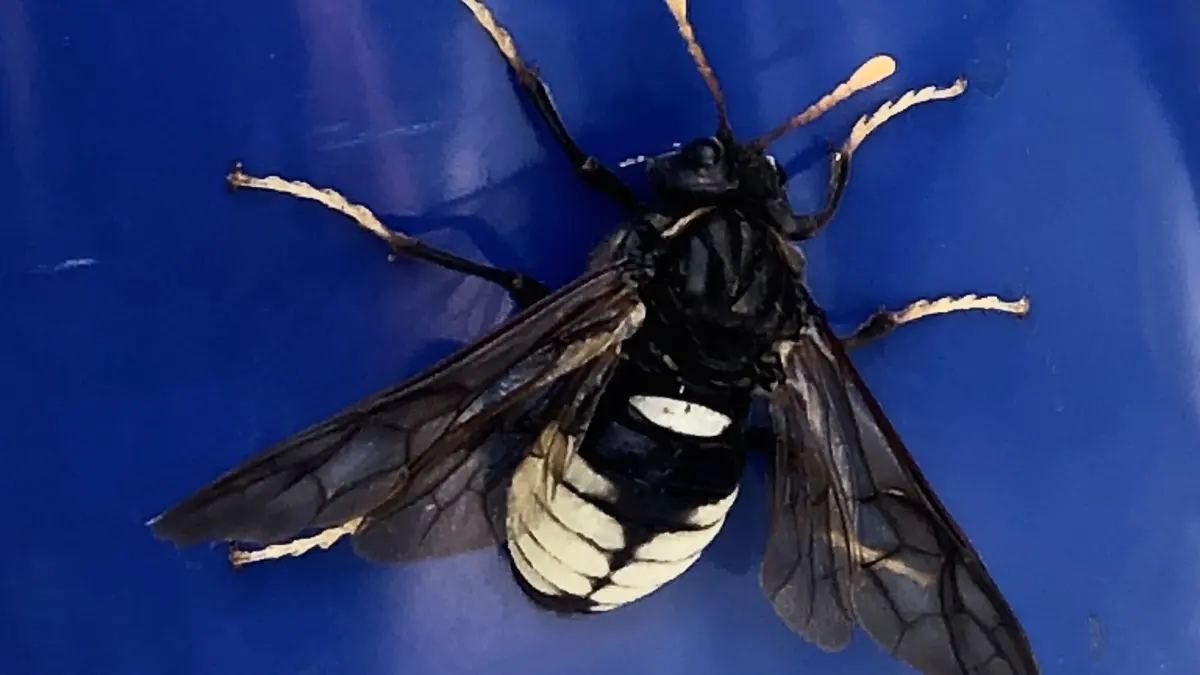
Image credits: Featured photo of an adult elm sawfly (Cimbex americana), St. Louis County, Minnesota, by MamaTeeth, via Wikimedia Commons, CC BY-SA 4.0, cropped to 16:9. Other photo credits are in each caption. The proleg chart, the two sighting charts and the life-cycle diagram are by BeeKeepersRealm from the sources and iNaturalist data above.