Reviewed by Thomas B. · How we review
A wasp trap catches foraging workers, not the nest. University extension sources say lure and bait traps can thin out the yellowjackets around a patio or picnic area, but they do not eliminate a colony of thousands, and they rarely suit paper wasps. What works depends on matching the bait to the season and the species: protein in spring and early summer, sweet bait in late summer and fall, and a lure that suits your yellowjacket. Hang traps at least 20 feet from where people sit.
This is the yard and patio version of the question. It is built from university extension guides and peer-reviewed trap trials, not product reviews, and it names no brands. If you keep bees, our separate guide to protecting beehives from yellow jackets covers apiary entrances and trap placement near hives.
Key Takeaways
- Traps reduce foragers, not colonies. UC IPM says lure traps help reduce localized foraging workers but do not eliminate large populations, and Ohio State says no trap gives rapid knockdown.
- Traps are a yellowjacket tool. UC IPM does not suggest trapping other social wasps, and Utah State says heptyl butyrate traps will not attract European paper wasps or hornets.
- The species decides the lure. Heptyl butyrate pulls western yellowjackets; in Michigan trials the eastern and common yellowjackets responded mainly to acetic acid plus isobutanol; German yellowjackets responded well to meat in trials.
- Bait follows the season. Colonies want protein from spring to midsummer and sugar from late summer, so use meat early and sweet bait late.
- Hang traps 20 feet or more from people, at the edge of the property and between the patio and the nests.
- Sweet baits can attract honey bees. In one Vancouver trial, heptyl butyrate traps caught six honey bees among 44,489 yellowjackets.
- A nest in a wall or the ground is not a trap job. Call a professional.
Table of Contents
- Do Wasp Traps Work?
- Which Wasps a Trap Will and Won’t Catch
- Wasp Trap Types Compared
- Which Bait to Use, Month by Month
- Where to Hang a Wasp Trap
- Homemade Wasp Trap: A Recipe From Extension Sources
- Will a Wasp Trap Catch Bees?
- Emptying a Trap Safely
- When a Trap Is Not Enough
- Frequently Asked Questions
- The Bottom Line
Do Wasp Traps Work?
Yes, for a narrow job. A trap intercepts the wasps that come looking for food, so it lowers the number of foragers at a patio, picnic table or trash area. It does nothing to the nest, where the queen’s sole job is laying eggs, according to Ohio State. The University of California puts the limit plainly.
“Lure traps can help reduce the number of localized foraging workers, but they don’t eliminate large populations.”
The sources disagree about how much a trap helps, mostly because they measure different things:
- Oregon State’s homeowner guide rates lure traps “very effective” and low risk for reducing yellowjacket numbers around outdoor eating areas.
- Ohio State says trapping adult workers often fails to bring populations down to acceptable levels, because yellowjackets fly 300 to 1,000 yards from the nest. It adds that no trap gives rapid knockdown, so traps should go out two or more days before an event.
- The Pacific Northwest Insect Management Handbook says traps give temporary relief at picnics by drawing workers away from people, but are ineffective for area-wide nest control even when many workers are caught.
- Spring queens: Oregon State Extension’s EM 9211 notes that each colony can yield up to 5,000 workers, so a queen caught in spring might matter. But a California study it cites found that trapping queens did not reduce the workers trapped in late summer.
Two field results show the range. Interceptive trapping around a California public picnic area cut yellowjacket foraging in the eating area by 88% on average (Reierson and colleagues, 2008, as reported by Borden and colleagues). And 70 heptyl butyrate traps at a Vancouver fair caught 44,489 yellowjackets in four weeks (Borden, Lait and Kovacs, 2025). That trial had no untrapped comparison site, its authors were employed by the lure’s maker, and they only infer that the traps probably diverted wasps from people. So treat a trap as a way to pull nuisance wasps away from where you sit, not as nest control.
Which Wasps a Trap Will and Won’t Catch
UC IPM says trapping isn’t suggested for social wasps other than yellowjackets. Utah State adds that a heptyl butyrate lure will not attract the European paper wasp or hornets. Paper wasps feed caterpillars to their young and are less aggressive, which is why our guides to paper wasps and the invasive European paper wasp focus on nests instead.
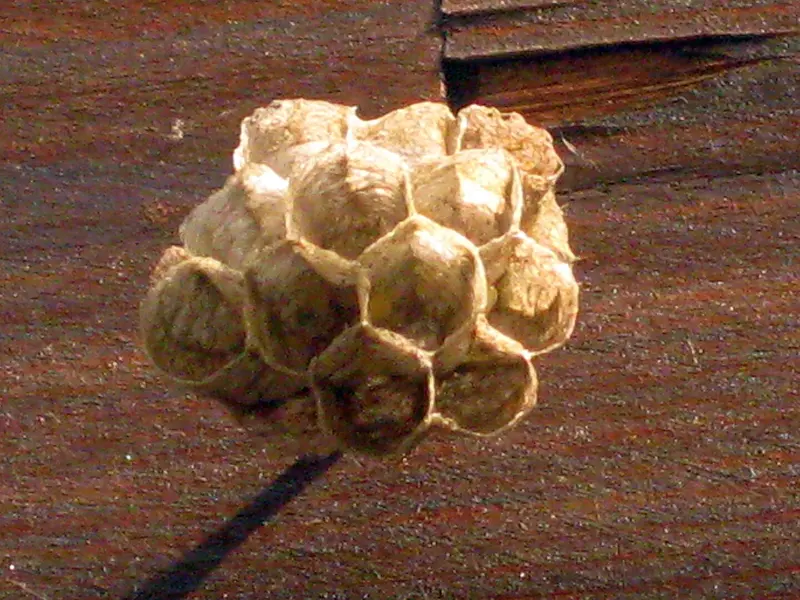
Among yellowjackets, the lure matters more than most guides admit. USDA Agricultural Research Service and university trials found different species respond to different baits:
| Wasp | What attracted it in trials | What did not | Source |
|---|---|---|---|
| Western yellowjacket (Vespula pensylvanica) | Heptyl butyrate; rotisserie chicken, but less strongly | Lure plus chicken together caught fewer than the lure alone | UC IPM; Trottier and Borden 2025 |
| German yellowjacket (V. germanica) | Meat; in Argentina fish-flavored cat food and fruit powder with yeast beat a heptyl butyrate lure | Mixed for heptyl butyrate: Ohio State says most commercial traps are not attractive to it, yet a USDA trial caught it in Washington | Ohio State; Trottier and Borden 2025; Landolt, Reed and Ellis 2003 |
| Eastern and common yellowjackets (V. maculifrons, V. vulgaris) | Acetic acid plus isobutanol (Michigan; V. vulgaris also in Alaska) | Heptyl butyrate was not the main draw | Reed, Landolt and Ellis 2003; Landolt, Pantoja and Green 2005 |
| Northern and boreal species (V. acadica, V. consobrina, V. vidua) | Heptyl butyrate only | Acetic acid plus isobutanol | Reed, Landolt and Ellis 2003 |
| Bald-faced hornet and aerial yellowjackets (Dolichovespula) | Acetic acid, more strongly with isobutanol | Heptyl butyrate traps will not attract hornets (Utah State) | Reed, Landolt and Ellis 2003; Utah State |
| European paper wasp (Polistes dominula) | Fermenting fruit juice with yeast | Heptyl butyrate | Utah State |
Treat the table as a guide, not a guarantee. Trials differ in region, trap design and season, and a British Columbia study found acetic acid plus isobutanol ineffective for western and northern yellowjackets there (Borden and Trottier, 2025). The practical step is to identify the wasp first: our yellow jackets guide covers species and nests, and hornet vs wasp sorts the look-alikes. A lure labeled heptyl butyrate alone suits the West; in the East, expect a weaker catch unless you add meat.
Wasp Trap Types Compared
There are three trap types with extension backing. Each suits a different job and season.
| Trap type | Bait | Best season | Catches | Risk to bees and non-targets | Source |
|---|---|---|---|---|---|
| Commercial lure trap (jar, bag or cone) | Heptyl butyrate lure; read the label for other lures | Early spring for queens, then summer and fall for workers | Mainly western yellowjackets; see the species table | Very low for honey bees: six among 44,489 wasps in one trial | UC IPM; Oregon State; Borden et al. 2025 |
| Protein water trap (bucket or bowl) | Turkey, ham, fish or liver hung 1 to 2 inches over soapy water | Late winter to early spring for queens; spring to midsummer for workers | Yellowjackets; UC IPM says meat is believed to help with German and common yellowjackets | Low for honey bees, which gather protein only from pollen; spoils fast and other animals can reach it | UC IPM; Oregon State EM 9211 |
| Sweet or fermented bottle trap | Fruit juice, jelly, syrup or banana peel; with yeast and ripe fruit for European paper wasps | Late summer and fall | Yellowjackets and European paper wasps | Higher: Oregon State advises against sugary bait near bees | Ohio State; Utah State; Oregon State EM 9211 |
| Sticky trap | Retail visual or scent lures on glue | Not established | Not established | Not rated: we found no extension or trial data | None found |
Oregon State says reusable lure traps must be cleaned and re-baited, while disposable ones are easiest. UC IPM says to replace lures periodically, and meat often, because yellowjackets aren’t attracted to rotting meat.
Which Bait to Use, Month by Month
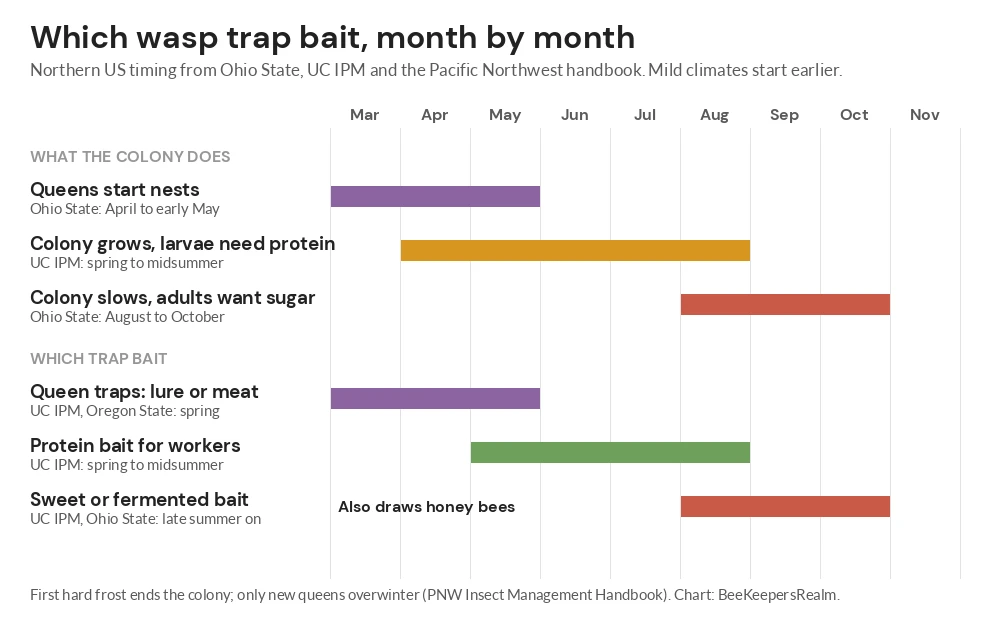
Yellowjacket colonies change what they want over the year, and the trap has to follow.
- Spring: overwintered queens emerge. Ohio State says this happens on warm days in April and early May; UC IPM says late winter to early spring in California. Oregon State advises setting traps in spring so they catch queens.
- Spring to midsummer: larvae need large amounts of protein, so workers mostly hunt insects, UC IPM says. Meat or fish bait fits this window.
- Late summer: UC IPM says colonies slow or stop growing and need large amounts of sugar, so foragers want sweets. Ohio State dates the switch to August through October.
- First hard frost: workers die and only new queens overwinter, according to the Pacific Northwest handbook. Our guide to when wasps die off explains the end of the season.
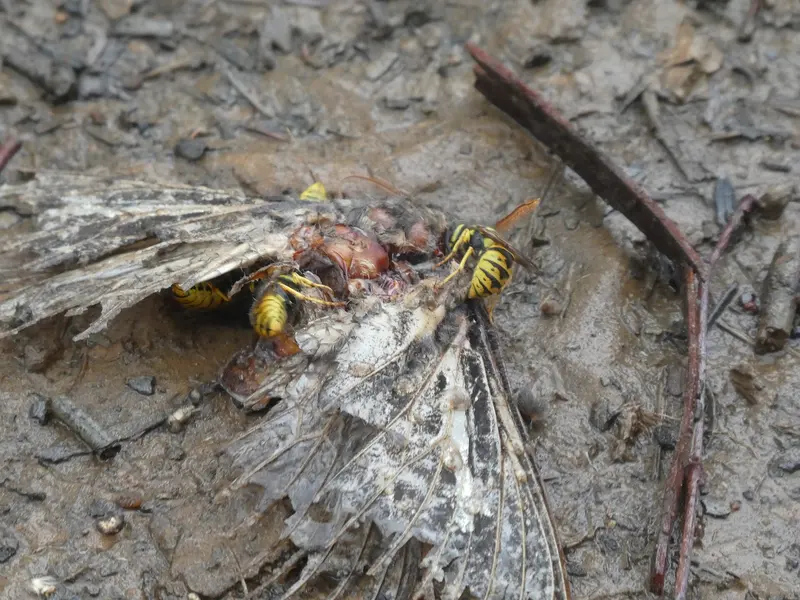
Freshness matters as much as type. UC IPM says to replace meat frequently, and Oregon State EM 9211 notes fresh meat or fish may spoil within hours and stop working. Utah State’s school guide suggests using yellowjacket baits and traps in June and early July.
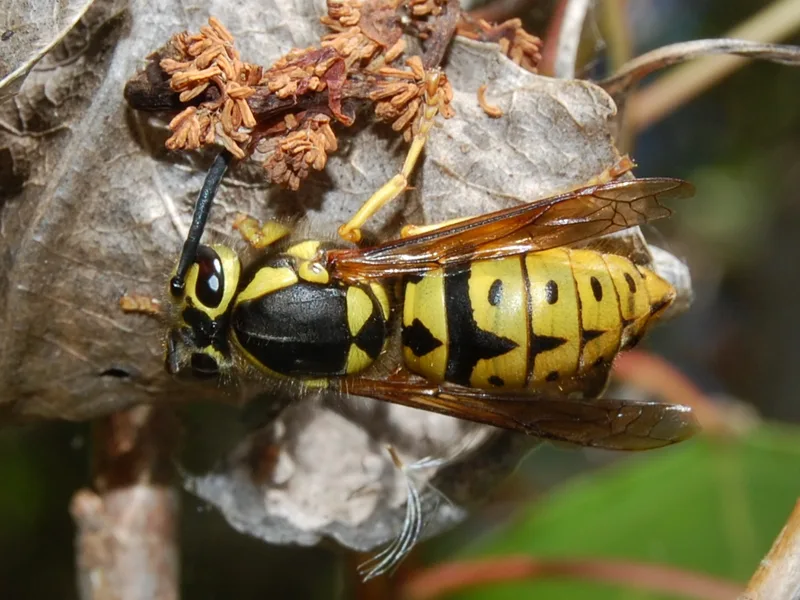
Where to Hang a Wasp Trap
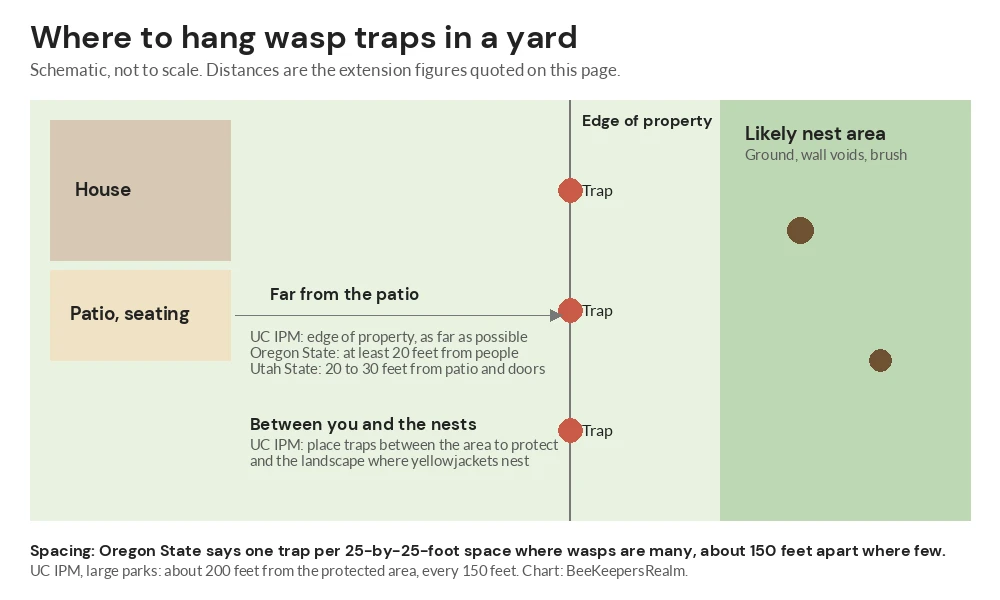
A trap is an attractant, so where it hangs matters. The extension figures are:
- Distance from people: Oregon State says at least 20 feet. Utah State says 20 to 30 feet from the patio, doorways and other busy areas. UC IPM says to put backyard traps along the edge of the property line, as far from the patio as possible.
- Direction: UC IPM says traps should sit between the area to protect and the landscape where yellowjackets nest, since they forage about a quarter mile.
- How many: Oregon State says one trap per 25-by-25-foot space where yellowjackets are many, and about 150 feet apart where they are few. UC IPM says parks use traps about 200 feet from the protected area and every 150 feet along its edge. No extension source we read gives a count for a typical backyard.
- Height: guidance is thin. Oregon State’s bulletin for beekeepers says yellowjackets forage near the ground, so it advises low placement. The Vancouver trial hung traps about 5 feet up, above the reach of small children.
- Near a nest: Oregon State warns to be cautious when setting lure traps near one.
Homemade Wasp Trap: A Recipe From Extension Sources
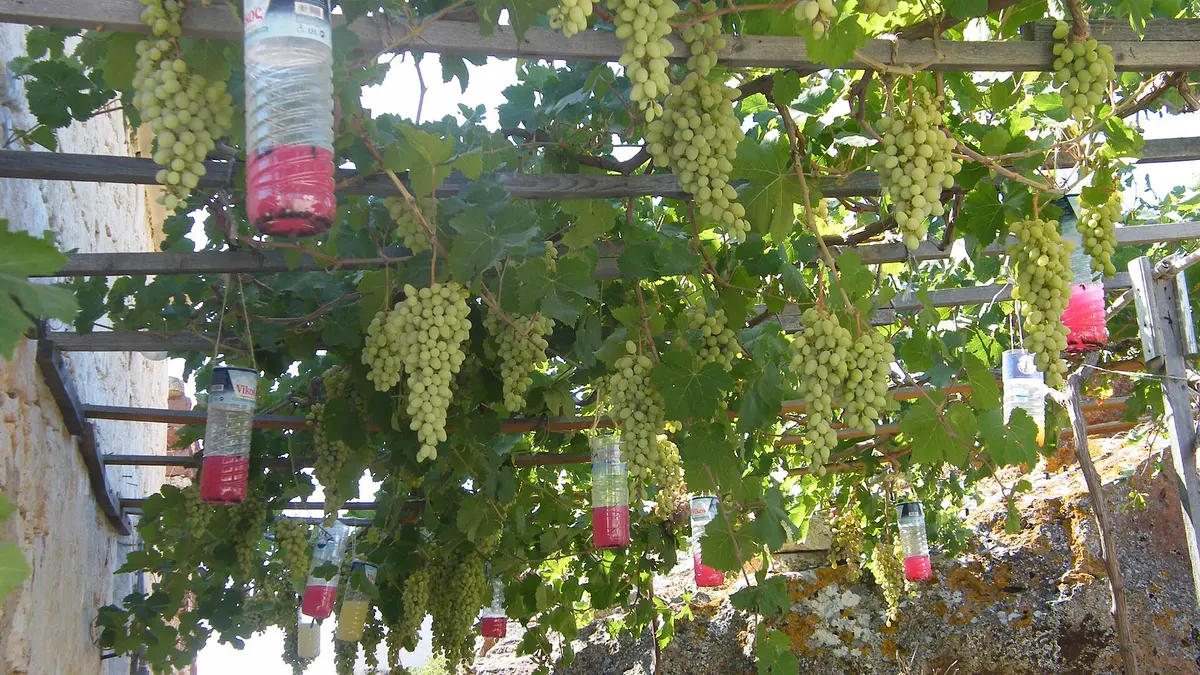
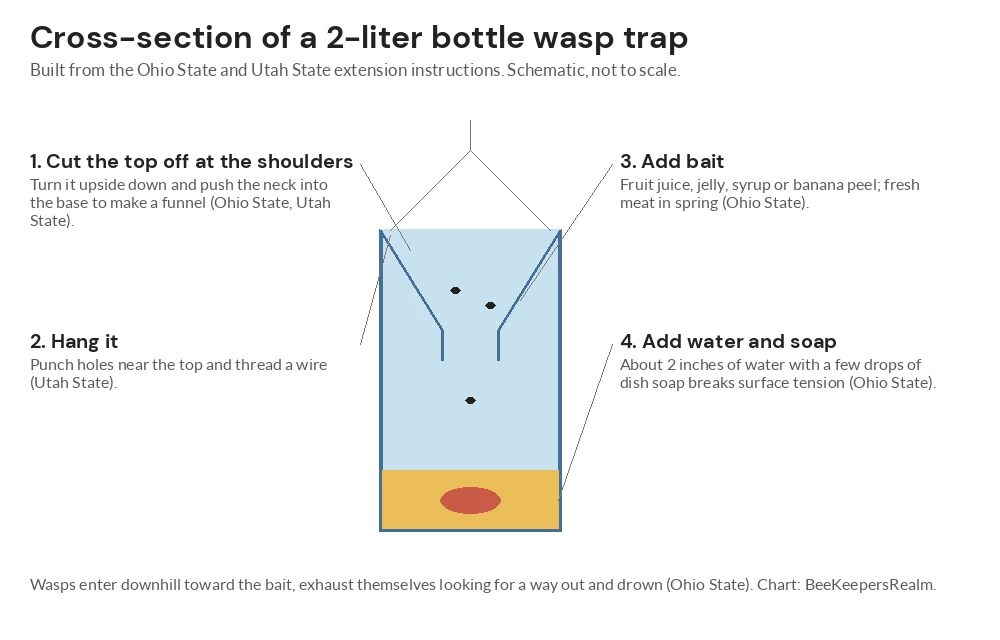
Ohio State says homemade traps are inexpensive and often as effective as commercial ones. This is the Ohio State and Utah State bottle design, step by step:
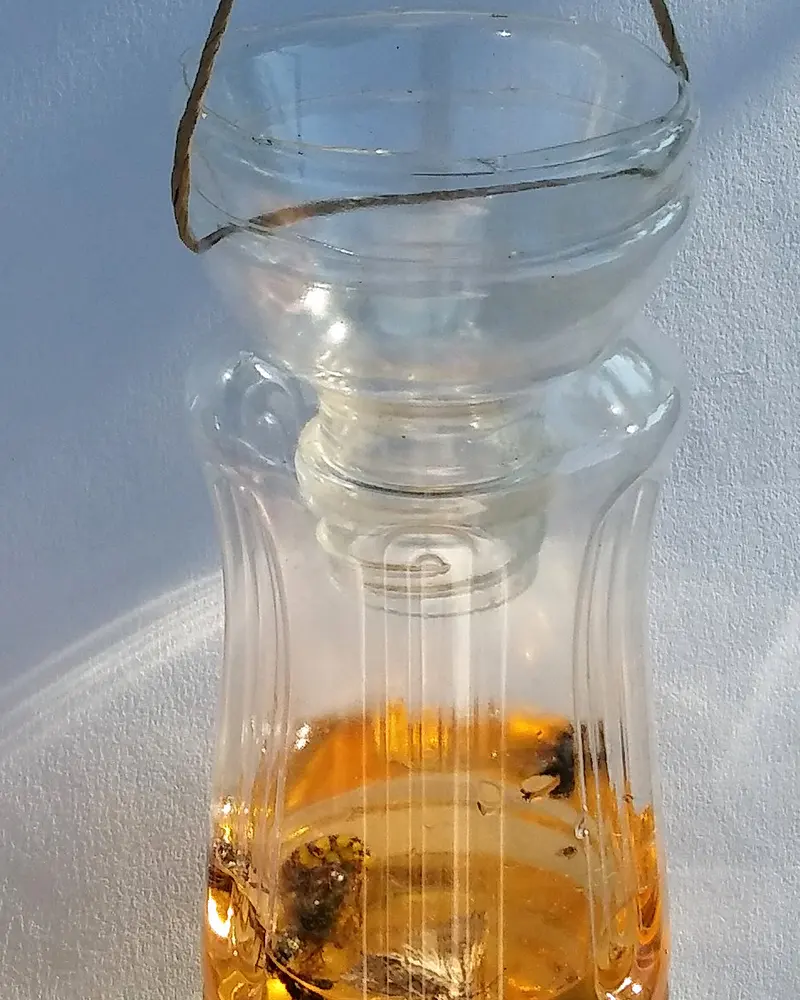
- Cut the top off a 2-liter soda bottle at the shoulders, turn it upside down and insert it into the base so the neck forms an inverted funnel.
- Punch holes near the top and thread a wire to hang it.
- Add bait, then about 2 inches of water with a few drops of dish soap to break the surface tension.
- Hang it using the placement rules above. Wait until every insect is dead before you empty it.
| Recipe | Mix | Season | Source |
|---|---|---|---|
| Protein bucket trap | 5-gallon bucket of soapy water; string and protein bait (turkey, ham, fish or liver) hung 1 to 2 inches above the water; wide mesh screen on top | Late winter to spring for queens; spring to midsummer | UC IPM |
| Sweet bottle trap | Fruit juice, jelly, syrup or banana peels; fresh meat in spring; 2 inches of soapy water | Late summer and fall | Ohio State |
| European paper wasp trap | 1 part fruit juice to 10 parts water, 1 teaspoon yeast, a piece of ripe fruit and several drops of liquid detergent | Mid to late summer; refresh every 2 weeks, one trap about every 30 feet around fruit crops | Utah State |
Extension sources give no sugar quantities, so the amounts in many online recipes are not from them. Brewer’s yeast is the one additive with trial support: researchers found that adding yeast to fruit-based lures significantly increased captures of German and common yellowjackets (Babcock and colleagues, 2017, discussed in Trottier and Borden 2025).
Will a Wasp Trap Catch Bees?
Sweet bait can. Oregon State Extension’s guidance for homemade traps is direct.
“If building your own trap, it is important to avoid using sugary attractants as they could inadvertently attract bees.”
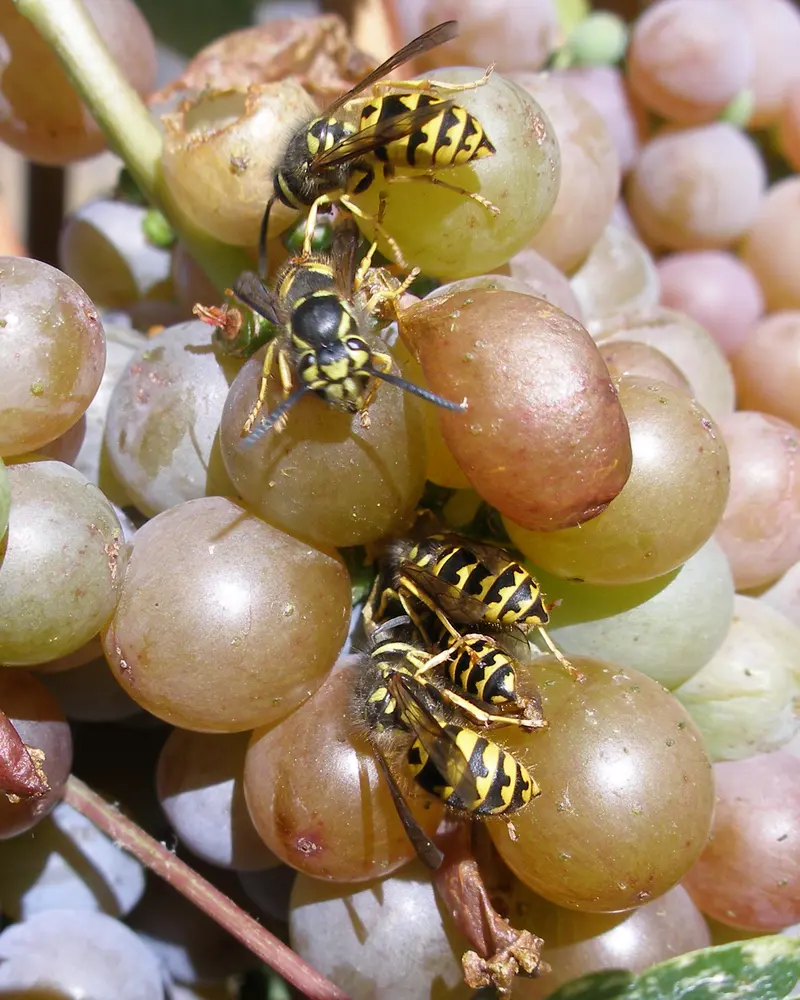
Protein and heptyl butyrate are safer for bees. EM 9211 says honey bees gather protein only from pollen, and that heptyl butyrate “does not attract honey bees.” The Vancouver trial counted six honey bees among 44,489 yellowjackets, a ratio of 7,415 wasps to one bee. We found no extension source or trial showing that vinegar, dish soap or any other additive keeps honey bees out of a sweet bait, so treat sweet bait as bee-attractive. If you are unsure what is in the trap, see how to tell a bee from a wasp.
Emptying a Trap Safely
Oregon State says the attractant can get on your skin and draw insects to you, so wear rubber gloves and wash with soap afterward. It names early morning and dusk as the safest times to handle traps, when yellowjackets are less active, and says to wait until all the insects are dead before emptying and cleaning.
Oregon State also says about 3% of adults are severely allergic to insect stings, and an allergic reaction is a medical emergency; the Pacific Northwest handbook puts the figure at 1 to 2 percent. See our guides to treating a bee or wasp sting and to bee sting vs wasp sting.
When a Trap Is Not Enough
Wasps flying steadily in and out of one hole in the ground or a wall point to a nest, UC IPM says, and traps will not fix that. UC IPM calls professional help the easiest and safest route when a nest must go, because stings are likely even when a nest is sprayed at night. Oregon State says to take action when a nest is near homes and for anyone with known allergies. Our wasp nest removal guide covers identifying the nest and when to call a pro.
Food control often does more than traps. UC IPM says to cover food, pet food and soda cans, keep garbage in sealed cans and pick up ripe fruit, because wasps keep hunting a spot long after the food is gone. If a pesticide is needed near flowers, Oregon State warns that many insecticides are extremely toxic to bees; see pollinator-safe pest control products.
Frequently Asked Questions
What is the best bait to trap wasps?
Meat or fish from spring to midsummer, sweet bait such as fruit juice from late summer, or a heptyl butyrate lure if you have western yellowjackets.
How do you make a homemade wasp trap?
Cut a 2-liter bottle at the shoulders, invert the top as a funnel, add bait and 2 inches of soapy water, and hang it. The steps are above.
Where is the best place to hang a wasp trap?
At least 20 feet from where people sit, at the property edge and between the patio and the nests.
Is there a wasp trap that actually works?
Extension sources say lure traps work for reducing yellowjackets near an eating area, not for ending a colony. Match the lure to the species.
What’s the best liquid to put in a wasp trap?
Water with a few drops of dish soap, plus bait. For late season, Ohio State lists fruit juice, jelly, syrup or banana peels.
Will wasp traps catch bees?
Sweet ones can. Heptyl butyrate and meat baits catch very few honey bees.
Do wasp traps attract more wasps?
We found no extension trial showing that. The extension advice is to place traps away from people so the attracted wasps are drawn away from you.
Is a wasp trap the same as a yellow jacket trap?
Mostly. Extension trap advice targets yellowjackets, so a “wasp trap” works best on them.
The Bottom Line
Use a trap to move nuisance yellowjackets away from the patio: meat early, sweets late, a species-matched lure if you buy one, hung 20 feet or more away. Remove food sources, and call a professional if there is a nest.
This guide is educational information drawn from university extension, USDA and peer-reviewed sources. It is not professional pest-control or medical advice. Pesticide rules vary by state, so follow the label, and call 911 for trouble breathing or swelling away from the sting site.
Sources: UC IPM Pest Notes; Oregon State Solve Pest Problems; Ohio State HYG-2075; Utah State Extension; Trottier and Borden 2025. Also cited: Oregon State EM 9211, the Pacific Northwest Insect Management Handbook, Borden et al. 2025 (J. Entomol. Soc. Brit. Columbia 122) and USDA ARS trials.
Image credits: featured image, Greek vineyard with bottle wasp traps, photo by Chris Booth via Wikimedia Commons, CC BY-SA 2.0, cropped to 16:9 and resized. Other photos are credited in their captions.