Reviewed by Thomas B. · How we review
Honey garlic chicken is chicken glazed with honey, garlic and usually soy sauce. It is done when the thickest part reads 165°F on a food thermometer, whatever color the meat is, and any mild liquid honey makes a good glaze. The two things that go wrong are a burnt sauce and undercooked chicken, and both come down to heat.
Below: which honey to buy, why honey glazes scorch, how cuts and methods compare, the food-safety basics, and a starting recipe with exact quantities.
Key Takeaways
- Cook all cuts to 165°F, measured at the thickest part, per the USDA Food Safety and Inspection Service (FSIS). Color does not decide it.
- Any liquid honey works. The National Honey Board points to mild clover and alfalfa for cooking; simmering ends “raw” status anyway, so skip the premium jar.
- Honey is about 82% sugar and 41% fructose by USDA figures. Fructose browns near 230°F, far below sucrose’s 320°F, so a sauce scorches once its water cooks off. Keep liquid in the pan, use medium heat and add garlic carefully.
- Of eight popular recipe pages we measured, only two mention 165°F.
- Honey is unsafe for babies under 1 year old, and the CDC extends that to products made with it.
Table of Contents
- Which Honey to Use for Honey Garlic Chicken
- Why Honey Glaze Burns and How to Stop It
- Cuts and Methods Compared
- Food Safety: Temperature, Raw Chicken and Babies
- Our Starting Recipe: Skillet Honey Garlic Thighs
- Substitutions and Variations
- Storing and Reheating Leftovers
- Frequently Asked Questions
- The Bottom Line
Which Honey to Use for Honey Garlic Chicken
Any liquid honey works, because the sauce needs sweetness and stickiness, not a showpiece flavor. The National Honey Board (NHB), an industry-funded board that calls itself an instrumentality of the USDA, says darker honey tastes stronger and lighter honey milder. Of the six top recipe pages we could save in full, none says which honey to use.
| Honey | What the NHB says | Our take for this sauce |
|---|---|---|
| Clover | Sweet, flowery aroma and “mild taste”; “excels on the table or in the oven” | The safe default |
| Alfalfa | Mild flavor, aroma “similar to beeswax”; suited to marinades for chicken | Closest the NHB gets to naming chicken |
| Orange blossom | Pronounced orange aroma; good in marinades | Noticeable citrus; fine if you like it |
| Wildflower | Mild floral overtones, “extremely versatile” | Fine, but varies jar to jar |
| Buckwheat | Dark, molasses and malt flavors; used in barbecue sauces | Will dominate the garlic; suits a darker, barbecue-style glaze |
“It is also perfect for mildly sweet marinades for fish or chicken.”
The “our take” column is judgment, not test results. For other jars, see our guide to 16 popular U.S. honey varieties.
Raw versus processed. The NHB’s FAQ says there is no official U.S. federal definition of “raw” honey; it generally means honey that has not been heated or filtered. An NHB study of raw and processed honey found processing cut pollen but “did not affect the nutrient content or antioxidant activity.” A simmering sauce heats the honey anyway, so a premium raw jar buys no nutritional edge here. We found no test of aroma loss in a pan, so saving delicate honeys for drizzling is our judgment. See raw vs. manuka vs. local honey.
Crystallized honey is safe to eat, the NHB says, and melts into a warm sauce. Measure by weight: USDA data give 21 g per tablespoon and 339 g per cup.
Why Honey Glaze Burns and How to Stop It
Honey scorches because it is almost all sugar, and its main sugar browns early. USDA FoodData Central lists 100 g of honey as 17.1 g water, 40.9 g fructose, 35.8 g glucose and 0.9 g sucrose.
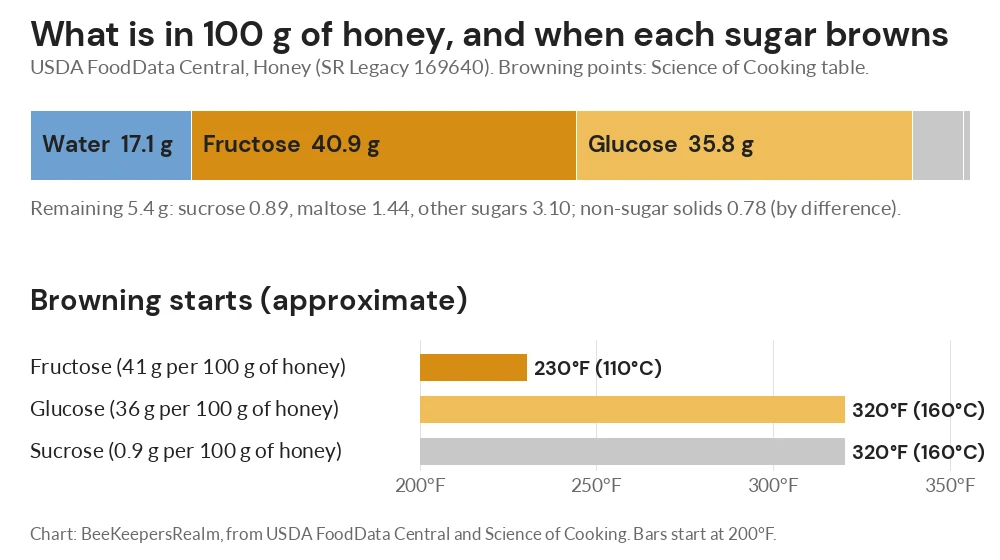
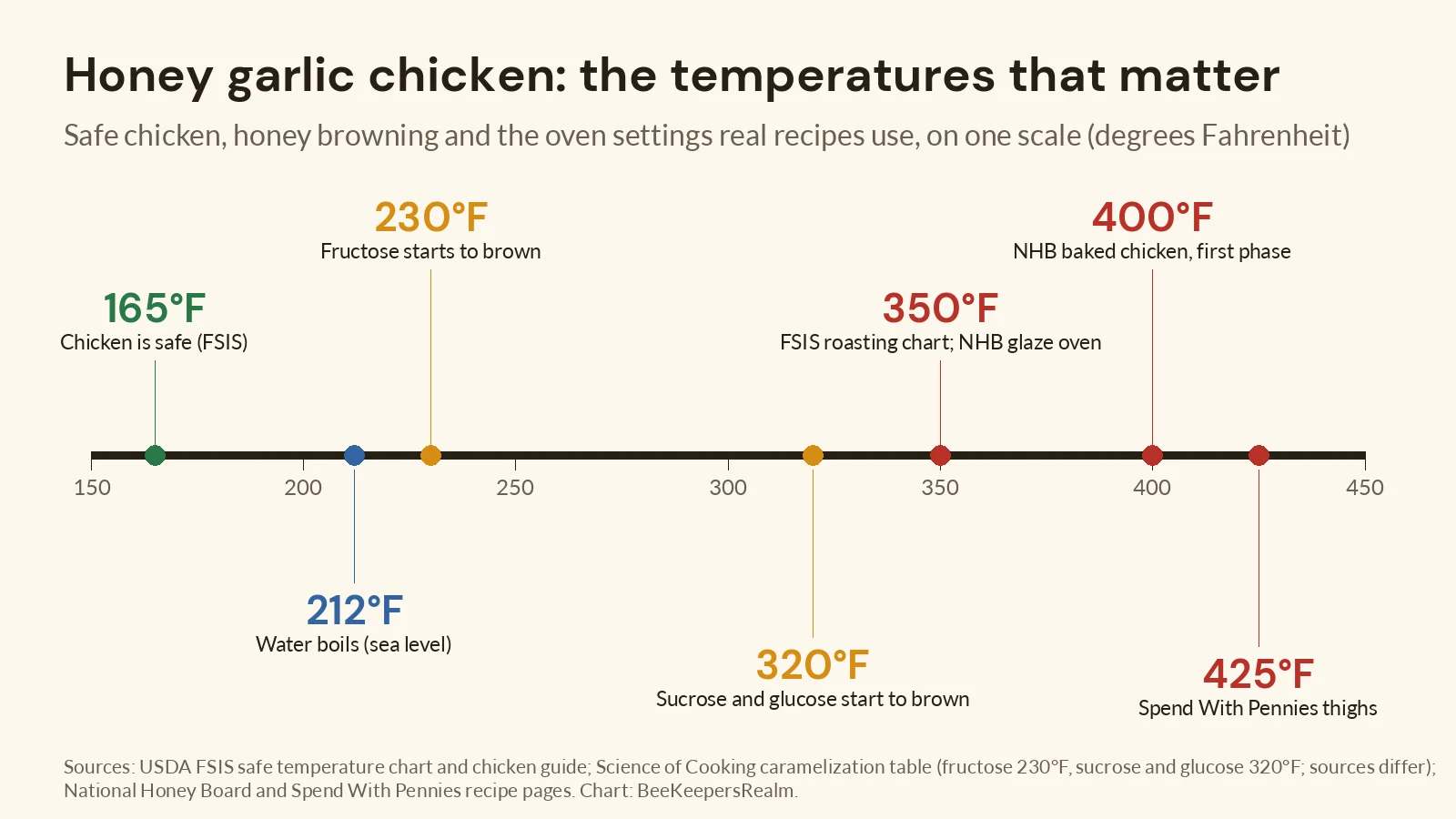
The Science of Cooking table puts fructose browning at 110°C (230°F) and sucrose and glucose at 160°C (320°F), and says honey bakes darker for that reason. Other tables give different numbers, but fructose is lowest in both we checked. This is also why bakers cut the oven by 25°F when swapping in honey; see swapping honey for sugar in baking.
Our inference: a simmering sauce sits near 212°F while water remains. Once the water cooks off, the syrup can climb past 230°F and darken fast. Our recipe uses about 1/2 cup of honey, roughly 140 g of sugar, and the honey itself brings only about 29 g of water. Broth, soy sauce and vinegar add another 1/2 cup of liquid to keep the sauce below that point.
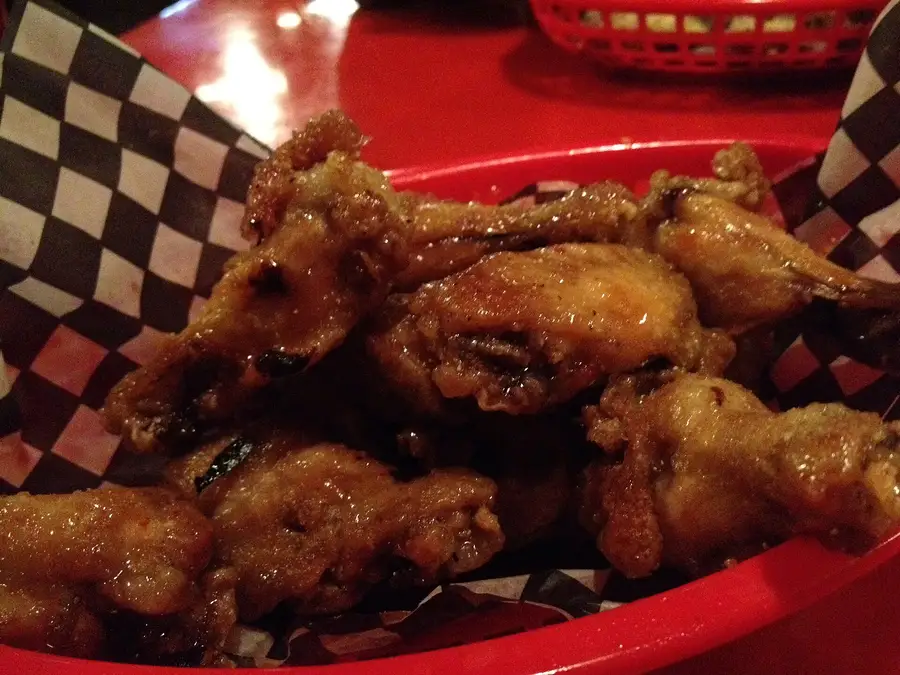
“Add the glaze late” is only half the story. Of the published recipes we read, skillet versions keep the sauce on the heat for 1 to 5 minutes. Spend With Pennies leaves a honey sauce with 1/4 cup of water in the dish for 45 minutes at 425°F, and the NHB’s wing recipe bakes honey, soy and chili sauce for an hour at 350°F. Liquid and temperature matter as much as timing. To stay safe from scorching:
- Keep some broth or water in the sauce, and add a splash if it tightens early. RecipeTin Eats says to add “a touch of water” if it gets too thick.
- Reduce over medium heat, not high.
- Cook garlic briefly: Budget Bytes allows 30 to 60 seconds on medium-low, and Kitchen Sanctuary turns the heat down so it does not burn.
- In the oven, follow the NHB’s baked chicken: bake plain first, then lower the oven from 400°F to 350°F for the glaze.
Cuts and Methods Compared
Every cut needs 165°F, but time varies. FSIS gives these approximate roasting times at 350°F.
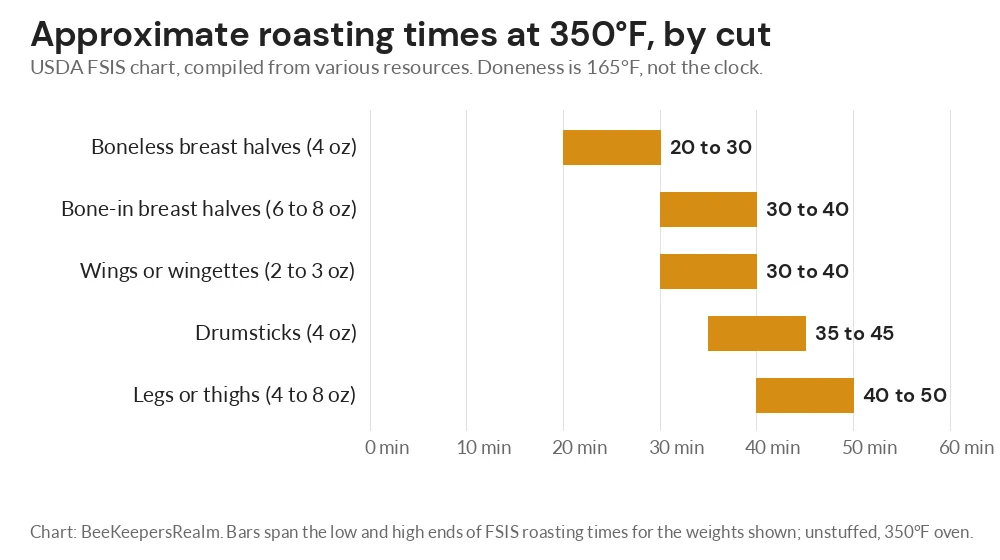
Kitchen Sanctuary says thigh meat is more tender than breast and can take a short burst of high heat without drying out; breasts cook fastest by the FSIS chart. Here is how the recipes we measured differ:
| Recipe | Method and cut | Honey sauce on the heat | Checks 165°F? |
|---|---|---|---|
| RecipeTin Eats | Skillet, breast steaks; 12 min total | About 1 minute | No |
| Kitchen Sanctuary | Skillet, boneless thighs; 20 min | 4 to 5 minutes | No (“no longer pink”) |
| Budget Bytes | Skillet, breast pieces; 28 min | 2 minutes, then 1 to 2 with chicken | No |
| I Heart Eating | Skillet, breast cubes; 20 min | About 5 minutes | No |
| Fine Dining Lovers | Skillet, boneless thighs; 30 min | About 5 minutes | No |
| Spend With Pennies | Oven 425°F, bone-in thighs; 70 min | 45 minutes in the dish | Yes, in notes |
| NHB Honey Baked Chicken | Oven 400°F then 350°F, thighs and drumsticks | Last 10 minutes at 350°F | No |
| NHB Honey Chicken Wings | Oven 350°F, wings | 60 minutes | No |
Slow cooker versions exist, but FSIS says to thaw poultry first and notes slow cookers run roughly 170° to 280°F. A closed pot will not reduce the sauce, so our judgment is to finish it in a pan.
Food Safety: Temperature, Raw Chicken and Babies
FSIS’s safe temperature chart sets 165°F for all poultry: breasts, legs, thighs and wings. Its chicken guide says to check the innermost part of the thigh and wing and the thickest part of the breast.
“The color of cooked chicken is not a sign of its safety. Only by using a food thermometer can one accurately determine that chicken has reached a safe minimum internal temperature of 165°F throughout.”
- Do not rinse raw chicken. FSIS says washing it is not recommended as the safest method because bacteria can splash onto kitchen surfaces. The NHB’s baked chicken recipe says to “rinse and pat dry” the chicken; we follow FSIS and just pat dry.
- Keep sauce and raw chicken apart. FSIS says to bring any marinade to a full boil before brushing it on cooked chicken and to discard leftover raw marinade. Our recipe mixes the sauce in a clean bowl and never dips a raw-chicken utensil into it.
- Marinate in the refrigerator, for up to 2 days, per FSIS.
- Babies: the CDC says honey is not safe for infants.
“Do not feed honey to a child who is younger than 1 year old.”
The CDC extends this to “products made with” honey; see why honey is unsafe for babies. This is educational information from USDA and CDC, not medical or professional advice.
Our Starting Recipe: Skillet Honey Garlic Thighs
We built this from the ranges in the published recipes above and the FSIS guidance. We have not test-cooked this exact version, so treat the times as estimates and let the thermometer decide. The honey ratio, 1/3 cup per pound of chicken, matches RecipeTin Eats (1/3 cup for 1 lb) and I Heart Eating (1/2 cup for 1.5 lb). Serves 4.
Ingredients
- 1-1/2 lb (680 g) boneless, skinless chicken thighs, patted dry
- 1/4 tsp salt and 1/4 tsp black pepper
- 2 tbsp cornstarch
- 2 tbsp neutral oil
- 1/2 cup (170 g) mild liquid honey, such as clover
- 3 tbsp soy sauce
- 1/4 cup low-sodium chicken broth or water
- 1 tbsp rice vinegar or apple cider vinegar
- 4 garlic cloves, minced
- 1 tbsp butter
- Sliced green onion, to serve
Method
- Pat the chicken dry; do not rinse it. Season with the salt and pepper and toss in the cornstarch.
- In a clean bowl, whisk the honey, soy sauce, broth and vinegar.
- Heat the oil in a 12-inch skillet over medium-high. Cook the thighs in one layer for 4 to 5 minutes until golden, flip, and cook 2 to 3 minutes more.
- Lower to medium-low. Push the chicken aside, melt the butter, add the garlic and stir for 30 seconds.
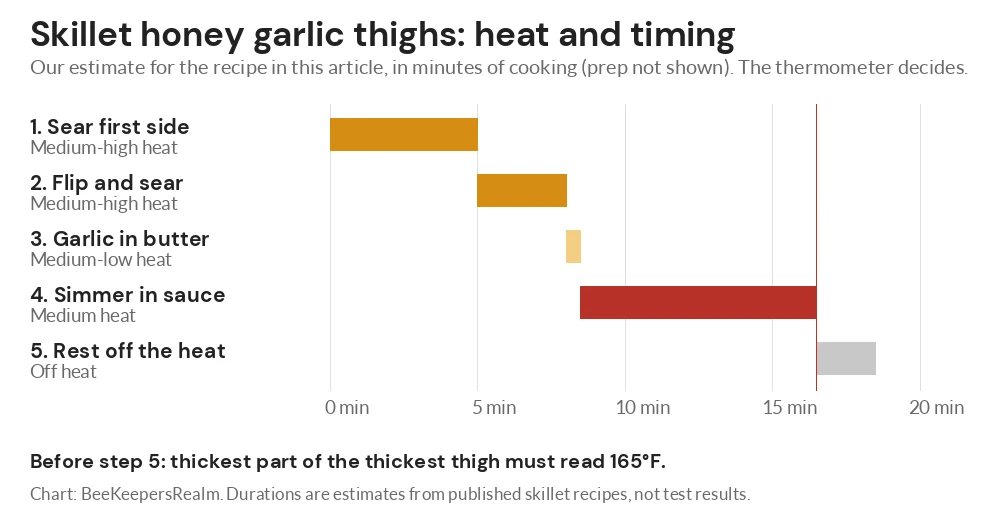
- Pour in the sauce, raise to medium and bring to a gentle simmer. Turn the thighs and simmer 5 to 8 minutes, until the sauce coats the back of a spoon and the thickest thigh reads 165°F. If the sauce tightens first, add 2 tablespoons of water and cover.
- Take off the heat, rest 2 minutes, top with green onion and serve.
Estimated time: about 25 minutes. The similar skillet recipes above publish totals of 12 to 30 minutes.
Honey arithmetic. From USDA data, 170 g of honey holds about 515 calories and 140 g of sugars. Divided four ways, that is about 130 calories and 35 g of sugars per serving from honey alone, if you eat all the sauce. It is not a full nutrition analysis.
Oven version. Spend With Pennies pours 1/2 cup honey, 1/4 cup water, 1/4 cup low-sodium soy sauce, 3 tbsp apple cider vinegar and 4 minced garlic cloves over 4 bone-in, skin-on thighs. It bakes them at 425°F for 25 minutes skin side down, flips them for 20 more, then boils the pan juices with cornstarch. Check 165°F in the thickest part first.
Substitutions and Variations
- Maple syrup: RecipeTin Eats lists it as an alternative to honey. The flavor changes, and it is no longer honey garlic.
- Garlic powder: Budget Bytes and I Heart Eating use it in the chicken coating. Keep fresh garlic in the sauce.
- Soy-free: replace the soy sauce with an equal amount of broth and salt to taste. We have not tested it, and the sauce will be milder.
- Breasts: cut them into steaks or pieces. FSIS roasting times are shortest for boneless breasts.
- Heat: see how to make hot honey. Do not jar leftover garlic sauce as garlic honey; read how to infuse honey safely, and note that the CDC lists chopped garlic in oil as a botulism source.
Storing and Reheating Leftovers
FSIS says to refrigerate leftovers within 2 hours (1 hour above 90°F) and use them in 3 to 4 days, or freeze cooked chicken for about 4 months. Store in shallow covered containers. Reheat to 165°F; for microwaving, cover the food and add a little liquid if needed. FSIS says not to reheat leftovers in a slow cooker, only to hold them hot afterward.
Frequently Asked Questions
What temperature should honey garlic chicken reach?
165°F at the thickest part, measured with a food thermometer. FSIS gives the same figure for breasts, thighs and wings.
How long does honey garlic chicken take to cook?
Skillet recipes publish 12 to 30 minutes in total; FSIS lists 40 to 50 minutes for thighs at 350°F. Trust the thermometer, not the clock.
Why does my honey garlic sauce burn?
Honey is about 82% sugar, and its fructose browns near 230°F. Once the water boils off, the sauce overshoots. Keep liquid in it and use medium heat.
Can I use raw honey?
Yes, but heating ends “raw” status in the NHB’s terms, and its study found processing did not change nutrient or antioxidant content. A cheaper mild honey does the same job.
How do I cook honey garlic chicken in the oven?
Bake plain chicken first and glaze at 350°F for the last 10 minutes (NHB), or use the all-in-sauce method above. Confirm 165°F either way.
Is it better to bake chicken at 350°F or 400°F?
FSIS publishes no single best oven temperature. Its time chart uses 350°F, and the NHB bakes at 400°F then drops to 350°F for the glaze. Lower is gentler on a honey glaze; 165°F decides doneness.
How do you cook honey garlic chicken breast?
Use boneless breast halves of about 4 ounces. The FSIS chart gives them 20 to 30 minutes roasting at 350°F, 25 to 30 minutes simmering, or 6 to 8 minutes per side on the grill, the fastest of the cuts it lists. Breast is leaner than thigh, so add the honey sauce only near the end and take the chicken off the heat as soon as the thickest part reads 165°F.
Can babies eat honey garlic chicken?
No. The CDC says not to give honey or products made with it to a child under 1 year old.
The Bottom Line
Pick a mild honey, keep liquid in the sauce, cook garlic briefly and trust a thermometer, not color. For a spicy version, start with our hot honey guide.