Reviewed by Sofia T. · How we review
Hot honey is honey infused with chili heat. The simplest safe way to make it is to warm 1 cup of honey with 1 tablespoon of dried chili flakes, steep it for 5 to 30 minutes, strain it and seal the jar. Dried chiles need no weight limit; fresh chiles must go into honey held at 140°F or higher and stay at or under 15% of the total weight. That fresh-chile rule comes from Oregon State University (OSU) Extension, and most recipe pages never mention it. It builds on our guide to infusing honey at home safely.
Key Takeaways
- Dried chili flakes are the low-risk route: OSU Extension lists dried chiles as a “dry addition” with no weight cap.
- Fresh chiles, garlic and herbs are high-risk. OSU allows them only in a hot infusion at 140°F or above, capped at 15% of total weight (honey weight times 0.176).
- Vinegar and fresh chiles add water. By our arithmetic, 1 cup of honey with 2 tablespoons each of flakes and vinegar is about 23% water against 17.1% for plain honey; a New Zealand guide calls fermentation highly likely above 19%.
- Of 11 hot honey recipe pages we read in full, one mentions botulism and none gives a temperature or weight limit.
- Never give hot honey to a child under 12 months, however it was cooked.
Table of Contents
- Which Honey to Use for Hot Honey
- Dried or Fresh Chiles: A Safety Decision
- Recipe 1: Dried-Flake Hot Honey
- Recipe 2: Fresh-Chile Hot Honey at 140°F
- Why Vinegar and Fresh Chiles Shorten Shelf Life
- Storing Hot Honey and Fixing Crystallization
- Safety Notes: Babies and Wounds
- How to Use Hot Honey
- Frequently Asked Questions
- The Bottom Line
Which Honey to Use for Hot Honey
Any liquid honey works. The choice changes how much honey flavor survives the chile and how soon the jar sets. A mild honey lets the chile lead; Allrecipes says a basic clover honey will do. A dark, strong honey such as buckwheat competes with the heat, which is our judgment, not a tested result.
Setting speed matters because hot honey sits in a pantry for months. Our guide to why some honeys crystallize faster explains that glucose-rich honeys such as clover and canola can set within weeks, while fructose-rich tupelo, sage and black locust (sold as acacia) can stay liquid for years. The National Honey Board adds that filtered honey stays liquid much longer than unfiltered.
Ordinary jar honey is fine here. A hot infusion at 140°F means the finished honey is no longer “raw,” which the National Honey Board describes as generally unheated and unfiltered, so skip the premium raw jar; see raw vs processed honey.
Dried or Fresh Chiles: A Safety Decision
Honey keeps for years because it has little available water, not because it is acidic or antimicrobial. OSU Extension puts it directly:
“Honey’s low water activity, not its acidity or antimicrobial components, is what keeps it safe during long storage periods.”
A fresh chile is mostly water: USDA lists a raw jalapeño at 91.7% against about 17% for honey (USDA FoodData Central). OSU’s lab trials found bacteria growing where a submerged ingredient meets honey, and fresh chiles are low in acid, so OSU files them in its riskiest group.
| Chile form | OSU category | Allowed method | Weight cap |
|---|---|---|---|
| Dried flakes or dried whole chiles (brittle and crisp) | 1, dry addition | Hot, cold or room-temperature | None |
| Fresh chiles, garlic, fresh herbs | 3, high-moisture and low-acid | Hot infusion only, honey at 140°F or above | 15% of total weight |
| Chile simmered in vinegar first | 3, with the vinegar counted | Same as fresh chiles | 15% of total weight |
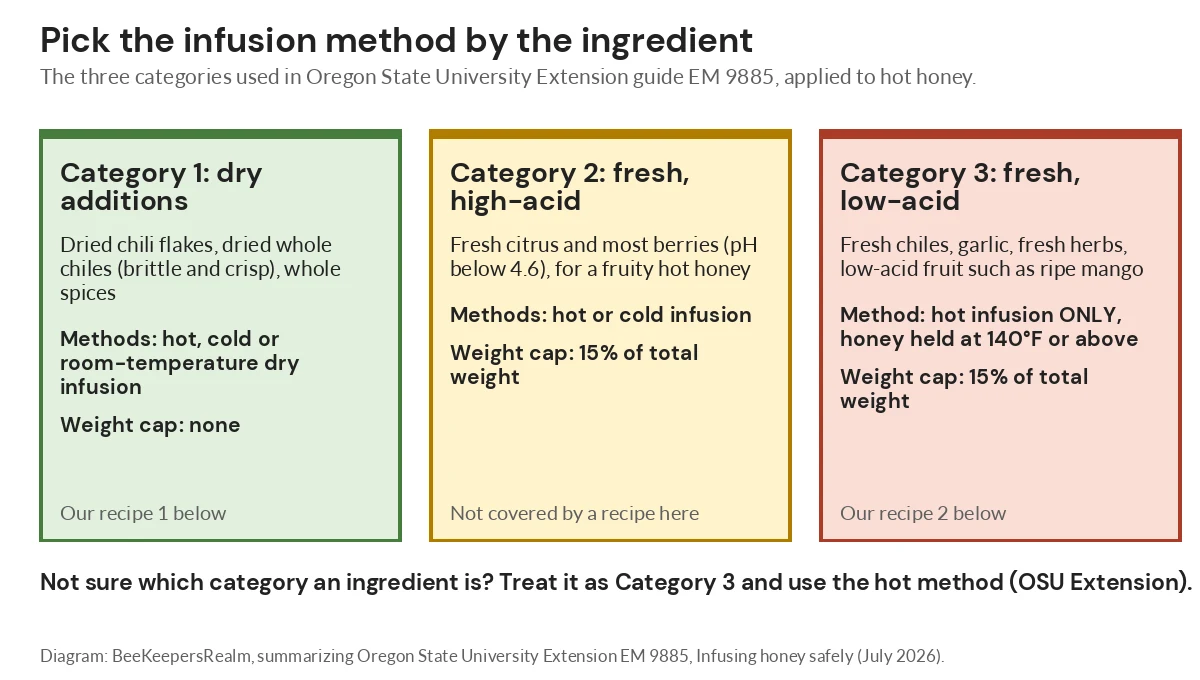
Chile crisp, chili oil and chile pastes are not covered by OSU’s guide, so we give no method for them. If you are unsure about an ingredient, OSU says to treat it as Category 3.
Recipe 1: Dried-Flake Hot Honey
This is a starting point, not a result we tasted. The amounts sit inside the range of eight recipe pages we reviewed (table below), and the safety rests on OSU’s dry-addition rule.
Makes about 1 cup. Use 1 cup (339 g, about 12 oz) honey and 1 tablespoon dried chili flakes for medium heat. Use 1 teaspoon for mild or 2 tablespoons for hot. Add up to 1 teaspoon cider vinegar only if you want the tang (see the moisture section).
- Stir the honey and flakes together in a small, heavy saucepan.
- Warm over low heat, stirring, until the honey is runny with tiny bubbles at the edge. Do not boil; OSU warns overheating scorches honey.
- Take it off the heat and steep for 5 to 30 minutes. A longer steep is hotter, as the recipe pages we read agree.
- Stir in the vinegar, if using.
- Strain through a fine sieve into a clean jar and seal it. Strained honey keeps a steady heat, and OSU notes that unfiltered particles make honey more likely to crystallize.
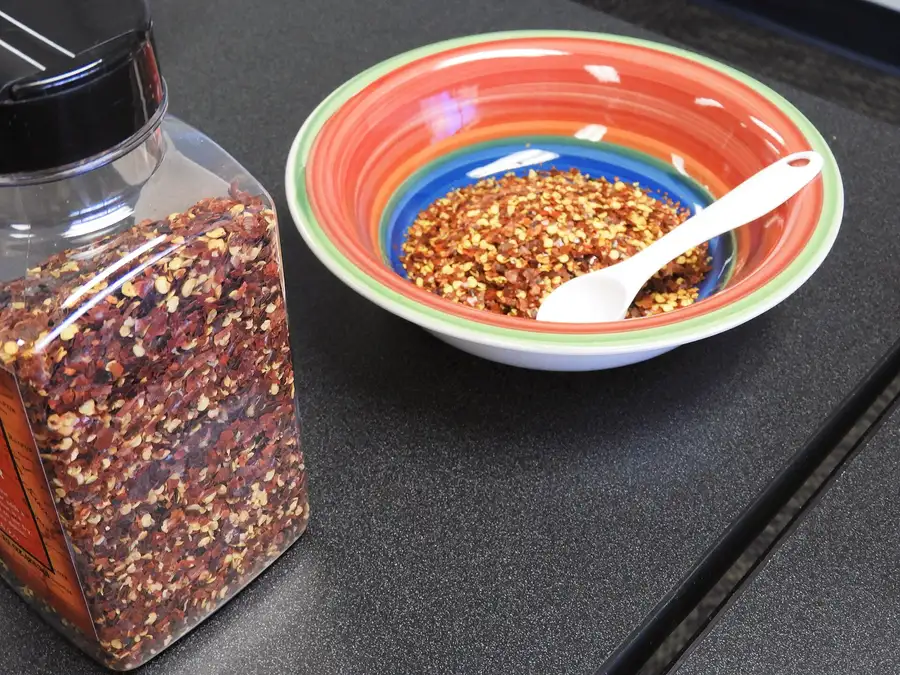
A no-heat version also works: OSU’s unlimited dry infusion covers the flakes with honey and strains them after several weeks.
Recipe 2: Fresh-Chile Hot Honey at 140°F
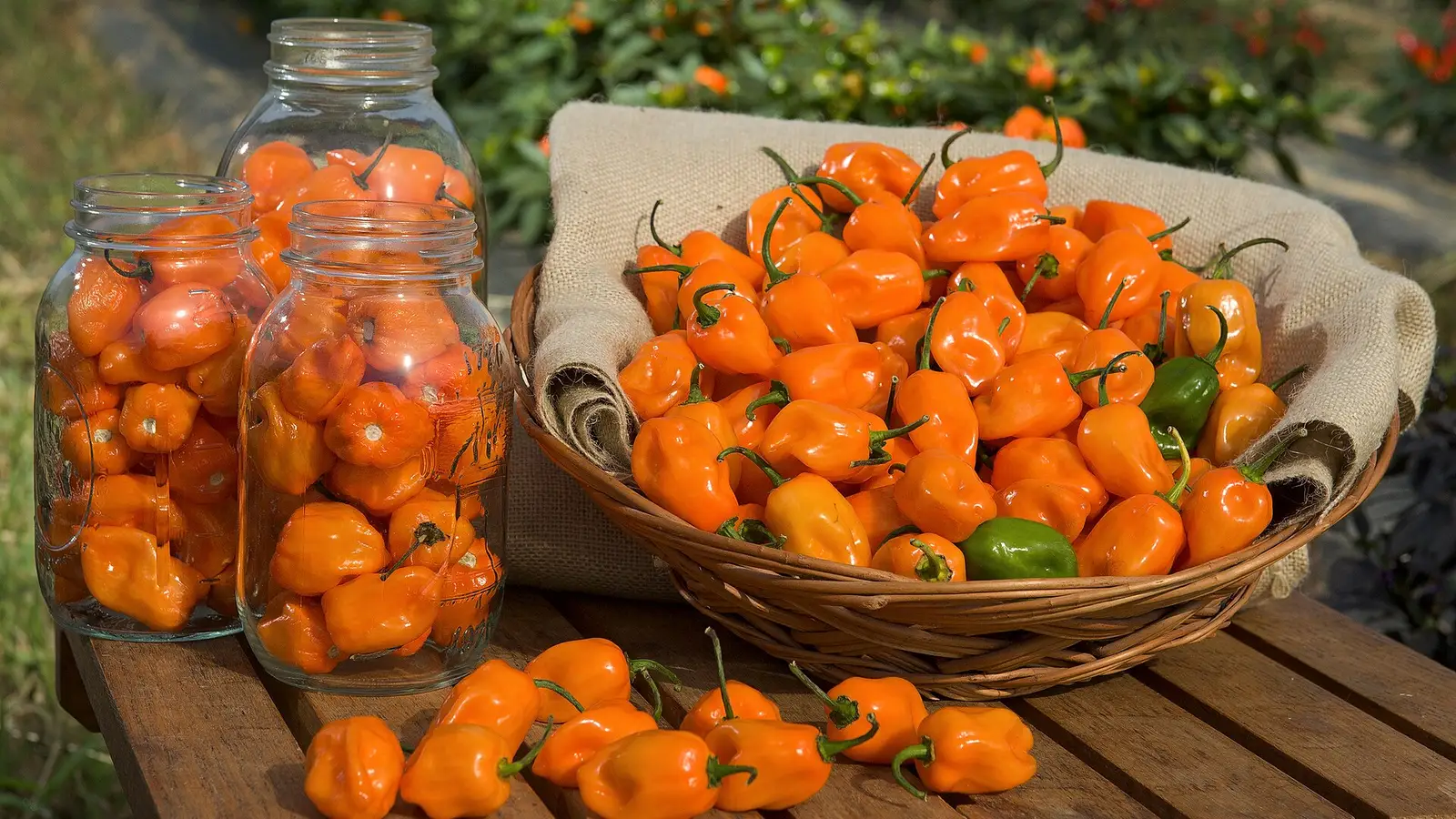
This is OSU’s habanero hot honey, adapted. OSU simmers 8 sliced habaneros in ½ cup of cider vinegar for 2 minutes, then adds up to 5.63 oz of that pepper-and-vinegar mixture to 2 lb of honey. It infuses at 140°F for 15 minutes. The scaling below is our arithmetic.
| Honey | Most fresh chile and vinegar mixture (honey weight x 0.176) |
|---|---|
| 8 oz (227 g) | 1.4 oz (40 g) |
| 12 oz (340 g) | 2.1 oz (60 g) |
| 1 lb (454 g) | 2.8 oz (80 g) |
| 2 lb (907 g) | 5.6 oz (160 g), OSU’s example |
- Wear gloves and ventilate. OSU warns of potent fumes from cooking hot peppers.
- Heat the vinegar until it steams but does not boil, add the sliced chiles, simmer 2 minutes, then weigh out no more than the table allows.
- Heat the weighed honey to 140°F or above and hold it there, checking with a probe thermometer.
- Add the weighed mixture, stir now and then and infuse for 15 minutes (OSU says 10 minutes to 2 hours). Keep it above 140°F and never boil.
- Strain through a fine sieve or several layers of cheesecloth, then bottle in clean jars.
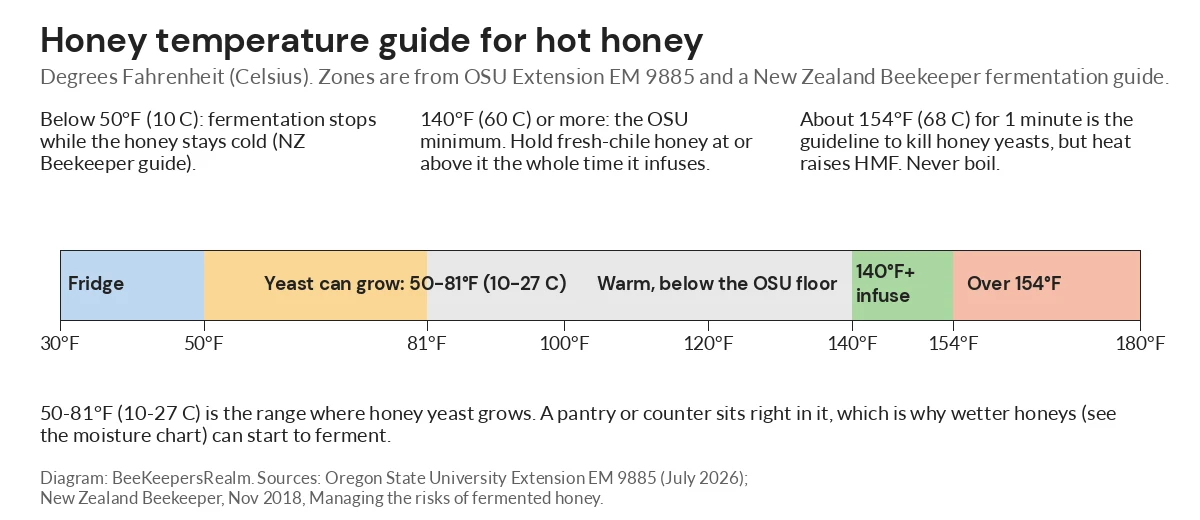
Use a kitchen scale: the 15% cap only works on weighed amounts, not cups.
Why Vinegar and Fresh Chiles Shorten Shelf Life
OSU’s guide addresses botulism and says properly infused honeys keep indefinitely when sealed, but bubbling or a sour smell means fermentation and the jar goes in the trash. Water drives that second risk. A New Zealand Beekeeper guide, citing USDA Agriculture Handbook 335, says honey at 17% moisture or less is unlikely to ferment, risk rises between 17% and 19%, and fermentation is highly likely above 19%.
Plain honey is 17.1% water, right at that line, and cider vinegar is 93.8%. Using USDA values, we worked out the water in 1 cup of honey for each ratio on the pages we reviewed:
| Recipe page (per 1 cup honey) | Flakes | Vinegar | Water in the jar |
|---|---|---|---|
| Endless Meal, no vinegar | 2 tbsp | none | 16.8% |
| Taste of Home | 1 tsp | 1 tsp | 18.2% |
| Melissa Jane Lee | 1 tbsp | 1 tsp | 18.1% |
| Gimme Some Oven | 2 to 3 tsp | 1 to 2 tsp | 18.1 to 19.1% |
| The Healthy Maven | 1 to 2 tbsp | 2 tsp | 19.0 to 19.1% |
| Well Plated (scaled up) | 2 tbsp | 2 tsp | 19.0% |
| Casual Foodist | 2 tsp | 1 tbsp | 20.2% |
| Bee Inspired Goods | 2 tbsp | 2 tbsp | 22.9% |
These are upper-bound calculations that assume every gram of added water stays in the jar; we measured no batch. Flakes are 8.1% water (USDA’s cayenne entry stands in) and 1 cup of honey weighs 339 g.
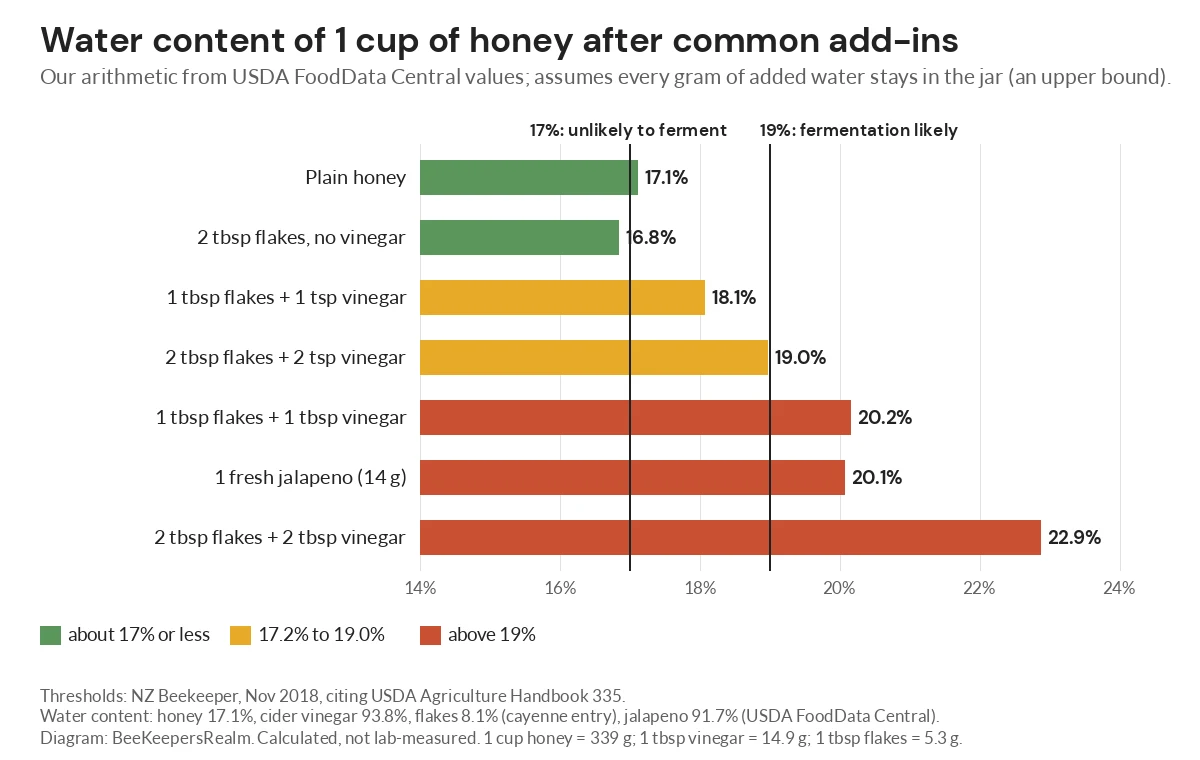
Our rule follows from that arithmetic and is conservative, not OSU’s: keep vinegar to 1 teaspoon per cup, or add it at the plate. Refrigerate anything made with fresh chiles; one fresh jalapeño (14 g) in a cup of honey works out near 20%. The NZ guide says staying below 10°C (50°F) halts fermentation while it lasts. See how to prevent honey fermentation.
Storing Hot Honey and Fixing Crystallization
A dried-flake batch without vinegar stays near plain-honey moisture, so ordinary honey storage applies: a sealed jar in a cool, dark cupboard. The recipe pages we read quote anything from 1 week (fresh chiles, refrigerated) to 6 to 8 months. OSU’s figure for properly infused honey is indefinite. The National Honey Board says a two-year shelf life is often stated for plain honey; see does honey expire.
The National Honey Board says all honey crystallizes eventually, and suspended particles speed it up, another reason to strain the flakes out. To fix a set jar, OSU says to stand it in a pan with a few inches of water and heat gently until fully liquid; leftover crystals make it set again fast, so heat thoroughly. See reliquefying honey without damage.
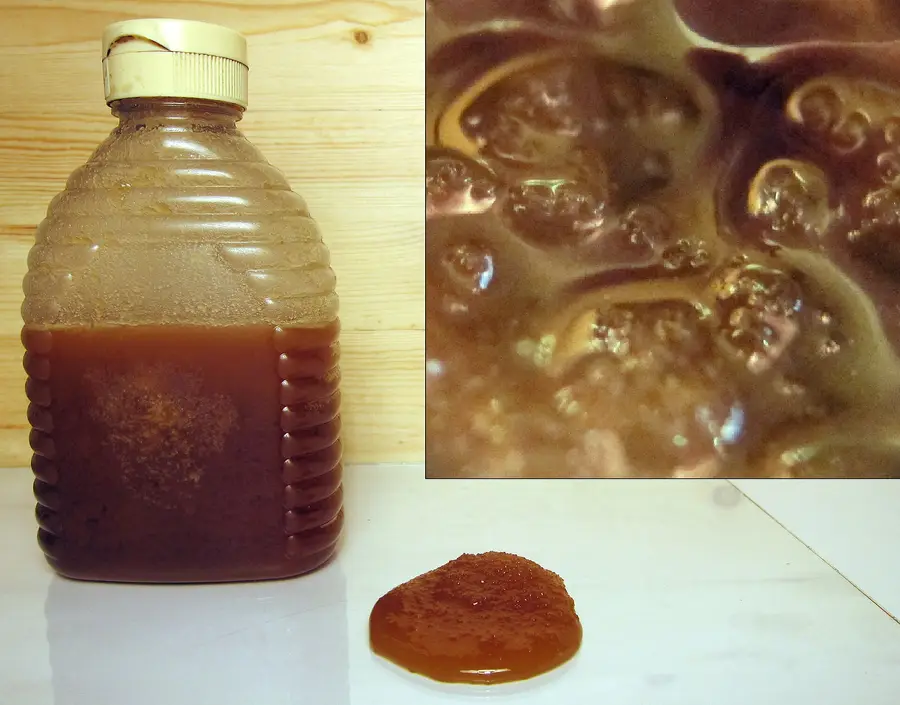
Bubbling or a sour smell is different: that is fermentation, and OSU says to discard the jar. Our guide to granulation vs fermentation shows how to tell them apart.
Safety Notes: Babies and Wounds
Infants under 12 months must not eat honey in any form. The Dietary Guidelines for Americans say so in plain terms:
“Infants should not be given any foods containing raw or cooked honey.”
OSU adds that pasteurization does not kill the spores, so heating a hot honey does not make it safe for babies. Our explainer on honey and infant botulism covers the risk. Hot honey is also not wound care; the honey used on wounds is a sterilized product (see medical-grade honey). This article is educational food information, not professional food-safety or medical advice. OSU Extension’s guide is the official source for the infusion rules.
How to Use Hot Honey
Drizzle it on pizza, fried chicken, roasted vegetables or a cheese board (see our honey and cheese pairing guide), or stir it into softened butter. Add it at the end of cooking, since honey browns faster than sugar; the National Honey Board advises lowering the oven temperature by 25°F when baking with honey.

Frequently Asked Questions
Can you make hot honey without cooking it?
Yes, with dried chiles: OSU’s dry infusion steeps them in honey for several weeks. Fresh chiles cannot be made this way.
Does hot honey need to be refrigerated?
A dried-flake batch with little or no vinegar does not. Refrigerate anything made with fresh chiles, and consider it for vinegar-heavy batches (see the moisture table).
How long does hot honey last?
OSU says properly infused honey keeps indefinitely when sealed. Our advice is to use flake batches within a few months for best flavor, and fresh-chile batches within 1 to 2 weeks in the fridge, the range recipe pages that use fresh peppers give.
Can hot honey go bad?
Yes. Bubbling or a sour smell means fermentation; discard the jar. The bigger danger is a fresh-chile or garlic infusion made at room temperature.
Is hot honey good for you?
It is a sweet condiment. By USDA data a 21 g tablespoon of honey is roughly 64 calories and 17 g of sugar, and we found no solid evidence of health benefits for hot honey itself.
Is hot honey gluten free?
Honey and chili flakes contain no wheat, barley or rye. Bottled brands add other ingredients, so check the label.
Why is my hot honey not hot, or too hot?
Heat depends on the chile, the amount and the steeping time. Strain for a stable heat; if a batch is too fierce, stir in plain honey.
Can I add garlic to hot honey?
Only by the hot method: fresh garlic is Category 3, held at 140°F or above and capped at 15% of weight. See our garlic honey rules.
The Bottom Line
If you make one batch, make Recipe 1 with strained dried flakes and no vinegar.
Image credits: Featured photo: Stephen Ausmus, USDA Agricultural Research Service, public domain, via Wikimedia Commons, cropped. Pepper flakes: Nutrition, Food Safety and Health program, CC0. Crystallized honey: Zaereth, CC0. Pizza: Fantinisapizza, CC0. Diagrams and charts: BeeKeepersRealm.