Reviewed by Thomas B. · How we review
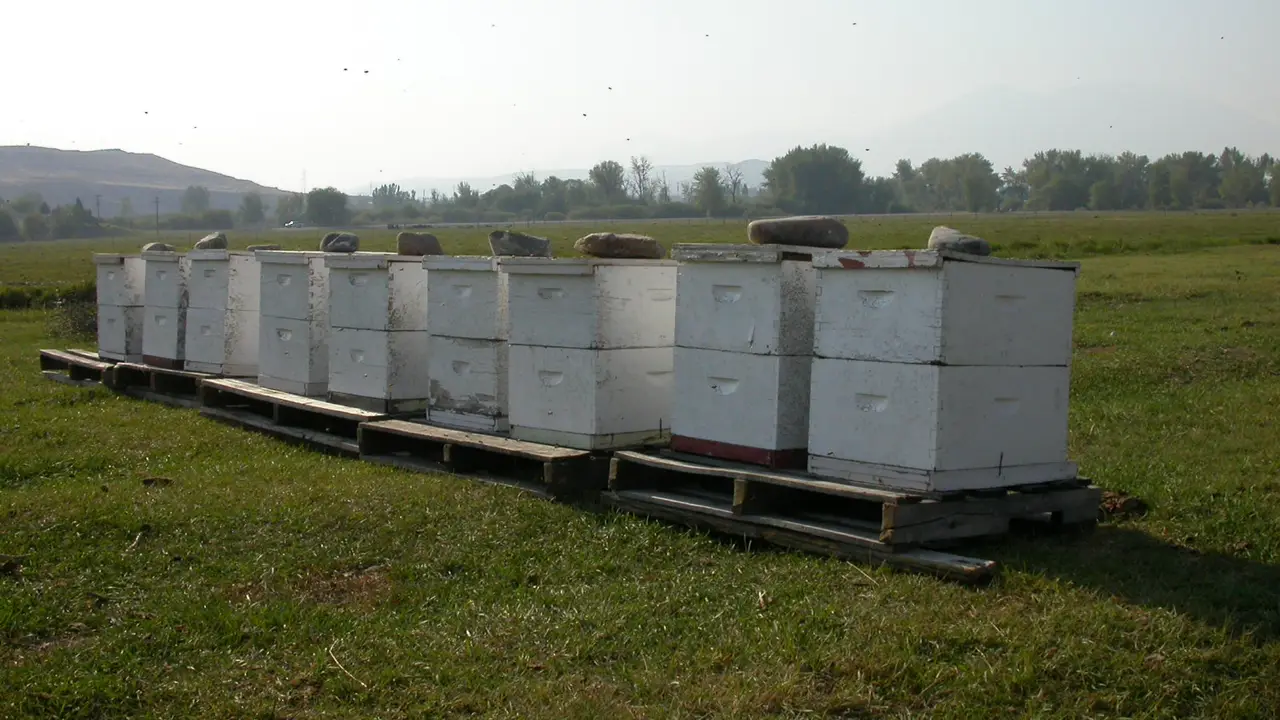
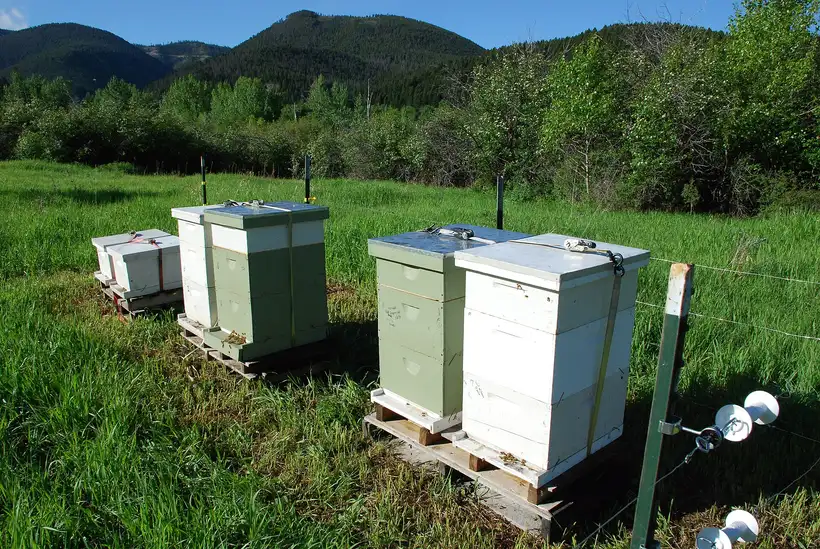
An apiary is a place where beehives are kept, and beekeepers usually call it a bee yard. The word names the site, not the bees: a hive is the box, a colony is the bees living in it, and an apiary can be one backyard hive or hundreds of them on a farm. The state laws we checked do not require more than one hive either: Montana’s says “one or more.”
Educational information only, not legal advice. We read the statutes below on their official sites on October 24, 2026. For your own state’s rules, ask your state apiary inspector; Apiary Inspectors of America lists them.
Key Takeaways
- An apiary is the site, a hive is one box, a colony is the bees inside it, and “bee yard” is the everyday word for an apiary.
- Merriam-Webster traces the word to Latin apiārium, from apis, “bee,” and dates its first English use to 1654.
- Texas, Florida and Montana define an apiary without a hive minimum; Montana says “one or more.” Texas dropped “six or more” colonies from its definition on September 1, 2023.
- Law sets no typical size. Texas AgriLife describes hobbyists as typically keeping fewer than 10 hives, and most beekeepers in a national survey said each colony needs 2 to 5 acres of forage.
- Main types: home, commercial and migratory, queen-mating, teaching and community, and urban rooftop apiaries.
Table of Contents
- Apiary Meaning, Pronunciation and Word Origin
- Apiary vs Hive vs Colony vs Bee Yard
- How State Law Defines an Apiary
- How Big Is an Apiary?
- What You Find in an Apiary
- Types of Apiaries
- Starting and Registering an Apiary
- Frequently Asked Questions
- The Bottom Line
Apiary Meaning, Pronunciation and Word Origin
In American English the word is said AY-pee-air-ee, and the plural is apiaries. Merriam-Webster defines it as “a place where bees are kept,” especially “a collection of hives or colonies of bees kept for their honey.” Its usage note adds that the word can cover more than honey yards:
“can refer to any place where bees are kept, but is used especially for a collection of hives or colonies of bees kept for their honey”
Do not confuse it with aviary, a place for birds. Our glossary of beekeeping terms covers the rest of the vocabulary.
Merriam-Webster gives the etymology as borrowed from Latin apiārium, from apis (“bee”) plus the suffix -ārium. It marks apis as “of obscure origin,” says it cannot be tied to English “bee” by regular sound change, and notes that a loan from ancient Egyptian has been hypothesized. The first known English use is 1654. One UK beekeeper who writes as The Apiarist puts the meaning plainly:
“The word apiary is derived from the Latin ‘apiārium’ which is a concatenation of ‘Apis’, meaning bee, and ‘‑ārium’ which means ‘a place for’.”
So an apiary is literally a “place for bees.” The same writer notes a British usage: in the UK, “bee-house” or “bee shed” often means a building that holds hives, which is different from an outdoor yard.
Apiary vs Hive vs Colony vs Bee Yard
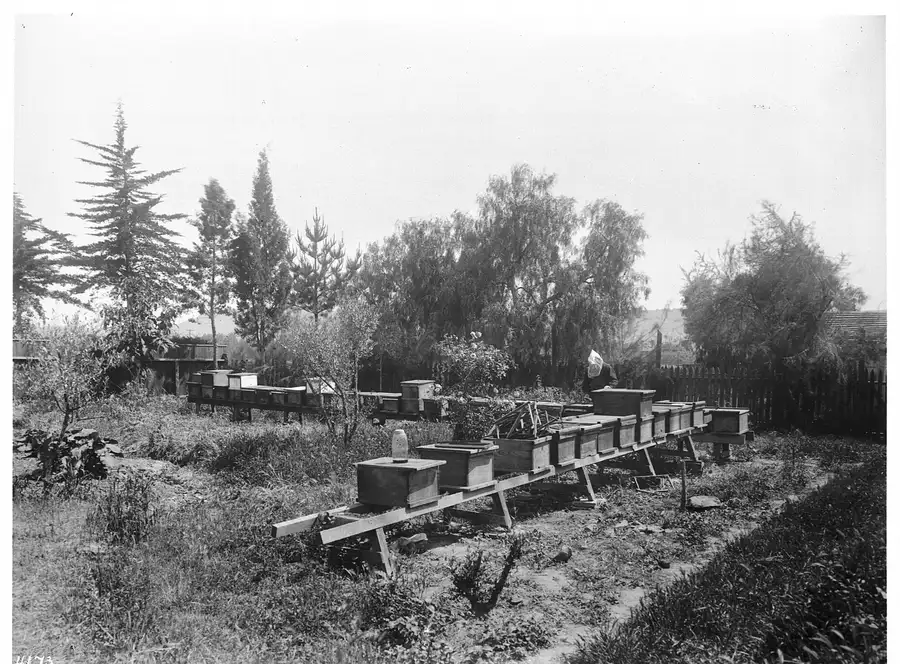
People swap these words, but each one names a different level of a beekeeping operation. The wording for hive, colony and nucleus below is Texas’s legal text; the rest are standard usage.
| Term | What it names | Short definition |
|---|---|---|
| Colony | The bees | “a distinguishable localized population of bees in which one or more life stages may be present” (Texas Agriculture Code § 131.001(5)) |
| Hive | The box | “a box or other shelter containing a colony of bees” (§ 131.001(8-a)) |
| Nucleus (nuc) | A small starter colony | “a small mass of bees and combs of brood used in forming a new colony” (§ 131.001(12)) |
| Apiary or bee yard | One site | A place where bees or hives are kept; the same thing in everyday and legal use |
| Outyard | A second site | A bee yard away from the beekeeper’s home yard, often chosen for better forage or fewer neighbor conflicts |
| Mating yard | A site defined by its job | An apiary made mostly of queen-mating nucs and drone-producing hives |
| Queen apiary | A legal category in Texas | “an apiary in which queen bees are reared or kept for sale, barter, or exchange” (§ 131.001(15)) |
| Apiarist | The person | A beekeeper who tends an apiary |
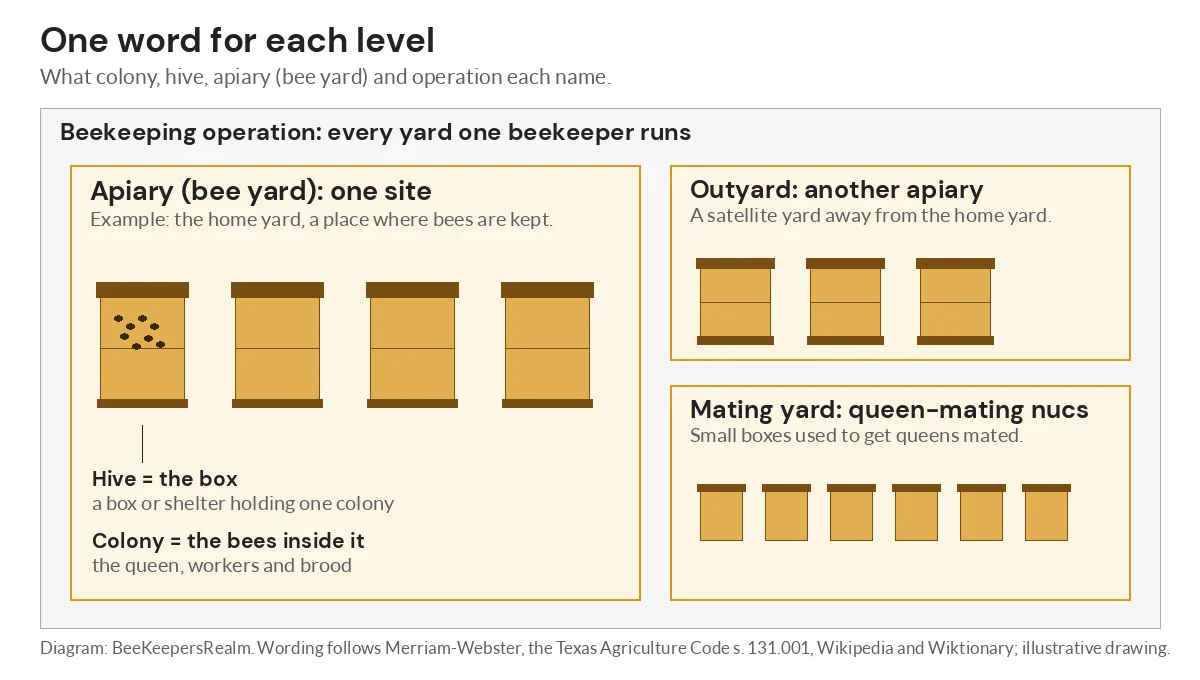
An outyard is defined by where it sits and a mating yard by what it does, so one apiary can be both. Some popular explainers say you need “more than one hive” to have an apiary. That is a convention, not the legal test, as the next section shows.
How State Law Defines an Apiary
Apiary is also a legal term. State bee laws define it so that inspection, quarantine and abandoned-colony rules know what they apply to. These are the three official definitions we checked, plus one rule that goes further:
| State | Citation | Definition of “apiary” | What stands out |
|---|---|---|---|
| Texas | Agriculture Code § 131.001(2) | “a place where colonies of bees or nuclei of bees are kept” | No hive minimum since September 1, 2023 |
| Florida | Fla. Stat. § 586.02(1) | “a beeyard or site where honeybee hives, honeybees, or honeybee equipment is located” | Also covers a site that holds only equipment |
| Montana | Mont. Code Ann. § 80-6-101(1) | “a location where one or more colonies of bees are kept or one or more hives containing honeycombs or bee combs are kept” | Says “one or more”; registers apiary sites by type |
The Texas history matters because the rule changed recently. Until 2023 the statute defined an apiary as a place where “six or more” colonies are kept. H.B. 4538 of the 88th Legislature struck those two words, and the amendment took effect on September 1, 2023; our Texas beekeeping laws guide covers what else that law changed. The current text reads:
“‘Apiary’ means a place where colonies of bees or nuclei of bees are kept.”
The definitions now sit in § 131.001; § 131.002 is the chief apiary inspector section. The same section defines “abandoned apiary, equipment, or bees” as one “not regularly maintained or attended in accordance with this chapter,” so the definition of apiary decides what the abandonment rules cover.
Montana goes furthest. Its code registers apiary sites by type: general, pollination, landowner and hobbyist. A hobbyist beekeeper is “a person who owns a total of no more than five hives,” and general apiary sites “must be located 3 or more miles apart” unless an exception applies (Mont. Code Ann. § 80-6-111(1)). That spacing law is separate from the 3 feet or 3 miles rule for moving hives, covered in the FAQ below.
Texas land valuation is a separate test. Tax Code § 23.51(2) counts land used “to raise or keep bees for pollination or for the production of human food or other tangible products having a commercial value” as agricultural use “provided that the land used is not less than 5 or more than 20 acres.” That is an acreage window, not a hive count, so ask your county appraisal district what it expects.
Registration is written differently from state to state. Montana registers the site. Florida’s statute (§ 586.045(1)) tells “each beekeeper having honeybee colonies within the state” to apply for a certificate, so its duty is written around the person. Our guides to state bee inspector programs and apiary registration and beekeeping regulations by state show how states differ.
How Big Is an Apiary?
No law sets a typical size. What exists is a loose classification of beekeepers and a forage limit that decides how many hives one site can carry.
A Texas A&M AgriLife Extension entomologist describes three groups: hobbyists, typically fewer than 10 hives; sideliners, typically 50 to 250; and commercial beekeepers, 500 colonies or more. Those figures describe a whole operation, which may run many apiaries. The source is AgriLife Today’s October 2020 Texas honey report.
A single site is capped by forage. In a 2015 to 2016 survey by the North American Pollinator Protection Campaign, 2,250 beekeepers in more than 30 states said most need 2 to 5 acres of forage per colony. The survey also found 92% needed at least 1 acre per colony in summer. Multiplying that range gives a rough ceiling:
| Hives in one apiary | Forage at 2 acres per colony | Forage at 5 acres per colony |
|---|---|---|
| 5 | 10 acres | 25 acres |
| 10 | 20 acres | 50 acres |
| 20 | 40 acres | 100 acres |
| 50 | 100 acres | 250 acres |
The table is our arithmetic from the survey’s range. Bees forage on land you do not own, so these are acres they can reach, not acres to buy. When too many hives share one patch they compete for scarce resources, which can lower honey yields and raise disease spread and robbing. If you are weighing growth, see how many hives one person can manage.
What You Find in an Apiary
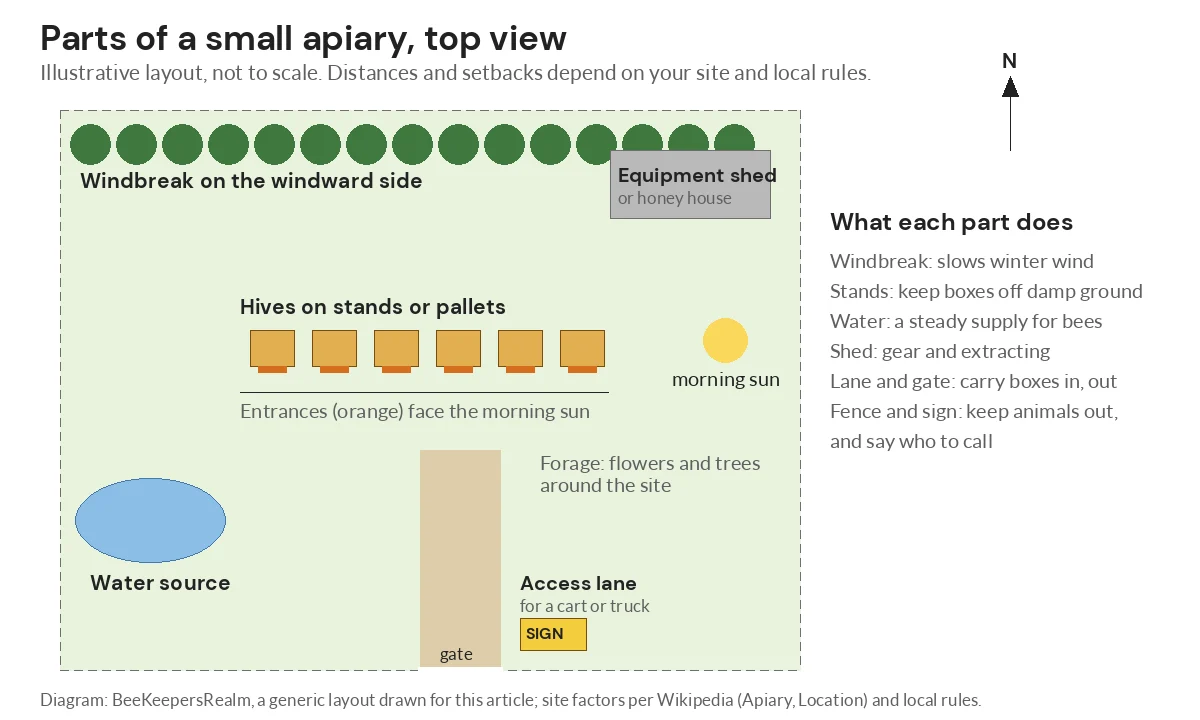
Hives are the only essential part. Beekeepers usually add what the site lacks, and the common site factors are dry high ground, a steady water source, nectar and pollen nearby, sun, good drainage and easy access.
- Hives on stands or pallets. Raising boxes keeps them off damp ground.
- A windbreak. Shrubs, a fence or panels on the windward side; our windbreak strategies for apiaries cover options.
- Water. Bees need a steady supply close by, so a natural source or a bee waterer is part of the site.
- Forage. Flowers and trees within flying range, which sets the size limit above.
- Fencing, a sign and an access lane. Fences keep out livestock or bears, a sign says who to call, and a clear path lets you carry boxes in and out.
- Storage or a honey house. Many yards add a shed for gear and a place to extract honey.
Placement near people matters as much as the layout. How close hives can be to neighbors sets out the usual distance questions.
Types of Apiaries
- Home or hobby apiaries. A backyard, a farm corner or a rural lot, usually under 10 hives per AgriLife’s hobbyist description.
- Commercial and migratory apiaries. Larger operations run many yards and may truck colonies to crops. Migratory beekeeping in the USA covers routes and logistics.
- Queen-mating yards. Small mating nucs and drone hives set up to get queens mated, as in our Kieler mini mating nuc guide.
- Teaching, research and community apiaries. Schools, nonprofits and city programs keep hives for training and outreach; see university campus apiary programs.
- Urban and rooftop apiaries. Hives in a city yard or on a roof face tighter space and rules. Read our urban beekeeping guide, the rooftop beekeeping guide and urban beekeeping equipment for small spaces.
Starting and Registering an Apiary
Check the rules before you buy bees. Zoning and local limits come first, then state registration, then the site. Our beekeeping zoning laws guide explains local limits, and the beginner’s guide to starting beekeeping walks through the first season.
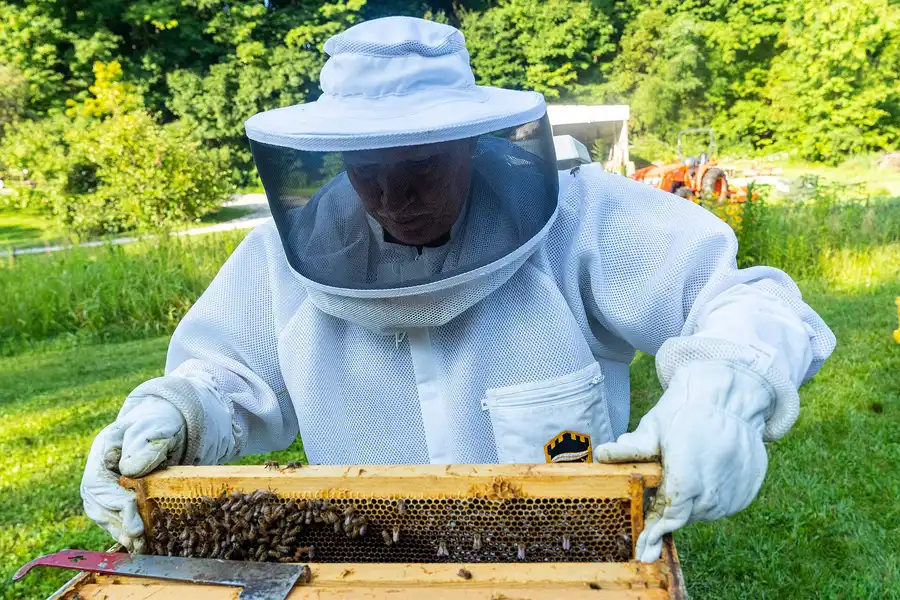
Two practical points follow from the definitions above. Registration and inspection rules attach to the beekeeper or to the yard depending on the state, so call your state apiary program early. And because no law fixes a minimum hive count, plan your first apiary around what you can manage and what the forage supports, not around a number.
Frequently Asked Questions
What is the difference between a hive and an apiary?
A hive is one box or shelter holding a colony of bees. An apiary is the whole site where hives are kept.
Why are they called apiaries?
The word is borrowed from Latin apiārium, built from apis, “bee,” plus a suffix meaning a place for something. Merriam-Webster dates its first English use to 1654.
What is an apiary also called?
A bee yard. Many beekeepers say “bee yard” in conversation, while “apiary” is the form you see in statutes.
How many hives make an apiary?
None of the definitions we checked requires more than one. Montana says “one or more” colonies, and Texas required “six or more” until September 1, 2023 and now has no minimum. Check your own state’s wording.
Do I have to register my apiary?
It depends on your state, and sometimes your city. Montana registers apiary sites by type, while Florida’s statute is written around the beekeeper (Fla. Stat. § 586.045(1)). Ask your state apiary inspector, and check local zoning too.
What is the 3 feet or 3 miles rule for bees?
It is a folk rule for moving a hive, not a law. The American Bee Journal describes it as moving a colony either three feet or three miles, because a short move keeps foragers near the hive’s odors, while a move beyond their normal range stops them flying back to the old spot. Do not confuse it with laws such as Montana’s 3-mile spacing rule for general apiary sites.
What is an outyard?
A bee yard away from the beekeeper’s home yard, often used when a home site has too many bees for the space or too little forage.
What is an apiary used for?
Honey and wax production, crop pollination, queen rearing, research and teaching are the common uses.
The Bottom Line
Think of an apiary as the address and the hive as the box. Before you set one up, check how your state defines it and what it requires, then read our backyard apiary setup guide.
Image credits: Featured photo: USDA NRCS, via Wikimedia Commons (file page), public domain, cropped.