
Reviewed by Daniel M. · Last Updated October 14, 2026 · How we review
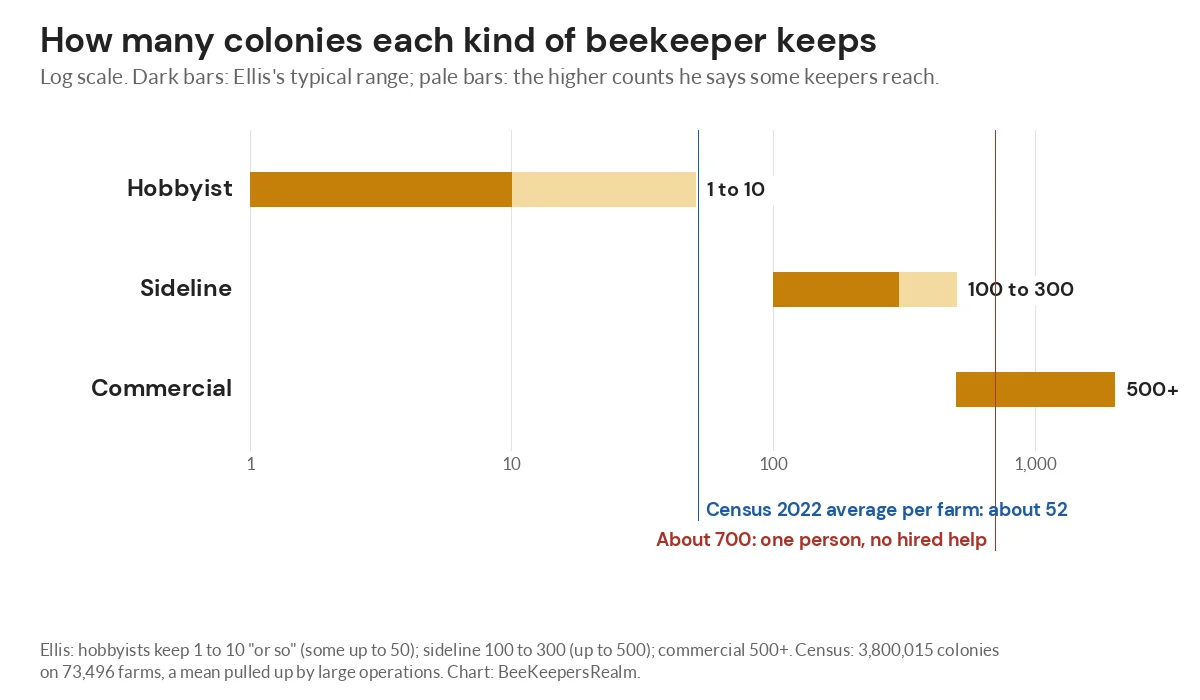
One person can manage as many colonies as they have inspection hours to cover. At Alabama Cooperative Extension’s pace of 45 minutes per colony every two weeks in spring, 10 free hours a fortnight covers about 13 colonies; visit weekly and it covers about 6. University of Florida entomologist Jamie Ellis puts hobbyists at 1 to 10 colonies, sideline beekeepers with another job at 100 to 300, and about 700 as the most one person manages before hiring help.
This guide works the number out from your own hours, then checks it against forage, equipment, income and the point where help makes sense. If you are still weighing a first hive, start with how to start beekeeping. If you are growing past a first pair, our guide to expanding an apiary safely covers the split-and-buy methods and a table of hours, boxes and state fees at 2, 5, 10 and 25 colonies.
Key Takeaways
- Your free hours set the number. At Alabama Extension’s 45-minute visit every two weeks, 10 free hours a fortnight covers about 13 colonies; weekly visits cover about 6 (our arithmetic).
- Ellis’s ranges: hobbyists 1 to 10 colonies, sideline beekeepers 100 to 300, commercial operations 500 or more, with about 700 the limit for one person without hired help.
- USDA counted about 27,000 apiary workers in 2025 against 2.64 to 3.12 million colonies on operations with five or more colonies, roughly 100 colonies per worker.
- Forage can cap you first: Mississippi State Extension expects 25 to 40 colonies in one yard where 30 to 40 percent of the land within 2 miles is in major spring bloom.
- An average colony grossed about $146 in honey in 2025 (48.0 lb at $3.05 a pound), and Oklahoma State says one hive is unlikely to turn a profit. Gross is not profit.
- People quit over lifting, yearly expenses and colony deaths as well as time (University of Minnesota Bee Lab). Plan help before you need it.
Table of Contents
- How Many Hives Each Kind of Beekeeper Manages
- The Time Math: Hours per Colony by Season
- Find Your Own Number in Three Steps
- Forage and Space Can Cap You Before Time Does
- Equipment, Harvest and Heavy Lifting
- What Colonies Earn: Income Thresholds
- When to Hire Help
- Burnout and Why People Quit
- Frequently Asked Questions
- The Bottom Line
How Many Hives Each Kind of Beekeeper Manages
Ellis sorts beekeepers by what they use colonies for rather than by a strict count, but he notes that the two track each other: hobbyists do not keep 1,000 colonies and commercial beekeepers do not keep 10. His ranges, from his American Bee Journal column on the time commitment of keeping bees, are the best published benchmark we found.
| Type | Colonies (Ellis) | What defines it | What usually limits you |
|---|---|---|---|
| Hobbyist | 1 to 10 or so; some keep up to 50 | Bees for pleasure; sales only cover the cost of the hobby | Free hours in spring and swarm season |
| Sideline | 100 to 300; some reach 500 | Bees for income alongside another job | Nights and weekends; moving bees for flows and pollination |
| Commercial | 500 or more | Bees are the main or only income | About 700 for one person; beyond that, employees |
These are ranges, not rules. Ellis says there is no hard-and-fast line between the categories, and the money side is covered in commercial vs hobby beekeeping.
He is direct about the ceiling for one person:
“In my experience, the maximum number of colonies that a single individual can manage before needing to hire assistance is somewhere in the neighborhood of 700 colonies.”
He adds that he has heard of single people managing 1,200 to 1,500 colonies but does not consider that a realistic goal for most. Two USDA figures give a reality check on the rest of the scale:
- Farms. The 2022 Census of Agriculture counted 3,800,015 colonies on 73,496 farms (Table 21), a mean of about 52 colonies per farm. Large commercial operations pull that mean up, and the table does not publish a median.
- Workers. USDA’s March 2026 Honey report counted 27,000 paid and unpaid apiary workers in 2025, while the Honey Bee Colonies report put colonies on operations with five or more colonies at 2.64 million on January 1 and 3.12 million on July 1, 2025. That is roughly 100 to 115 colonies per worker (our arithmetic), counting part-time and unpaid help as well as full-time staff.

The Time Math: Hours per Colony by Season
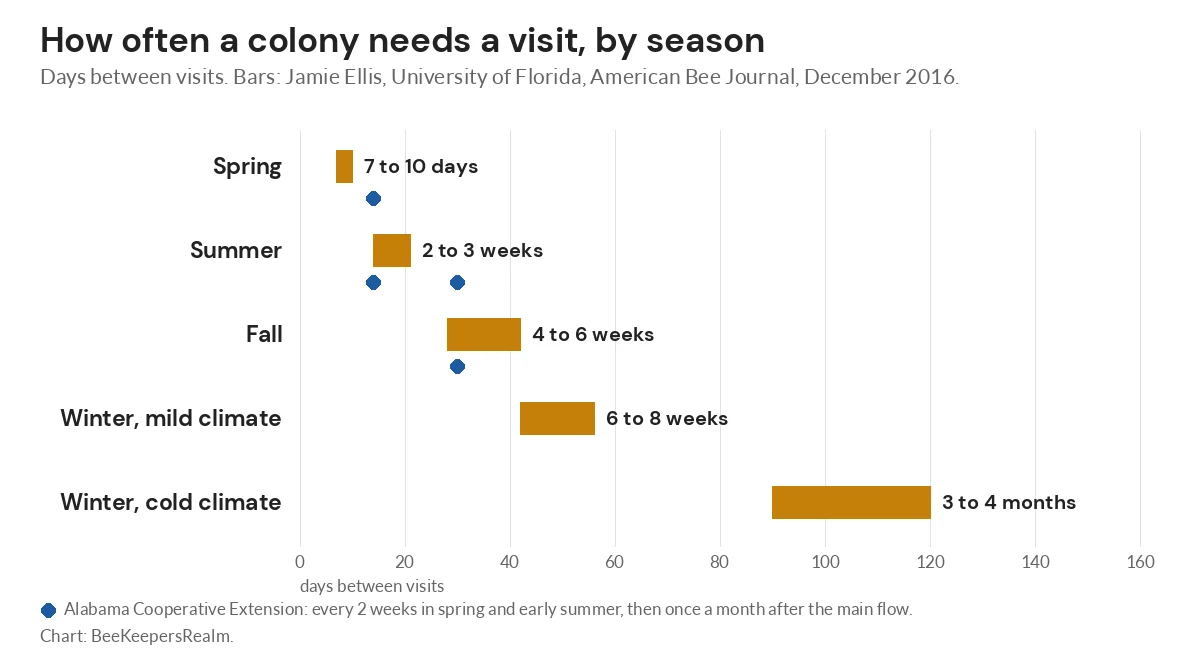
Ellis writes that the single most important factor in how much time you spend working bees is how many colonies you have to manage. The season then sets the rhythm. He reports visits every 7 to 10 days in spring, every 2 to 3 weeks in summer, every 4 to 6 weeks in fall, and every 6 to 8 weeks in winter in a mild climate or every 3 to 4 months in a cold one. In fall he notes a counterintuitive pattern: keepers with more colonies tend to visit them more often, because it is easy for things to get out of hand.
What each season asks of you
Ellis’s seasonal summary shows why the busy weeks decide your number:
- Spring is arguably the busiest time: controlling swarming, supering, splitting and applying medications, with colony size peaking in late spring.
- Summer is mostly pest and disease management, extracting and processing honey, and splitting to make increase for next season.
- Fall is readying colonies for winter: keeping pests and pathogens under control and feeding so they have enough food.
- Winter is the least labor-intensive season; the visits mostly check that colonies have enough food.
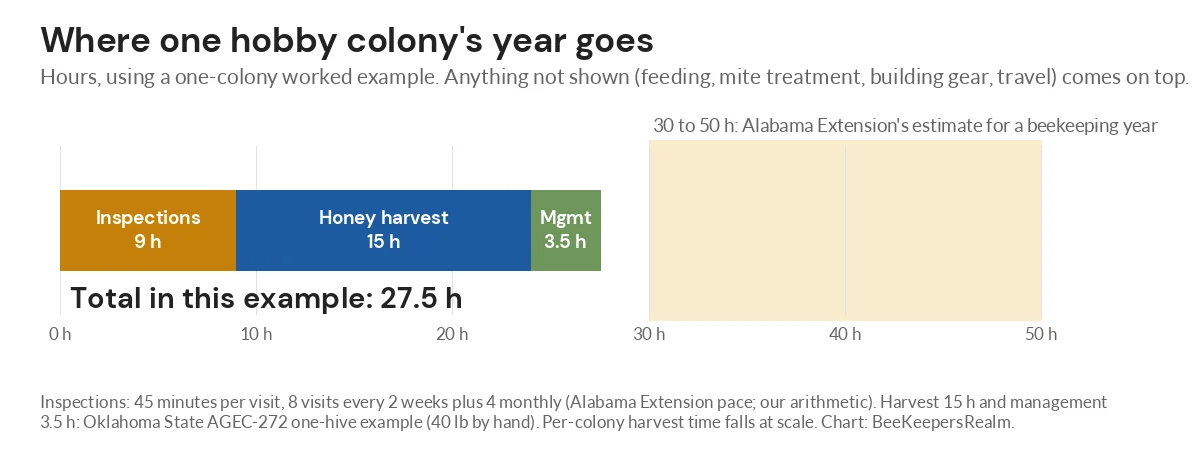
Alabama Cooperative Extension’s guide “Beekeeping Basics: Is Beekeeping Right for You?” puts a number on each visit: in spring and early summer, inspect every 2 weeks and allow 45 minutes per colony; once the main nectar flow ends, one 45-minute inspection a month is enough. A figure of 15 minutes per hive is often repeated online, but the extension guidance we found is three times that. Alabama also estimates that beekeeping may take 30 to 50 hours of your year.
Minnesota’s cold-climate view fits the same picture:
“Good colony and equipment management can take a couple of days every week depending on a colony’s needs.”
The Bee Lab adds that spring and late summer tend to be the busiest times and July a slower one, so plan your hours around the busy weeks, not the average ones. Our seasonal beekeeping calendar for the USA lists what each visit should cover, and every visit should include a mite check; see how often to test colonies for varroa.
Where a year of hours goes
At Alabama’s pace, inspections come to about 9 hours per colony a year: eight two-week visits plus four monthly ones at 45 minutes each (our arithmetic). Oklahoma State University Extension’s one-hive example in its honey harvest and breakeven fact sheet adds 15 hours of harvest labor and 3.5 hours of management for 40 pounds of honey taken off by hand. That is 27.5 hours before feeding, mite treatment, building gear or driving. Some of the harvest time shrinks per colony when you batch it, but experienced keepers’ speed-ups are not part of the extension numbers.
Why 45 minutes per colony stops working at 100
Alabama’s 45 minutes is a hobby-scale pace. Scale it up and the arithmetic breaks: 100 colonies would need 75 hours every two weeks in spring, about a full-time job, and 300 colonies would need 225 hours, almost three. Ellis’s sideline range of 100 to 300 colonies is therefore only possible with much shorter visits, and with the work pushed to nights and weekends as he describes. That is our reading of the numbers, not an extension figure, but it explains why the jump from 20 colonies to 100 changes how you keep bees, not just how many you keep. Before growing past about 20, decide which checks every visit must include (mite count, queen and brood, stores, space) and practise doing only those.
Find Your Own Number in Three Steps
- Count your free hours in the busiest fortnight. Use spring, when swarm control, splits and supering all land together, not your average week.
- Divide by the minutes per colony. Colonies = free hours ÷ 0.75 for Alabama’s every-two-weeks pace, or ÷ 1.5 if you will visit weekly, the tight end of Ellis’s 7 to 10 days.
- Keep a margin. The result covers inspections only. Harvest, feeding, treatments, gear and travel come on top.
| Free hours per two weeks | Colonies at an every-2-weeks pace | Colonies at a weekly pace |
|---|---|---|
| 3 | 4 | 2 |
| 6 | 8 | 4 |
| 10 | 13 | 6 |
| 15 | 20 | 10 |
| 20 | 26 | 13 |
Someone with 6 free hours in May can inspect 8 colonies every two weeks or 4 every week. Twenty colonies at Alabama’s pace need 15 hours a fortnight in spring, about two full working days, which is why twenty is a stretch for anyone who keeps bees only on weekends.
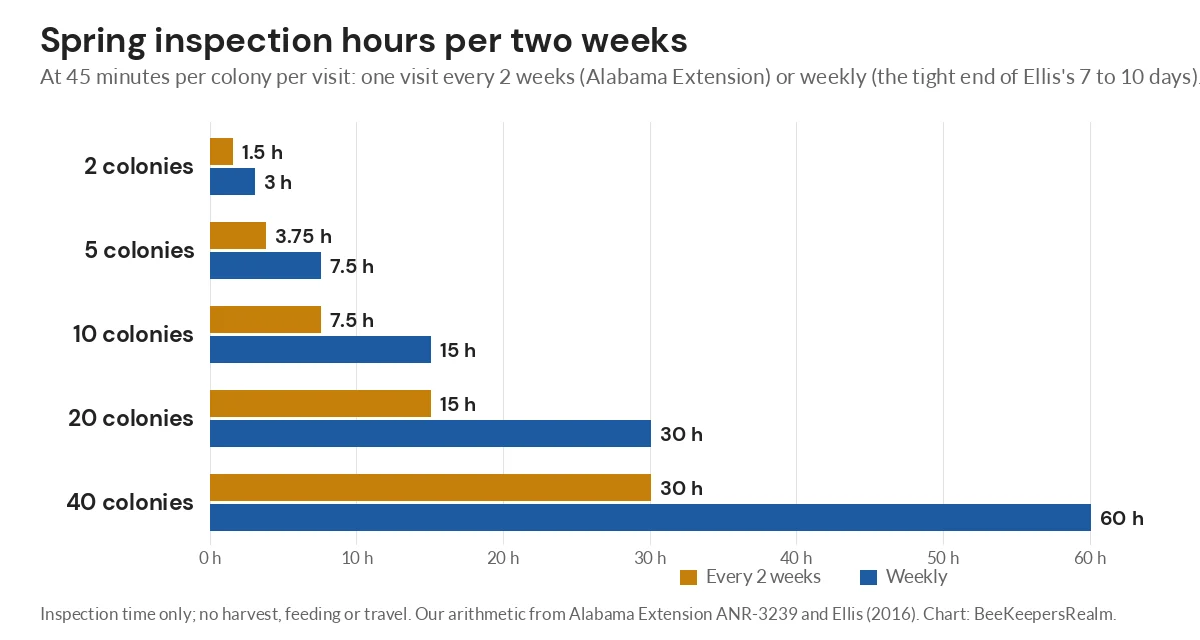
If you are just starting, two colonies is the usual answer. Oklahoma State recommends at least two hives even for backyard beekeepers, so resources can move between them and you can compare their strength through the season. At 45 minutes every two weeks, two colonies cost about an hour and a half a fortnight.
Forage and Space Can Cap You Before Time Does
Hours are only one limit. Mississippi State University Extension’s honey-production guide says bees regularly forage within a 2-mile radius of the hive, about 9,000 acres, and that the number of colonies kept together is the second-most important factor in a honey crop after location. Where 30 to 40 percent of that land is in major spring bloom, it expects as many as 25 to 40 colonies to produce harvestable honey. Past that, yields fall.
A backyard hits space, neighbors and local rules long before that. See how far bees travel to forage and hive density per acre for pollination to judge your site, and our expansion guide for the overstocking arithmetic and when to open a second yard.
Check the paperwork before you add colonies, too. Some states set registration or fees by colony count, and zoning or HOA rules may cap hives per lot; our overview of state bee inspector programs and apiary registration is the place to start.
Equipment, Harvest and Heavy Lifting
Every added colony multiplies the gear and the lifting. Oklahoma State estimates a deep Langstroth frame at about 6 pounds of honey, a medium at 4 and a shallow at 3, and its worked example takes one full 10-frame medium box at 40 pounds. If each of ten colonies gives you one such box, that is 400 pounds of honey to carry, uncap and spin, and the example’s honey-harvest labor was 15 hours for one box.
Extraction equipment is a fixed cost that spreads across colonies: Oklahoma State’s example prices an extractor at $254 and the full extraction kit at $395. Whether to buy a manual or motorized machine depends on colony count; see manual vs electric honey extractors by hive count. If lifting is your limit, adaptive equipment and techniques for limited mobility can raise the number you can safely run, and our expansion guide lists the boxes and frames each colony needs.
What Colonies Earn: Income Thresholds
The honest income question is gross versus net. These are the best current figures we found:
| Measure | Figure | Source |
|---|---|---|
| Honey per producing colony, 2025 | 48.0 lb | USDA NASS Honey, March 2026 |
| Average honey price, 2025 | $3.05 per lb (up from $2.41) | USDA NASS Honey, March 2026 |
| Gross honey per colony at those averages | about $146 | Our arithmetic |
| Same honey sold retail at Ellis’s $4 to $15 a lb | about $192 to $720 | Ellis (2016 prices); our arithmetic |
| Average price paid, 2025 | Nuc $130; package $110; queen $22 | USDA NASS Honey, March 2026 |
| One-hive example: total cost, 40 lb of honey | $1,393; breakeven $11.72 per 8-oz bottle | Oklahoma State AGEC-272 |
Oklahoma State’s breakeven works out to about $23 a pound (80 eight-ounce bottles from 40 lb; our arithmetic), with labor priced at the $7.25 minimum wage. Its authors say plainly why more hives help:
“It is unlikely a beekeeper will be profitable from one hive.”
Plan year one at zero. Oklahoma State and Alabama Extension both say a newly established colony is unlikely to produce surplus honey in its first season. Even among established keepers, the Census shows 46,447 of the 73,496 farms with colonies, about 63 percent, collected honey in 2022 (our arithmetic).
The reason is fixed costs: suits and extractors spread across several hives. For a threshold, take an illustrative $50,000 of gross honey sales. At $146 a colony that is about 340 colonies; sold retail at $4 to $15 a pound it is roughly 70 to 260 colonies (our arithmetic, before any costs, labor or marketing time). The Census puts average honey sales at about $16,000 on the 32,134 farms that sold honey in 2022, a mean that large operations pull up.
Honey is not the only product. NASS counts pollination income of about $225 million in 2025. In his column on ways of generating income, Ellis lists pollination fees of $30 to $200 or more per colony in 2016, the top end paid for almonds, and recalls renting two of his 16 colonies to a backyard blueberry grower for $40 each. He also lists comb honey, nucs, packages and queens. Pollination colonies need heavy management and face more pesticide exposure, he cautions, so the fee is not free money. For the practical side, see beekeeping as a side income, what beekeeping costs, what growers pay for pollination and hobby vs business tax rules.
When to Hire Help
The published markers are Ellis’s roughly 700 colonies for one person and USDA’s ratio of about 100 colonies per apiary worker. Most people need help far earlier than 700, because the limit is the busiest week, not the average one. Our own rules of thumb, not extension figures, are to bring in help when:
- You skip or delay spring visits on some colonies, because swarm control and supering cannot wait.
- Your mite counts are out of date for any colony; testing frequency is what scales worst.
- Harvest day means lifting more than you can safely carry in a day.
- A second or third yard turns travel into the biggest block of your time. Ellis notes that commercial beekeepers with 2,000 or more colonies “people keep” as much as they “bee keep.”
Hand off the work that is heaviest and least skilled first: carrying and extracting full boxes, assembling and cleaning equipment, and yard upkeep. Keep the judgment calls, such as queen quality, mite thresholds and treatment timing, with you until a helper has worked a full season beside you.
Help does not have to mean employees. A seasonal helper for harvest, a mentor or a club work day covers the peaks. Once you pay someone, you take on payroll work; see payroll and labor tracking for a small apiary. The expansion guide lists the signs you are growing faster than you can keep up.
Burnout and Why People Quit
The University of Minnesota Bee Lab lists why people give up: discomfort with stings, needing to lift and move heavy boxes, frustration with the yearly expenses of keeping colonies healthy, and disappointment with yearly colony deaths. Time is not on the list; the load is.
The colony deaths are not rare. NASS reported 16 percent of colonies lost from January through March 2026, and 12 percent in October through December 2025, the highest quarter of 2025, with varroa the number one stressor. On 10 colonies a 16 percent loss is about 2 colonies, or roughly $260 at 2025’s average nuc price of $130 (our arithmetic). Budget for losses as a normal cost.
Replacing them is work too. NASS says 18 percent of colonies were renovated, meaning requeened or given a new nuc or package, in April through June 2026. Each one is a purchase, an installation and a follow-up inspection on top of the schedule above, so more colonies also means more of these unplanned jobs.
- Choose a number below your maximum. Run it for a full spring and summer before you add colonies.
- Find a mentor and a club. The Bee Lab recommends both for learning what a normal season looks like.
- Write it down. Minutes per colony, mite counts and losses show your real limit; a notebook or a record-keeping app makes that quicker.
Yield per colony by state is in how much honey one hive produces.
Frequently Asked Questions
How many hives should a beginner start with?
Two. Oklahoma State recommends at least two even for backyard beekeepers, so you can compare colonies and move resources between them. Two colonies need about 1.5 hours a fortnight in spring at Alabama’s pace.
How many hives can one person manage with a full-time job?
It depends on free hours. On 6 free hours a fortnight in spring, about 8 colonies at Alabama’s pace. Ellis’s sideline beekeepers run 100 to 300 colonies alongside another job, but he notes their work gets pushed to nights and weekends.
Does a second hive double the work?
For inspections, yes: extension time is counted per colony, so 2 colonies take twice the inspection time of 1. What does not double are fixed costs such as the suit and extractor, which Oklahoma State says make a multi-hive operation more profitable.
Can one person manage 20 hives?
Yes, with time. At 45 minutes every two weeks, 20 colonies take 15 hours a fortnight in spring, plus harvest, feeding and mite work. That is a stretch for weekend-only beekeeping.
How many hives do you need to make a living?
Ellis puts commercial operations at 500 or more colonies. As a gross-only illustration, $50,000 of honey sales needs about 340 colonies at 2025’s average yield and price, before costs. Oklahoma State finds one hive unlikely to profit.
How many hours a week does one beehive take?
At Alabama’s pace, about 22 minutes a week per colony for inspections in spring (45 minutes every two weeks). The Minnesota Bee Lab says good colony and equipment management can take a couple of days a week in the busy season.
How many hives can you keep in one location?
Mississippi State expects 25 to 40 colonies where 30 to 40 percent of the land within 2 miles is in major spring bloom. Backyards usually run out of space, neighbor goodwill or local rules first.
When should I hire help?
Ellis puts the solo limit near 700 colonies, but most people need help sooner: when spring visits slip, mite counts fall behind, or harvest lifting exceeds what you can do safely.
The Bottom Line
Divide your busiest-fortnight hours by 0.75, subtract a margin, and check the result against your forage and your back. Run that number for a full year before you add more, and keep a record of the minutes it actually takes.


