Reviewed by Sofia T. · How we review
The average U.S. colony that produced a honey crop gave 48.0 pounds in 2025, according to the USDA, down from 51.7 pounds in 2024. That average counts only colonies that were harvested, on operations with at least five colonies, so it leaves out any hive that gave no crop and the one-to-four-hive backyard.
We write from eastern North Dakota, the country’s biggest honey state: USDA counted 460,000 producing colonies there in 2025, averaging 67 pounds each. Below: the yearly numbers, the state spread, what a pound figure looks like in boxes, and what moves one hive’s result.
Key Takeaways
- USDA’s national average was 48.0 lb per producing colony in 2025 and has stayed between 47.0 and 55.8 lb every year since 2018.
- The average excludes colonies from which no honey was harvested. The last USDA figure for operations with fewer than five colonies, from 2017, was 30.0 lb, against 55.3 lb for larger operations.
- State averages for 2025 ran from 27 lb in Oregon to 89 lb in Mississippi. Four of the 20 published states moved 30% or more in a single year.
- In boxes, 48 lb is about 8 deep frames, 12 medium frames or 16 shallow frames, using Oklahoma State Extension’s per-frame weights.
- Expect little or nothing from a first-year colony, and leave the winter reserve first: about 60 to 70 lb in cold climates, 20 to 30 lb where winters are mild.
Table of Contents
- What the USDA Number Counts and Leaves Out
- Yield per Colony, 2018 to 2025
- Yield by State: From 27 to 89 Pounds
- Per Hive, Per Box, Per Frame
- Gross Honey, Surplus and Winter Reserve
- What Moves a Hive’s Result
- First-Year Colonies: Plan on Little or Nothing
- A Yardstick for Your Own Apiary
- Frequently Asked Questions
- The Bottom Line
What the USDA Number Counts and Leaves Out
The 48.0 figure comes from the National Agricultural Statistics Service (NASS) Honey report released March 13, 2026. NASS surveys operations that keep at least five colonies and count as farms, meaning $1,000 or more of agricultural products produced and sold, or normally sold, in a year. Then comes the sentence that matters most to a small keeper:
“Colonies were not included if honey was not harvested.”
A colony that built comb, stored nothing for you and ended the year alive is not a zero in the average. It is missing from it. NASS adds that colonies producing in more than one state are counted in each, which can leave the national yield understated.
Small apiaries once had their own line. NASS’s March 2018 report put the 2017 yield at 55.3 lb for operations with five or more colonies and 30.0 lb for operations with fewer than five, from about 20 thousand colonies. NASS has since suspended the under-five series, so that is the last small-apiary figure its Honey reports gave. Treat it as a sign that small apiaries ran well below the headline, not as a forecast.
Yield per Colony, 2018 to 2025
The last eight crops sit in a narrow band, 47.0 to 55.8 lb, but the moves inside it are big. From 2022 to 2023 the national yield rose from 47.0 to 55.1 lb, a 17% jump, then slid back to 48.0 by 2025.
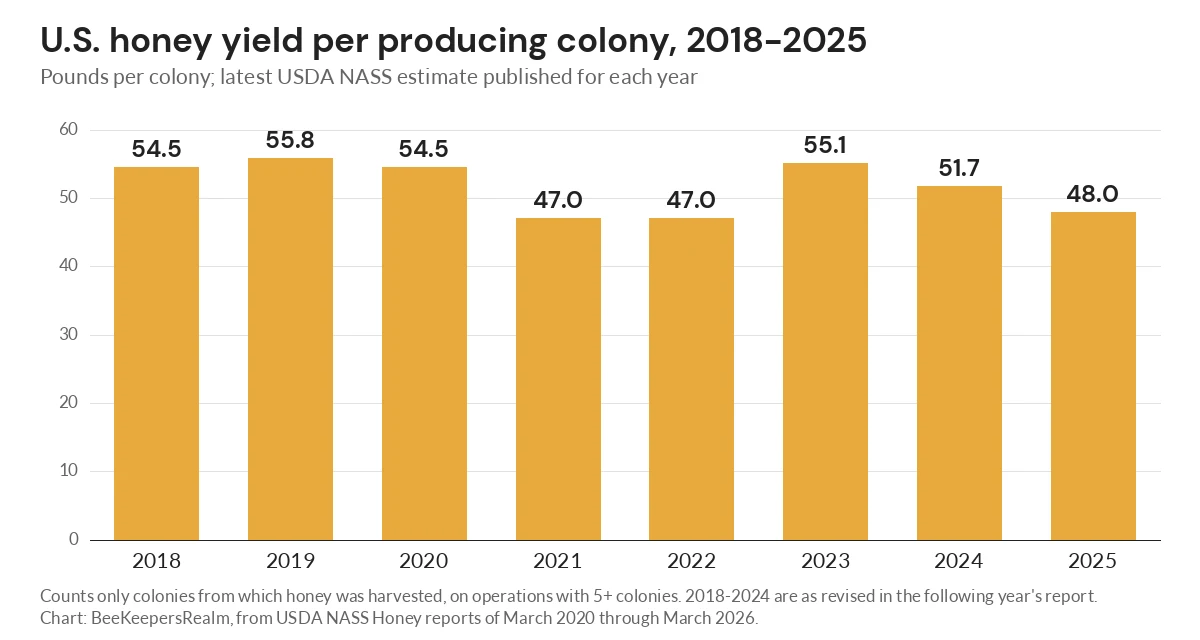
Total production fell 14% in 2025, to 116 million pounds, because both inputs dropped: producing colonies fell 7% to 2.41 million and yield per colony fell 7%. Prices went the other way, up 27% to $3.05 a pound. Our report on the 2025 USDA data covers the market side, and honey production trends puts the 1993 to 2025 decline in yield per colony in context. Swings this size are why one season’s harvest says little about the next.
Yield by State: From 27 to 89 Pounds
NASS publishes 20 states individually. In 2025 Mississippi (89 lb) and Montana (85 lb) led, and Oregon (27 lb) was last, a 3.3-fold spread. North Dakota’s 67 lb on 460,000 colonies made about 27% of the national crop by itself.
| State | Producing colonies (1,000) | Production 2025 (million lb) | Yield 2025 (lb) | Yield 2024 (lb) |
|---|---|---|---|---|
| North Dakota | 460 | 30.8 | 67 | 74 |
| California | 315 | 11.0 | 35 | 43 |
| Montana | 123 | 10.5 | 85 | 71 |
| South Dakota | 205 | 8.2 | 40 | 53 |
| Minnesota | 113 | 5.7 | 50 | 54 |
| Michigan | 89 | 3.7 | 42 | 61 |
| Florida | 113 | 3.6 | 32 | 33 |
| Louisiana | 62 | 3.3 | 53 | 50 |
| Idaho | 104 | 3.0 | 29 | 22 |
| New York | 52 | 2.9 | 56 | 53 |
| United States | 2,412 | 115.7 | 48.0 | 51.7 |
Ten of the 20 states USDA publishes, ranked by 2025 crop; together they made about 71% of the national total. Source: USDA NASS Honey, March 13, 2026.
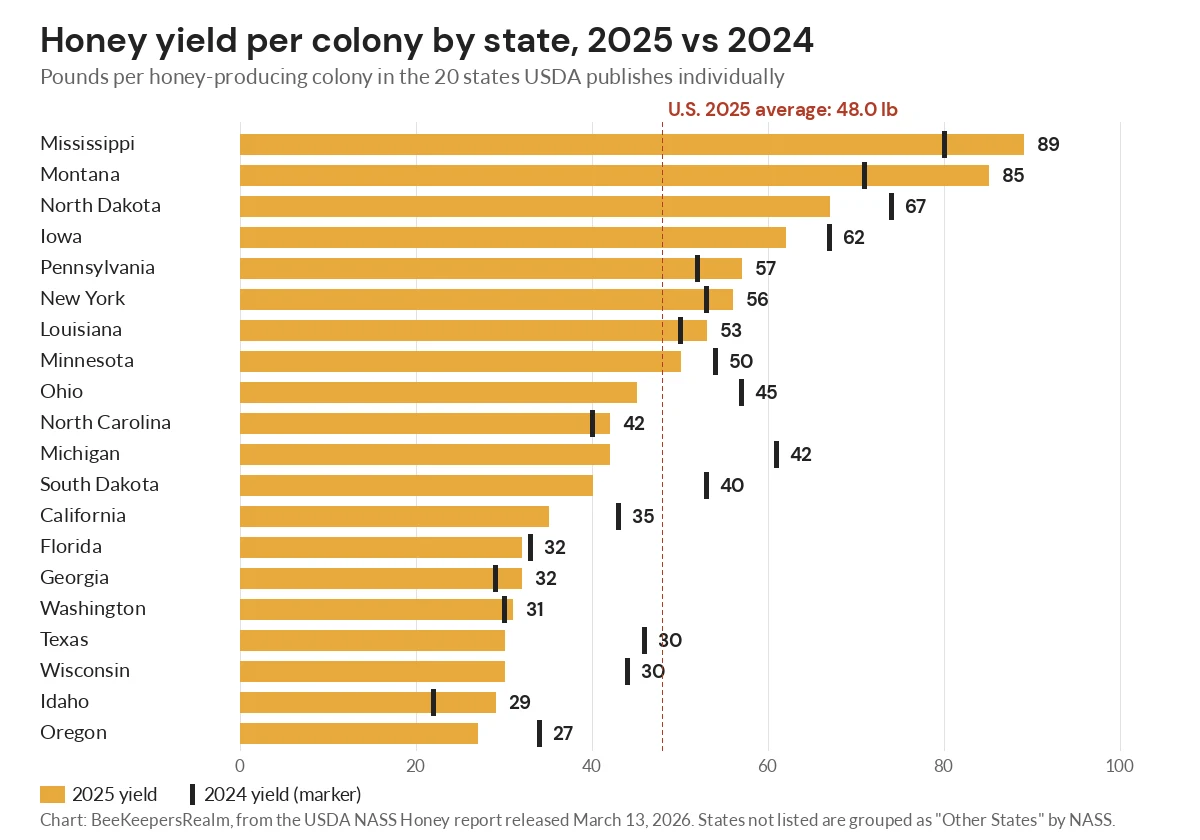
A state average hides very different operations, and it moves fast. Texas, Wisconsin and Michigan fell 31% to 35% in one year while Idaho rose 32%. Penn State researchers who analyzed five decades of USDA data found where the baseline comes from:
“The eco-regional soil and climate conditions set the baseline levels of honey production, while changes in land use, herbicide use and weather influenced how much is produced in a given year.”
That is why your region’s number matters more than the national one. Our guide to how weather and climate affect honey production covers the local side.
Per Hive, Per Box, Per Frame
A pound figure is easier to judge as boxes. Oklahoma State University Extension estimates a full Langstroth deep frame at about 6 lb of honey, a medium at 4 lb and a shallow at 3 lb, and its worked example takes one 10-frame medium box as 40 lb (AGEC-272). By our arithmetic, the 48.0 lb national average is about 8 deep frames, 12 medium frames or 16 shallow frames, so roughly 1.2 medium boxes.
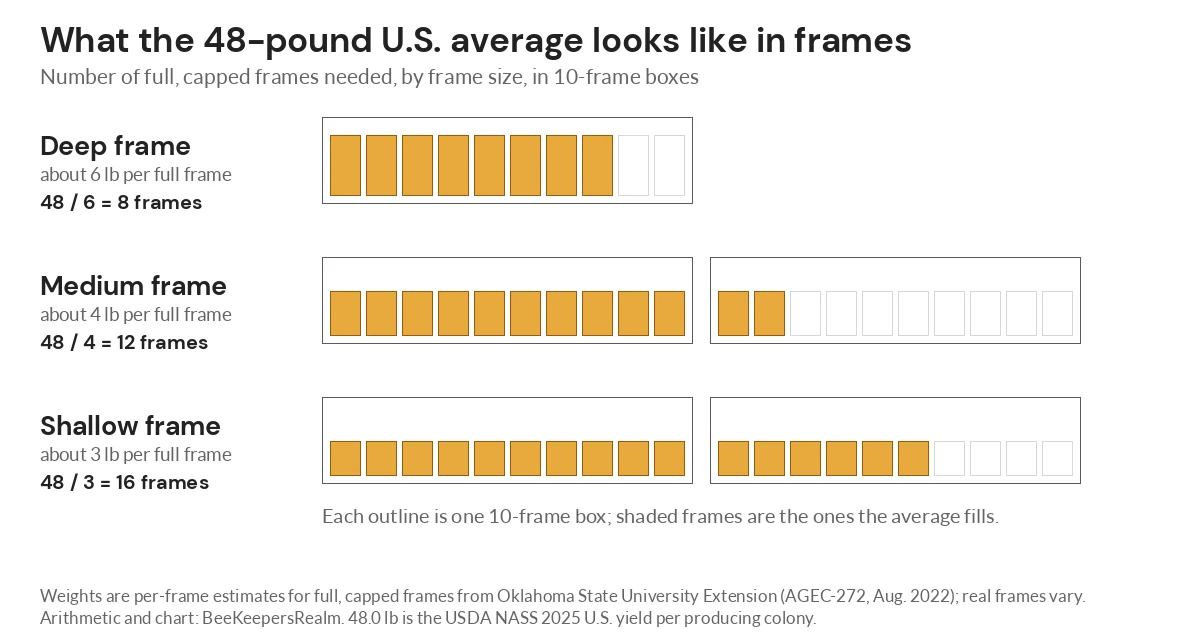
Box size caps the crop, not the other way round. A 10-frame box holds 25% more frames than an 8-frame one, a difference our guide to the 8-frame and 10-frame hive works through in weight.
USDA does not split yields by hive type, and measured comparisons are scarce. A Massachusetts SARE-funded trial weighed top-bar and Langstroth colonies from May 26 to October 13, 2013. Top-bar colonies gained 22 lb at their peak on average and Langstroth colonies 17 lb, a difference the project found not statistically significant, and 93% of its colonies did not survive the winter, which limits what it can show. Peak weight gain is also not harvested honey. Harvest method matters too: Oklahoma State notes that crush-and-strain damages comb and that bees consume many pounds of honey to build one pound of comb.
Gross Honey, Surplus and Winter Reserve
Three numbers hide inside “how much honey”: what the colony stores, what it needs to keep, and what you can take. USDA measures only the third. Oklahoma State recommends leaving about 60 to 70 lb per hive in colder climates and 20 to 30 lb where there is little or no cold season, and says a frame is ready when 80% or more is capped. A colony can fill a super and still leave you nothing, because the reserve comes first. Our guide to how much honey bees need for winter has the targets by climate.
What Moves a Hive’s Result
- Forage and soil. Penn State’s analysis ranked climate and soil productivity among the most important factors, with herbicide use and land use, including conservation land, also predicting yield.
- Weather. The national average moved 17% between 2022 and 2023, and the Penn State analysis found that annual weather anomalies also contributed to changes in yield.
- Colony strength at flow onset. A large, healthy workforce when the flow starts matters more than anything done during it. Our guide to timing colonies to the flow covers queens, mites, swarm control and supering.
- Harvest decisions. Taking the winter reserve to lift this year’s total costs you next year’s colony, so the reserve comes off the top before any yield is counted.
First-Year Colonies: Plan on Little or Nothing
“Within the first year of establishing your beehive, you are unlikely to collect a significant amount of surplus honey.”
New colonies spend their first season building comb and population, and the USDA average does not count a first-year colony that gave no crop. So the national figure is not a promise for a new hive. Read can you harvest honey in the first year before you cut into one.
A Yardstick for Your Own Apiary
| Situation | Pounds per colony | Source |
|---|---|---|
| U.S. average, 2025 | 48.0 | USDA NASS, March 2026 |
| U.S. average range, 2018 to 2025 | 47.0 to 55.8 | USDA NASS, 2020 to 2026 |
| State averages, 2025 (20 states) | 27 to 89 | USDA NASS, March 2026 |
| Operations with fewer than five colonies, 2017 (last published) | 30.0 | USDA NASS, March 2018 |
| First-year colony | Often none | Oklahoma State Extension |
| Reserve to leave: cold climate / mild climate | 60 to 70 / 20 to 30 | Oklahoma State Extension |
None of these is a target. The only number that predicts your crop is your own: weigh each super at harvest and write down the date, the flow and the weather, and after two or three seasons you have a benchmark that beats any national average.
The crop’s value is simple arithmetic, not income. At USDA’s 2025 average price of $3.05 a pound, 48.0 lb is about $146; at the $7.15 NASS reports for retail sales, about $343. Jars, equipment and time come out of that, and Oklahoma State says it is unlikely a beekeeper will be profitable from one hive. Our guides cover what it costs to produce honey, beekeeping as a side income and how many hives one person can manage.
Frequently Asked Questions
How much honey does one hive produce in a year?
The U.S. average was 48.0 lb per producing colony in 2025 and 51.7 lb in 2024. State averages in 2025 ran from 27 to 89 lb, and a first-year colony often gives none.
How much honey does a hive produce per month or per week?
There is no monthly figure worth quoting. Honey arrives in bursts during nectar flows, and USDA publishes one number per year. Weighing your supers through your own flow shows your pattern.
How much honey does a 10-frame hive produce?
Frame count sets a ceiling, not a crop. Ten full medium frames hold about 40 lb and ten full deep frames about 60 lb, by Oklahoma State’s weights, so the U.S. average is a little over one medium box.
How much honey should a first-year hive make?
Plan on little or none. Oklahoma State Extension says you may not harvest any honey your first year, and the bees need it to build comb and survive winter.
Is 100 pounds per hive realistic?
It is above every 2025 state average USDA published, the highest being Mississippi at 89 lb. Individual colonies can beat averages, but no national statistic tracks them, so treat 100 lb as an exceptional season, not a plan.
How much is a pound of honey worth?
NASS put the 2025 average at $3.05 a pound across all channels, $2.45 through co-ops and private sales, and $7.15 at retail.
Why did U.S. honey yield fall in 2025?
USDA reported yield per colony down from 51.7 to 48.0 lb and producing colonies down from 2.60 to 2.41 million, so production fell 14%. The report does not give a cause, though it shows spending on varroa control up from $16.6 million to $22.2 million.
Does having more hives mean more honey?
In total, yes, but not per hive. Oklahoma State recommends starting with at least two hives for comparison, and time per colony is the real limit.
The Bottom Line
Use 48 lb as the national yardstick and 30 lb as the last official small-apiary figure, then replace both with your own scale readings after a few seasons.
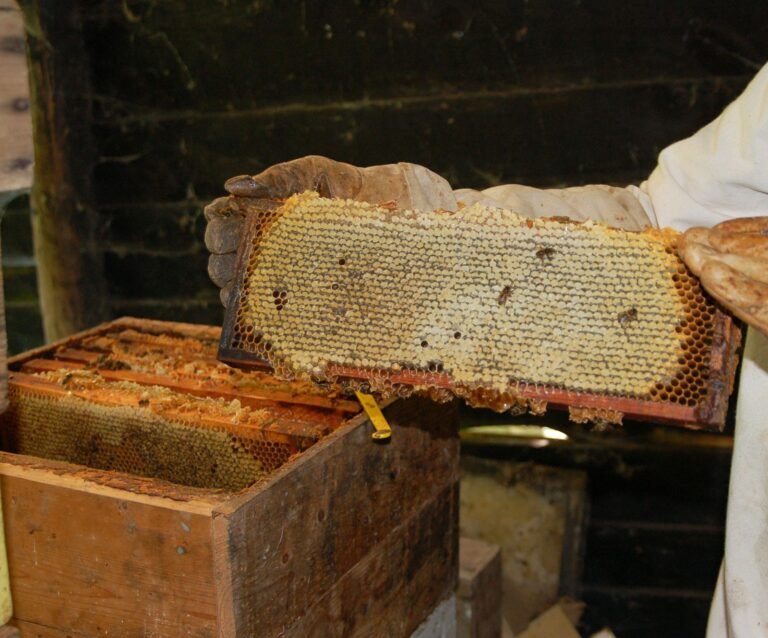
Image credits: Featured image: USDA NRCS, public domain (U.S. government work), via Wikimedia Commons, cropped. Frame of capped honey: Einebillion, CC BY 4.0, via Wikimedia Commons.