Reviewed by Sofia T. · How we review
The safest way to buy bees is to pick up a nuc or package in person from a local seller your beekeeping club has used, with a current state inspection or health certificate in hand. Shipped packages are the fallback; swarms and splits are cheaper but suit beekeepers with a season behind them. Prices for spring 2027 already run from $145 to $300, so a few checks before you pay matter.
This guide covers where to find sellers, what they charge, which state rules apply and how to avoid a bad deal. If you are still choosing a format, start with package bees vs nucs for beginners.
Key Takeaways
- Buy local if you can. UF/IFAS Extension advises new beekeepers to buy only from a well-established, reputable, local supplier and to collect the bees in person.
- On 22 October 2026, seller pages listed packages at $145 to $214 and 5-frame nucs at $179 to $300. Nucs cost more and vary more.
- Several states make sellers prove their bees were inspected: Texas within 12 months, South Dakota within six. Ask for the certificate wherever you live.
- Order early. Seven sellers we read already list 2027 bees, and one showed its 2027 packages and nucs as sold out.
- Avoid paying strangers by Venmo, Cash App or “friends and family” transfers. Use a credit card, PayPal Goods and Services, or cash in person.
Table of Contents
- Where to Find Bees: Five Sources Compared
- When to Order, With Dates Sellers Published
- What Bees Cost: Prices From Eight Seller Pages
- Health Certificates and State Rules
- How to Vet a Seller
- Pickup-Day Checklist
- Swarms, Splits and Used Colonies
- Frequently Asked Questions
- The Bottom Line
Where to Find Bees: Five Sources Compared
| Source | Best for | Watch for |
|---|---|---|
| Local beekeeper or small nuc producer | A first hive; bees raised through your own winters; a mentor on call | Small batches sell out early. Ask how long the nuc has been made up. |
| Club or association listing or group order | Finding sellers other members have actually used | A listing is not a vetting. Colorado’s state association says being listed on its page is not an endorsement. |
| Regional supplier with pickup stops | Packages or nucs without shipping. One North Dakota seller runs 106 pickup points across ten states. | Dates are tentative, and the bees may not be raised near you. |
| Bee supply store or farm store | Buying gear and bees in one trip | The retailer may not be the producer, so ask where the bees come from. |
| Mail-order shipper | Beekeepers with no local source. Packages are the usual mail-order item; many sellers sell nucs for pickup only. | Delays, weather and a missed delivery. See how live bees travel by mail. |
Local does not always mean nearby. The Puget Sound Beekeepers Association notes that most packaged bees it sees in Washington come from California, so ask any seller where the colonies were built and where the queens were mated. A retailer and a producer are often different businesses, as Beekeeping Insider and Beekeeping For Newbies both point out.
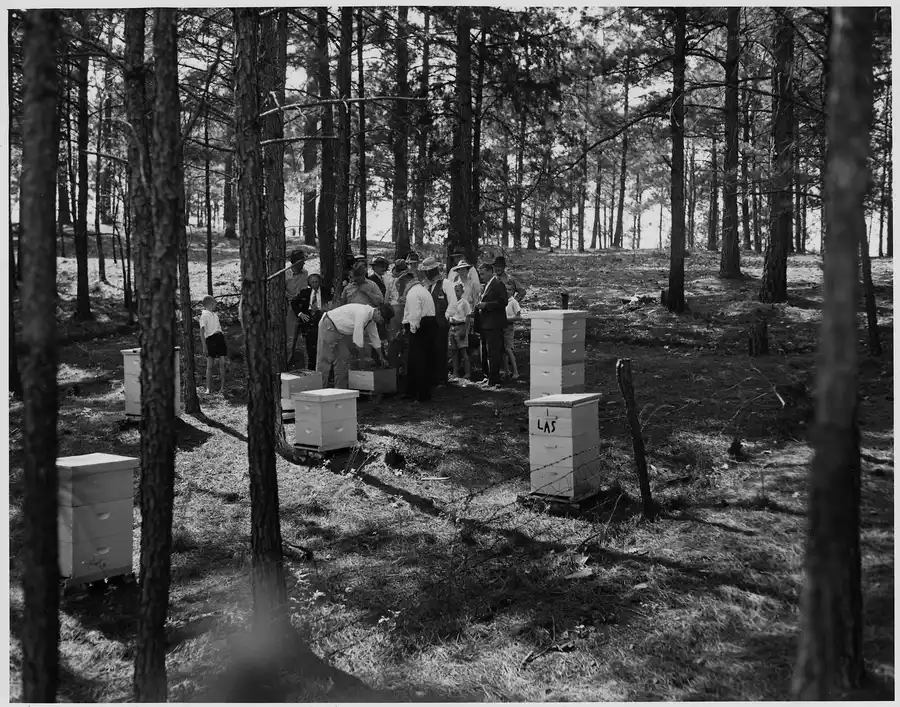
Clubs still help. Many keep seller lists and swap member recommendations; see our directory of U.S. beekeeping associations to find yours. Go to a meeting before ordering and ask members who they bought from last year.
When to Order, With Dates Sellers Published
Order in winter at the latest, and earlier for nucs. UF/IFAS Extension says small-scale beekeepers usually pre-order in December to February, with bees typically available around April. Sellers show the same rhythm.
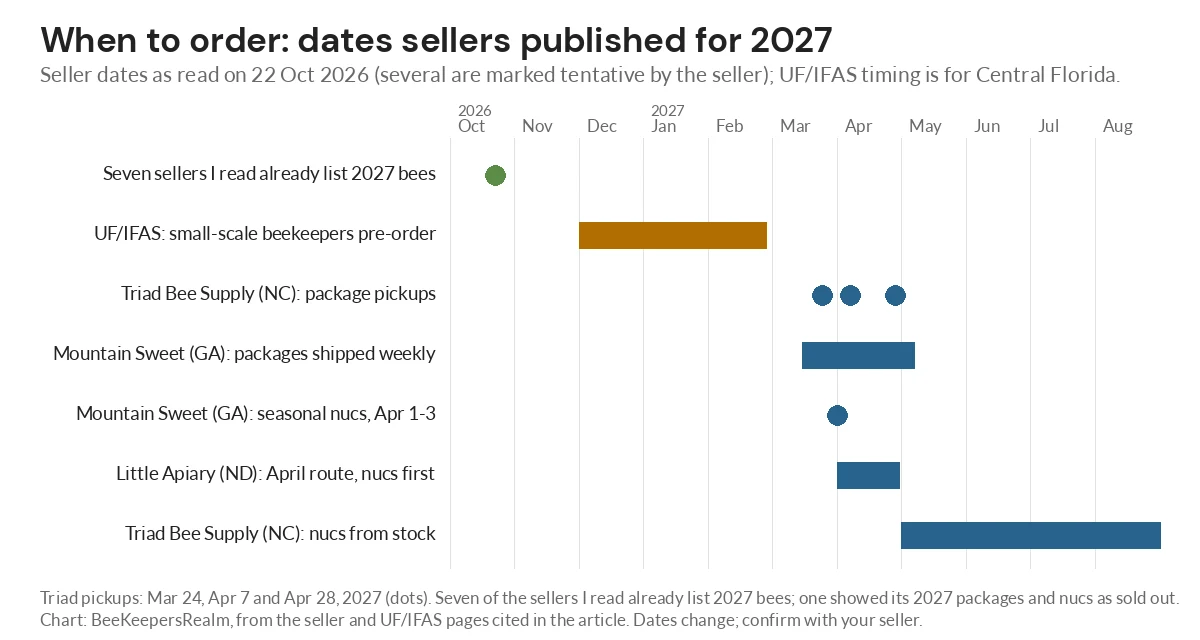
- Triad Bee Supply in North Carolina lists package pickups on March 24, April 7 and April 28, 2027, and sells nucs from its own stock from May to the end of August.
- Mountain Sweet Honey in Georgia ships packages weekly from mid-March to early May 2027 and lists seasonal nucs for April 1 to 3.
- Little Apiary on the Prairie plans April 2027 delivery, nucs first and packages about two weeks later, and calls its dates tentative.
Late-season buying is a different matter. Foxhound Bee Company, an Alabama seller, says most bees are picked up in March, April and May and warns that buying after the main nectar flow leaves little time to build up for winter. For the full yearly sequence, see our seasonal beekeeping calendar.
What Bees Cost: Prices From Eight Seller Pages
We read these pages on 22 October 2026. Prices are listing prices for spring 2027, not endorsements, and we did not buy from any of them. “From” means the seller’s listed minimum.
| Seller (state) | What is listed | Price | How you get it |
|---|---|---|---|
| Triad Bee Supply (NC) | 3 lb package, marked queen | $145 | Local pickup only |
| Little Apiary on the Prairie (ND) | 3 lb Italian package | $160 | Pickup at route stops, April |
| Mountain Sweet Honey (GA) | 3 lb Italian package; seasonal Italian nuc | $175; $189 | Shipped or store pickup |
| Lappe’s Bee Supply (IA) | 3 lb package; 5-frame nuc | $185; $250 | Iowa pickup. Other pickup states: nucs $189.95 to $215.95. A shipped Carniolan package is $199.95. |
| R. Weaver Apiaries (TX) | 3 lb package; Weaver Buckfast nuc | From $200; $300 | Pickup or shipped |
| The Bee Supply (TX) | 3 lb package; nuc, unmarked queen | $214; $272 | Pickup |
| Rainy Day Bees (WA) | Package; nuc | From $200; $300 | Early April pickup; all four 2027 bee listings showed Sold Out |
| KY Backyard Beekeepers listing (KY) | Italian nuc from local splits: 3 frames brood, 1 honey, 1 pollen | $179 | Pickup from April 11, full payment as deposit |
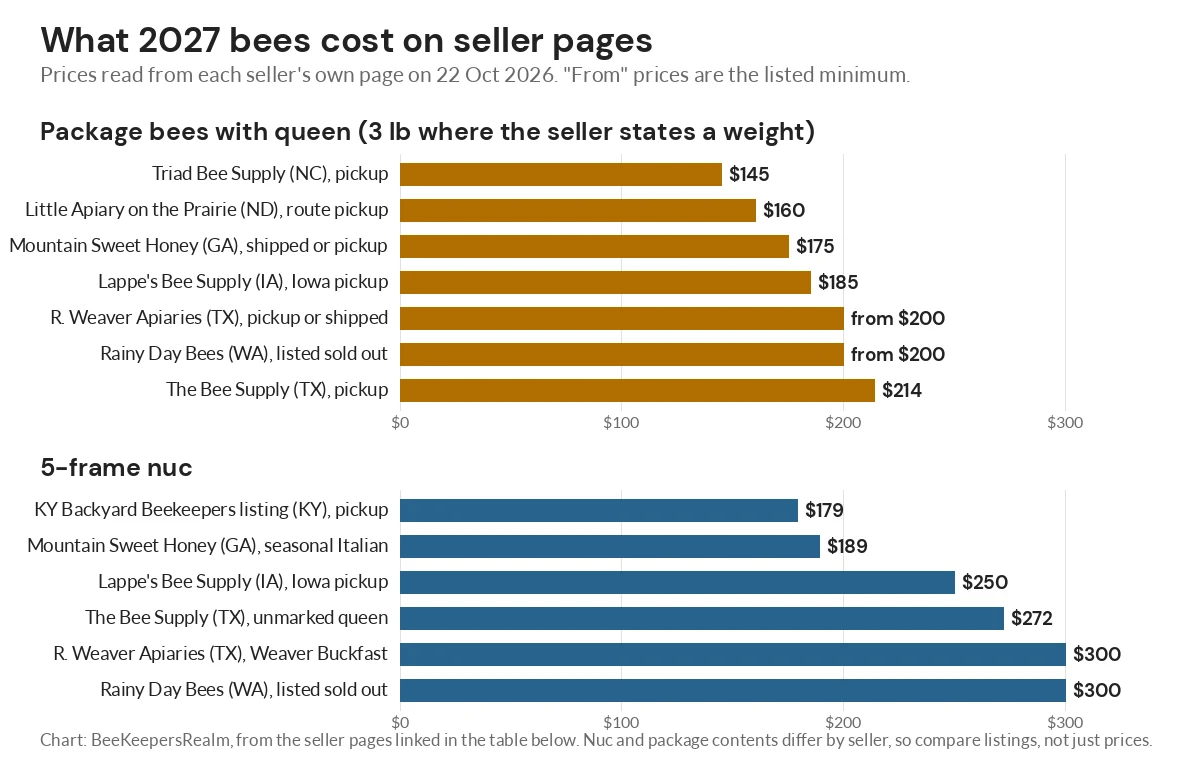
Across these listings, packages run $145 to $214, with a middle value of $185, and nucs run $179 to $300. UF/IFAS Extension told small-scale beekeepers to expect $200 and up per colony in spring 2025, so these figures sit in a familiar band. Two patterns stand out. Shipping did not add much where we could compare: Mountain Sweet charges $175 shipped or picked up, and Lappe’s lists Carniolan packages at $185 for Iowa pickup and $199.95 shipped, with shipping free. And nucs cost far more than packages, but nuc contents vary.
“One beekeeper may provide one frame of brood in a five-frame nuc box, while another will provide three.”
That is why a $179 nuc and a $300 nuc may not be the same product. Compare the frames of brood, the queen’s age and the bee count before you compare prices. For deposit terms, see queen and nuc deposit policies.
Health Certificates and State Rules
A health certificate is an official record that a state inspector found the source apiary free of disease. Rules differ sharply by state, and a seller who ships or sells across a state line may need one even where local sales do not.
| State | What the rule says |
|---|---|
| Texas | Package bees, colonies and nuclei may not be sold unless accompanied by a certificate from the chief apiary inspector showing the apiary was inspected within 12 months, or by the beekeeper’s affidavit that the bees are not diseased. Agriculture Code 131.023 |
| South Dakota | Anyone selling, giving away or transferring bees needs a state inspection certificate issued within the prior six months and must hand the buyer a copy at delivery. Codified Law 38-18-26 |
| Florida | Producing nucs or colonies for sale requires a Stock Dealer Certificate, and a Certificate of Beekeeping Registration is required on each sale or trade. Rule 5B-54.014 |
| North Carolina | Selling queens, packages, nucs or hives requires a state permit, with exemptions such as fewer than 10 hives a year for residents. NC State Beekeepers Association summary |
This is educational information, not legal advice, and statutes change. Check your state’s rules and, if you are keeping bees yourself, our U.S. beekeeping regulations by state.
“Always request a health certificate from the seller before purchasing bees. Keep a copy for your records.”
To find the right office, use the state apiary inspector directory that Bee Culture maintains. The Apiary Inspectors of America is the professional group of state apiarists. Some sellers state the paperwork up front: Mountain Sweet says its bees ship with a Georgia Department of Agriculture health certificate. A certificate is a baseline, not a guarantee, so keep reading.
How to Vet a Seller
Start with first-hand references. Ask two or three people in your club who bought from this seller last year, and what happened when something went wrong. Then ask the seller directly:
- Where were the bees and queens raised, and when was the queen mated? Foxhound Bee Company suggests asking this of any package seller.
- For packages, when were the bees shaken into the box? Foxhound says ideally within the previous 24 to 48 hours.
- For nucs, how many frames of brood, how old is the queen, and was the nuc overwintered or made up this spring? Insider guides note there is no standard nuc.
- When was the colony last treated for mites?
- What is the deposit, the refund rule and the replacement policy if the queen is dead or the delivery fails?
- Can I see the current inspection certificate?
Mountain Sweet Honey publishes its own nuc standard: a nuc made up for four weeks or more, a queen at least nine weeks old, 5,000 to 8,000 bees, and no more than 25 dead bees or 25 small hive beetles. That is one seller’s yardstick, not an industry rule, but it shows the kind of specifics worth requesting. If you want a particular stock, our bee breed buying guide explains the options.
Spotting a scam
Fake sellers are a known problem. An American Bee Journal guide by Jared Malcolm describes the usual pattern: prices a little below the competition, a deposit up front, then new fees before delivery. His advice when terms change is to ask for a refund and send no more money. He also warns that a seller named in a club’s Facebook page is not automatically legitimate, because scammers use fake accounts to endorse each other.
“Buying bees from sources like internet classified ads may seem like an easy way to obtain bees, but not all sellers are following good beekeeping practices.”
The safest payments, per the American Bee Journal guide, are cash on delivery in person, PayPal Goods and Services, or a credit card. Avoid wire transfers, gift cards, and, with sellers you do not personally know, Venmo, Cash App and PayPal Friends and Family. Foxhound Bee Company adds that scam sellers tend to avoid giving a phone number.
Pickup-Day Checklist
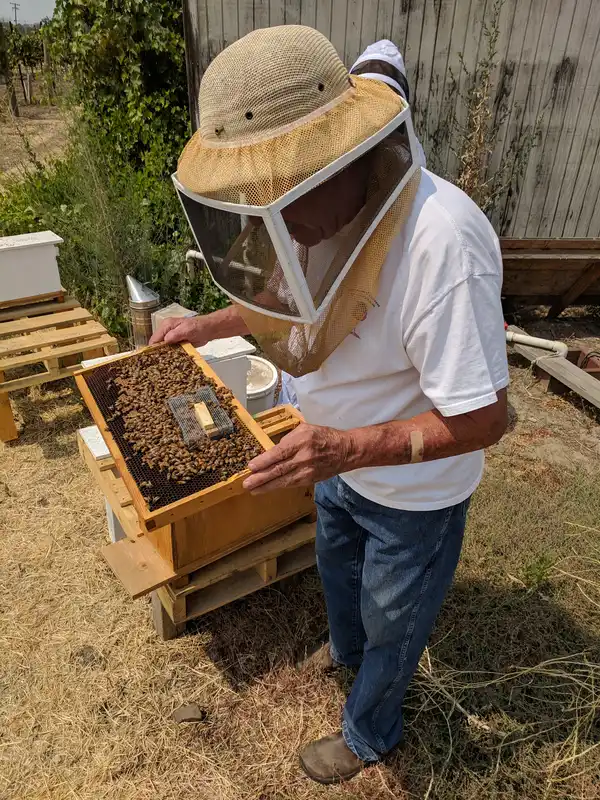
Bring your hive ready, a ventilated way to carry the box and a copy of your order. Then check these before you hand over the balance:
- The inspection or health certificate, plus a written receipt listing what you bought and any box you must return.
- For a nuc: brood in every stage, not only capped brood, which can mean frames were pulled from several hives and a queen added recently; light-colored comb; bees covering most frames; and the frame count you were promised. Mountain Sweet’s standard above is a useful reference, and some sellers let you inspect the evening before.
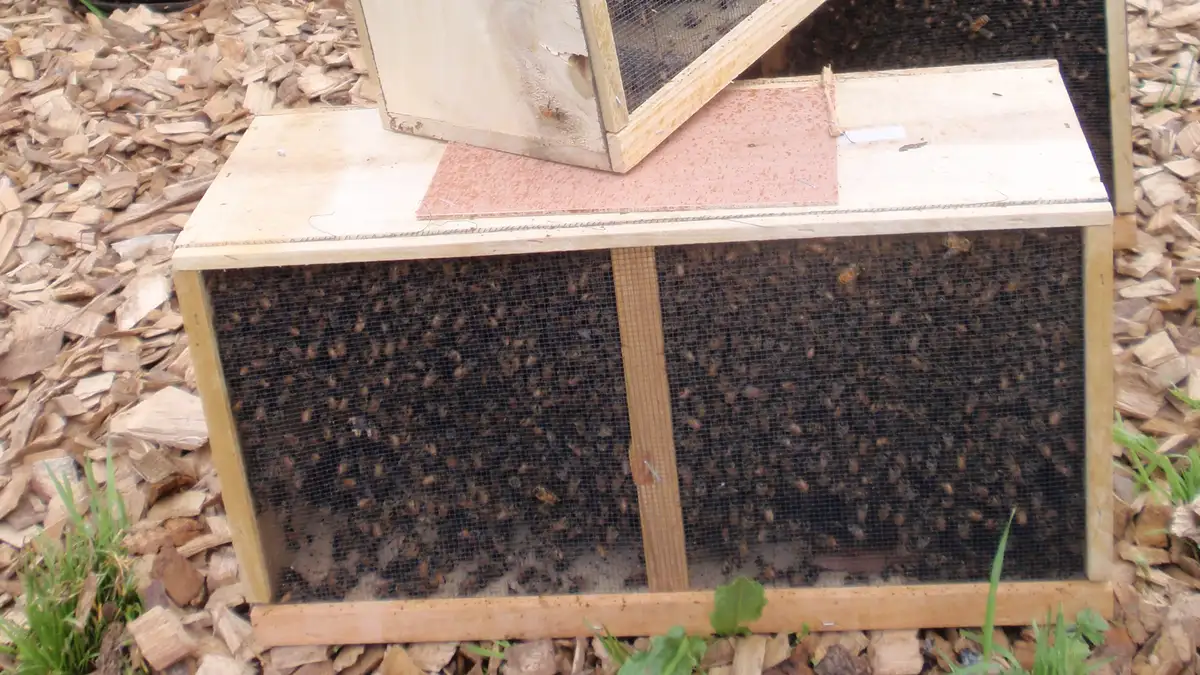
- For a package: a live queen in her cage, and no more than about half an inch of dead bees on the bottom, a figure Beekeeping Insider says is acceptable.
- Payment made the way you agreed, with the seller’s contact details in your phone.
Carrying and installing are covered in our customer checklist for picking up nucs, then how to install a nuc or how to install package bees. A few stray bees in the car are normal; a shut, strapped box is not optional.
Swarms, Splits and Used Colonies
Swarms and splits cost little but trade certainty for price. Beekeeping For Newbies advises against relying on a swarm to start your first season, because a beginner needs to learn hive handling first and cannot count on catching one.
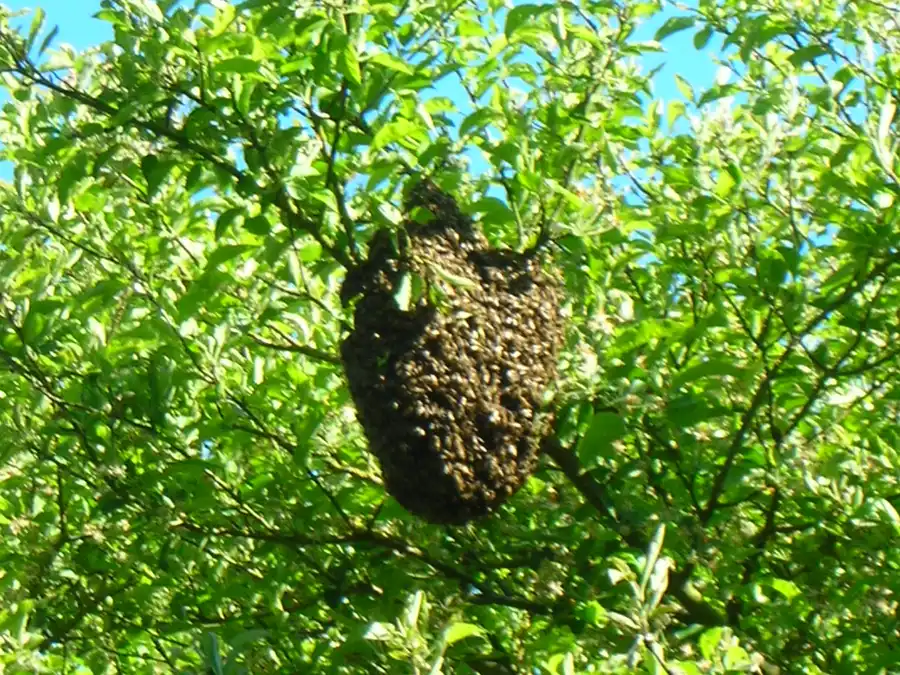
- Swarms. The Old Farmer’s Almanac warns that wild bees can carry disease or have weak genetics, and that taking bees from a neighbor’s tree may be considered stealing. Some clubs run swarm hotlines, such as the Colorado State Beekeepers Association’s, which is how experienced members get called. Learn how to catch a swarm safely first.
- Splits. A split from a local colony is a nuc by another name, so ask the same questions. For the trade-off against buying, see how to expand an apiary safely, and if you are tempted to split your first nuc, read can you split a first-year nuc.
- Used colonies. Beekeeping Insider says to bring an experienced beekeeper, check the colony’s disease and treatment history, and walk away if something looks wrong.
Frequently Asked Questions
Where is the best place to buy bees?
From a local beekeeper or club-recommended seller you can visit, collecting the bees yourself. Mail order is the fallback when no local source exists.
How much do bees cost?
On 22 October 2026, seller pages listed packages at $145 to $214 and 5-frame nucs at $179 to $300 for spring 2027.
When should I order bees?
As soon as a seller you trust opens pre-orders. UF/IFAS Extension says small-scale beekeepers usually order in December to February for April bees, and some 2027 stock is already listed as sold out.
Can you buy bees online?
Yes, mostly packages. Check the shipper’s guarantee, the ship date and who will be home to receive them. See shipping bees by mail.
Do I need a health certificate to buy bees?
It depends on your state and the seller’s. Texas and South Dakota set inspection requirements for sellers, and Alabama’s agriculture department tells buyers to ask for one every time.
Should a beginner buy a nuc or a package?
Several seller guides favor a nuc for a first hive; packages cost less but need more work. Our package vs nuc comparison covers the trade-offs.
Is it safe to buy bees from Facebook?
Treat it like any online purchase. Verify the seller with first-hand references, avoid Venmo, Cash App and Friends and Family payments, and meet in person.
The Bottom Line
Find your state’s inspector page, join a club, and ask two members who they bought from. Then compare listings by frames, queen and certificate, not by price alone, and pay with a card.