Reviewed by Elena P. · Last Updated October 8, 2026 · How we review
Put beehives in full sun where summers are mild, and give them afternoon shade where summers are long and hot. Shaded colonies carried more varroa mites and more small hive beetles in field studies, so sun is the default. Heat is the limit: in USDA tests in Arizona, colonies under solid shade made 50 percent more honey than colonies in the sun.
Key Takeaways
- Sun works against pests: shade sped up varroa growth and raised beetle numbers in field studies.
- Shade works against extreme heat: four hours at 122°F overheated brood in a 2026 study.
- With fewer than about 25 days a year at 90°F, as across the northern U.S., use full sun.
- With over 100 such days, as in Texas and the desert Southwest, shade hives from about noon in summer.
- Face entrances east to south and keep hives out of wooded understory.
What Field Studies Found About Sun and Shade
Most placement advice skips the evidence. These studies measured it.
| Study | Setting | Finding |
|---|---|---|
| Rinderer et al., American Bee Journal, 2004 (USDA-ARS) | Sunny and shaded apiaries | Shade sped up varroa growth; apiaries in direct sun had the fewest mites |
| Teixeira et al., Journal of Applied Entomology, 2024 | Rio de Janeiro state, Brazil; 10 sunny and 11 shaded colonies | More small hive beetles in the shaded apiary |
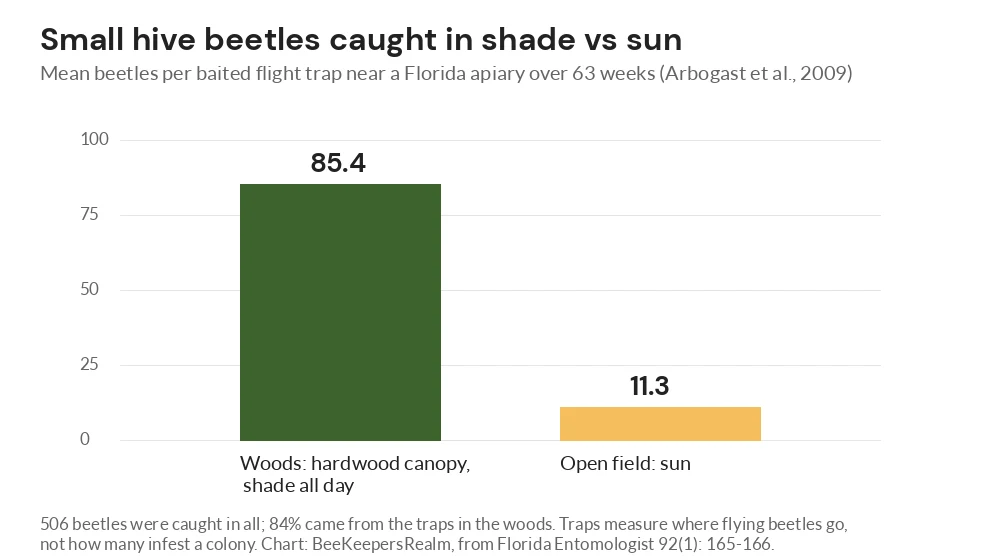
| Arbogast et al., Florida Entomologist, 2009 | Beetle traps near an apiary in Alachua County, Florida | Traps in all-day shade averaged 85.4 beetles; in the open field, 11.3 |
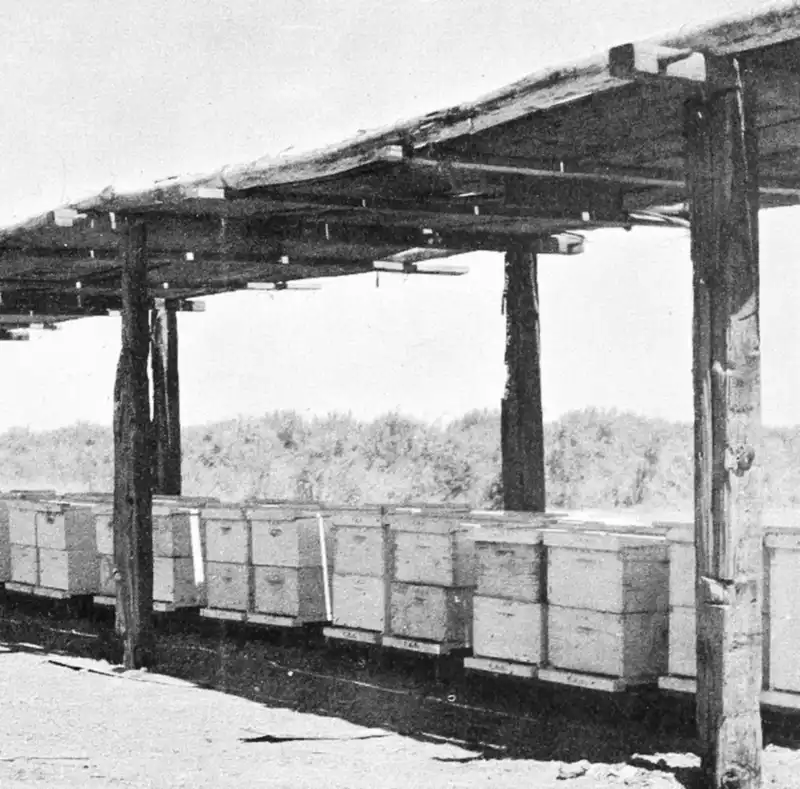
| Owens and McGregor, USDA Leaflet 530, 1964 | Arizona | Colonies under solid shade made 50% more honey |
| Harrison et al., Journal of Experimental Biology, 2026 | Arizona State University heat tests | Four hours of 122°F (50°C) air pushed brood to a damaging 100°F (38°C) |
Sun works against mites and beetles
The varroa trial compared Russian and Italian colonies. Its USDA-ARS abstract is blunt:
“Exposure to sunlight retarded mite population growth while prolonged shade accelerated it, causing the death of many of the Italian colonies.”
Sun slowed mites but did not stop them. Even the mite-resistant Russian honey bees in that trial carried mites, so keep doing mite counts.
The 2024 Brazilian study found significantly higher beetle infestations in the shaded apiary; the authors call the cause unknown and advise sunny apiaries wherever beetles are a pest. Mississippi State University Extension adds that understory sites invite beetles and Argentine ants. If beetles are already in, see hive beetle traps that work.
Shade works against heat
Brood develops properly at about 91°F to 97°F (33 to 36°C), per a 2010 PLoS One study of colony thermoregulation. Harrison’s team found where that fails, and noted that hives cool overnight, so shading the hottest afternoon hours does most of the work.
“Tests made in Arizona show that a colony under solid shade produces 50 percent more honey than a colony exposed to the sun.”
The leaflet gives no test details and is archived as a historic document, so treat that figure as a desert result, not a rule for cooler states. It also reports that unshaded colonies were more likely to be lost after insecticide poisoning.
Sun or Shade by Region
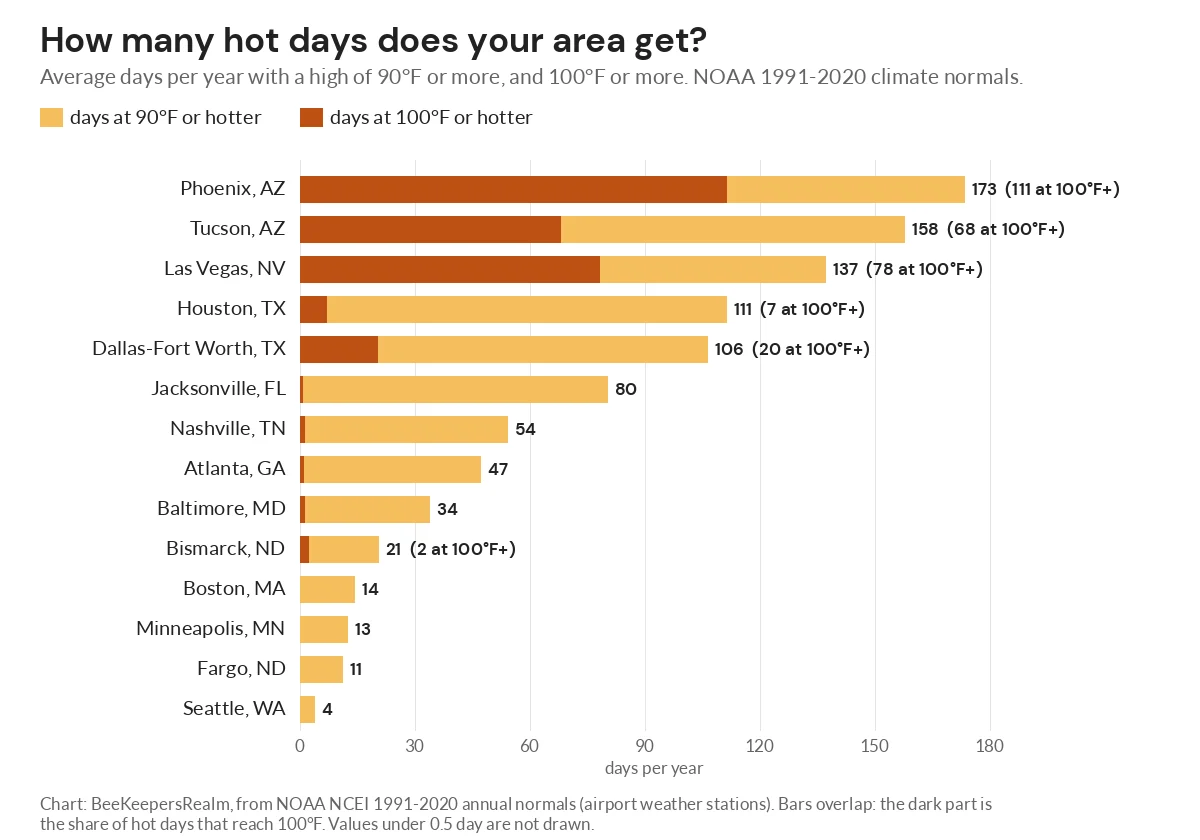
The deciding number is how often your summer gets hot. NOAA’s 1991-2020 climate normals give the average days per year at 90°F and 100°F or above. The placement column is our reading of the research, not NOAA advice.
| Region | Days 90°F+ / 100°F+ per year | Placement |
|---|---|---|
| Northern tier and Pacific Northwest | Fargo 11 / 0; Minneapolis 13 / 0; Bismarck 21 / 2; Seattle 4 / 0 | Full sun all day; windbreak on the north side |
| Mid-Atlantic and inland Southeast | Baltimore 34 / 1; Atlanta 47 / 1; Nashville 54 / 1 | Mostly sun; light afternoon shade from a deciduous tree is fine |
| Gulf Coast and Texas | Jacksonville 80 / 1; Dallas-Fort Worth 106 / 20; Houston 111 / 7 | Morning sun, shade from about noon in summer |
| Desert Southwest | Las Vegas 137 / 78; Tucson 158 / 68; Phoenix 173 / 111 | Solid afternoon shade, water close by |
North. The University of Minnesota Bee Lab’s apiary checklist asks for sun exposure, “ideally full sun,” and a windbreak, especially on the north side. See beekeeping in cold-winter climates.
Humid Southeast. Mississippi State Extension calls sun exposure in the South “debatable”: humid air makes evaporative cooling harder, so bees in full sun beard more and may store less honey.
“Ultimately, each beekeeper will need to decide on which is more stressful for their bees—working harder to cool the nest or dealing with increased pest pressure.”
Texas. Texas A&M AgriLife’s apiary guide (ENTO-099) recommends morning sun and afternoon shade, noting that shade attracts small hive beetles and full sun means more water for cooling.
Desert Southwest. The USDA leaflet notes that a colony may use as much as a gallon of water on a hot day. See our Southwest desert beekeeping guide.
How to Set Up Morning Sun and Afternoon Shade
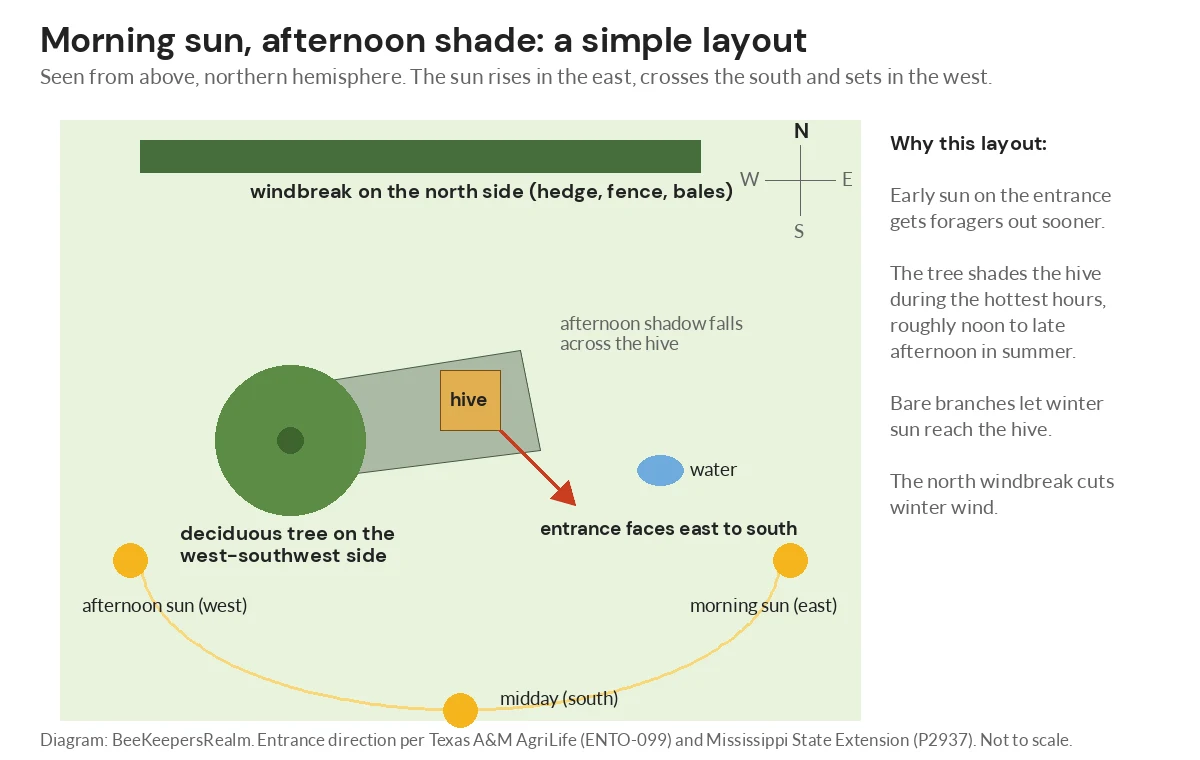
- Entrance: face it east to south, never directly north into winter wind.
- Shade source: on the west to southwest side. A deciduous tree is ideal; bare branches let winter sun through.
- No tree? Use a shade board, a roof or shade cloth; the USDA’s portable shade used 90-percent cloth. Compare hive shade cover options.
- Heat load: paint hives white and set them over grass, not bare ground.
- Watch the bees: heavy bearding every hot afternoon means more shade or airflow; slow, chilly mornings mean more sun.
Frequently Asked Questions
Do bees prefer sun or shade?
No clear preference has been shown. In Seeley and Morse’s 1978 nest-box tests, swarms favored south-facing entrances.
Can a beehive be in full shade?
It can survive, but expect more small hive beetles and later mornings. Move it into sun if you can.
How many hours of sun does a beehive need?
No study sets an hour count. Aim for sun on the entrance from early morning, and full sun all day in cool regions.
Should I shade my hive during a heat wave?
Yes, if it sits in full afternoon sun. Add a shade board or cloth above the lid and keep water close.
Where should you not put a beehive?
Avoid wooded understory, the bottom of a hill, flood plains and spots where the entrance faces foot traffic.
The Bottom Line
Default to sun and add afternoon shade as your summers get hotter. Adding colonies? Plan sun exposure when you expand an apiary, and see our beehive placement guide for wind, access and flight paths.