Reviewed by Michael R. · How we review
Which orientation best suits your apiary and climate? This guide opens with the core question U.S. beekeepers face: how orientation influences heat movement, moisture balance, and colony health. The answer matters for winter survival, summer cooling, honey yield, and inspection ease.
Bees favor cavities that are dry, elevated, and roomy. In cool regions they nest up in trunks; in warm zones they spread along logs. Stacked boxes like Langstroth, Warre, and British National support upward heat flow and tight clustering in cold climates.
Long, side-by-side designs such as Top-bar, Long Langstroth, and Layens/Lazutin ease access and shed heat across the nest in hot climates. Material choices and wall thickness often decide success: natural tree nests offer far more insulation than many store-bought options.
Expect a practical, data-driven comparison that links airflow science to field practice. Learn when insulation, ventilation, entrances, or modular boxes will make the difference for your bees and your management goals. For deeper climate-focused comparisons see this Langstroth vs top-bar climate guide and an overview of horizontal beehives.
Key Takeaways
- Orientation affects heat, moisture, and overwintering success.
- Stacked designs aid cold-climate thermoregulation and clustering.
- Elongated layouts favor cooling and easier inspections in warm areas.
- Insulation and wall thickness often outweigh orientation alone.
- Modular boxes let you adjust volume to match colony needs.
- Ventilation choices—entrances, lids, screened floors—shape outcomes.
Table of Contents
- How airflow shapes hive performance across climates and hive designs
- Vertical vs horizontal hive airflow: climate, insulation, and ventilation in practice
- Beekeeper considerations: inspections, honey yield, and management style
- Conclusion
- FAQ
How airflow shapes hive performance across climates and hive designs
Air circulation inside a colony governs temperature, moisture, and energy use. Good air paths let clustered bees ride warm plumes above the brood and cut the work needed to stay warm.
Convection works like this: heat from the cluster rises, cools at upper surfaces, and can condense if vents and thermal gradients are wrong.
Natural nest patterns and design lessons
In tree cavities, colonies stack brood and stores to take advantage of rising warmth. In log nests, bees spread brood side-to-side to shed excess heat in warm areas.
Commercial boxes often have thinner walls than trunks, so use heavier lids, tight seams, and staged vents in cold climates. In hot regions, focus on crossflow and shading to remove excess warmth.
- Frames, headspace, and comb spacing shape micro‑currents and scent flow.
- Moisture from nectar and respiration will condense above clusters without absorbent layers or controlled vents.
- Small entrance or lid changes can pivot outcomes—consider front vs. side openings, quilt boxes, and vent placement.
For research on climate effects see climate studies on nest design, and for practical venting options consult a beehive ventilation guide.
Vertical vs horizontal hive airflow: climate, insulation, and ventilation in practice
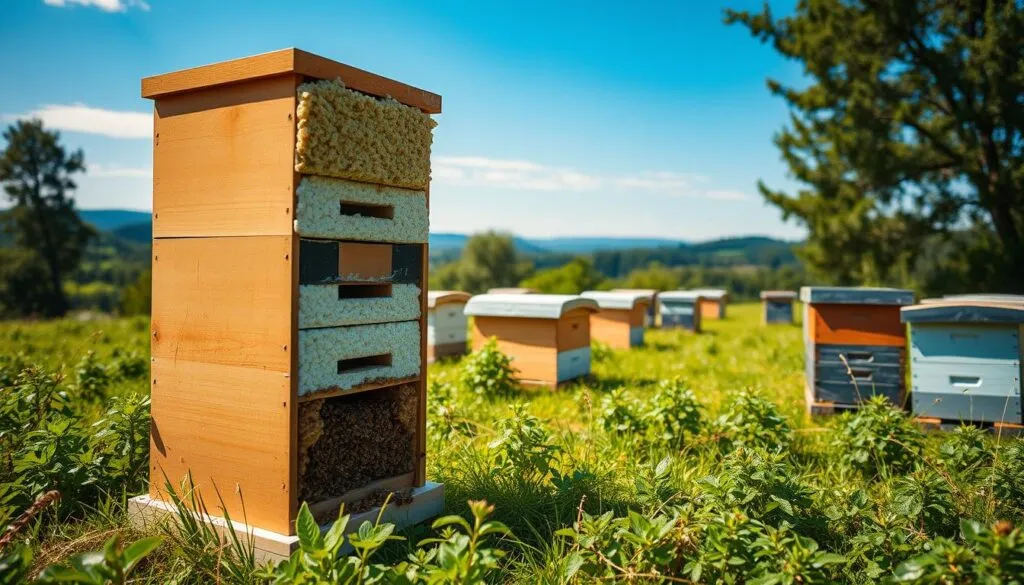
How a hive is built often dictates whether bees conserve heat or need extra cooling strategies. In cold regions, stacked boxes like Langstroth, Warre, and British National let the colony form a tight, upward cluster that keeps brood warm and uses stores efficiently.
Cold climate advantage of stacked boxes: upward clustering
Compact clustering reduces convective losses as warm air rises through the cluster and into stores above. Keep top vents minimal, use a snug inner cover, and add thicker lids or wraps. For practical winter tips see winter management.
Warm climate strengths of elongated designs: easier cooling
Long layouts — top bar, long Langstroth, Layens — allow cross-venting along the run. Wide entrances and screened gaps help bees shed metabolic heat and finish honey without chilling brood. Place these units in dappled shade and add adjustable side vents for afternoon relief.
Insulation needs by orientation
Many commercial boxes ship with ~25 mm walls while natural cavities offer 30–125 mm. Thicker timber, insulated wraps, or denser materials move man-made performance closer to natural nests and matter most when long designs are used in cold climates.
Managing moisture and ventilation
In stacked setups favor controlled upper vents, quilt boxes, and a tight seal to limit drafts. For long runs, use ventilated lids sparingly in cold months and more freely in heat. Practical vent tactics are detailed in this ventilation guide.
Frame layout and space
Concentrating brood under stores in stacked boxes reduces the warmed surface area. A long sequence of frames can increase lateral losses unless follower boards, baffles, or added insulation reduce exposed space.
Examples by type and area
- Langstroth and Warre: favored across cool-temperate U.S. and Canada for winter survival and modular scaling.
- Top bar, Long Langstroth, Layens: common in southern U.S., Southwest, and coastal zones for passive cooling and backyard, stationary use.
Beekeeper considerations: inspections, honey yield, and management style
Your equipment choice shapes daily tasks, physical load, and production goals. Think about how often you will open colonies, how much time you can give, and whether you need high-volume honey or low-intervention observation.
Inspections and ergonomics: box lifting vs. side access
Stacked systems require lifting upper boxes to reach brood, which increases physical strain and inspection time. Use a hive lifter or a helper during peak flows.
Long formats let a beekeeper slide frames from the side without heavy lifts. That cuts disturbance and shortens checks, which helps when you have limited time.
Honey and scale: colony growth, yield potential, and time investment
Stackable boxes make it easy to add space during nectar flows. This supports larger colony populations and higher honey yields.
Top bar and long boxes can be productive, too, but they suit smaller scale operations and lower intervention styles.
Mobility and operations: stationary setups vs. migratory beekeeping
Modular boxes strap and palletize well for commercial moves. If you plan to truck colonies for pollination, choose standardized parts.
Stationary long units fit backyard and suburban areas where minimizing lifting and neighborhood disturbance matters.
Matching format to climate and goals: practical advice for U.S. beekeepers
- Plan for more frequent, light-touch visits with long designs; fewer but heavier inspections with stacked ones.
- Set long units at waist height to protect your back and speed frame handling.
- In cold regions, pair stacked setups with robust insulation and tight vents; in hot areas, favor shade and crossflow for comfort.
| Consideration | Stackable Boxes | Long / Top Bar | Practical Tip |
|---|---|---|---|
| Inspections | Fewer visits, heavier lifts | More visits, easier side access | Use lifters or waist-high stands |
| Honey potential | High with added boxes | Moderate, steady yields | Match to your harvest goals |
| Mobility | Good for migratory ops | Best for stationary apiaries | Choose by operation scale |
| Colony care | Fast reconfiguration | Gentler, low-disturbance work | Align with your time and strength |
Deep-frame, one-room designs such as the Golden Hive add another variable, since the whole colony lives in a single chamber.
For how a Layens hive is built and wintered, see the Layens hive guide.
Conclusion
A colony’s success depends on matching design to climate, materials, and management.
Vertical hive layouts generally retain heat better in cold climates because bees cluster upward and use convection to conserve warmth. Long, side-by-side styles lose heat faster in winter and need thicker insulation, yet they shed heat well in hot seasons.
Materials matter: natural cavities often provide 30–125 mm of insulation versus ~25 mm for many commercial boxes. Improve performance with better wall thickness, tight seals, and seasonally tuned ventilation.
Practical advice: favor minimal, controlled vents above the cluster in cold weather and encourage crossflow plus shade in heat. Prioritize your physical capacity and honey goals when choosing modular, standardized boxes or a top bar option for low-lift checks.
For details on parts and insulation choices, see this components guide. Meet the core needs—stable temperature, dry interiors, good comb support, and seasonal entrances—and your bees will thrive regardless of label.
FAQ
How does air movement affect colony temperature and moisture control?
Air movement drives convective heat transfer and moisture removal inside a brood nest. Warm air rises, helping colonies shed excess heat when openings allow upward venting. Proper ventilation prevents condensation on combs that can chill brood. Good practice uses controlled openings—top vents, screened inner covers, or adjustable entrances—to balance heat retention and humidity depending on season and local climate.
Why do some beekeepers prefer upright, stacked boxes for winter?
Stacked, multi-box systems encourage upward heat flow, letting clustered bees conserve warmth while moving vertically into honey stores. This orientation mimics tree-trunk nests and simplifies insulating the outer walls. In cold regions, thicker walls, reduced entrance size, and limited drafts help colonies maintain brood rearing and reduce feeding stress.
What are the ventilation advantages of side-access, single-level designs?
Single-level, side-entry designs offer easier cross-ventilation and fast heat dissipation, which helps in hot, humid areas. With more surface area exposed and lower stacking, airflow patterns remove warm, moist air quickly. These designs also tend to reduce overheating risk during summer nectar flows and make it simpler to add screened panels or adjustable side vents.
How should insulation and materials change with hive orientation and climate?
Insulation depends on both orientation and regional weather. In cooler climates, thicker timber or added insulation on the outer boxes and top reduces heat loss in stacked setups. In warm climates, reflective roofs, ventilation gaps, and thinner walls prevent heat buildup. Choose breathable materials to avoid trapping moisture when insulating.
What practical steps control moisture without harming temperature balance?
Use limited top ventilation to avoid chilling brood while allowing humid air to escape. Install moisture-absorbing upper inserts in very cold, wet areas. Keep entrances adjusted for sufficient air exchange and consider screened bottom boards seasonally. Monitor internal humidity during inspections and adapt vents rather than making permanent large openings.
How do frame layout and box spacing influence bee movement and heat retention?
Denser frame arrangements and tighter box joins reduce internal air pockets and increase heat retention. Frames that allow bees continuous movement between stores and brood support efficient clustering and thermoregulation. Wider gaps or poorly sealed joints create cold spots and force bees to spend energy bridging space.
Are there specific hive types better suited to particular regions or management styles?
Yes. Standard Langstroth and Warre designs work well for cold and variable U.S. climates when insulated correctly. Top-bar and long single-level boxes fit warm regions and small-scale, low-lift beekeepers who favor side access. British National and Layens offer compact options with trade-offs in expansion and harvest methods. Match the hive to your climate, physical ability, and honey goals.
How do inspection frequency and ergonomics differ between stacked and side-entry systems?
Stacked systems require lifting heavy boxes, which can be physically demanding but allow focused, vertical inspections of brood and stores. Side-entry systems enable full-frame checks without heavy lifts, speeding inspections and reducing strain. Choose based on your strength, frequency of checks, and whether you prioritize rapid hive work or modular management.
What effects do orientation and ventilation have on honey yield and colony growth?
Properly matched orientation and ventilation reduce stress, disease risk, and overwinter losses, supporting stronger spring buildup and higher honey yields. Overheating or chronic moisture problems cut foraging efficiency and brood rearing, lowering production. Consistent microclimate management boosts colony health and harvest potential over seasons.
Can hives be adapted for migratory beekeeping or frequent moves?
Yes. For frequent transport, secure box joints, inner covers, and screened openings to prevent shifting and robbing. Lighter single-level designs reduce lifting and loading time, while well-insulated stacked boxes protect against temperature swings during transit. Choose durable materials and simple fastening systems for safe moves.
How should U.S. beekeepers choose a hive based on local weather and goals?
Assess winter lows, summer heat, humidity, and nectar flow patterns. In colder northern zones, select insulated, multi-box systems that promote upward clustering. In hot, humid southern zones, favor low-profile or single-level designs with strong ventilation. Also weigh inspection style, lifting capability, and honey extraction preferences before committing.
We go deeper into this topic in our post on improve hive health with solar-powered hive ventilators.