Reviewed by Michael R. · How we review
When beekeepers feed sugar syrup, the ratio of sugar to water changes with the season because the colony’s needs change. In spring, bees use syrup right away to raise brood and build comb. In fall, they need to store it as winter food. In the depth of winter, liquid syrup is usually the wrong choice altogether. This guide explains which syrup ratio to use in each season, how to mix it correctly, and what not to feed.
Key Takeaways
- Spring and buildup: 1:1 syrup (one part sugar to one part water by weight). Bees use it right away rather than storing it.
- Fall: 2:1 syrup (two parts sugar to one part water by weight). The lower water content lets bees cure and cap it quickly for winter.
- Winter: avoid liquid syrup. Fondant can serve as emergency feed in late winter or early spring when a colony is light.
- Ratios are by weight. 1 kilogram of water is 1 liter; in U.S. units, water weighs about 8.3 pounds per gallon.
- Use plain white sugar, never feed honey of unknown origin, and stop feeding before honey supers go on.
Table of Contents
- What 1:1 and 2:1 Actually Mean
- Seasonal Syrup Ratios at a Glance
- Spring: 1:1 Syrup for Buildup
- Summer: Feed Only When There Is a Dearth
- Fall: 2:1 Syrup for Winter Stores
- Winter: Switch from Syrup to Solid Feed
- How to Mix Sugar Syrup
- What Not to Feed
- Conclusion
- FAQ
What 1:1 and 2:1 Actually Mean
Syrup ratios are written as parts sugar to parts water. The Ontario Beekeepers’ Association guide to feeding bees is clear that these ratios are by weight, not volume. A 1:1 syrup is about 50% sugar. A 2:1 syrup is about two-thirds sugar, which the OBA guide rounds to 70%.
Metric makes this easy, because 1 liter of water weighs 1 kilogram. For 1:1, mix 5 kg of sugar with 5 L of water. For 2:1, mix 10 kg of sugar with 5 L of water. In U.S. units, a gallon of water weighs about 8.3 pounds, so a 2:1 batch made with 10 pounds of sugar needs about 5 pounds of water, which is a little under two and a half quarts.
Mixing by volume (for example, a quart of sugar to a quart of water) makes a syrup that is somewhat thinner than a true 1:1 by weight, because a quart of sugar weighs less than a quart of water. That is fine for spring feeding. For fall syrup, where sugar content matters, weigh the sugar.
Seasonal Syrup Ratios at a Glance
| Season | What the colony is doing | What to feed | Notes |
|---|---|---|---|
| Early spring | Building up brood; stores may be low | 1:1 syrup (2:1 also works) | Only if the hive is light. Use in-hive feeders. Keep feeding until nectar is available. |
| New packages, nucs and splits | Drawing comb and establishing | 1:1 syrup | Light syrup is close to nectar and supports comb building. |
| Summer dearth | Foraging slows when nectar dries up | Usually nothing; 1:1 if a colony is short | Feed inside the hive to limit robbing. Never feed with honey supers on. |
| Fall, after harvest | Storing food for winter | 2:1 syrup | Finish before daytime temperatures fall below about 10 °C (50 °F), when bees stop flying. |
| Winter | Clustered; eating stored food | No liquid syrup; fondant only as emergency feed | Check stores by hefting the hive. Dry sugar is not a fix for a weak, starving colony. |
Spring: 1:1 Syrup for Buildup
Spring feeding is not always needed. The OBA guide points out that a strong colony that was fed well in the fall often needs nothing in spring. To check, lift the back of the hive by the bottom board. A hive that feels light and lifts easily has used up its stores and should be fed right away.
Once you start feeding a light colony in spring, plan to keep going until nectar is reliably available, because bees use spring syrup directly rather than storing it. If the feed runs out before nectar arrives, the colony can still starve. Use 1:1 syrup in an in-hive feeder, such as a pail feeder over the inner cover or a hive-top feeder. Early-spring weather often keeps bees from flying, and bees are not attracted to cold syrup in open feeders. For a detailed comparison, see top feeder, frame feeder and pail feeder options.
Stop feeding before you put honey supers on. Otherwise the bees can move syrup up into the supers, and what you harvest will be adulterated with sugar syrup instead of pure honey.
Summer: Feed Only When There Is a Dearth
Most colonies do not need syrup in summer. The exception is a nectar dearth that leaves a colony, often a young one, short of food. If you must feed, use 1:1 syrup inside the hive. The OBA guide recommends frame feeders for mid-season dearth feeding. Dearths are also when robbing is most likely, so reduce entrances, avoid spilling syrup, and read our guide to feeding bees without causing robbing.
Fall: 2:1 Syrup for Winter Stores
Fall is the season when feeding matters most. Colonies that go into winter without enough stores can starve. Bees keep the winter cluster warm by vibrating their flight muscles, and that uses a lot of energy.
Use 2:1 syrup in fall. Because it holds less water, the bees can cure and cap it quickly. The OBA guide warns that stored syrup with too much moisture can cause dysentery, which is a common cause of winter losses. Start feeding once your honey supers are off. Try to finish before daytime temperatures fall below about 10 °C (50 °F), because the bees need warm weather to take syrup down, cure it and cap it.
How much? The OBA guide, written for Ontario conditions, suggests at least 15 liters (about 4 gallons) of syrup per colony. It gives target hive weights going into winter of 70–90 lb for a single brood chamber and 100–120 lb for a double. Colder or warmer climates will shift those numbers, but the hefting test works everywhere: a hive that is ready for winter should feel very heavy.
Winter: Switch from Syrup to Solid Feed
Once it is too cold for bees to fly, liquid syrup is the wrong tool. Bees cannot process and store it, and a cold, wet feeder above the cluster adds moisture to the hive. If a colony is running short in late winter or early spring, the OBA guide describes fondant as an emergency feed. It goes directly on the brood chamber where the bees can reach it.
Dry sugar needs more care. Bees need water to eat it, and the OBA guide warns that a weak or starving colony may not have the strength to collect that water, so it can starve with dry sugar in the hive. Some beekeepers still use dry sugar over newspaper as winter insurance for colonies that are otherwise in good shape; our article on the Mountain Camp method explains how that works and when it is appropriate.
How to Mix Sugar Syrup
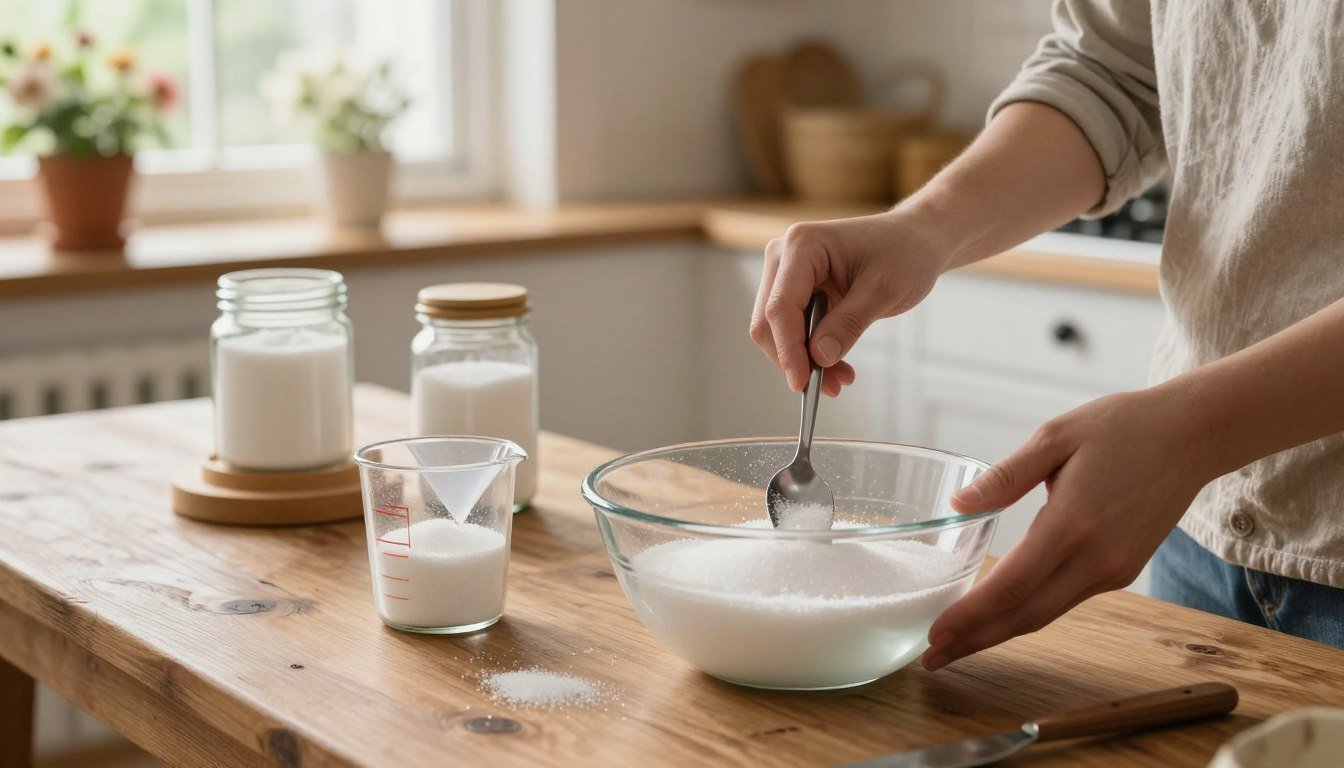
- Weigh the sugar. Use plain white granulated sugar.
- Measure the water. Use the same weight of water for 1:1, or half the weight of the sugar for 2:1. In metric, 1 L of water is 1 kg.
- Use warm water. Stir until the sugar is completely dissolved. You do not need to boil it; warm tap water or water heated on the stove is enough. 2:1 dissolves more easily in hotter water.
- Cool it before feeding. Let the syrup come down to a comfortable temperature before it goes in the hive.
- Mix what you will use. Syrup can ferment or grow mold if it sits. Make batches you will use within a few days, and clean feeders between fills.
What Not to Feed
- Honey from an unknown source. Honey can carry spores of American foulbrood, a serious bacterial brood disease. Penn State Extension’s guidance on American foulbrood warns that honey from infected colonies contains spores. Store-bought honey or honey from someone else’s hives can bring disease into your apiary even if it looks perfectly normal.
- Brown sugar, molasses and unrefined sugars. These contain more non-sugar solids than white sugar and are harder on bees, especially over winter when they cannot fly out to relieve themselves. Stick to plain white sugar.
- Syrup while honey supers are on. It ends up in your harvest.
- Old or fermented syrup. Throw it out and clean the feeder.
Conclusion
Seasonal syrup ratios come down to what the colony will do with the food. Use 1:1 in spring and during buildup, when bees use it right away. Use 2:1 in fall, when they need to store it quickly with little water. In winter, stop liquid feeding and keep fondant ready for emergencies. Mix by weight, use white sugar, feed inside the hive, and let hive weight, not the calendar, tell you whether a colony needs feeding at all. For a broader look at when and how much to feed, see Feeding Bees: When, How, and How Much to Feed Them.
FAQ
What sugar syrup ratio should I feed bees in spring?
Use 1:1 syrup, meaning equal weights of white sugar and water. Bees use light syrup right away for brood rearing and comb building, and it is closer to natural nectar. The Ontario Beekeepers’ Association guide notes that 2:1 can also be fed in spring, but 1:1 is the usual choice.
Why is 2:1 syrup used in the fall?
2:1 syrup has less water, so bees can cure it into stores and cap it quickly before cold weather. Stored food with too much moisture can contribute to dysentery over winter.
Are syrup ratios measured by weight or by volume?
By weight. In metric, 1 liter of water weighs 1 kilogram, so 1:1 is, for example, 5 kg of sugar in 5 L of water. Mixing equal volumes gives a slightly thinner syrup, which is acceptable in spring. For fall syrup, weigh the sugar.
Can I feed sugar syrup in winter?
Generally no. Once it is too cold for bees to fly, they cannot process and store liquid syrup. Use fondant as emergency feed in late winter or early spring, and make sure colonies go into winter heavy enough that they do not need it.
When should I stop feeding syrup?
In spring, stop once nectar is reliably available and before you add honey supers, so syrup does not end up in your honey. In fall, feed until the colony reaches a good winter weight or until it gets too cold for the bees to take syrup down.
Is it safe to feed bees store-bought honey instead of syrup?
No. Honey from another source can carry American foulbrood spores that can infect your colonies. Feed honey only from your own healthy hives, and use sugar syrup otherwise.