Reviewed by Michael R. · How we review
The best urban beekeeping equipment is a hive that fits your footprint and your lifting limit, a stand and strap that keep it steady, a solid barrier that lifts the flight path, and a water dish on your own side of the fence. An 8-frame Langstroth box covers about 1.9 square feet, and an 8-frame starter setup with bees costs roughly $424 to $439 at the prices we checked. Check your lease and local rules first; our urban beekeeping guide covers the full plan.
Key Takeaways
- Choose by footprint and lifting: an 8-frame Langstroth box is about 14 by 19-7/8 inches, a Warré box 13-1/2 inches square, a top-bar hive 4.8 to 6.3 square feet.
- A full 10-frame deep weighs up to 90 pounds, Hoover Hives says; its 8-frame size is 20% lighter, about 72 pounds.
- Put a solid barrier at least 6 feet tall a few feet in front of the entrance (MSU Extension). A property-line fence does not count in San Diego County.
- Bees can drink up to a gallon of water a day (Texas A&M AgriLife). Set out a dish with pebbles before they arrive.
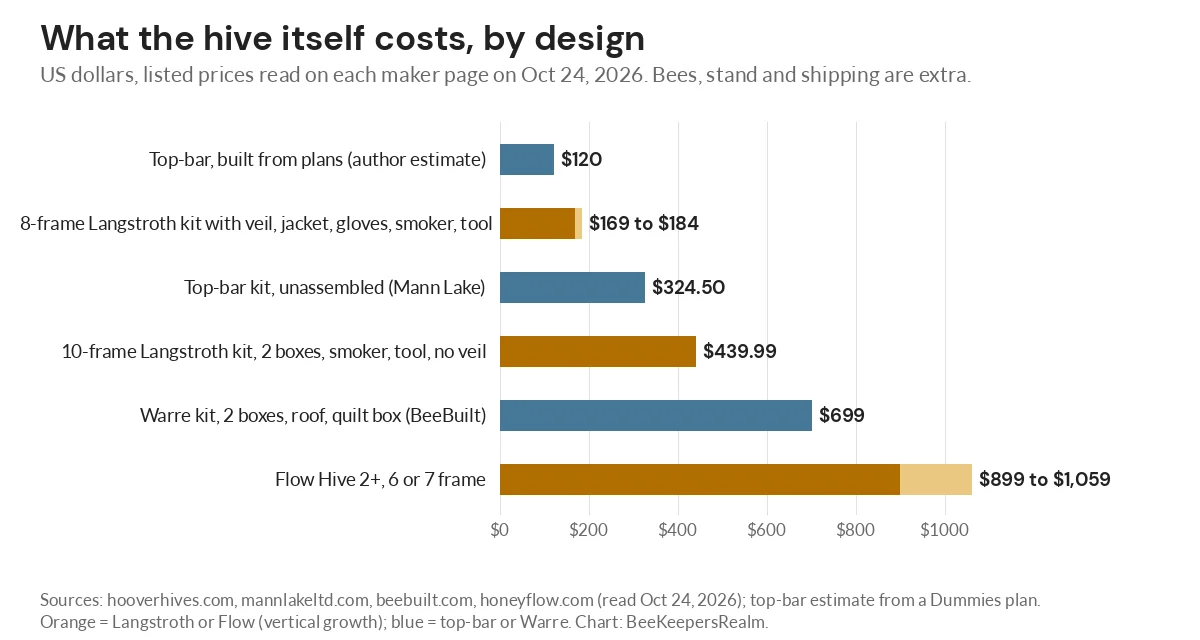
- An 8-frame kit with veil, jacket, gloves, smoker and tool lists at $169 to $184; add a $69.99 stand and a $185 nuc for about $424 to $439 (prices read Oct 24, 2026).
Table of Contents
- What a Small Space Changes About Your Equipment
- Compact Hive Designs Compared
- Stands, Straps and Wind
- Flight-Path Barriers and Entrance Direction
- Water Without Annoying the Neighbors
- Smoker, Fuel and Neighbor-Friendly Habits
- Protective Gear and Tools You Still Need
- Storage for Spare Boxes and Frames
- What a Starter Setup Costs
- Frequently Asked Questions
- The Bottom Line
What a Small Space Changes About Your Equipment
Three limits shape every purchase on a small lot or balcony: ground area, lifting height and the people next door.
Ground area decides the hive design, because a hive that grows sideways needs several times the floor of one that grows upward. Lifting decides box size, since a full honey box is heavy. The neighbors decide the rest: a barrier, a water dish and a smoker you can use safely.
Local rules often cap the count too. A county that tiers its rules, such as San Diego County in its Bee BMPs checklist, starts at one or two colonies per location. Plan gear for one hive. For permits, HOAs and lease limits, start with our guide to keeping bees in a condo or co-op and your city code.
Compact Hive Designs Compared
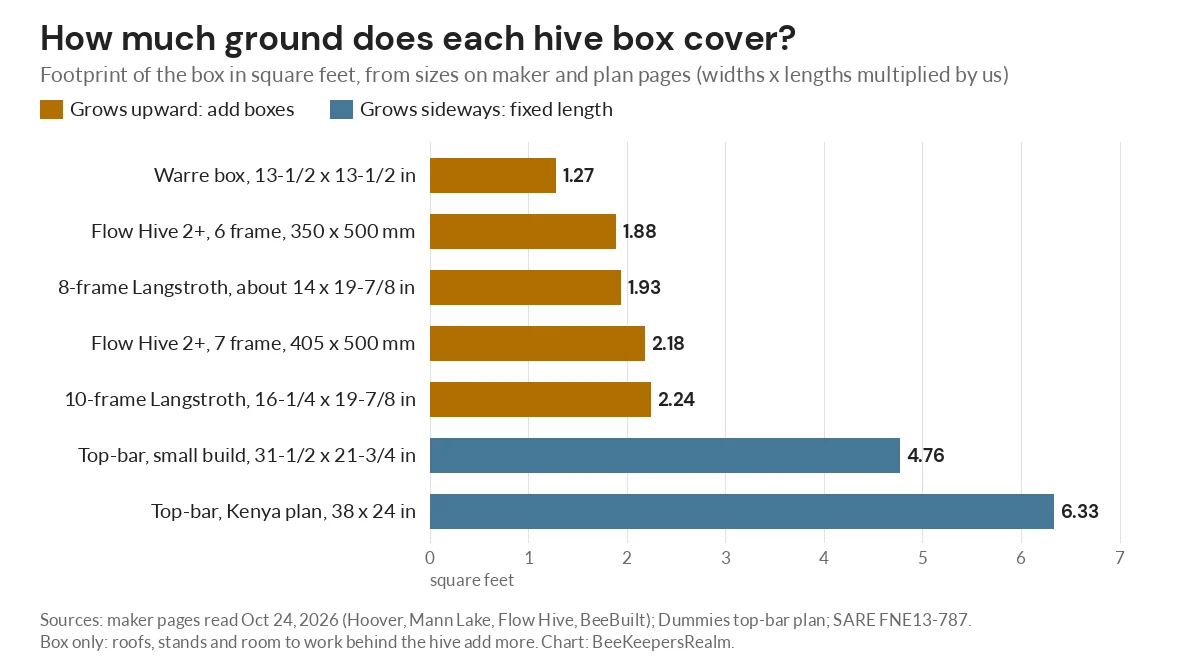
A hive’s footprint is the number most gear guides skip. This table converts listed dimensions into square feet of ground for the box itself; roofs, stands and working room add more.
| Design | Box footprint | How it grows | Heaviest lift | Listed price (Oct 24, 2026) |
|---|---|---|---|---|
| 8-frame Langstroth | 14 x 19-7/8 in, 1.9 sq ft | Add boxes upward | Full deep, about 72 lb* | $169 to $184 kit with protective gear (Hoover Hives) |
| 10-frame Langstroth | 16-1/4 x 19-7/8 in, 2.2 sq ft | Add boxes upward | Full deep, up to 90 lb | $439.99 kit, two boxes, no veil (Mann Lake) |
| Flow Hive 2+, 6 or 7 frame | 350 x 500 mm or 405 x 500 mm, 1.9 to 2.2 sq ft | Add boxes upward | Flow super holds 39 lb (6 frame) or 46 lb (7 frame) of honey | $899 to $1,059 (Flow Hive US) |
| Top-bar | 31-1/2 x 21-3/4 in to 38 x 24 in, 4.8 to 6.3 sq ft | Fixed length; no supers | One comb at a time | $324.50 unassembled kit (Mann Lake); about $120 to build |
| Warré | 13-1/2 x 13-1/2 in, 1.3 sq ft | Add boxes below | A whole box; BeeBuilt lists no weight | $699 two-box kit (BeeBuilt) |
*Hoover Hives says a full 10-frame deep weighs up to 90 pounds and the 8-frame size is 20% lighter: 90 x 0.8 = 72. Footprints are our conversions of the listed sizes: 14 x 19.875 in = 278 sq in = 1.93 sq ft, and 350 x 500 mm = 13.8 x 19.7 in = 1.88 sq ft.
8-frame Langstroth: the default for a tight footprint
The 8-frame Langstroth is the standard hive in a narrower box, so frames, extractors and most parts match what local clubs use. Hoover Hives lists its 8-frame brood box at 14 by 19-7/8 inches and its telescoping cover at 16-1/4 by 22 inches, so the roof sets the true footprint at about 2.5 square feet. The hive grows by adding boxes upward, which keeps the ground area fixed.
Buy covers and bottoms from one maker, because 8-frame sizes vary slightly. Our 8 frame vs 10 frame comparison shows which parts fit both widths, and Langstroth hive dimensions lists exact box sizes.
Flow Hive: a Langstroth footprint with a different harvest
A 6-frame Flow Hive 2+ super measures 350 by 500 millimeters (13-3/4 by 19-11/16 inches), which Flow lists as compatible with 8-frame deep Langstroth equipment. The 7-frame size is 405 millimeters (16 inches) wide, so ground area matches an 8- or 10-frame box.
The draw is harvesting without an extractor. Flow’s product page says a full 6-frame super can hold up to 39 pounds of honey and a 7-frame up to 46, and lists the hive at $899 to $1,059. The colony still needs inspections and mite checks; our Flow Hive explainer shows how the tap works.
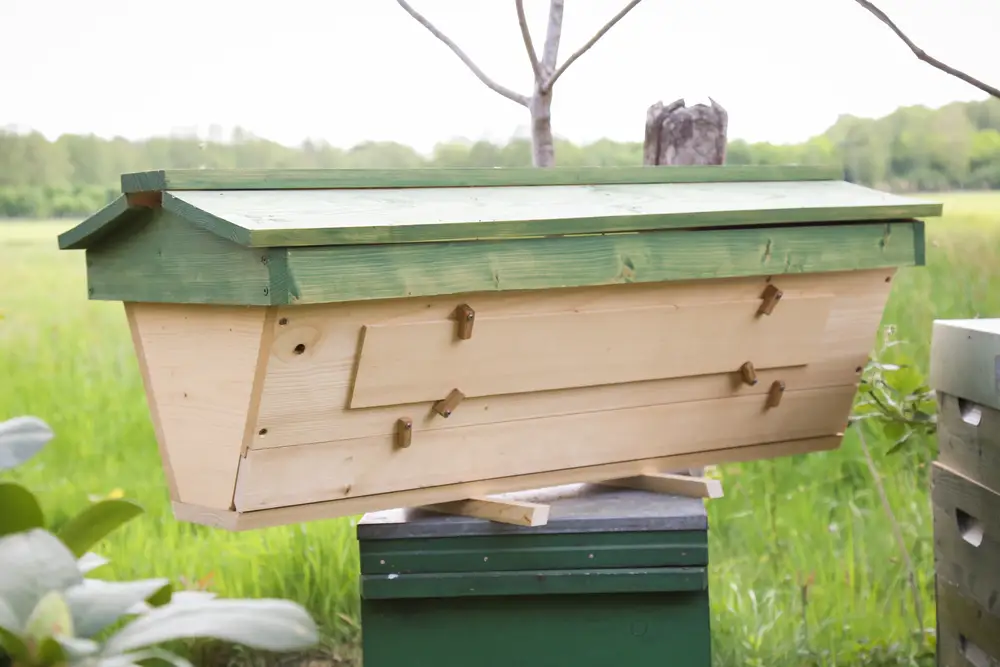
Top-bar hives: little lifting, but long and fixed
A top-bar hive has no boxes to stack, so you lift one comb at a time. Mann Lake sells its unassembled kit on that point, at $324.50. The trade-off is ground area, 4.8 to 6.3 square feet in the two designs we found (a SARE-funded build at 31-1/2 by 21-3/4 inches and a Kenya plan at 38 by 24), and a fixed capacity: you cannot add supers. The Kenya plan estimates about $120 to build one with a stand.
“The top-bar system certainly has some disadvantages, the main one being that top-bar hives require a high level of skill and confidence from the beginning beekeeper.”
One upside: the same excerpt says top-bar hives need no extractor, only a colander and a bowl for small batches. Our top-bar hive guide explains the Kenyan design.
Warré hives: narrow boxes that stack downward
A Warré hive uses small square boxes and adds new ones beneath the old, a practice called nadiring. BeeBuilt’s kit lists boxes of 13-1/2 by 13-1/2 by 8-1/4 inches, a footprint of about 1.3 square feet, the smallest we found for a full-size colony. You lift whole boxes rather than frames, and the design has limits that our Warré hive guide lays out.
Nucs and mini hives: stepping stones, not main hives
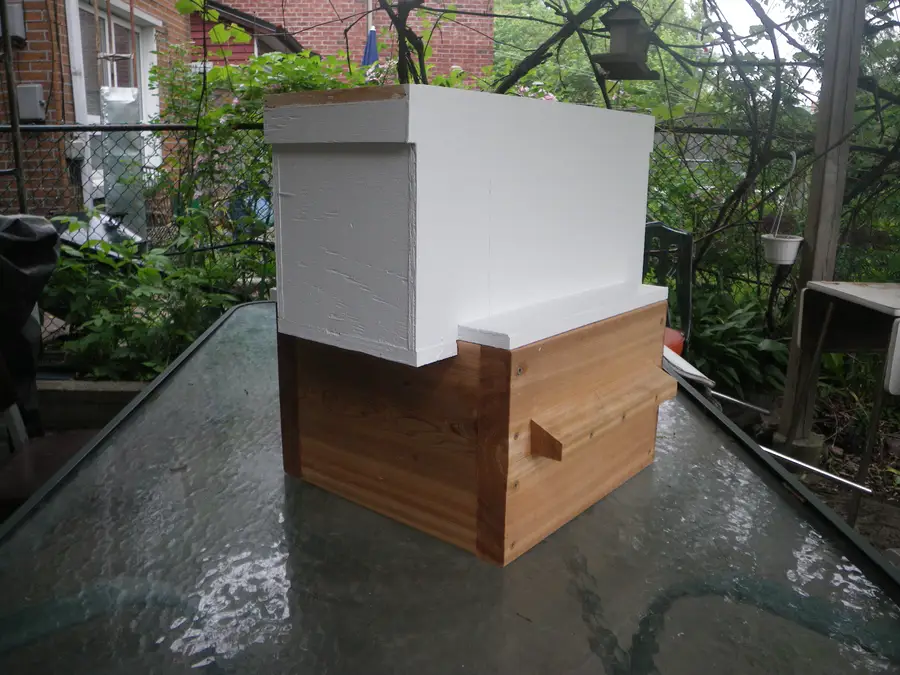
A standard 5-frame nuc box is how most beginners receive their first colony (see package bees vs nucs). The photo shows one set on a Warré box to move a colony between designs.
Mini hives are smaller still. Eco Bee Box describes its mini boxes as one quarter of the standard Langstroth size and lists queen rearing, splits, swarm control and garden pollination as uses. Treat them as a side tool, not a first honey hive.
Stands, Straps and Wind
A stand keeps the bottom board off wet ground and puts the hive at a comfortable working height. Mann Lake’s collapsible stand fits 8- and 10-frame hives, places the bottom of the hive 8 inches up and lists at $69.99 (Oct 24, 2026). Our hive stand height guide covers the best working height.
Narrow stacks catch the wind. On a balcony or roof, strap the stack to the stand and the stand to something solid; ratchet straps for windy apiaries covers the fittings.
Weight is the other limit. A hive heading into a northern winter carries 90 to 100 pounds of honey, as our winter honey guide shows, plus boxes, frames and bees, all on a few small feet. Ask the building owner or a structural engineer whether a balcony or roof can take a concentrated load; a beekeeping site cannot answer that.
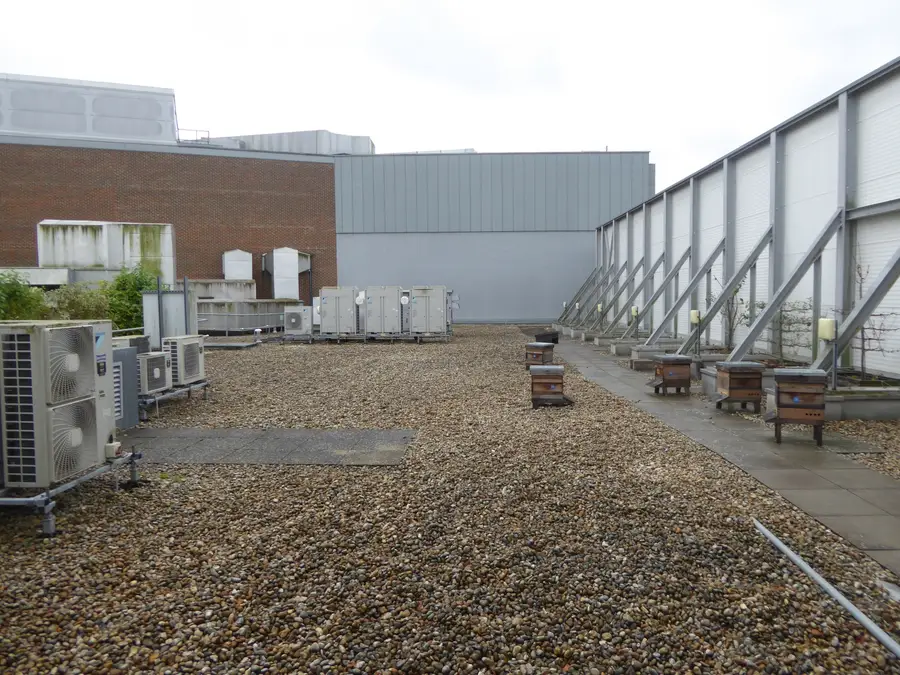
Flight-Path Barriers and Entrance Direction
A barrier is the cheapest equipment for keeping neighbors calm. Texas A&M AgriLife Extension explains why:
“Utilizing tall, solid fencing around the bees will force the bees to fly up and over the fence—thereby flying over human heads, making it less likely that they will fly into a person and sting them.”
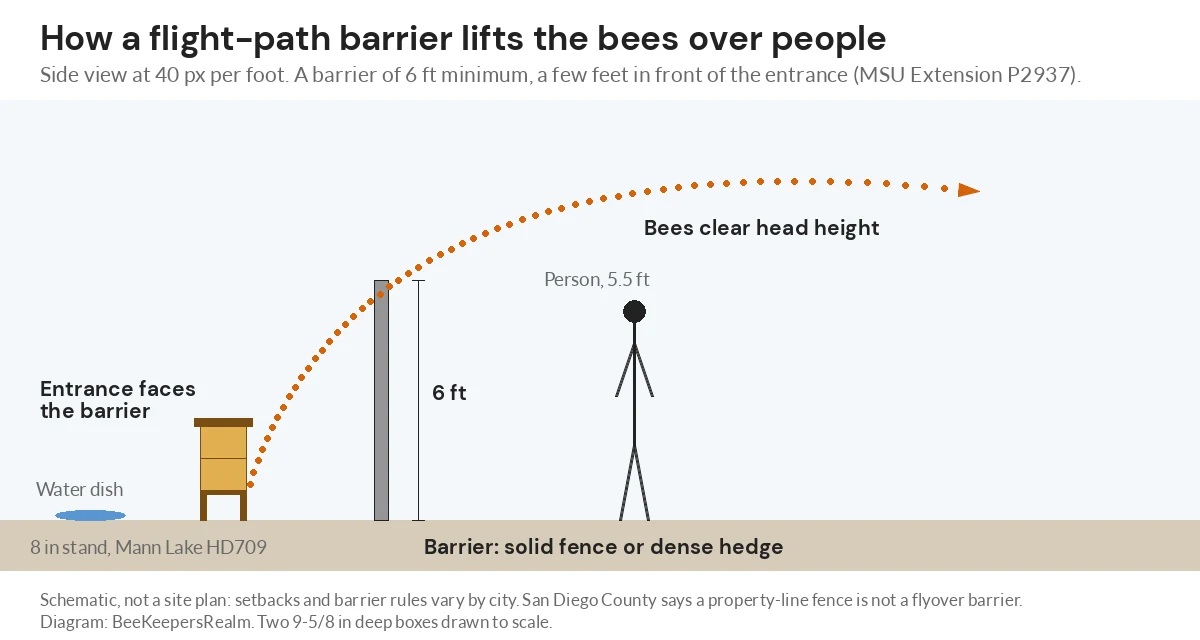
Mississippi State University Extension adds the numbers: near public areas, a barrier of at least 6 feet, placed a few feet in front of the hive entrance. San Diego County’s Bee BMPs go further. They call for a six-foot flyover barrier of solid wall, fence or dense vegetation at residential apiaries within 300 feet of neighboring dwellings (its two smaller tiers, up to 20 colonies), and they say a property-line fence does not count.
So build the barrier close to the hive, not at the property line. Solid fence panels, a dense hedge in planters or windbreak panels all work, and the same screen cuts the wind. Face the entrance at the barrier and away from walkways. Mississippi State suggests south to east; Texas A&M says east or southeast, so morning sun warms the entrance.
Texas A&M also advises 25 feet from property lines and a 10-foot flight path before sidewalks. A small city lot often cannot meet that, which is why the barrier matters.
Water Without Annoying the Neighbors
Texas A&M says a colony may consume up to a gallon of water a day and that you should provide a source if none exists within 100 yards of the hive. Bees often prefer a muddy puddle or birdbath to clean water, so use a shallow dish with straw or pebbles to land on. Mississippi State adds a city-friendly option: a drip from a faucet makes a puddle where bees can drink.
Act early, because of the neighbor’s pool.
“Sometimes, despite a beekeeper’s best efforts, the bees will choose a neighbor’s swimming pool as a source for water.”
The publication warns that once a hive fixates on a pool it can be almost impossible to deter, and that moving the bees may be the only fix. Set up water before the bees arrive and keep it filled all season; our bee waterer build has plans and costs.
Smoker, Fuel and Neighbor-Friendly Habits
Smoke calms bees but alarms people, and a lit smoker is a fire risk on a balcony or roof. San Diego County’s checklist asks for a noncombustible smoker plug, a noncombustible carrying container with a secured lid, and extinguishing everything burning or smoldering after use. Follow it on any balcony or roof. A 4 by 7 inch stainless smoker lists at $35.99 at Mann Lake, and the Hoover kit includes one. For smell and smoke volume, see what to burn and avoid.
Habits matter as much as hardware. Texas A&M says every beekeeper should prevent swarming and requeen yearly for gentle genetics, and calls this especially important in cities. And tell the neighbors before the bees arrive; how to talk to your neighbors about getting bees has the approach.
Protective Gear and Tools You Still Need
City bees sting like any other bees, so you still need a veil, a jacket or suit, gloves, a hive tool and a smoker. A kit is the cheapest route: Hoover’s 8-frame kit lists all of them in its price. Our beekeeping equipment guide lists every item with costs, and the starter kit comparison weighs the kits.
You can skip an extractor in year one. The Chelsea Green excerpt calls it a costly requirement for producing Langstroth honey in volume, so plan to borrow or share one.
Storage for Spare Boxes and Frames
Stored comb is what wax moths target, so keep spare drawn frames in a sealed, dry container; our wax moth storage guide has the details.
What a Starter Setup Costs
Prices were read on each seller’s page on October 24, 2026, before shipping and tax. We use no affiliate links.
| Item | Listed price | Source |
|---|---|---|
| 8-frame Langstroth starter kit: one deep box, frames, covers, jacket, veil, gloves, smoker, hive tool | $169 to $184 | Hoover Hives |
| Adjustable hive stand, bottom of hive 8 in up | $69.99 | Mann Lake |
| 5-frame nuc with a laying queen (2027 pre-sale, pickup only, South Carolina) | $185 | Blythewood Bee Company |
| Total | $423.99 to $438.99 | 169 + 69.99 + 185 and 184 + 69.99 + 185 |
Not included: shipping, a second box, a feeder, a water dish, mite treatment and a beginner course. Nuc prices vary by region and season, so treat $185 as one seller’s figure. Other designs cost more up front, as the chart shows; a 10-frame option is the Mann Lake premium kit at $439.99.
Frequently Asked Questions
What is the smallest beehive you can keep?
For a full-size colony, the smallest box we found is a Warré box at 13-1/2 inches square, about 1.3 square feet. Quarter-size mini hives are smaller but are sold for queens, splits and pollination.
Can you keep a beehive on a balcony?
Sometimes. An 8-frame box takes about 1.9 square feet, but you also need room behind it, a barrier, water and a balcony that can carry the load. Texas A&M says to check with the city and the homeowners association first, and a lease may add limits.
What is the best beehive for a small yard?
An 8-frame Langstroth suits most beginners: compact, lighter boxes and standard parts. Choose a top-bar hive only if you have 5 to 6 square feet and prefer lifting combs to boxes.
Where should you not put a beehive?
Avoid low or wet ground, according to Texas A&M, and avoid pointing the entrance at foot traffic. Keep the bees away from a neighbor’s pool by providing water first.
How much does an urban beekeeping setup cost?
One example is $424 to $439: an 8-frame kit with protective gear, a stand and a nuc. Shipping, a second box and mite treatment come on top.
The Bottom Line
Pick the smallest hive you can lift, strap it down, screen the entrance, water the bees and talk to your neighbors first. For permits, honey and the rest of the year, see our urban beekeeping guide.
Image credits: Hero photo: Ben P L, via Wikimedia Commons (File:SLC Library beehives (28949155437).jpg), CC BY-SA 2.0, cropped.