Reviewed by Thomas B. · Last Updated September 29, 2026 · How we review
The best smoker fuel for beekeeping is any dry, untreated plant material that smoulders instead of flaming: dry pine needles or pine shavings, clean untreated burlap, 100 percent cotton, plain wood pellets, and uninked corrugated cardboard. All of them light reliably, hold a bed of coals through an inspection, and give off the dense, white smoke that quiets a colony without scorching comb. Anything painted, treated, printed, oiled or synthetic does not belong in a smoker at any temperature.
Most smoker-fuel advice is anecdote, and it contradicts itself: the same wood pellets are said to last 25 minutes in one guide and most of a day in another. This guide checks those claims against the only instrumented side-by-side fuel test we could find, published in the American Bee Journal in 2022, and against USDA and university research on how smoke actually works on bees.
Key Takeaways
- Cool, thick, white smoke is the goal. If it feels hot on the back of your bare hand, it is too hot for the bees.
- No single fuel wins on every measure. In a controlled test, pine needles and pine shavings made dense smoke fastest, while hardwood pellets and cotton burned several times longer.
- Every fuel in that test stayed 15–35°F (8–19°C) above air temperature eight inches from the nozzle. Hot smoke comes from over-pumping and poor packing far more than from the fuel itself.
- Moisture content matters more than the material. Poorly cured fuel is the commonest reason a smoker dies mid-inspection.
- Smoke dulls the bees’ sense of smell rather than drugging them, and the effect wears off in roughly 10 to 20 minutes, so re-smoke lightly about every ten minutes.
- Never burn treated or painted wood, plastic, glossy or printed board, or burlap whose history you do not know.
Table of Contents
- What a controlled smoker-fuel test actually measured
- Bee smoker fuels compared side by side
- Why smoke calms a colony, according to the research
- What separates good smoker fuel from bad
- The fuels worth keeping on hand
- Fuels to avoid, and why
- Damp fuel and cold-weather smoking
- Lighting and packing a smoker that stays lit
- Curing and storing a season’s fuel supply
- Fire safety and ash disposal
- Frequently Asked Questions
What a controlled smoker-fuel test actually measured
Indiana beekeeper Jim Berndt, who keeps 35 to 40 hives and works professionally as a hydrogeologist, built a rig to take the guesswork out of fuel comparisons. He ran one new smoker off a motor-driven arm so every fuel got identical puffing, measured smoke density with a laser beam and a light meter, and logged smoke temperature with a probe fixed eight inches from the nozzle, roughly where the bees meet it. Each fuel got a two-cup charge, was lit from half a sheet of newspaper, and was burned three times. The results appeared as A Test of Smoker Fuels in the American Bee Journal (June 2022).
| Fuel tested | Burn length | Smoke density | Smoke temperature | Other observations |
|---|---|---|---|---|
| Pine shavings (animal bedding) | Short group; the fastest to burn out | High, dense almost at once | Peaked 25–30°F above air | Cheap, easy to light |
| Pine needles (pine straw) | Short group; slightly longer than shavings | High, dense almost at once | Peaked 25–30°F above air | Pleasant pine smell; fine grey ash in the plume |
| Burlap | Short group | Medium | Peaked 25–30°F above air | Brownish, more acrid smoke; more irritating to eyes than cotton, though still usable |
| Cotton (denim) | Long group; generally the longest | Lower, but the steadiest from start to finish | Peaked mid-burn, then eased off | Harder to light than the wood fuels |
| Hardwood pellets | Long group; nearly as long as denim | The densest of the long burners, but took up to 10 minutes to build | Rose steadily; the hottest smoke recorded by the end | The densest fuel tested (1.40 g/cm³) and the easiest to store |
| Dried cow manure | Long group | Lowest | Coolest of the long burners | Needed a very hot fire to catch; most objectionable smell |
Under nonstop puffing the short-burning fuels were consumed in 8 to 18 minutes and the long-burning ones in 36 to 43. A second run imitated real apiary use, with 25 slow puffs every ten minutes, and it stretched burn times by a factor of 6.5 to 7.1. Even the fastest fuel, pine shavings, then lasted about 52 minutes.
No single fuel produced the most-dense, coolest, and longest-lasting smoke in these tests.
Four practical conclusions follow, and they settle most of the arguments you will find elsewhere:
- Published burn times disagree because puffing rates disagree. The same charge of pellets can last well under an hour under constant pumping, or through a whole morning when it is puffed a few times per hive.
- For a hobbyist with a few hives, burn time is not the constraint. Pine straw or pine shavings are free or cheap, catch easily and smoke densely at once. Pellets and packed cotton earn their place on long working days.
- Temperature is mostly technique. Every fuel stayed 15–35°F above air temperature when used properly, but pumping hard enough will push flame out of the nozzle with any of them.
- Pellet smoke warms as the load burns down. Top up before the last inch, or add a handful of needles, rather than working a nearly spent charge over open brood.
The limits are worth stating: this was one experienced beekeeper’s trade-journal test, not peer-reviewed research, using one smoker and six fuels, with three runs each. It did not test cardboard, commercial cotton rolls or punk wood. It is still the only instrumented comparison of common smoker fuels we could find, and its numbers replace the rough per-fuel burn times earlier versions of this guide gave.
Bee smoker fuels compared side by side
Burn length uses the test’s short and long groups where a fuel was tested; “not tested” means the rating rests on general field experience only. Cost is what a US beekeeper typically pays: free if gathered or salvaged, low if bought in bulk at a farm or feed store.
| Fuel | Cost | How it lights | Burn length | Smoke character | Cautions |
|---|---|---|---|---|---|
| Dry pine needles (pine straw) | Free if gathered | Very easy; catches from one match | Short (tested) | Dense and white almost at once | Resinous; leaves creosote in the firebox, so scrape it monthly. |
| Pine shavings (animal bedding) | Low; sold in bales for livestock | Very easy | Shortest (tested) | Dense almost at once | Loose shavings can blow out of the nozzle as sparks; cap the load with a twist of dry grass or needles. Use plain bedding, not scented. |
| Untreated burlap or jute | Free if salvaged; also sold as smoker fuel | Moderate; needs tinder beneath | Short (tested) | Medium density; browner and more acrid than cotton | Only sacking of known history or sold as smoker fuel. See the burlap note below. |
| Cotton (denim, rags, compressed rolls) | Free from old clothing; rolls are sold as fuel | Slower to catch than wood fuels | Long (tested) | Lighter, but the steadiest density | Must be 100 percent cotton. Blends, stretch fabric and flame-resistant workwear are not substitutes. |
| Plain wood pellets | Low; sold by the bag at farm stores | Hard from a match; a propane torch helps | Long (tested) | Densest of the long burners, but slow to build | Smoke warms as the charge burns down. Use plain wood pellets with nothing added for scent or flavour. |
| Plain uninked corrugated cardboard | Free | Easy; ideal starter layer | Not tested; fast unless rolled tight | Good volume, can spark | Printed, waxed, glossy or coloured board is off limits. Roll it tight so it smoulders. |
| Punk wood (dry rotted hardwood) | Free | Slow; wants a strong coal bed | Not tested | Mild | Inconsistent; must be dry rot, and it needs curing. |
| Dried herbs, lavender, sumac bobs | Free from the garden | Easy | Additive only | Fragrant, light | Too light to carry an inspection alone. Blend into a bulkier fuel. |
Why smoke calms a colony, according to the research
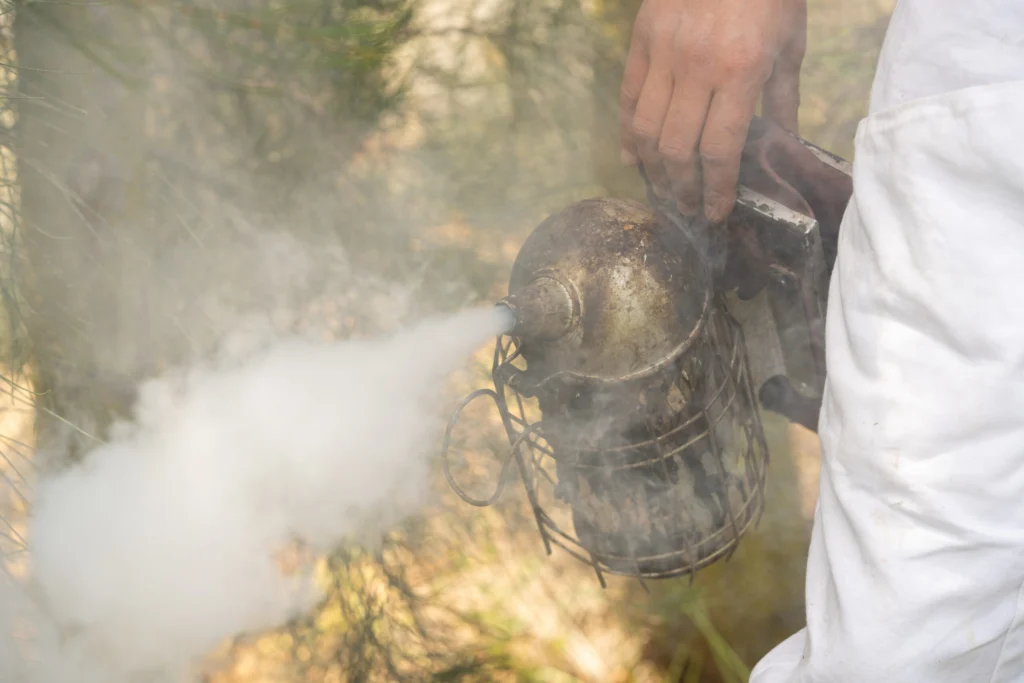
The folk explanation is that smoke convinces bees the woods are burning, so they gorge on honey and become too full to bend and sting. That is only half right, and the better half is measurable. When researchers applied smoke to honey bee antennae and recorded the antennal response to alarm pheromone, the response dropped sharply and then recovered on its own.
The application of smoke to honey bee (Apis mellifera) antennae reduced the subsequent electroantennograph response of the antennae to honey bee alarm pheromones, isopentyl acetate, and 2-heptanone. This effect was reversible, and the responsiveness of antennae gradually returned to that of controls within 10-20 min.
Two practical points fall out of that. Smoke blunts the colony’s sense of smell in general, which interrupts alarm pheromone spreading from one guard bee to the next; and the effect is temporary, roughly a quarter of an hour. If you are still in the brood nest twenty-five minutes after your first puff without re-smoking, the colony is not being stubborn. Its antennae have come back online.
A later study from the USDA Agricultural Research Service’s Carl Hayden Bee Research Center in Tucson adds a second mechanism, and it is the only peer-reviewed work we found that compares two smoker fuels directly. Stephanie Gage and colleagues gave restrained bees a mild electrical stimulus under burlap smoke, smoke from spent hops pellets, or no smoke. Bees under smoke still extended their stingers, but were less likely to release the venom droplet that accompanies sting extension. Because that droplet carries alarm pheromone, suppressing it suppresses the recruitment signal. At the lower stimulus both smokes worked about equally; at the strongest stimulus only the hops smoke still made a significant difference.
Two caveats before you buy hops: these were single bees in a lab chamber rather than colonies, and one of the five authors worked for a hop-products company. The open-access paper is Smoke Conditions Affect the Release of the Venom Droplet Accompanying Sting Extension in Honey Bees, Journal of Insect Science (2018). The fair reading is that fuel may matter at the margins, while temperature, volume and timing matter far more.
What separates good smoker fuel from bad
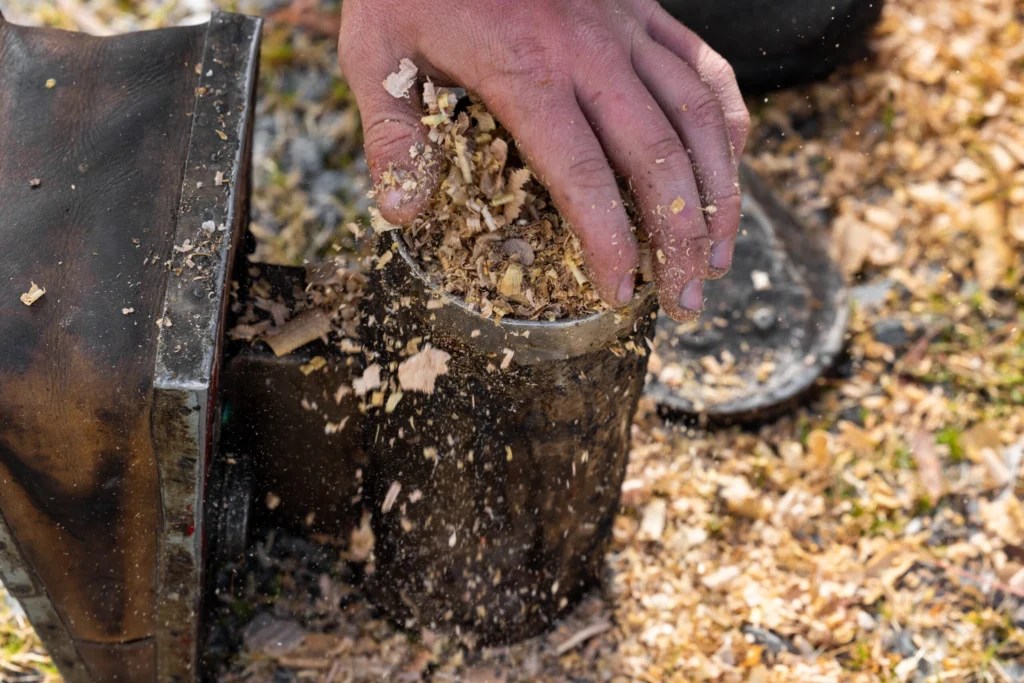
Every fuel that works shares four traits, and every fuel that disappoints fails at least one.
It smoulders rather than flames. An open flame in the firebox means the smoke leaving the spout is hot. The field check: puff a short stream onto the back of your bare hand from about six inches. If it is comfortable there, it is comfortable on the bees and on soft new wax.
It is genuinely dry. Dry fuel takes a coal quickly and holds it. Damp fuel refuses to catch, then produces an acrid, creosote-heavy smoke that bees visibly dislike and that gums up the smoker.
It packs loosely enough to breathe. A load crammed in tight with a hive tool will choke itself out within minutes no matter how good the material is.
It is chemically clean. The colony breathes what you burn and the wax absorbs it. The Mid-Atlantic Apiculture Research and Extension Consortium, run jointly by the University of Delaware, Penn State, Rutgers, Maryland and West Virginia, is blunt about the physics of cool smoke.
To produce large quantities of cool thick smoke, coals must be above the grate and unburned materials must be above the coals.
That sentence explains most smoker failures. A smoker is a two-layer system: a hot coal bed low down, and raw fuel stacked above it that the rising heat cooks into smoke. Dump everything in at once and light the top and you have a campfire in a can.
The fuels worth keeping on hand
You do not need seven fuels. You need one that lights reliably and one that burns long.
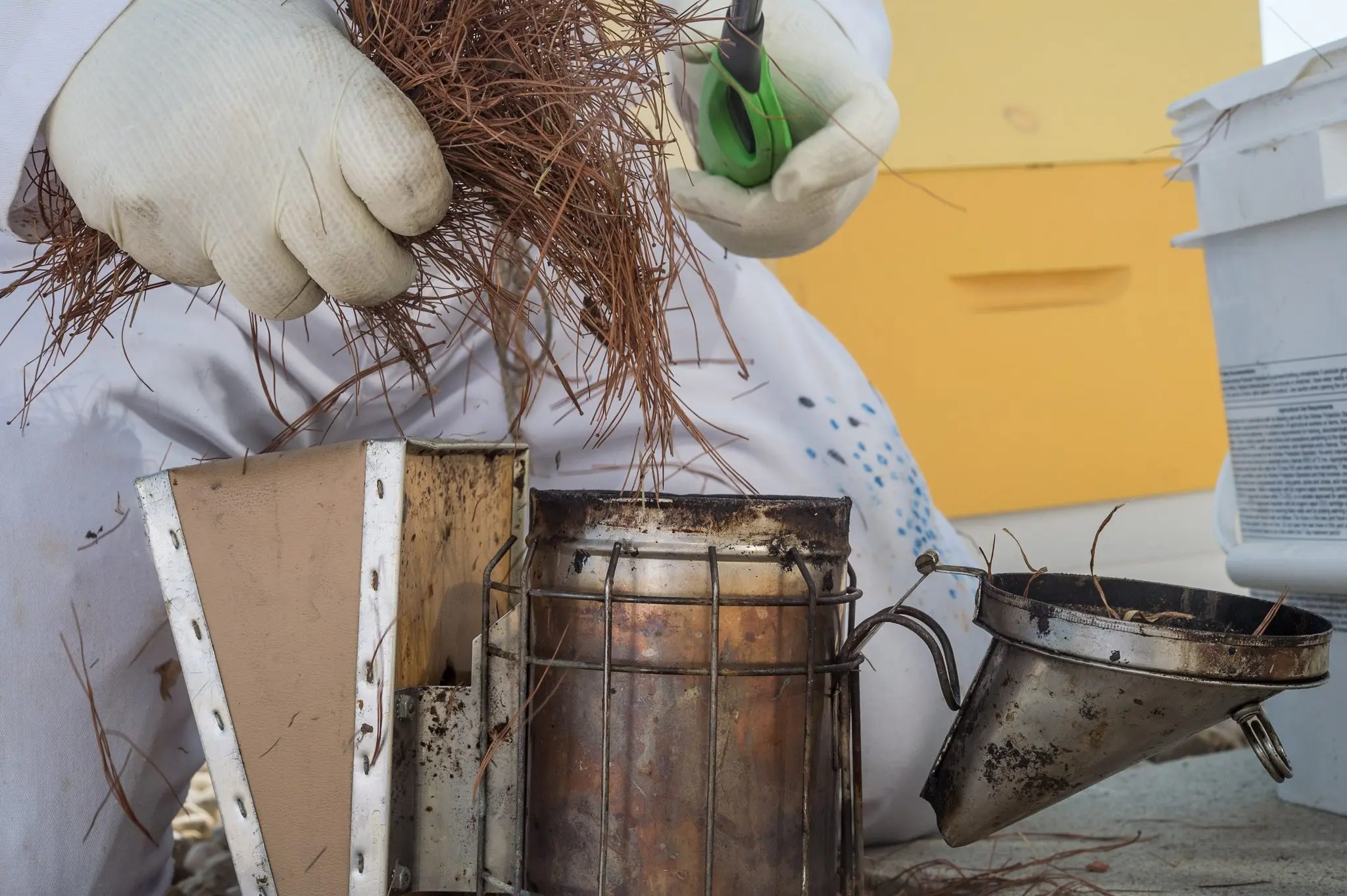
Pine needles are the national default: free, everywhere, and dense smoke almost immediately, which the test confirmed. Their weaknesses are a short burn and resin, which glazes the firebox black and narrows the spout over a season. Pine shavings sold as animal bedding behave much the same, burn even faster, and are handy where pines do not grow.
Untreated burlap is the traditional favourite because it smoulders steadily and rarely flares, but in the test it sat in the short-burning group and gave a browner, more acrid smoke than cotton: perfectly usable, just not the gentlest. Roll a strip into a cylinder leaving a finger’s gap around the firebox.
Cotton is the steady option. In the test, denim burned longest of all and held the most consistent smoke density from start to finish, though it was slower to light than the wood fuels. Wood pellets earn their keep in wet weather and on long apiary days: they store dry, gave the densest smoke of the long-burning fuels, and outlast any inspection. The trade-offs are that they are hard to light from a match, can take up to ten minutes to smoke well, and run warmer as the charge burns down. Uninked cardboard is a starter rather than a main fuel: treat it as tinder for building the coal bed and your lighting success rate climbs sharply.
Fuels to avoid, and why
Texas A&M AgriLife Extension’s rule in its Beekeeping Equipment – Tools fact sheet (ENTO-PU-179, 2025) is short: avoid painted or treated materials, or anything that may contain an insecticide. In practice that rules out:
- Pressure-treated, painted, stained or varnished wood. Burning it releases preservative compounds and, in older stock, heavy metals. There is no safe quantity in a hive.
- Plastics, foam, synthetic fabric and rubber. These melt rather than smoulder and are dangerous to you before they are dangerous to the bees.
- Printed, glossy, waxed or coloured board and paper. Inks, clay coatings and adhesives all end up in the smoke.
- Burlap of unknown history. Jute itself is a long-standing smoker fuel; the risk is what went onto or into it. New sacking may carry processing oils or a rot treatment, and used sacks carry residues of whatever they held. You cannot tell by looking, so burn sacking sold as smoker fuel or sacking you know the history of, and skip anything that smells of oil or chemicals.
- Any accelerant. Lighter fluid, petrol or starter gel is both a contamination problem and a burn risk, since the smoker often sits between your knees.
- Sawdust and fine dust. It packs airtight, burns hot when it catches, and can carry live embers down into the hive.
- Anything gathered without identifying it. Poison ivy, oak and sumac release urushiol in smoke and cause severe respiratory reactions.
Safety note: smouldering fuels produce carbon monoxide and fine particulates, synthetic materials release toxic fumes when heated, and treated or painted wood must never be burned in a smoker under any circumstances. This is practical beekeeping guidance based on field experience and published research; it is not a safety certification, a toxicology assessment, or a substitute for your local fire authority’s rules during burn restrictions.
Damp fuel and cold-weather smoking
This is the part most fuel guides skip, and in a northern climate it decides whether your smoker survives the apiary visit. Cold, damp air changes fuel behaviour in three specific ways.
Cold fuel needs more starting heat. On a forty-degree April morning, a charge of pine needles that would catch instantly in July will take the flame, glow, and quietly go out. The fix is a bigger tinder layer, not more puffing: a fuller roll of cardboard or a generous handful of shavings, burned down to real coals before any main fuel goes in.
Ambient humidity re-wets stored fuel. Fuel that was bone dry in a shed in August will have pulled moisture back out of the air by spring if it sat in a closed plastic tub or a garage that swings between freezing and thawing. Fuel stays cured only if it stays in dry, breathable storage.
Cold metal condenses smoke. A smoker body that has ridden in a cold truck bed condenses tar on its inner walls and chokes the draw within minutes. Lighting it ten minutes before you reach the first hive, so the body warms through, makes a noticeable difference.
The practical northern protocol: keep a paper sack of known-dry starter fuel in the truck year round, treat gathered pine straw as a summer luxury rather than a staple, and light the smoker before you suit up rather than after. See our guide to seasonal beekeeping tasks through the year for how fuel prep fits alongside everything else.
Lighting and packing a smoker that stays lit
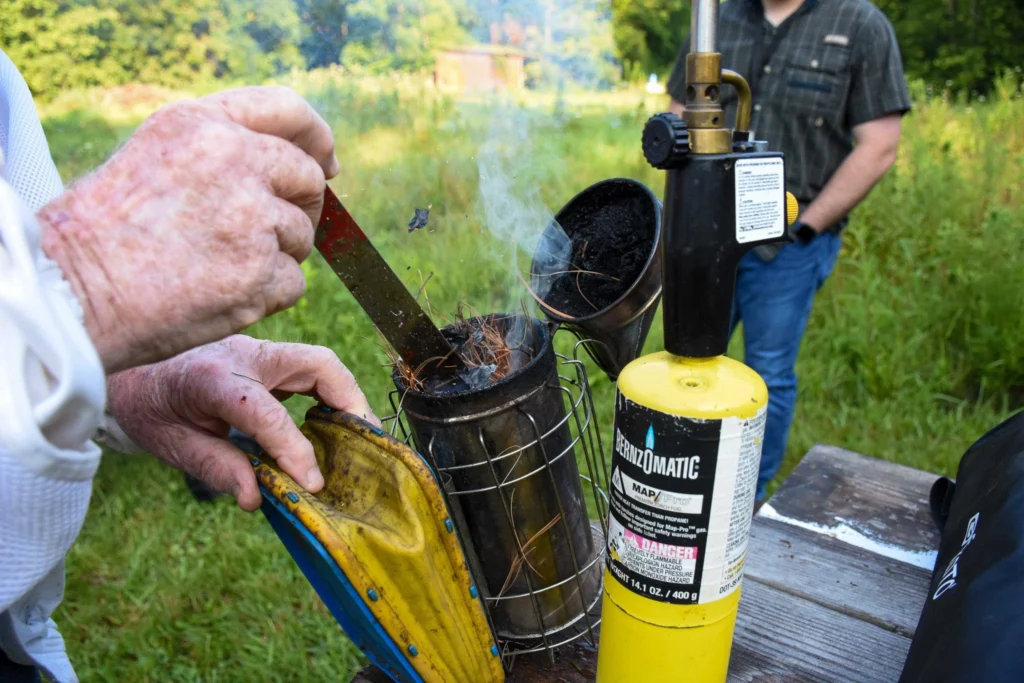
Almost every relighting problem is a layering problem. Build it in this order and it will hold for an hour.
- Drop a loose roll of tinder into the bottom of the firebox and light it.
- Puff slowly until you have a real flame, then keep puffing until that flame collapses into an orange coal bed on the grate. This is the step people rush. Give it a full minute.
- Add your main fuel in two or three handfuls, puffing between each, so the bed stays hot and the new fuel dries as it goes in.
- Press the load down lightly with the flat of a hive tool, enough to settle it, not enough to compress it.
- Close the lid and puff until the smoke is white, thick and cool on the back of your hand. Grey, thin or hot smoke means too much air and not enough fuel on top.
Dense fuels change step one. Pellets rarely catch from a match, which is why Texas A&M’s fact sheet notes they may need a propane torch: play the torch across the bottom layer while pumping, then give them time, since the test found pellets took up to ten minutes to produce dense smoke. Light a pellet smoker first, before you suit up.
At the hive, restraint beats volume. Two puffs at the entrance, thirty seconds’ wait, then two under the raised inner cover suits most colonies; our step-by-step hive inspection guide shows where smoke fits in the whole routine. Re-smoke lightly every ten minutes while the box is open, matching how long the research says the effect lasts. Over-smoking drives bees down into the frames and makes them run, and heavy smoke over open honey cells at harvest is a common reason honey ends up tasting of it; see why honey tastes smoky and how to prevent it. Timing helps as much as technique: our notes on the best time of day to inspect a hive cover when colonies are most forgiving, and different hive types want different smoking patterns, particularly horizontals where you work along a row rather than down through boxes.
Curing and storing a season’s fuel supply
Fuel gathering is a late-summer job, not an emergency job. Pine straw raked in August, spread on a tarp for a few dry days and then bagged, is worth far more than the same straw grabbed off wet ground in May.
Store fuel in paper feed sacks or open baskets, never sealed plastic. Paper lets residual moisture escape; plastic traps it and grows mould, and mouldy fuel smells foul in the smoke. Keep sacks off a concrete floor, which wicks damp upward. If you store burlap, cut and roll the charges first so each is a single lift-and-load item on inspection day. The same discipline that keeps drawn comb usable through winter applies here; see how to store frames and prevent pest damage, and our guide to starting beekeeping in the United States for where the smoker sits in a first kit.
Fire safety and ash disposal
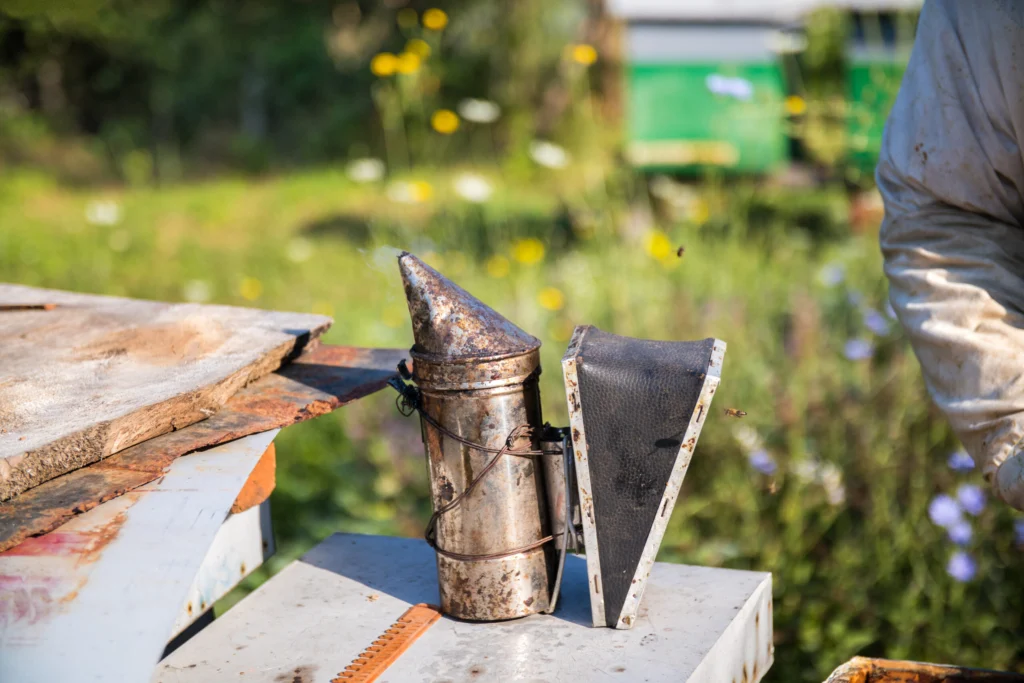
A lit smoker is an open ignition source that you will be tempted to set down in dry grass. Do not. Stand it on bare soil, a paving slab, an upturned metal lid or a purpose-built hook on the hive stand, and never leave it burning unattended, including in a vehicle.
When you finish, plug the spout and lay the smoker on its side so it starves of oxygen, or tip the contents into a metal bucket and soak them. A smoker that feels cool outside can still hold live coals deep in the fuel bed an hour later, which is how apiary fires typically start: after the beekeeper has gone home. During dry spells or declared fire restrictions, carry water to the yard and check local rules before lighting anything.
Keep the firebox clean while you are at it. Creosote scraped out monthly, an unclogged grate and bellows with no air leaks will do more for smoke quality than switching fuels ever will; a leaking bellows is the commonest hardware fault and usually a cheap repair. If the smoker itself is the problem, our bee smoker buying guide covers which firebox sizes, bellows and heat shields hold up. And if a colony stays defensive even under good cool smoke, the fuel is rarely the cause; work through how to calm aggressive bees instead.
Frequently Asked Questions
What is the best fuel for a bee smoker?
There is no single winner: in the only instrumented comparison we found, no fuel was at once the densest, coolest and longest-burning. For most hobbyists, dry pine needles or pine shavings are best, because they are free or cheap, easy to light and dense almost immediately. For long days or wet weather, plain wood pellets or 100 percent cotton burn several times longer. Many beekeepers light with needles and top up with pellets or cotton.
How do I know if my smoke is cool enough for the bees?
Puff a short stream onto the back of your bare hand from about six inches away. If it feels comfortably warm rather than stinging or scalding, it is cool enough for the colony. Hot, thin grey smoke means the fuel is flaming; add more raw fuel on top of the coal bed to cool it.
Can you use pine needles in a bee smoker?
Yes, and they are one of the most common free fuels in North America. Dry needles light from a single match and give dense white smoke within seconds. The drawbacks are a short burn and resin, which leaves creosote in the firebox and nozzle, so scrape it out monthly and top up during long inspections.
How long do smoker pellets last?
It depends mostly on how hard you puff. In the American Bee Journal test, hardwood pellets sat in the long-burning group at 36 to 43 minutes of nonstop puffing, and field-style use, a few puffs every ten minutes, stretched burn times about sevenfold. That is why published figures range from under half an hour to most of a day. Pellets can take up to ten minutes to smoke well and often need a torch to start.
Is burlap safe to burn in a bee smoker?
Untreated burlap is a long-standing smoker fuel and was usable in testing, though its smoke was more acrid than cotton’s. The risk is what was put onto or into the sacking: processing oils, rot treatments, or residues from whatever the sack held. Use burlap sold as smoker fuel or sacking whose history you know, and skip anything that smells of oil or chemicals.
Can I use newspaper or cardboard in my smoker?
As a starter, yes. Plain newsprint or uninked corrugated cardboard catches quickly and helps build the coal bed; the American Bee Journal test lit every fuel from half a sheet of crumpled newspaper. Neither makes a good main fuel alone because both burn fast, and glossy, coated, waxed or heavily printed paper and board should stay out of the smoker entirely.
Why does my smoker keep going out during inspections?
Nearly always damp fuel, packing that is too tight, or a coal bed that was never properly established before the main fuel went in. Leaking bellows are the fourth cause. Light the tinder, burn it down to glowing coals on the grate, then add fuel in stages rather than filling the firebox at once.
Do herbs or hops calm bees better than ordinary fuel?
Possibly a little, but the evidence is thin. The one lab study comparing fuels found smoke from spent hops pellets still reduced venom-droplet release at a stimulus where burlap smoke no longer did, but it used restrained single bees, not colonies. We found no published evidence that lavender or other garden herbs calm bees beyond ordinary smoke. Treat aromatic additives as a pleasant extra mixed into a bulkier fuel, not a substitute for good technique.