Reviewed by Elena P. · How we review
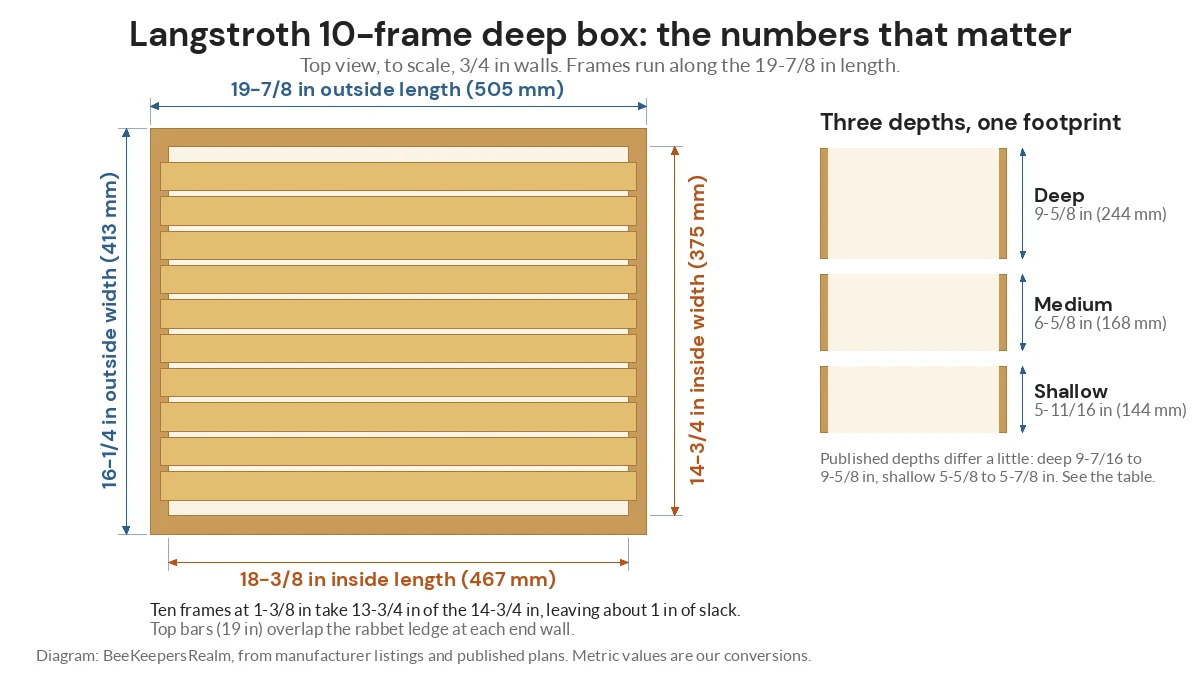
A standard 10-frame Langstroth box measures 19-7/8 by 16-1/4 inches outside and 18-3/8 by 14-3/4 inches inside, in three depths: deep 9-5/8 inches, medium 6-5/8 and shallow 5-11/16. An 8-frame box keeps the length and narrows to about 13-3/4 inches outside. No official standard fixes these numbers, so published sizes differ by up to 1/4 inch on depth. This page shows who says what, then turns the figures into a cut list.
For why this hive became the default, see the Langstroth hive explained. For choosing a width, see 8-frame vs 10-frame hives.
Key Takeaways
- With 3/4-inch walls, a 10-frame box is 19-7/8 x 16-1/4 inches outside and 18-3/8 x 14-3/4 inside. An 8-frame box is 13-3/4 inches wide outside and 12-1/4 inside.
- Depths are 9-5/8 (deep), 6-5/8 (medium) and 5-11/16 inches (shallow). Frames are 9-1/8, 6-1/4 and 5-3/8 inches tall, all with a 19-inch top bar.
- There is no recognised standard. Deep boxes run from 9-7/16 to 9-5/8 inches across extension plans, a 1967 USDA drawing and current catalogs, so buy each hive’s boxes from one maker.
- US lumber is thinner than its name. A 1×12 is 11-1/4 inches wide and rips to a 9-5/8-inch deep box; a 1×10 is 9-1/4 and falls short.
- The frame rest is a rabbet 5/8 inch tall and 3/8 inch deep, which makes the span between frame-rest ledges 19-1/8 inches.
Table of Contents
- Langstroth Box Dimensions at a Glance
- How Inside and Outside Sizes Connect
- Frame Sizes Behind the Box Depths
- Bee Space: The Gap Behind the Numbers
- Where Published Sizes Disagree
- Build One: A Cut List From Real US Lumber
- Metric Sizes and Other Countries
- Frequently Asked Questions
- The Bottom Line
Langstroth Box Dimensions at a Glance
These are the figures most US suppliers share for boxes with 3/4-inch walls. Outside sizes come from manufacturer listings. Inside sizes subtract two walls.
| Measure | 10-frame | 8-frame |
|---|---|---|
| Outside length | 19-7/8 in (505 mm) | 19-7/8 in (505 mm) |
| Outside width | 16-1/4 in (413 mm) | 13-3/4 in (349 mm) |
| Inside length | 18-3/8 in (467 mm) | 18-3/8 in (467 mm) |
| Inside width | 14-3/4 in (375 mm) | 12-1/4 in (311 mm) |
| Frames per box | 10 | 8 |
Mann Lake’s assembled deep box lists 16-1/4 by 19-7/8 inches outside. Betterbee gives the same length with widths of 16-1/4 inches (10-frame) and 13-3/4 inches (8-frame). Inside sizes are our arithmetic (19-7/8 minus 1-1/2 is 18-3/8; 16-1/4 minus 1-1/2 is 14-3/4; 13-3/4 minus 1-1/2 is 12-1/4), and the 10-frame figures match those published by Carolina Honeybees. Metric values are our conversions.
| Box | Depth | Frame height | Foundation sheet | Inside volume, 10-frame | Inside volume, 8-frame |
|---|---|---|---|---|---|
| Deep | 9-5/8 in (244 mm) | 9-1/8 in (232 mm) | 8-1/2 in | 42.7 L | 35.5 L |
| Medium (Illinois) | 6-5/8 in (168 mm) | 6-1/4 in (159 mm) | 5-5/8 in | 29.4 L | 24.4 L |
| Shallow | 5-11/16 in (144 mm) | 5-3/8 in (137 mm) | 4-3/4 in | 25.3 L | 21.0 L |
Depths and frame heights for deep and medium match Mann Lake and Dadant listings; the 5-11/16-inch shallow is the Betterbee, Dadant and Carolina Honeybees size (Mann Lake sells a 5-5/8-inch shallow). Foundation heights are from Mann Lake’s frame notes. Volumes are our arithmetic: inside length x inside width x depth.
This June 2024 video from the UF Honey Bee Lab puts names to the parts these numbers belong to. Its chapters run through the history of the hive, telescoping and migratory lids, boxes and supers, mediums, queen excluders, deeps and bottom boards.
How Inside and Outside Sizes Connect
Every number above is built from the inside out. Frames must fit inside, and the walls add thickness around them. Carolina Honeybees points out that most plans assume 3/4-inch boards and that other thicknesses throw the measurements off. Betterbee sells both 3/4-inch and 7/8-inch walls, so if you build from thicker boards, hold the inside size and let the outside grow.
Frames hang from a rabbet cut along the inside top of the two end walls. Betterbee specifies the frame-rest rabbet as 5/8 inch high by 3/8 inch deep, and Howland Blackiston’s plans give the same cut. Each 19-inch top bar therefore rests on a ledge 3/8 inch wide at both ends, and the span between ledges is 19-1/8 inches: 18-3/8 plus 3/8 plus 3/8.
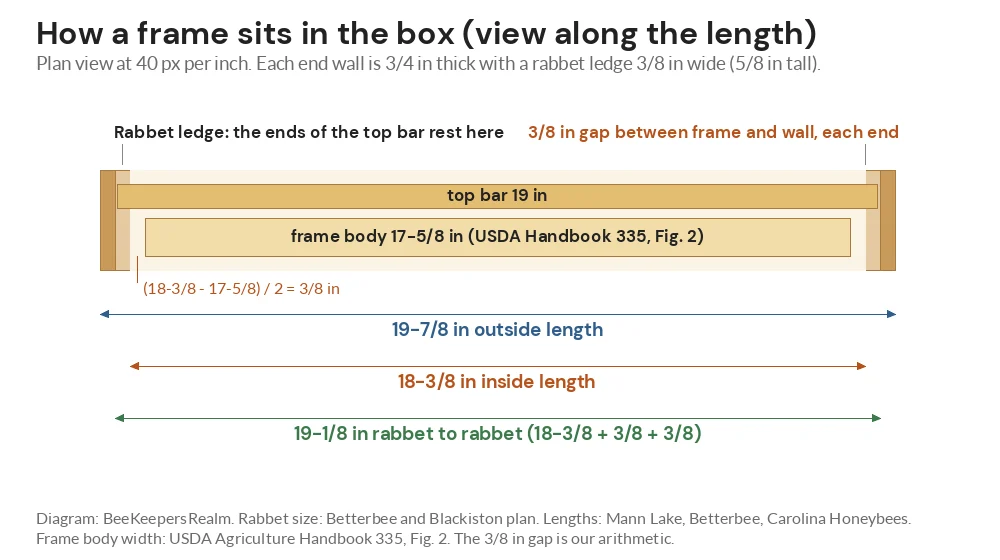
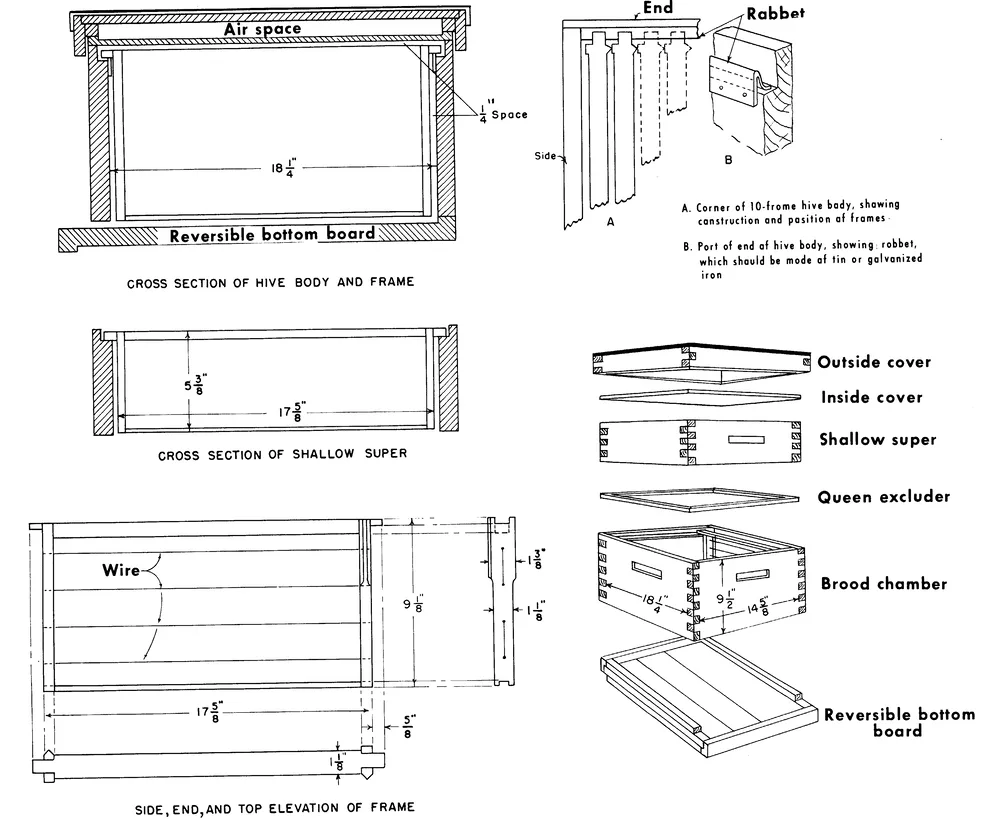
The 19-1/8-inch span is the steadier number. The University of Tennessee Extension plan cuts a 7/16-inch ledge and a shorter 18-1/4-inch inside length, yet it still gives 19-1/8 inches at the frame ends. Frame bodies are about 17-5/8 to 17-11/16 inches long (the USDA drawing and the Tennessee plan), which leaves roughly 3/8 inch at each end of an 18-3/8-inch box.
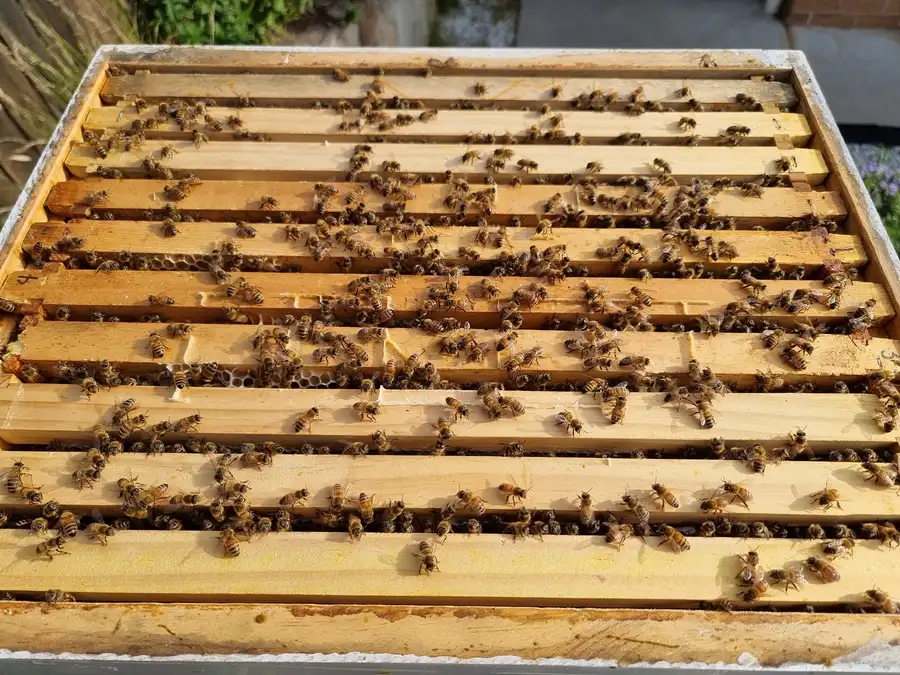
Across the width, ten frames at 1-3/8 inches take 13-3/4 of the 14-3/4 inches, which leaves about an inch of slack. Frame spacing for straight comb explains what to do with it.
Frame Sizes Behind the Box Depths
Frames are the same 19 inches long in every depth; only the end bars change. The University of Tennessee plan gives a top bar of 3/4 by 1-1/16 by 19 inches and end bars 1-3/8 inches wide, which is why frames space themselves at 1-3/8 inches when pushed together. For wedge and grooved bars and plastic frames, see beehive frame types; for choosing a depth, see deep vs medium frames.
What changes between sources is the clearance left under the frame. A 9-1/8-inch deep frame sits in a 9-5/8-inch box at Mann Lake (1/2 inch of total clearance), a 9-1/2-inch box at Betterbee (3/8) and a 9-7/16-inch box in the Tennessee plan (5/16). The Scottish Beekeepers’ sheet, reproducing a 1967 UK leaflet, makes the deep 9-9/16 inches, 7/16 inch deeper than its frames, to leave a 1/4-inch bee space above them and a small gap below for shrinkage.
Bee Space: The Gap Behind the Numbers
Every Langstroth measurement exists to keep one gap open, roughly 1/4 to 3/8 inch, which bees neither fill with comb nor seal with propolis. The USDA drawing below marks a 1/4-inch space beside the frame ends. Blackiston treats 3/8 inch as ideal and adds that gaps under 1/4 inch get sealed with propolis and gaps over 1/2 inch fill with comb. He also notes that US equipment uses top bee space, with the passage above the frames, where UK hives traditionally use bottom bee space, and that the two cannot be mixed in one hive.
“A Langstroth hive would have a 5/16- or 3/8-inch space separating each frame and the frames from all other hive parts.”
The history of the discovery is in the history of the Langstroth hive.
Where Published Sizes Disagree
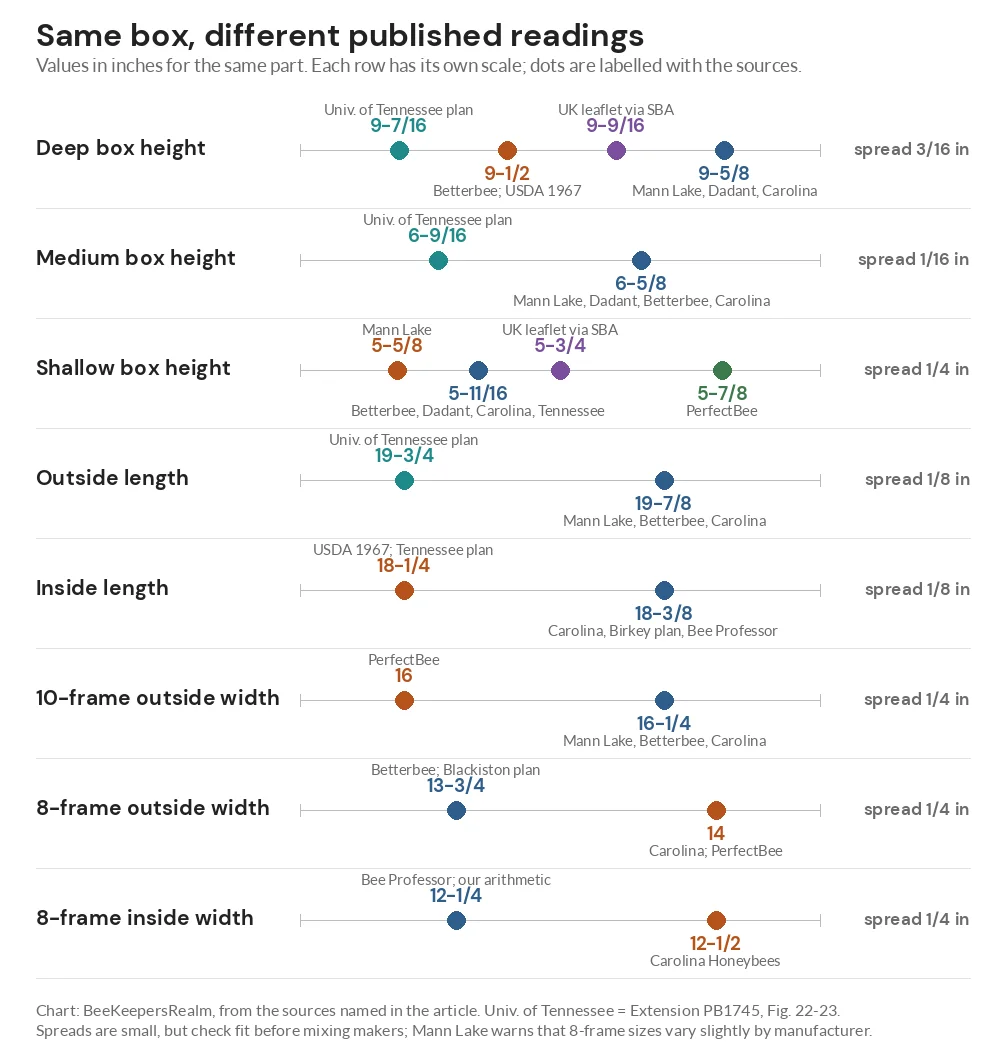
We compared manufacturer listings, two published plans, a university extension plan, a 1967 USDA drawing and several guides. Medium boxes are nearly unanimous; deep and shallow boxes are not.
| Part | Published values and who gives them | Spread |
|---|---|---|
| Deep box depth | 9-5/8: Mann Lake, Dadant, Carolina Honeybees. 9-1/2: Betterbee, USDA 1967. 9-9/16: UK leaflet. 9-7/16: Tennessee plan. | 3/16 in |
| Medium box depth | 6-5/8: Mann Lake, Dadant, Betterbee, Carolina Honeybees. 6-9/16: Tennessee plan. | 1/16 in |
| Shallow box depth | 5-5/8: Mann Lake. 5-11/16: Betterbee, Dadant, Carolina Honeybees, Tennessee plan. 5-3/4: UK leaflet. 5-7/8: PerfectBee. | 1/4 in |
| Outside length | 19-7/8: Mann Lake, Betterbee, Carolina Honeybees. 19-3/4: Tennessee plan. | 1/8 in |
| Inside length | 18-3/8: Carolina Honeybees, Birkey plan, Bee Professor. 18-1/4: USDA 1967, Tennessee plan. | 1/8 in |
| 8-frame outside width | 13-3/4: Betterbee, Blackiston. 14: Carolina Honeybees, PerfectBee. | 1/4 in |
“there is no recognised standard to which to refer for constructional details for these hives.”
Search summaries can make this worse. On 22 October 2026 Google’s AI summary for “langstroth hive dimensions” listed frames 19-1/8 inches long and a shallow frame 4-3/4 inches tall. Manufacturers list 19 inches and 5-3/8 inches; 19-1/8 is the span between ledges, and 4-3/4 is the shallow foundation sheet. Its summary for “how to build a langstroth hive” gave the rabbet as 3/4 inch deep and 3/8 inch wide, the reverse of Betterbee’s 5/8 inch high by 3/8 inch deep.
In practice, buy all the boxes for one hive from one maker and check inside length and width before ordering frames. Mann Lake warns that 8-frame sizes “vary slightly by manufacturers.” If you build, match your own frames to the inside size, not to a catalog.
Build One: A Cut List From Real US Lumber
Lumber is sold by nominal size, and the finished board is smaller. A 1×12 is 3/4 by 11-1/4 inches, a 1×10 is 9-1/4, a 1×8 is 7-1/4 and a 1×6 is 5-1/2, per ArchToolbox’s table of American Softwood Lumber Standard sizes. A 9-5/8-inch deep box therefore cannot come from a 1×10, which is 3/8 inch short. Use a 1×12 and rip it.
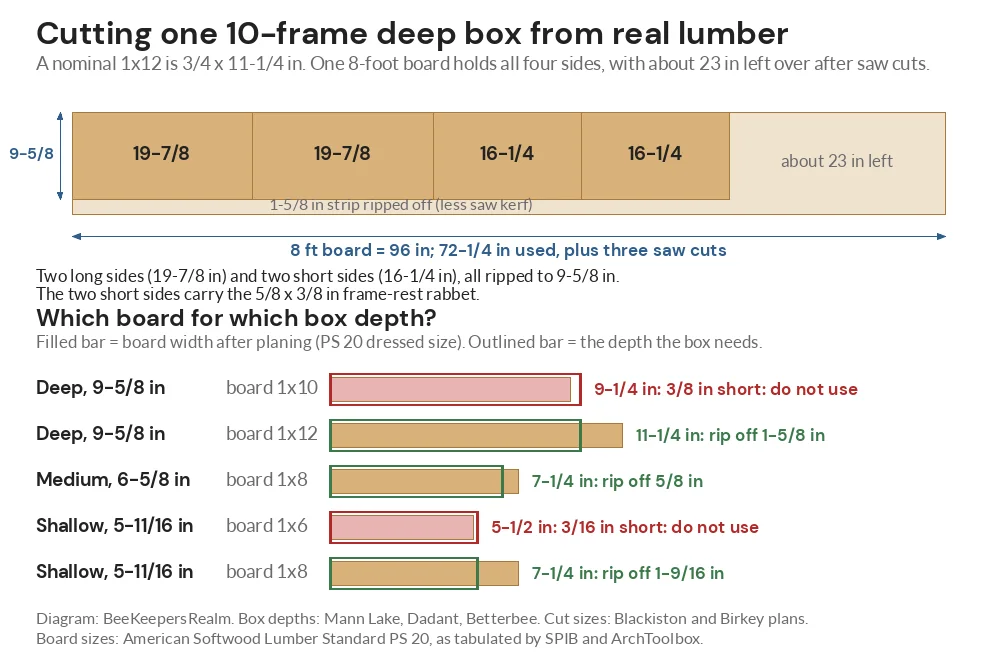
The cut list below follows Howland Blackiston’s ten-frame and eight-frame plans for 3/4-inch stock and agrees with a 1998 plan by Barry Birkey, which gives the same 18-3/8 by 14-3/4 by 9-5/8 inside deep body. Sizes are finished sizes, per box. Blackiston lists deep-box quantities for two boxes; halve them.
| Part (per box) | Qty | 10-frame size | 8-frame size | Notes |
|---|---|---|---|---|
| Long sides | 2 | 19-7/8 x D x 3/4 in | 19-7/8 x D x 3/4 in | D is 9-5/8 (deep) or 6-5/8 (medium). Rabbet-joint version: 19-1/8 in long. |
| Short sides | 2 | 16-1/4 x D x 3/4 in | 13-3/4 x D x 3/4 in | Cut a 5/8 x 3/8 in rabbet along the inside top edge. |
| Hand rails | 2 | 16-1/4 x 1-7/8 x 3/4 in | 13-3/4 x 1-7/8 x 3/4 in | Handholds fixed to the short sides. |
For the simpler rabbet joint, Blackiston cuts a 3/4-inch-wide, 3/8-inch-deep rabbet at each corner of the short sides and shortens the long sides to 19-1/8 inches: 19-1/8 plus 3/8 plus 3/8 is 19-7/8. The bottom board is a separate small build.
| Bottom board part | Qty | 10-frame | 8-frame |
|---|---|---|---|
| Side rails | 2 | 22 x 1-7/8 x 3/4 in | 22 x 1-7/8 x 3/4 in |
| Rear rail | 1 | 15-1/2 x 1-7/8 x 3/4 in | 13 x 1-7/8 x 3/4 in |
| Entrance reducer | 1 | 14-5/8 x 3/4 x 3/4 in | 12-1/8 x 3/4 x 3/4 in |
| Floor, exterior plywood | 1 | 21-5/8 x 15-1/2 x 3/4 in | 21-5/8 x 13 x 3/4 in |
- Cut the boards to length, then rip them to depth. Add a little saw kerf allowance and trim to final size after the joints are cut.
- Cut the corner joints. Birkey’s plan cuts the box joints first, then the 5/8 x 3/8 rabbet on the short boards, stopping just short of the joint pins.
- Pre-drill, glue and nail the corners. Birkey specifies 6d galvanized nails; Blackiston specifies weatherproof wood glue plus nails. See the best glue for hive boxes.
- Fix the hand rails and fill holes. Corner joints are the usual failure point; repairing hive boxes shows what loose ones look like.
- Test-fit a real frame. The top bar should rest on both ledges with about 3/8 inch to spare at each end.
- Paint or wax-dip the finished box before bees move in; see wax dipping beehive boxes.
Winter is when many people cut boxes, and spare boards make a good next job: a moisture board is cut to the box’s outside size.
Metric Sizes and Other Countries
The US numbers in millimeters are in the tables above; they are conversions, not a metric standard. Other countries differ. The Scottish Beekeepers Association’s sheet, based on a 1967 UK leaflet, uses 7/8-inch timber, 20 by 16-1/4 inches outside and 18-1/4 by 14-1/2 inside, and Bee Professor lists inner widths from 362 mm (Australia and New Zealand) to 380 mm (Canada). Check the local maker’s sizes before cutting.
Frequently Asked Questions
What are the dimensions of a standard 10-frame Langstroth beehive?
Each box is 19-7/8 by 16-1/4 inches outside and 18-3/8 by 14-3/4 inside. Depth is 9-5/8 inches for a deep, 6-5/8 for a medium and 5-11/16 for a shallow.
What are the dimensions of a Langstroth 8-frame hive?
The same length and depths as a 10-frame box, about 13-3/4 inches wide outside and 12-1/4 inside. Some sources round the outside width to 14 inches.
What are the inside dimensions of a Langstroth box?
For 3/4-inch walls, 18-3/8 by 14-3/4 inches for 10 frames and 18-3/8 by 12-1/4 for 8 frames. Older plans give 18-1/4 inches for the length.
What size lumber do I need to build a Langstroth box?
A 1×12 (11-1/4 inches actual) for a deep, ripped to 9-5/8. A 1×8 (7-1/4) for a medium, ripped to 6-5/8. A 1×10 is too narrow for a deep.
How wide is bee space in a Langstroth hive?
About 1/4 to 3/8 inch. The University of Tennessee Extension plan spaces frames 5/16 or 3/8 inch from all other parts.
Is there a Langstroth standard in metric?
Not an official one. The Scottish Beekeepers Association says there is no recognised standard, and sizes in other countries differ from US inches.
Is it cheaper to build your own beehive?
Not automatically. A deep box takes one 8-foot 1×12 plus glue and nails, so compare today’s lumber price with an unassembled box and count the tools you would need to buy.
The Bottom Line
Use 19-7/8 by 16-1/4 outside and 18-3/8 by 14-3/4 inside for a 10-frame box, and 13-3/4 outside width for an 8-frame, then verify against the maker whose frames and boxes you will buy. Before you cut, check that the 1×12 you bought really is 11-1/4 inches wide.