Reviewed by Michael R. · Last Updated October 12, 2026 · How we review
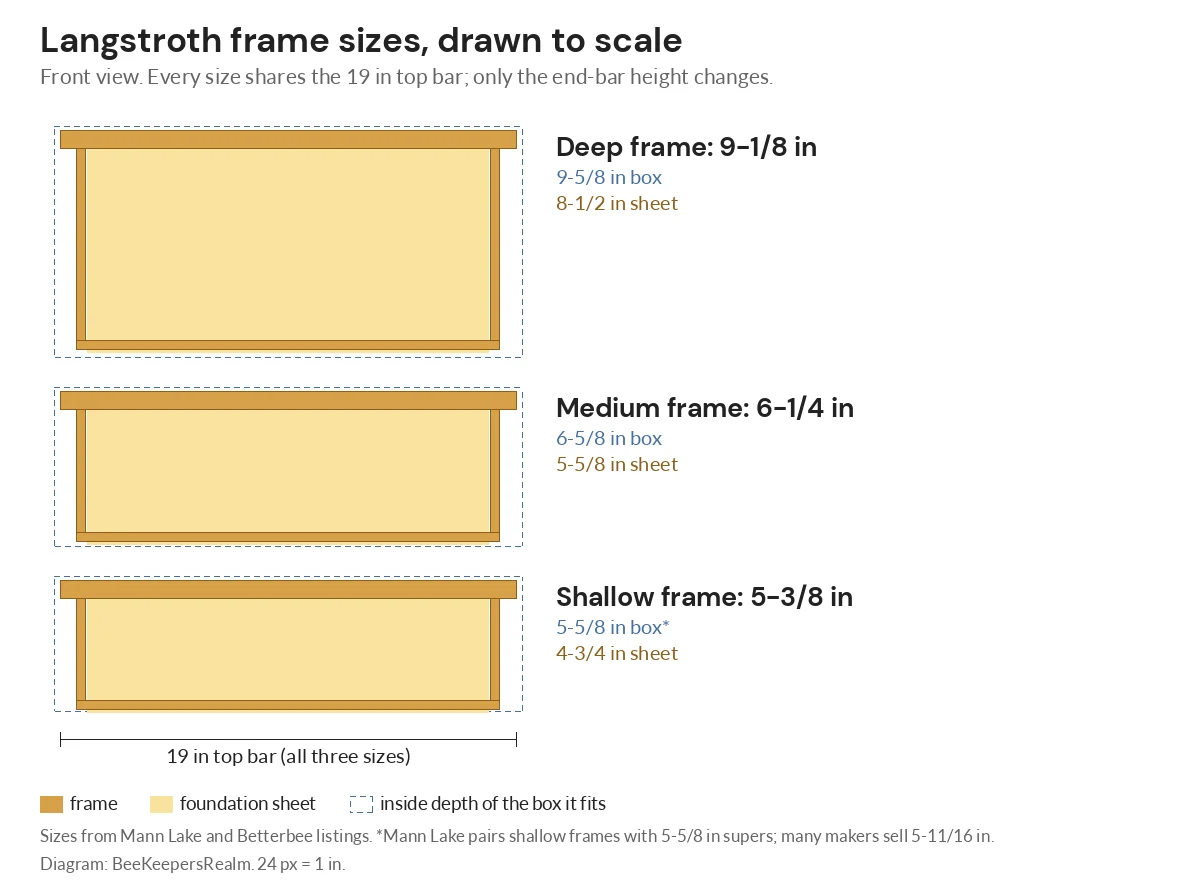
Beehive frames come in three standard Langstroth depths: deep (9-1/8 inches), medium (6-1/4 inches) and shallow (5-3/8 inches), all on the same 19-inch top bar. They are made of wood or one-piece plastic, and wooden frames come with a wedge or grooved top bar that decides which foundation fits. Choose the depth to match your boxes first, then the material and top bar to match your foundation.
This guide covers frames for the Langstroth hive used by most US beekeepers. For other designs, start with our overview of beehive types for US beekeepers, and for the hive itself, see why the Langstroth hive became the standard.
Key Takeaways
- Deep frames (9-1/8 in) fit 9-5/8 in boxes, mediums (6-1/4 in) fit 6-5/8 in boxes, and shallows (5-3/8 in) fit shallow supers of 5-5/8 to 5-11/16 in, depending on the maker.
- Every Langstroth frame shares a 19-inch top bar; only the end-bar height changes, so a frame must match the box depth, not just the hive.
- Wedge top bars are made for wax foundation; grooved top and bottom bars are made for plastic foundation. One-piece plastic frames have the foundation molded in.
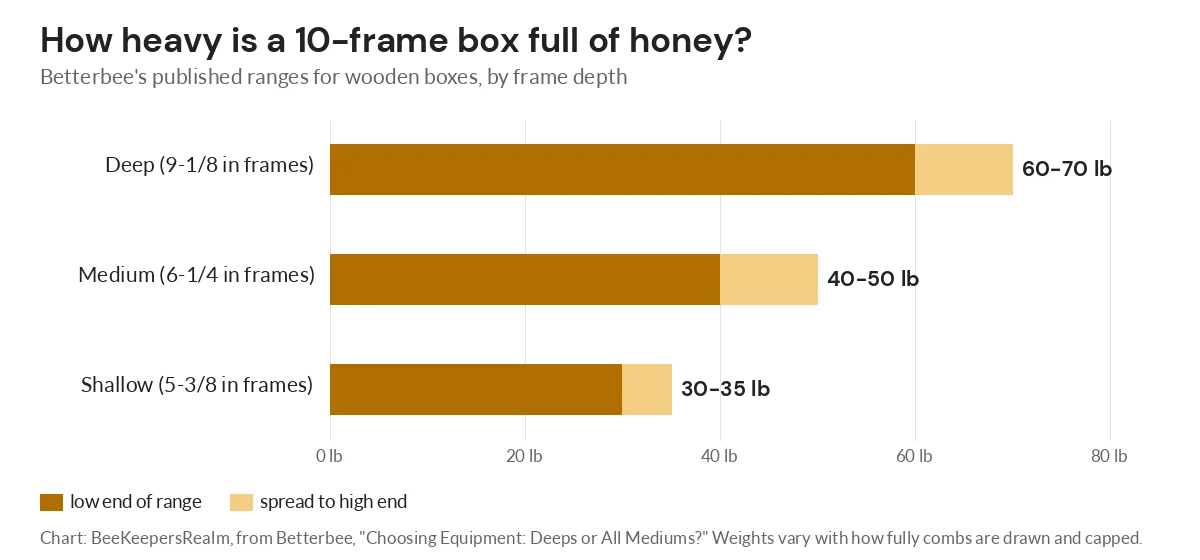
- Box weight, not bee preference, is the main reason to pick one depth over another. A full deep weighs 60 to 70 lb, a full medium 40 to 50 lb.
- Controlled trials found that small-cell comb does not lower Varroa mite loads, so frame choice is not a mite treatment.
Table of Contents
- Langstroth Frame Sizes and the Boxes They Fit
- Video: Assembling Three Kinds of Frames
- Deep, Medium and Shallow: What Each Depth Is For
- Top Bars and Bottom Bars: Wedge, Grooved and Split
- Wooden Frames vs One-Piece Plastic Frames
- Foundation, Starter Strips or Foundationless
- How Many Frames Go in Each Box
- Frames in Other Hive Types
- Which Frames to Buy
- Frequently Asked Questions
Langstroth Frame Sizes and the Boxes They Fit
A Langstroth frame has a top bar, two end bars and a bottom bar, and the top bar is the same length on every size. Betterbee lists its unassembled deep frames at 19 inches long by 9-1/8 inches high and its mediums at 19 by 6-1/4 inches, and an FAO beekeeping manual gives the same 19-inch top bar, with end bars 1-3/8 inches wide. That end-bar width is what spaces frames at 1-3/8 inches center to center when they are pushed together.
The table collects sizes from manufacturers’ own listings, so you can match frames, boxes and foundation before you buy.
| Frame | Frame depth | Box it fits (inside depth) | Foundation sheet height | Usual job |
|---|---|---|---|---|
| Deep | 9-1/8 in | 9-5/8 in | 8-1/2 in | Brood nest |
| Medium | 6-1/4 in | 6-5/8 in | 5-5/8 in | Honey, or brood in an all-medium hive |
| Shallow | 5-3/8 in | 5-5/8 in (Mann Lake); 5-11/16 in (common) | 4-3/4 in | Honey, comb honey |
| All sizes | 19 in top bar | 10-frame box: 18-3/8 x 14-3/4 in inside, 19-7/8 x 16-1/4 in outside | – | – |
Sources: box and foundation pairings from Mann Lake’s listings for its deep frames, medium super and shallow frames, and outside size from its 10-frame deep box; inside size and the 5-11/16 in shallow from Master Beekeeper Charlotte Anderson of Carolina Honeybees.
The shallow-super catch
Deep and medium sizes agree across the listings we checked. Shallow supers do not: Mann Lake tells buyers of its 5-3/8 in frames to use 5-5/8 in supers, while other makers and guides list shallow boxes at 5-11/16 in. That leaves 1/4 or 5/16 in under a 5-3/8 in frame, both within bee space, so the frame works in either box. Just don’t assume two makers’ shallow boxes are identical when you order more.
Video: Assembling Three Kinds of Frames
In this 21-minute video from 2018, John of The Bee Store in Lake Ridge, Virginia, walks through three frame setups in this order: plastic foundation, wired wax foundation and pure wax foundation. The video’s description calls plastic the easiest and pure wax the most work, and the closing chapter suggests trying all three to see which your bees prefer.
Deep, Medium and Shallow: What Each Depth Is For
Bees will build comb and raise brood in any depth. The real difference is what a full box weighs.
“The chief reason to choose one box size over another is their weight once the bees have filled them.”
Deep frames (9-1/8 in)
Deeps are the traditional brood frame. Two deep boxes give the queen 20 large combs in a short stack, which is the “standard” setup Betterbee describes: deeps for brood, mediums for supers. The trade-off is weight: Betterbee puts a wooden 10-frame deep full of honey at 60 to 70 pounds.
Medium frames (6-1/4 in)
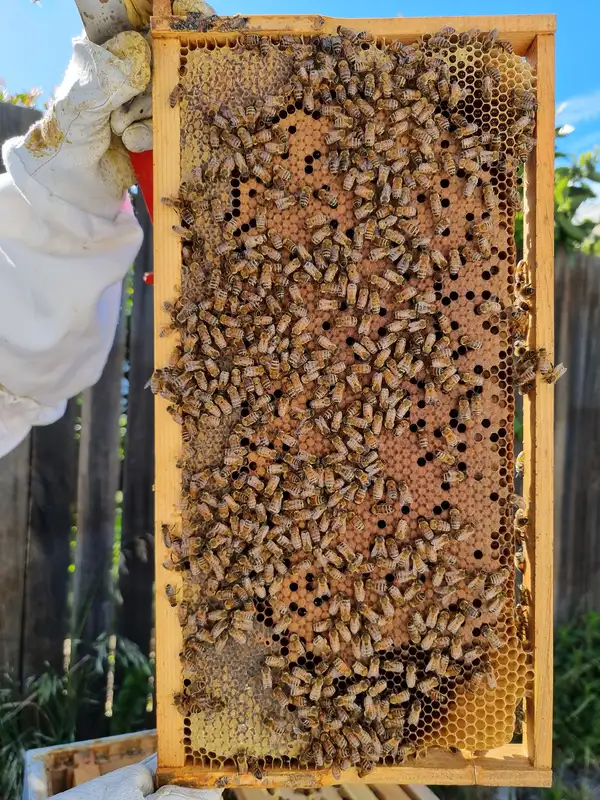
Mediums are the most flexible size. The 6-5/8 in box they fit is sometimes called an Illinois super. A full 10-frame medium weighs 40 to 50 pounds by Betterbee’s figures. Many beekeepers now run mediums for everything, brood included, so every frame fits every box. Betterbee counts three mediums as roughly equal to two deeps of brood space, then adds three or four more mediums for honey. Our comparison of deep vs medium frames for the brood nest covers the trade-offs in detail.
Shallow frames (5-3/8 in)
Shallows are the lightest option, about 30 to 35 pounds for a full wooden 10-frame box. They are used almost entirely for honey supers, including cut-comb honey. Nothing stops bees raising brood in them, but a brood nest in shallows means many more boxes and frames to inspect.
Top Bars and Bottom Bars: Wedge, Grooved and Split
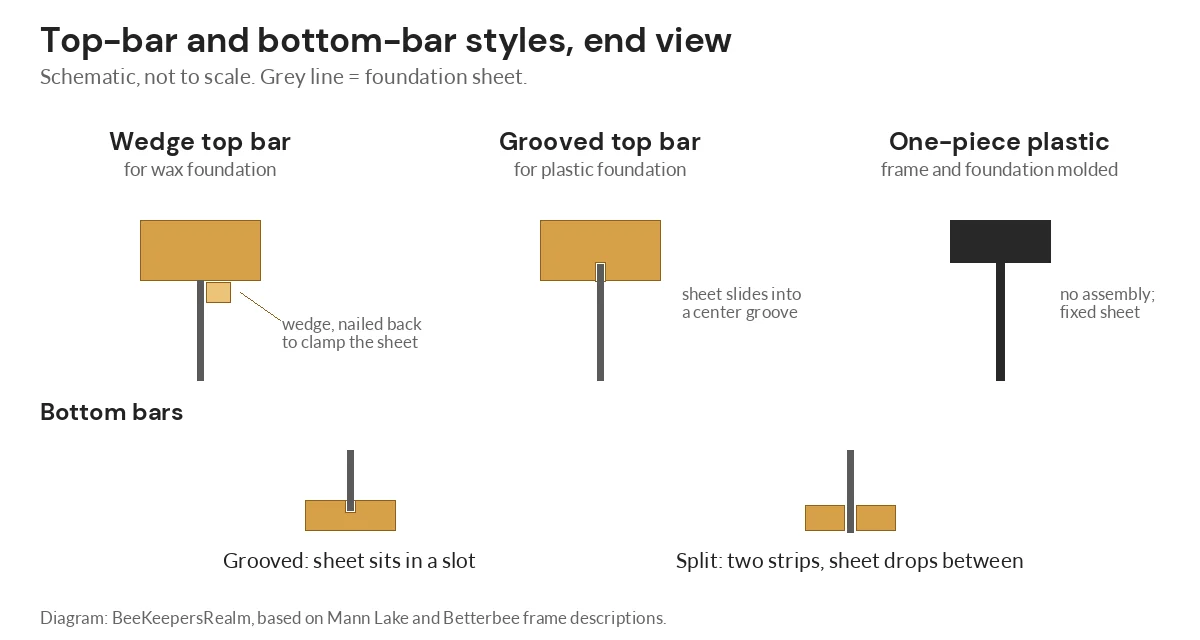
Wooden frames are sold by bar style as well as depth; Mann Lake sells groove/groove, wedge/groove and wedge/split versions of the same frame. The style decides how the foundation is held.
Wedge top bar
A wedge top bar has a thin strip that you snap off, set the foundation against, and nail back in place to clamp the sheet. Mann Lake explains that the wedge exists to support wax foundation, which also needs support from wire, support pins or both.
“Wedged Top Bars are best for pure beeswax foundation.”
Grooved top bar
A grooved top bar has a slot down the center. A rigid plastic sheet slides into the bottom groove and pops into the top one, with no nails or wire. Mann Lake says its groove top bars are best for its plastic Rite-Cell foundation.
“Choose groove/groove frames so you have top and bottom slots for the foundation.”
Grooved and split bottom bars
A grooved bottom bar holds the lower edge of the sheet in a slot and works with any foundation, which is why Betterbee builds its eastern white pine frames with a single grooved bottom bar and a choice of top bar. A split bottom bar is two thin strips with a gap that the sheet drops into; Mann Lake sells it paired with a wedge top. Mann Lake’s bottom bars are a full 1/2 inch thick, which it says means fewer blowouts in the extractor. More detail: grooved vs wedged top bar frames.
Wooden Frames vs One-Piece Plastic Frames
Wooden frames
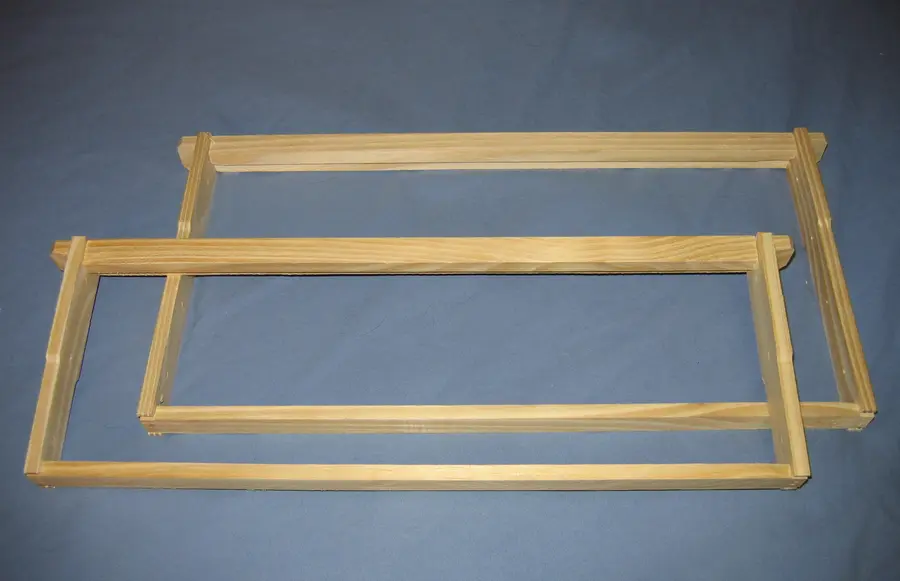
Most wooden frames are pine; Betterbee builds its frames only from eastern white pine. Wood takes every kind of foundation, from wired wax to plastic to a bare starter strip, and a broken end bar can be replaced. Kits need gluing and nailing, and the end bars must have pre-drilled holes if you plan to wire them.
One-piece plastic frames
A one-piece plastic frame is molded with its foundation as a single unit, so there is nothing to assemble. Acorn’s version, sold by Foxhound Bee Company, comes in 9-1/8 in deep and 6-1/4 in medium sizes that fit 9-5/8 in and 6-5/8 in boxes, carries a heavy double coat of beeswax, and has a 4.9 mm cell. Deep frames ship 52 to a case and mediums 72.
The limits: the foundation cannot be swapped, wax foundation cannot be used, and a frame that warps or cracks is replaced whole. The wax coating matters; Mann Lake says its pre-waxed plastic foundation promotes “quick acceptance by bees.” If you are weighing the sheet itself rather than the frame, see plastic vs wax foundation.
| Wooden frame | One-piece plastic frame | |
|---|---|---|
| Assembly | Kit or pre-assembled | None |
| Foundation | Any: wax, plastic or none | Molded in; plastic only |
| Repair | Replace bars or ears | Replace whole frame |
| Wiring | Needed for wax sheets | Never |
| Best for | Wax or foundationless comb, mixed setups | Speed, extracting, large numbers of frames |
Foundation, Starter Strips or Foundationless
Foundation is the embossed sheet that shows bees where to build. A wooden frame takes any of three options.
- Wax foundation. Pure beeswax that bees accept quickly but that sags without support. Use a wedge top bar plus wire or support pins; our step-by-step on wiring wax foundation into frames shows how. Some beekeepers make their own sheets; see making wax foundation at home.
- Plastic foundation. A rigid sheet, usually wax-coated, that slides into grooved bars and survives the extractor.
- Foundationless. An empty frame with a guide along the top bar, such as a wooden strip or a narrow strip of wax, so the bees draw natural comb. It needs a level hive and early checks for crooked comb. Our guide to foundationless frames for honey supers covers wiring and extraction.

Does natural or small-cell comb control mites?
A common claim is that foundationless frames, or small-cell foundation, help against Varroa mites because the bees build smaller cells. Controlled trials have not supported it. In a Cornell study published in Apidologie in 2011, Thomas D. Seeley and S. R. Griffin paired seven colonies on standard 5.4 mm comb with seven on small-cell 4.8 mm comb and found no difference in mite loads over a summer. A Georgia study by Berry, Owens and Delaplane, published in the same journal in 2010, reached the same conclusion. Choose foundation for comb quality and convenience; manage mites separately.
How Many Frames Go in Each Box
A 10-frame box holds 10 frames and an 8-frame box holds 8, in all three depths. The arithmetic is simple: 10 frames at 1-3/8 inches each take 13-3/4 inches of a 14-3/4-inch inside width, leaving about 1 inch of play for lifting the first frame out. That is also why an empty slot is a problem: bees fill gaps wider than bee space with comb, which Betterbee puts at about 5/16 of an inch. See our frame spacing rules for straight comb before running fewer frames than the box holds.
Frames are identical in both widths; see our 8 frame vs 10 frame hive comparison for weights and which parts fit both.
Frames in Other Hive Types
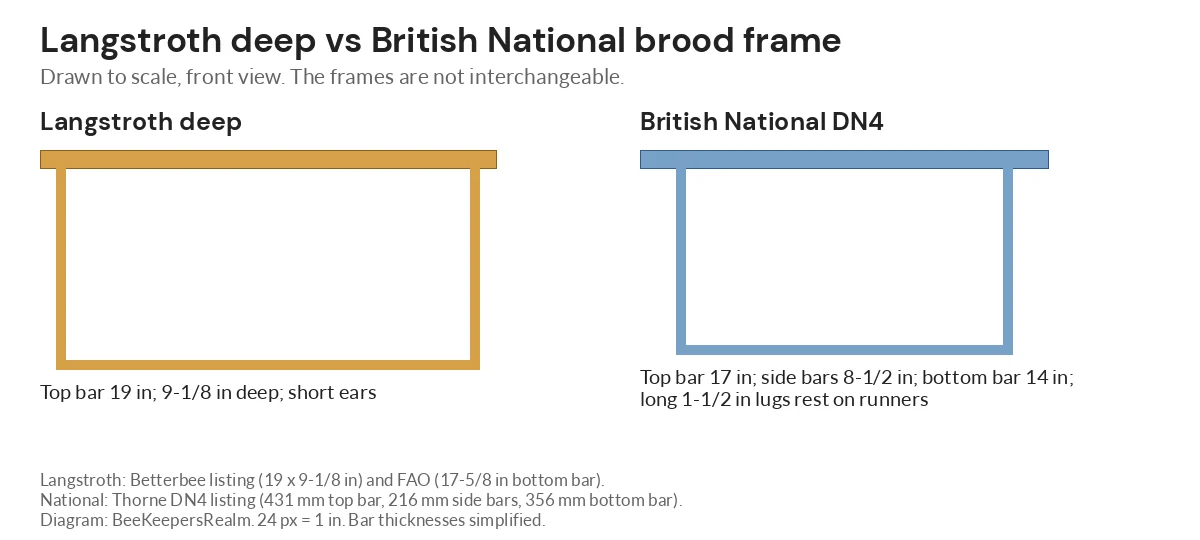
Langstroth frames do not fit other hive systems, even ones that look similar. The British National hive, widely used in the UK, uses a 17-inch top bar with long lugs. Thorne lists its DN4 brood frame at a 17 by 7/8 in top bar (431 by 22 mm), 8-1/2 in side bars (216 mm) and a 14 in bottom bar (356 mm). The SN4 super frame is the same with 5-1/2 in side bars. Thorne’s assembled National brood body measures 460 by 460 mm and 221 mm high, and its National super 148 mm high.
| Hive | Brood frame | Fits a Langstroth box? |
|---|---|---|
| Langstroth (US standard) | 19 in top bar, 9-1/8 in deep | – |
| British National | 17 in top bar, 8-1/2 in side bars (Thorne DN4) | No |
| Top-bar hive | Bars only, no frame sides or bottom | No |
Top-bar hives such as the Kenyan top-bar hive use bare bars instead of frames, and the comb hangs free. If you buy a used hive or a nuc, confirm the frame system first.
Which Frames to Buy
- New beekeeper with a two-deep hive: deep frames for brood, medium frames for honey, both 10-frame.
- If lifting is your limit: mediums for everything, so a full box stays near 40 to 50 pounds and every frame fits every box.
- Wax foundation: wooden frames with a wedge top bar and pre-drilled end bars for wire.
- Plastic foundation: grooved top and bottom bars, or one-piece plastic frames if you want no assembly.
- Comb honey: shallow or medium wooden frames with thin, unwired foundation or a starter strip.
For where to buy them, see buying frames from Dadant, Mann Lake or Betterbee.
Frequently Asked Questions
What are the three sizes of beehive frames?
Deep (9-1/8 in), medium (6-1/4 in) and shallow (5-3/8 in). All three use a 19-inch top bar.
Can I put medium frames in a deep box?
Only briefly. The bees will build comb in the gap under the short frames, so match frame depth to box depth.
Are plastic or wooden bee frames better?
Neither is better for the bees. Plastic saves assembly time; wood takes any foundation and can be repaired.
What is the difference between wedge and grooved top bars?
A wedge top bar clamps wax foundation with a nailed strip. A grooved top bar holds a plastic sheet in a slot.
How many frames go in a 10-frame deep?
Ten. Leave one out and the bees fill the gap with comb.
Do Langstroth frames fit a British National hive?
No. National frames have a 17-inch top bar and shorter bottom bar, so the two systems are not interchangeable.
The Bottom Line
Pick the depth you can lift and the top bar your foundation needs, then stay consistent. Measure any used frame against the table above before buying.