Reviewed by Daniel M. · How we review
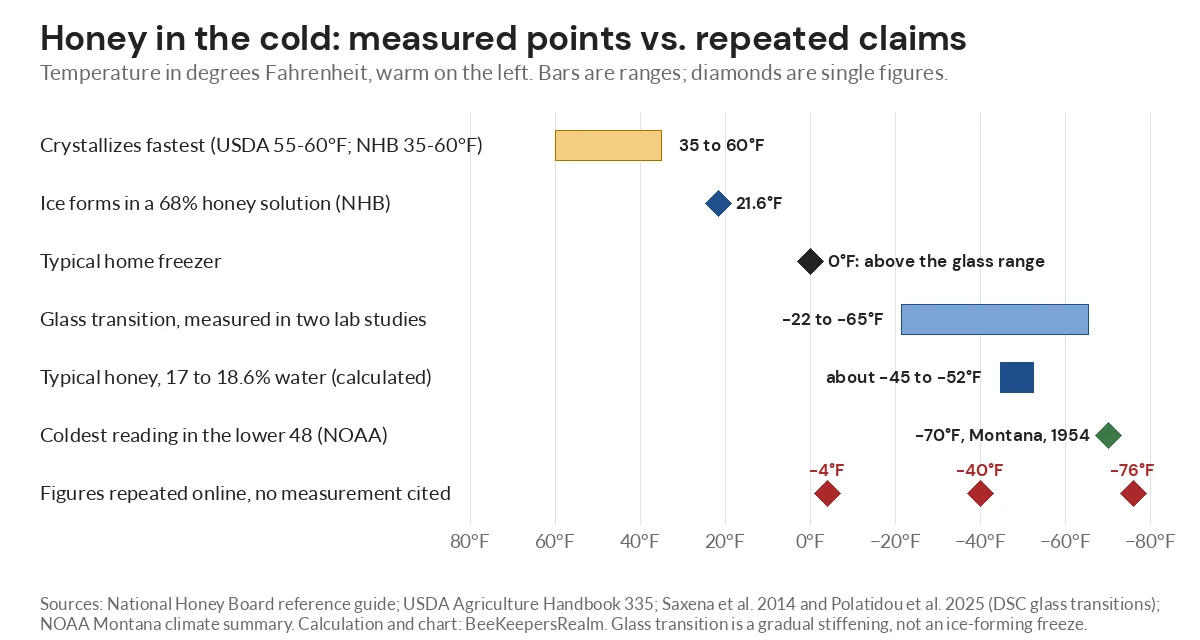
Honey does not freeze solid in a home freezer. At 0°F it stays a liquid, only a much thicker one, and lab measurements put the point where it finally stiffens into a glass-like solid between about −22°F and −65°F, depending on how much water it holds. Cold does not spoil honey; it changes how it pours and how fast it crystallizes.
We write from eastern North Dakota, so unheated garages and winter hives get as much room here as the freezer.
Key Takeaways
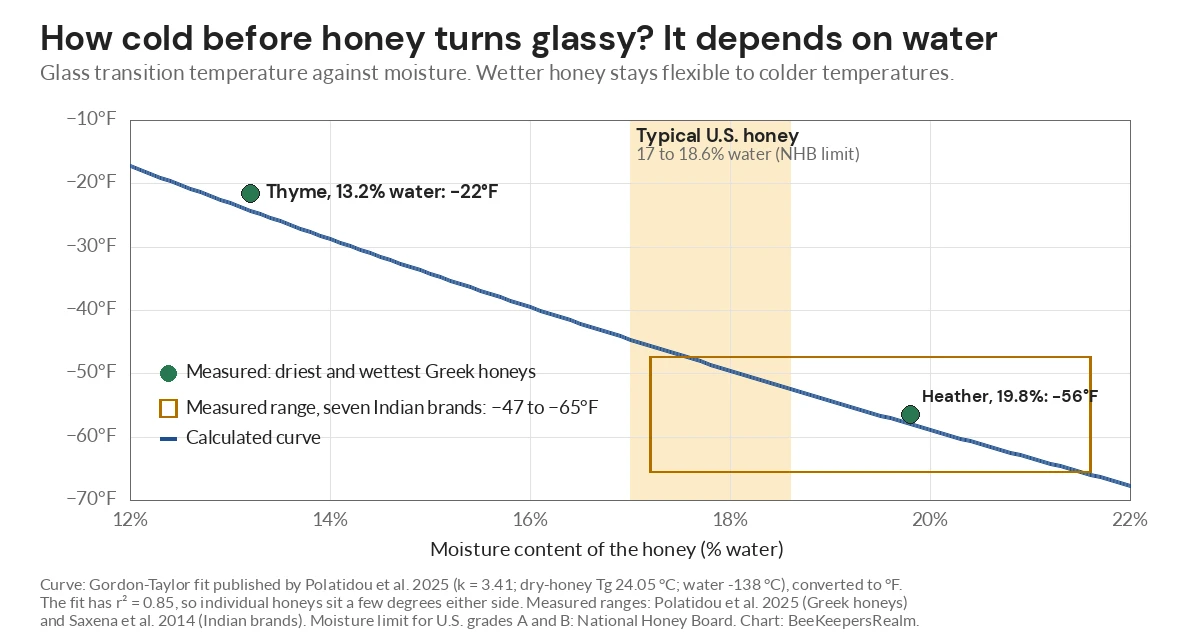
- Two peer-reviewed lab studies measured honey’s glass transition: −22 to −56°F in Greek honeys and −47 to −65°F in seven Indian brands. Wetter honey stays flexible to colder temperatures.
- The figures repeated online, −4°F, −40°F and −76°F, come with no measurement on any page we checked.
- A 0°F freezer, a refrigerator and a January garage all sit above the glass range of typical honey, so none of them turns it solid.
- The National Honey Board says 35 to 60°F speeds crystallization, which makes the refrigerator the worst place for a jar.
- USDA chemists judged winter cold the best place to hold unpasteurized honey, but in lab fits honey is 5 to 13 times thicker at 41°F than at 77°F.
Table of Contents
- Every Freezing-Point Number, Sorted by Evidence
- Why Honey Goes Glassy Instead of Icy
- Honey in a Home Freezer or Refrigerator
- Honey in an Unheated Garage or Shed
- Honey in a Winter Hive
- Frequently Asked Questions
- The Bottom Line
Every Freezing-Point Number, Sorted by Evidence
Pages answering this question quote a freezing point of −4°F, −31 to −58°F, −40°F or −76°F. None of the ones we read names a measurement behind it, and Google’s AI Overview, when we checked in October 2026, gave −40°F while citing social posts and Q&A pages. Two peer-reviewed studies measured when honey turns glassy, and the National Honey Board (NHB) published freezing points for honey-water mixtures.
| Temperature | What it marks | Source |
|---|---|---|
| 35 to 60°F | Crystallization is hastened; USDA puts the fastest range at 55 to 60°F | NHB; USDA Handbook 335 |
| 21.6°F (−5.8°C) | Ice forms in a 68% honey solution, far wetter than jar honey | NHB |
| 0°F | Home freezer; honey is still above its glass point | Our reading of the data below |
| −22 to −56°F (−30 to −49°C) | Glass transition, Greek honeys, 13.2 to 19.8% water | Polatidou et al. 2025 |
| −47 to −65°F (−44 to −54°C) | Glass transition, seven Indian brands, 17.2 to 21.6% water | Saxena et al. 2014 |
| −4, −40 and −76°F | Repeated online with no measurement cited | None found |
Sources: NHB, A Reference Guide to Nature’s Sweetener; USDA Agriculture Handbook 335; Polatidou et al. 2025; Saxena et al. 2014.
The 68% solution is a trap. U.S. grades A and B require at least 81.4% solids, so 21.6°F shows how far sugar lowers the freezing point, not when a jar freezes.
Why Honey Goes Glassy Instead of Icy
Honey is mostly sugar and under 20% water. As it chills, it thickens until its sugars lock into an amorphous glass instead of setting like ice, and both labs measured that transition. Water acts as a plasticizer, so the wetter the honey, the colder the glass point.
The fit published by the Greek team gives, by our arithmetic, about −52°F for honey at the 18.6% water limit and −45°F at 17%. Even outdoors, only extreme cold reaches that range: NOAA lists the lower 48’s record low as −70°F, at Rogers Pass, Montana, in 1954. Very dry honey is the exception. The Greek thyme honeys, the driest in that study, went glassy as warm as −22°F.
Honey in a Home Freezer or Refrigerator
A freezer set to 0°F is roughly 45 to 50°F above the glass point of typical honey, so the jar stays liquid; sellers and beekeepers describe it as very thick and slow to pour. Freezing is optional. The NHB says honey keeps best sealed at 64 to 75°F, (see whether honey expires). It helps with bulk batches, comb and long storage, and USDA chemists told beekeepers to freeze a sample of fresh honey as the benchmark for judging storage damage.
If you freeze a jar, seal it and leave a little headspace. Sellers advise this, though they note honey barely expands. Thaw it slowly, in a warm water bath rather than a microwave.
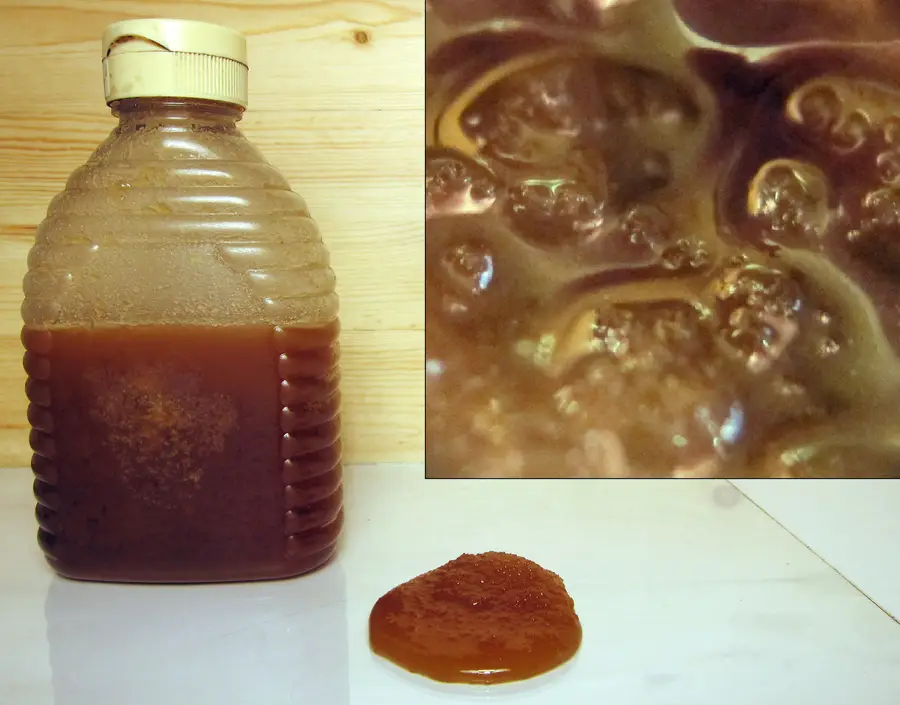
The refrigerator is the poor choice. It falls inside the NHB’s 35 to 60°F band that hastens crystallization, so a chilled jar tends to turn grainy (why honey crystallizes). Crystals are harmless; warm the sealed jar as described in our guide to reliquefying crystallized honey.
Honey in an Unheated Garage or Shed
“The best condition for storing unpasteurized honey seems to be below 50º, or winter temperatures over much of the United States.”
So a cold garage is fine for sealed honey. The trouble comes at the edges. USDA says granulation is accelerated between 55 and 60°F and initiated by fluctuation between 50 and 55°F, so the spring and fall swings do the damage, not January. For honey above about 17% water, cold only pauses fermentation: USDA warns that storage below 50°F prevents it only while the honey stays cold. Our honey storage guide covers the moisture limits.
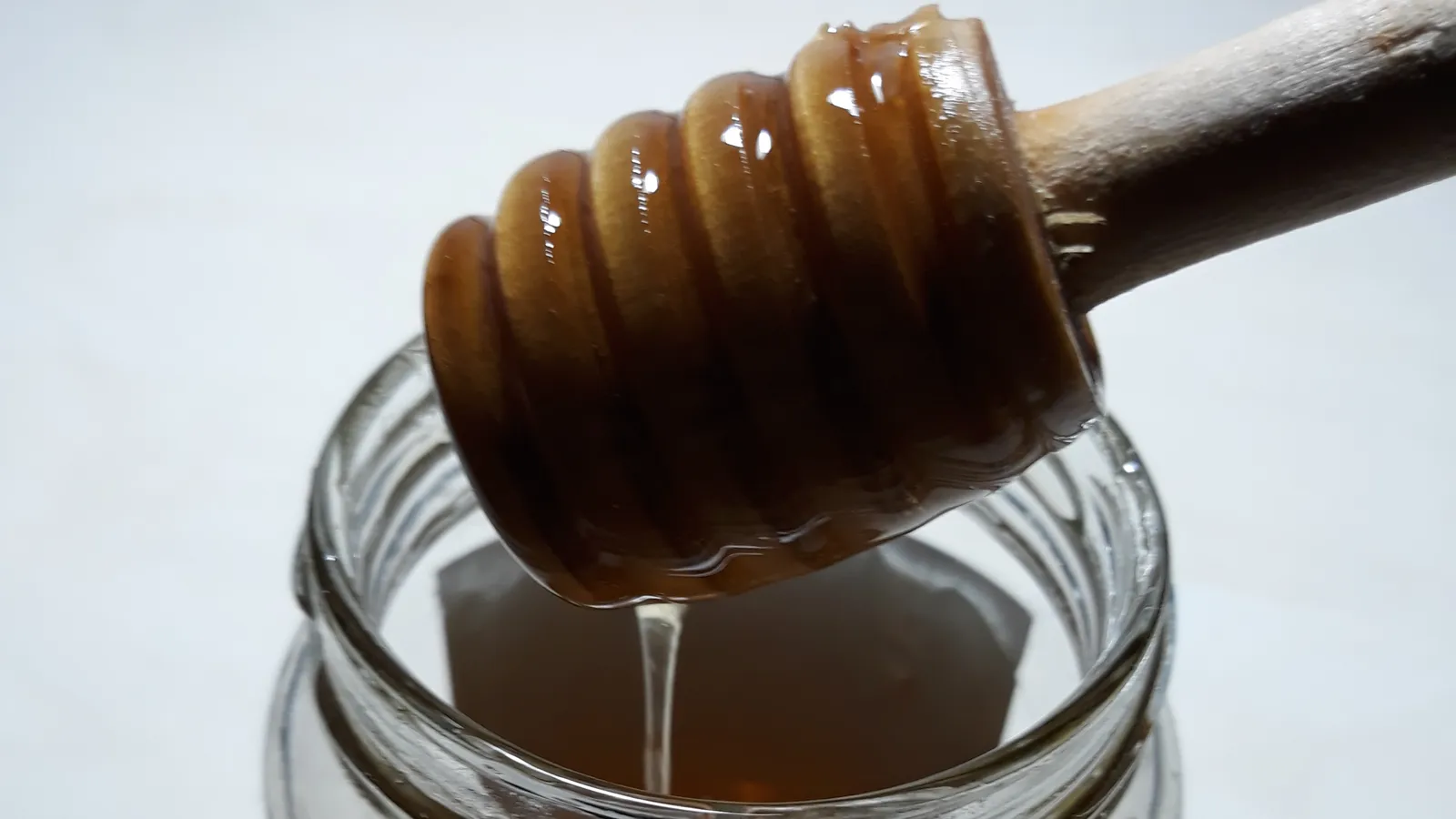
What winter does change is flow. In the seven Indian honeys, fitted viscosity at 41°F works out to 5 to 13 times that at 77°F; that is our arithmetic from the published fits, valid inside the 41 to 104°F range they measured. Bottle before the cold, since honey that sets in a bucket is hard to get out, and bring jars indoors a day before pouring.
Honey in a Winter Hive
Beekeeping writer James Tew said in the American Bee Journal that frigid stores are “very, very thick” and that he did not fully understand how bees eat them. In a hive, the practical danger is reach, not ice.
“When honey bees are in their cluster to keep warm and generate heat, the bees only move up and down in the hive, not side to side.”
Honey beside the cluster can be out of reach whatever its temperature. Keep stores above the bees; see how much honey bees need for winter.
Frequently Asked Questions
Is honey still good if it freezes?
Yes. Thick or crystallized honey is not spoiled. Warm the sealed jar in warm water until it flows.
At what temperature will honey freeze?
It does not freeze like water. The measured glass transition runs from about −22 to −65°F, depending on water content.
Does real honey freeze in winter?
No. It thickens, and it crystallizes faster if it hovers between 50 and 60°F.
Does honey freeze in the fridge?
No, but a fridge sits inside the NHB’s 35 to 60°F crystallization band, so the jar may turn grainy.
Does pure honey solidify?
Yes, by crystallizing, not freezing. The NHB notes that all honey crystallizes eventually.
Does freezing destroy honey’s enzymes?
We found no study testing it. Heat is the known enzyme killer; see how heating alters honey enzymes.
The Bottom Line
No home freezer or ordinary winter will freeze honey solid. Keep jars sealed, skip the refrigerator, and warm them gently when cold makes them stiff.
Image credits: Photo: Matankic, via Wikimedia Commons, CC0, cropped.