Reviewed by Elena P. · How we review
Rooftop beekeeping works when four things are settled before the first box goes up: written permission from whoever owns the roof, an engineer’s sign-off on the load, a safe route to the hive, and a plan for wind, heat and water. A four-box hive with every box full of honey can weigh 200 to 300 pounds, which is why the roof, not the bees, is usually the hard part.
This guide is for US keepers, and it is one branch of our urban beekeeping guide. The rules and numbers come from Boston, Saint Paul and New York City documents, OSHA, the EPA and a University of Sussex review of roof hives. Where a figure is our own arithmetic, we say so.
This is educational information, not engineering or legal advice. Your city, your building and your roof set the real limits; the official pages linked below are the place to start.
Key Takeaways
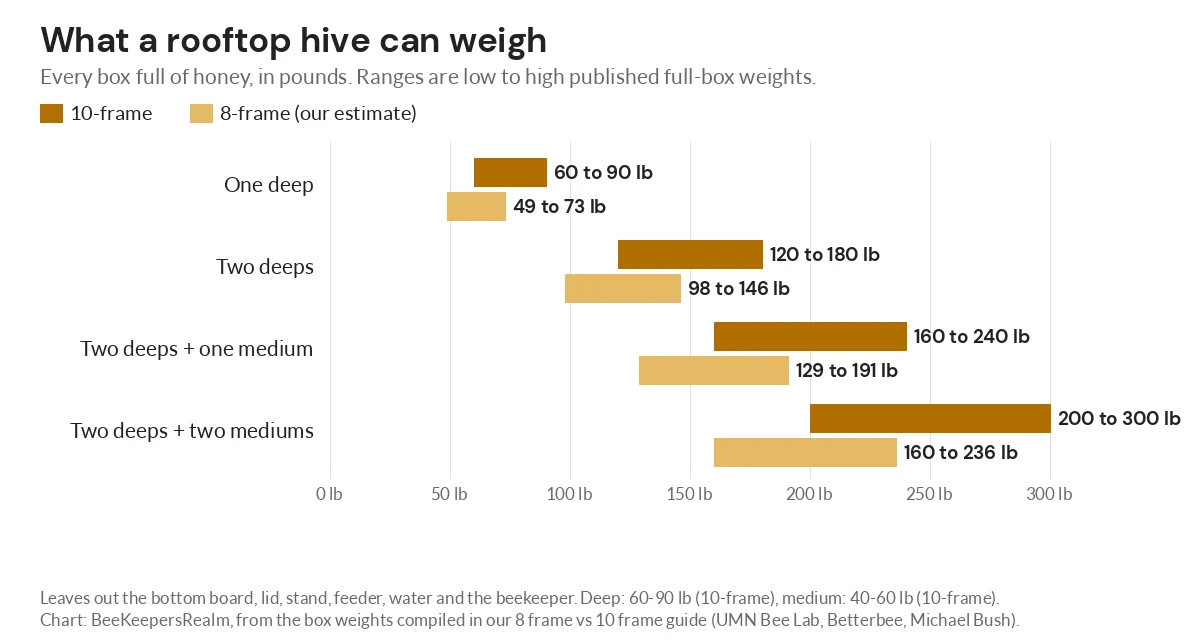
- A stack of two deeps and two mediums, every box full, weighs 200 to 300 lb in 10-frame gear and 160 to 236 lb in 8-frame gear, before the stand, lid and bottom board. That is our arithmetic from published box weights.
- Pressure per square foot matters more than total pounds. That 10-frame stack presses 89 to 134 lb per square foot on its own footprint, but 12.5 to 19 lb on a 4 by 4 ft platform (platform weight not counted), against a typical 20 lb design minimum for ordinary roofs.
- Boston asks for an engineer-certified load assessment for an existing permitted roof deck. Saint Paul says engineering may be required for a 200 to 500 lb load.
- Roof-edge distances in the sources run from 6 ft (Boston hive setback) to 10 ft (Saint Paul guard trigger) to 20 ft (a hive-hosting company’s rule without guardrails).
- Roofing can run up to 66°F hotter than the air (EPA), and wind is harsher on a roof. Put water, shade and straps in place before the bees arrive.
- Swarms from high roofs are hard to retrieve, so swarm control matters more up there than at ground level.
Table of Contents
- Is a Roof a Good Place for Bees?
- Permission, Permits and Registration
- How Much Weight Can the Roof Take? A Load Worksheet
- Fall Protection and Roof Access
- Wind: Straps, Stands and Windbreaks
- Heat, Sun and Water on a Roof
- Flight Paths, Swarms and Neighbors
- Hive Types and Gear That Suit a Roof
- Seasons and Winter Moves
- A Pre-Install Checklist, in Order
- Frequently Asked Questions
- The Bottom Line
Is a Roof a Good Place for Bees?
For the bees, a roof is usually fine. For the beekeeper, it is harder than the ground in almost every way. Karin Alton and Francis Ratnieks of the University of Sussex’s bee laboratory reviewed the question in Bee World after fielding repeated enquiries about roof hives, and their verdict on convenience is blunt.
“Most experienced beekeepers would prefer to keep hives at ground level vs. on roofs, because of convenience.”
The reasons are practical. Hive equipment is bulky and heavy, moving a whole hive is often a two-person job, and carrying boxes through buildings and up stairs or lifts is far harder than crossing a garden. Honey-filled boxes then have to come back down. Access can also depend on finding a janitor or manager with the key, every visit.
Height itself does not seem to bother the bees. The same paper notes that Cornell’s Thomas Seeley found wild colonies in a New York forest nesting at an average of 9.7 m (about 32 ft) up, with swarms choosing bait hives at 5 m over 1 m. Wind exposure is the likelier problem. New York City beekeeper James Fischer, quoted in the paper, calls hives above 10 stories “speculative ventures” and those at 15 and above “on life support”. Nobody has tested that, so treat it as an experienced keeper’s opinion, not data.
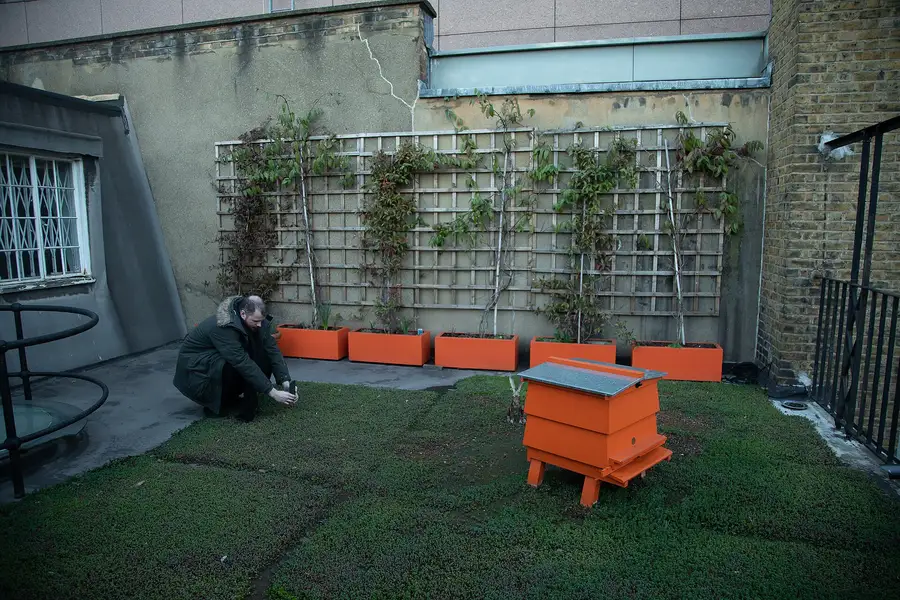
A roof suits you if you have no yard, a building owner who has agreed in writing, a safe and permanent way up, and the time to make frequent visits in spring. If one of those is missing, a ground site is the better answer, and our guide to urban beekeeping challenges covers the alternatives. The rest of this page assumes you have all four.
Permission, Permits and Registration
A rooftop hive usually needs approval at three levels, and they are separate. Skipping the first is the most common way a plan dies.
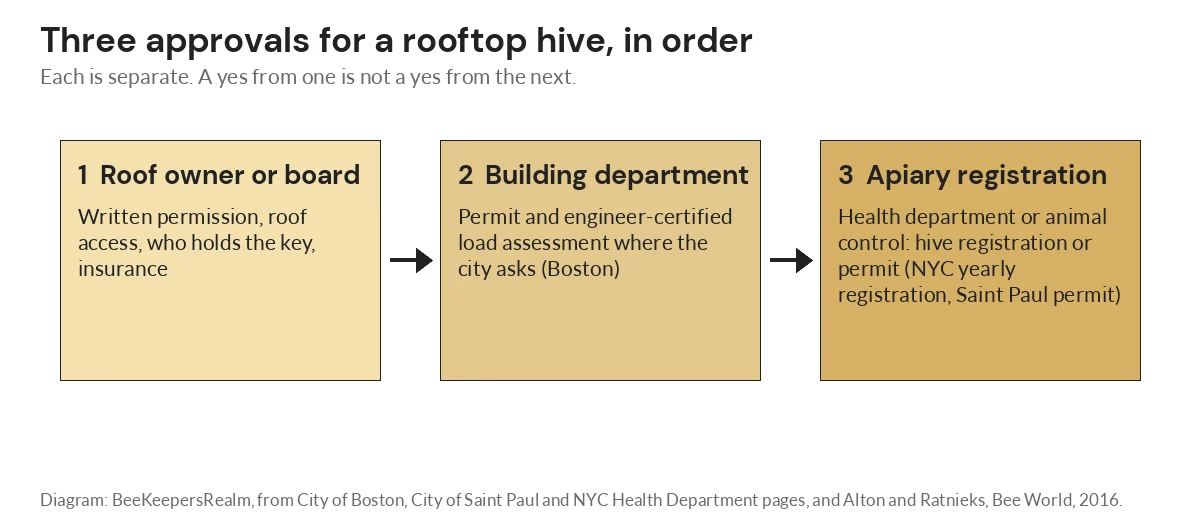
- The roof owner. Alton and Ratnieks put it plainly: once you find a suitable building, gaining permission is the next step, and it may start with negotiations with the building owner. In a shared building the board or association usually decides; see our guides to keeping bees in a condo or co-op and on a rental property.
- The building department, where the city regulates roof hives. Boston is the clearest US example.
- The apiary registration or permit, run by a health department, animal control or the state.
The three cities below publish rooftop rules or registration pages we could read in full. We checked them on October 24, 2026. Boston’s Commissioner’s Bulletin 2024-05 is dated December 4, 2024, and Saint Paul’s rules document is dated January 2018.
| Boston, MA | Saint Paul, MN | New York City | |
|---|---|---|---|
| Roof-specific approval | Building permit. Short form with an engineer-certified load assessment for an existing permitted roof deck; long form for a new or unpermitted roof area | Flat roofs only. Layout must show hives, stair access and guard rails | None listed on the registration page |
| Structure | For an existing permitted deck, an engineer certifies the added hive weight will not compromise the structure | Engineering may be required for a 200 to 500 lb load | Not addressed |
| Roof edge | Hive set back 6 ft from the edge | Guard required if a hive is within 10 ft | Not addressed |
| Access | Roof must be designed or permitted for access and occupancy | Permanent stairs, no ladders; secure, limited access; warning sign on the roof door | Not addressed |
| Hive limit | 5 per lot or roof; hive no taller than 6 ft or larger than 24 cu ft | 4 colonies per property | Not stated on the page |
| Registration | $25 fee | Permit, with proof of a beekeeping class in the past two years | Free, yearly by May 31, one form per hive, within 30 days of setting up |
| Standing rules | Constant water source; act on swarms and nuisance | Water source on the property | Movable-frame hives, constant water source, no bother to people |
Sources: the City of Boston’s keeping of honey bees page and its linked permit application and Commissioner’s Bulletin 2024-05; Saint Paul’s beekeeping rules; and the NYC beekeeper registration page. A blank cell means the page says nothing, not that nothing applies.
“Engaging a professional engineer for rooftop setups is crucial to ensure safety and compliance with Boston’s regulations.”
Your city may differ completely. Check your state’s page in our Massachusetts, Minnesota and New York law guides, then read our zoning laws guide for how setbacks and lot rules work. Also ask your insurer; our guide to homeowners insurance and beehives explains what to ask.
How Much Weight Can the Roof Take? A Load Worksheet
Guides we checked quote anywhere from 80 to 300 pounds per hive, including our own condo guide’s 80 to 120 lb. Much of that spread comes from how many boxes are stacked and how full they are, and this worksheet shows where the range comes from. It is our arithmetic, built from published full-box weights, and it is an input for an engineer, not a substitute for one.
Published figures for a 10-frame deep full of honey run from 60 to 90 lb, and the University of Minnesota Bee Lab guide says deeps can weigh over 80 lb when full. A full medium runs 40 to 60 lb. The sources are listed in our 8-frame vs 10-frame hive guide, which also estimates 49 to 73 lb for a full 8-frame deep and 31 to 45 lb for a full medium.
| Stack, every box full of honey | 10-frame | 8-frame |
|---|---|---|
| One deep | 60 to 90 lb | 49 to 73 lb |
| Two deeps | 120 to 180 lb | 98 to 146 lb |
| Two deeps and one medium | 160 to 240 lb | 129 to 191 lb |
| Two deeps and two mediums | 200 to 300 lb | 160 to 236 lb |
Treat the last row as a planning ceiling, because few hives are packed that full all at once. It leaves out the bottom board, lid, stand, any feeder and a water supply, and none of it counts you standing beside the hive with a heavy box in your hands.
Why pounds per square foot is the number to ask about
A 10-frame box measures 16-1/4 by 19-7/8 inches outside (Mann Lake’s listing for its 10-frame deep), so the hive sits on about 2.24 square feet. Divide the weight by the footprint and the same hive looks very different depending on what it stands on:
- Two deeps and two mediums, on their own footprint: 200 to 300 lb over 2.24 sq ft is 89 to 134 lb per square foot.
- The same stack on a 4 by 4 ft platform (16 sq ft): 12.5 to 18.8 lb per square foot, before the platform’s own weight.
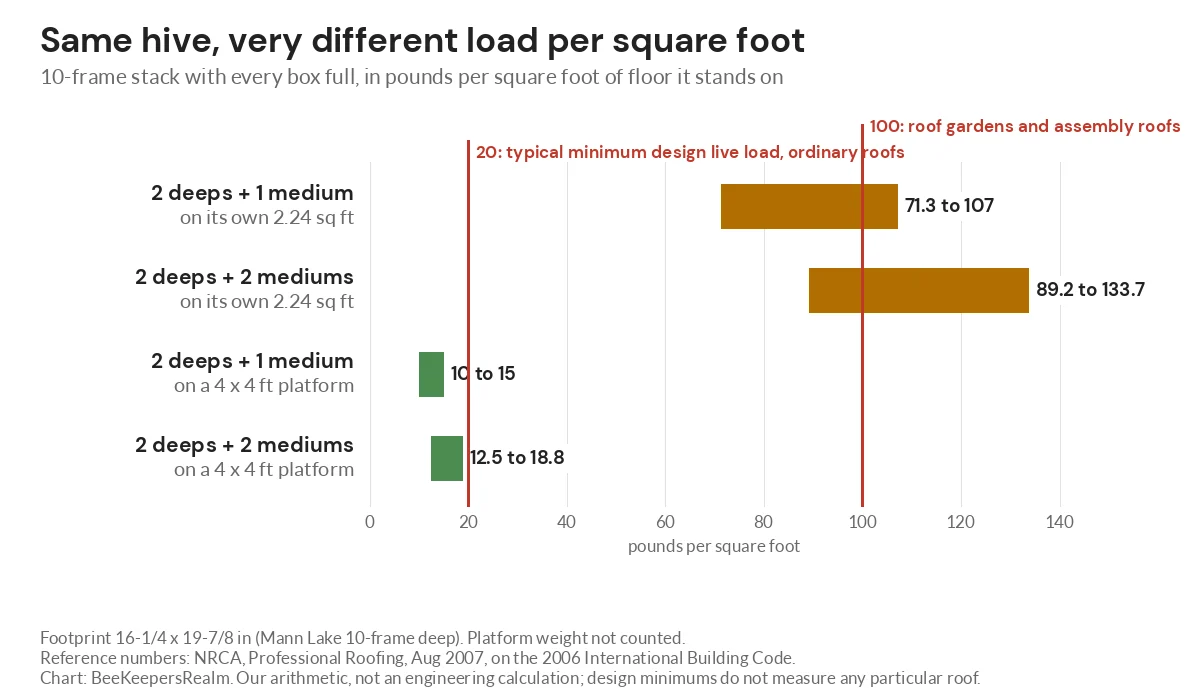
For scale, Mark Graham of the National Roofing Contractors Association (NRCA), writing in Professional Roofing in 2007 about the 2006 International Building Code, says conventional roof systems typically must be designed for a minimum 20 lb per square foot uniform live load, with 100 lb required for roofs used for roof gardens or assembly. Those are design minimums for new buildings from an older code edition, so check the one your city has adopted. They are not a measurement of your roof, which may have more or less in reserve.
So a platform brings the average load down toward ordinary-roof design levels, but that is exactly why an engineer has to look at the framing under the platform, not just the average. Saint Paul spells out what else the owner has to answer, and is clear that the city will not do it for you.
“These items will not be addressed in the City’s review of the installation but should be addressed by the property owner prior to installation.”
Those items are the roof’s stability under the added weight, any effect on drainage, and the effect on the roofing material. Alton and Ratnieks add two practical ones: many roof coverings, such as mineral felt, are not designed for foot traffic, and dead bees and hive debris can clog drains and raise the risk of leaks.
What to bring to the engineer
Hand over numbers, not a description. A useful package has the stack you plan to run in its heaviest state (the last row of the worksheet), the footprint and weight of the stand or platform, where on the roof it would sit and how it is secured, the weight of any water tub and windbreak, and who will be on the roof with it. Ask for the answer in writing; in Boston, the permit application has to include it.
Fall Protection and Roof Access
Saint Paul requires a permanent stair system that meets building code for rooftop hives, and says ladders may not stand in for stairs. Alton and Ratnieks reach the same view from the beekeeper’s side: most keepers would consider climbing vertical ladders with equipment or hives impractical, dangerous or even impossible, and they list safety as a standing concern, since roofs are hazardous because of the risk of falling.
How far from the edge?
Different rules answer different questions, so compare them rather than picking the first number you find.
| Source | Distance | What it says |
|---|---|---|
| Boston hive permit conditions | 6 ft | Hives are set back 6 ft from the edge of the roof |
| Saint Paul rooftop rules | 10 ft | A guard is required if a hive is within 10 ft of the roof edge |
| The Best Bees Company, placement guide | 20 ft | Hives are placed at least 20 ft from building ledges that lack guardrails |
| OSHA 29 CFR 1910.28(b)(13), workers on low-slope roofs | 6 ft and 15 ft | Under 6 ft from the edge, a guardrail, net, travel restraint or personal fall arrest system. From 6 to under 15 ft, the same, or a designated area for infrequent, temporary work. At 15 ft or more, protection or a designated area, and no protection needed for infrequent, temporary work |
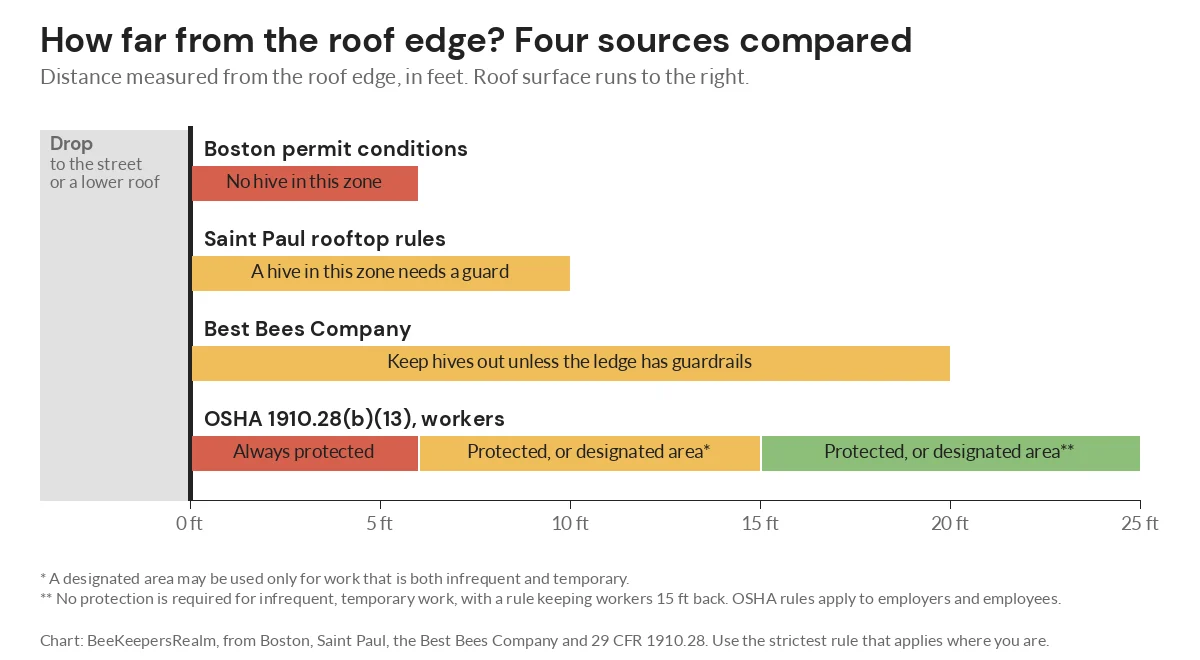
OSHA’s general-industry rule is written for employers and their employees, such as a building crew or a hired apiary service. It is not a rule for a homeowner on their own roof, but it is the most detailed public benchmark. The general rule applies at 4 ft or more above a lower level, and OSHA’s guardrail criteria in 29 CFR 1910.29 set the top rail at 42 inches, plus or minus 3, and require the system to withstand 200 lb applied outward or downward.
Two more access points come up in the sources. Saint Paul wants a warning sign on the rooftop access door and secure, limited access to the roof. And Alton and Ratnieks remind keepers that other people may use the same roof for maintenance, air conditioning equipment, dining or gardening, and may not want stinging insects there.
Wind: Straps, Stands and Windbreaks
Roofs are windier than most apiary sites. Alton and Ratnieks report that a British beekeeper who had strapped his roof hives down and put 15 kg weights on them saw them almost blown off their stands in a storm. At ground level that would harm the colony; on a roof, they note, hives or parts of hives could fall off. They add that buildings can make wind form unusual draughts and eddies.

What the rulebooks and hosts ask for:
- Straps. Saint Paul requires a strapping system that keeps each hive lid secure. Our guide to ratchet straps for windy apiaries covers how to fit them.
- A wind block. The Best Bees Company says winds can be quite heavy on a roof and recommends placing the hive so it is blocked from the wind. See windbreak strategies for apiaries and managing colonies in windy conditions.
- A low, wide base. A tall narrow stack catches more wind; see hive stand height.
Ask the engineer to include the stand, any windbreak and the straps’ anchor points in the review, since they all add load and attach to the roof.
Heat, Sun and Water on a Roof
The EPA says that on a warm day conventional roofing materials may reach as much as 66°F warmer than the surrounding air. On a 90°F day, that is up to 156°F at the surface; the example air temperature is ours.
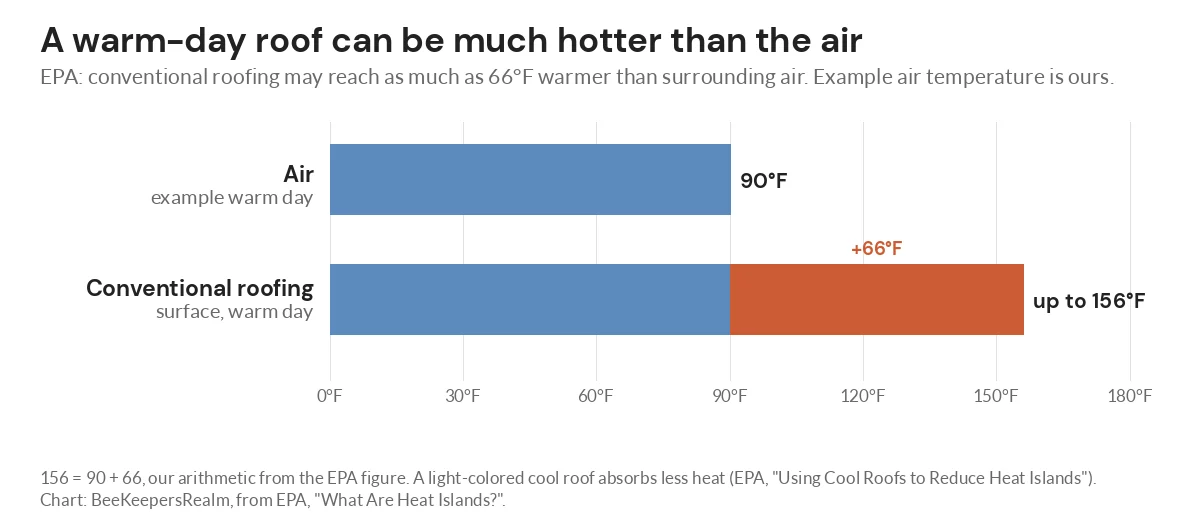
Heat is not hypothetical for roof colonies. Alton and Ratnieks describe 10 hives on a 37-story building in Austin, Texas that must be shaded and regularly misted with water to prevent heat damage, and are rotated with other hives and rural locations. Our guides on protecting hives from extreme heat and sun versus shade cover the colony side of the problem.
Water first, bees second
Boston’s permit conditions and NYC’s rules both require a constant water source. The reason is neighbors: Fischer told Alton and Ratnieks that most suburban and urban beekeeping problems start with water-collecting bees at dripping taps, ponds and pools, and that in New York a beekeeper who neglects water can be reprimanded or fined. The Sussex lab uses large plastic tubs with aquatic plants so bees can collect water without drowning or visiting human sources. Set the supply up before the bees arrive; see why bees need a reliable water source and how to build a bee waterer. Remember to count a full tub in the roof load.
Flight Paths, Swarms and Neighbors
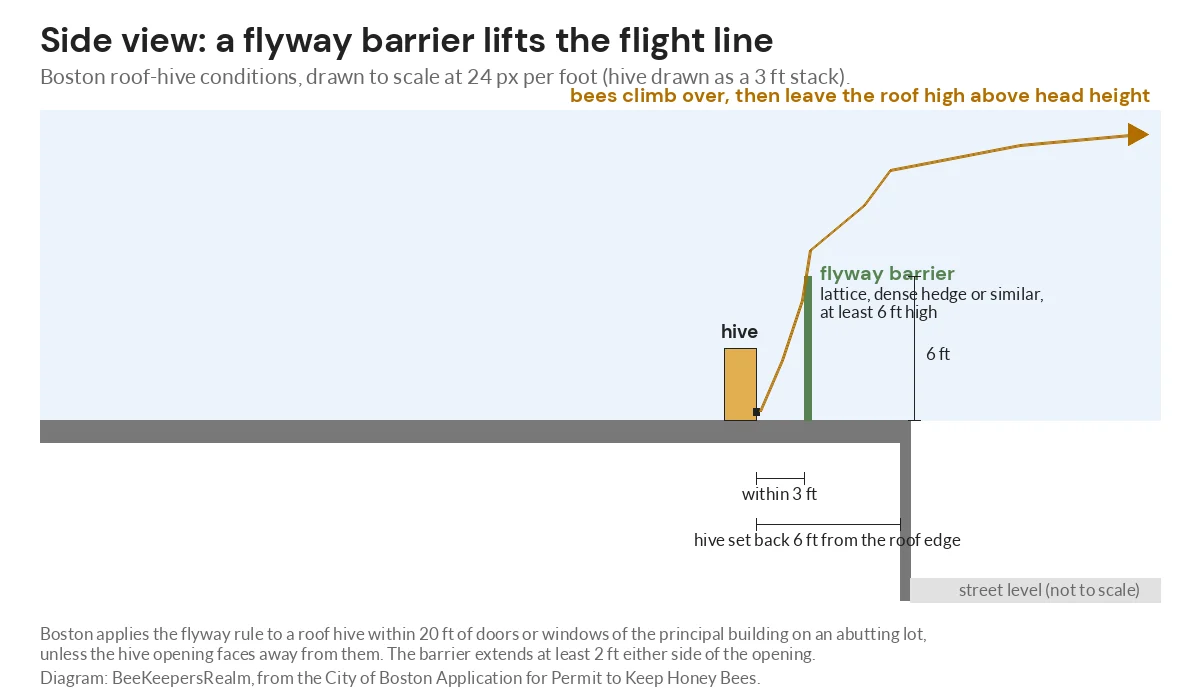
Boston’s conditions are the most specific we found. For a roof hive within 20 ft of the doors or windows of the principal building on an abutting lot, either the hive opening faces away from them, or a flyway of at least 6 ft in height, made of a lattice fence, dense hedge or similar barrier, sits within 3 ft of the entrance and extends at least 2 ft either side of it. The point is to make bees fly up and away from neighbors.
Swarms from a roof are harder to catch
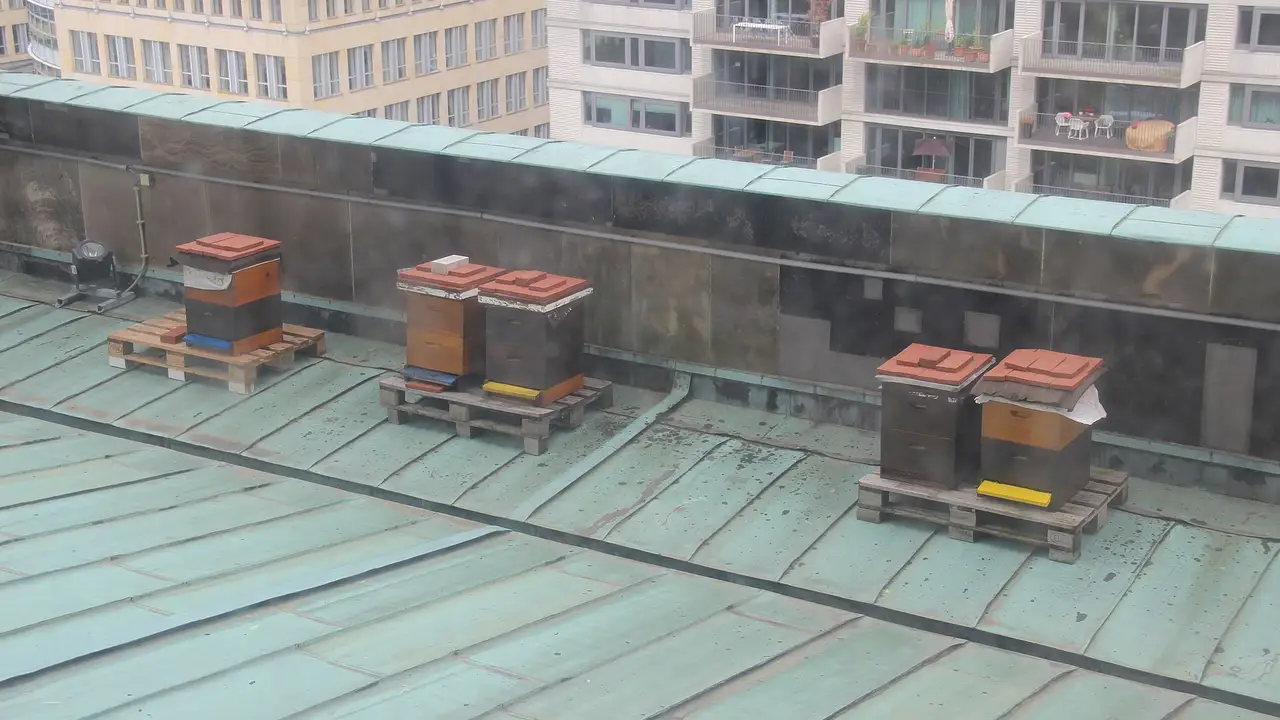
Alton and Ratnieks cite London cases. A roof hive near Piccadilly Circus swarmed three times in 10 days in 2013, each time settling at ground level, and one swarm flew into a restaurant. In 2015 a swarm from two hives on a 14-storey Canary Wharf roof settled 200 ft up a neighboring skyscraper, and collectors had to borrow a window-washing platform. The authors judge that the chance of following and retrieving a swarm is probably significantly higher from a ground hive than a roof hive, and that the Piccadilly hive had not been managed. Our guides to preventing swarming and to spotting a hive preparing to swarm apply twice over on a roof.
Neighbors and theft
On the plus side, the same paper notes that limited access may reduce vandalism and theft, and calls vandalism probably the bigger problem. NYC defines a beekeeping nuisance as aggressive or bothersome bees, hive placement that bothers people, and overcrowded, dead or abandoned hives. Tell the people who will notice before they find out; see how to talk to your neighbors and how close hives can be to neighbors.
Hive Types and Gear That Suit a Roof
The best roof hive is the one you can lift safely and strap down securely.
- Lighter boxes. An 8-frame deep saves about 11 to 17 lb over a 10-frame deep, and an 8-frame medium is the lightest common box. The trade-off is a taller stack for the same volume, which catches more wind. Our 8-frame vs 10-frame guide has the numbers.
- Mediums throughout. Keeping every box the same size keeps each lift well under the 80-plus lb a full deep can reach.
- A partner for heavy lifts. The University of Minnesota Bee Lab guide says lifting heavy boxes is easier with two beekeepers, and a roof makes that worth planning for.
- A planned footprint. A low, wide stand spreads the load, but the engineer, not the stand’s maker, decides how much spread is enough.
Seasons and Winter Moves
Roof hives need the same inspections, disease control, swarm prevention, harvest and winter preparation as ground hives, according to Alton and Ratnieks. Some roof keepers go further: the Scottish Parliament’s beekeeper moves hives to ground apiaries for winter, and the Austin keeper rotates hives off the roof for what he calls respite from honey production. If your roof is exposed, plan a ground site you can move to; our winter guide covers preparing bees for winter in your climate.
A Pre-Install Checklist, in Order
The order matters, because each step can end the project before you spend on the next.
- Get the owner’s or board’s written permission, including roof access and who holds the key.
- Call your city’s building and health departments and ask what rooftop hives require.
- Ask your insurer, and the owner’s insurer, what a hive does to coverage.
- Commission the engineer’s load assessment, giving the stack weights and footprint from the worksheet above.
- Plan access: permanent stairs, a walkway, a warning sign, and who else uses the roof.
- Plan the edge: measure the distance, and add a guard where any rule applies.
- Plan wind and heat: straps, a windbreak and shade, all reviewed with the stand.
- Set up water before the bees arrive.
- Register the hive with the city, county or state, and tell the neighbors.
Frequently Asked Questions
Is rooftop beekeeping legal in the US?
Often, with conditions that vary by city. Boston requires a building permit for rooftop hives, Saint Paul allows them only on flat roofs with permanent stairs, and New York City requires free yearly registration. Check your own city’s building and health departments, plus the roof owner’s rules.
Do I need a structural engineer for a rooftop beehive?
Boston requires an engineer-certified load assessment for an existing permitted roof deck, and Saint Paul says engineering may be required for a 200 to 500 lb load while leaving stability, drainage and roofing questions to the owner. Even where no rule asks, those questions still need a qualified answer.
How much does a rooftop beehive weigh?
By our arithmetic, 200 to 300 lb for two full deeps and two full mediums in 10-frame gear, and 160 to 236 lb in 8-frame gear, before the stand, lid and bottom board. A single full deep is 60 to 90 lb.
How far from the roof edge should hives be?
Boston requires 6 ft, Saint Paul requires a guard within 10 ft, and the Best Bees Company places hives at least 20 ft from ledges without guardrails. Use the strictest rule that applies to you.
Can a renter or condo owner keep bees on the roof?
Only with the roof owner’s or board’s permission, which Alton and Ratnieks identify as the first hurdle after finding a building. Our guides to condo and co-op rules and rental property cover the approach.
Do bees mind living high up?
Probably not by itself: wild colonies nest well above ground. Alton and Ratnieks think wind exposure is more likely to cause harm, and the question of very high roofs is still open.
How do I keep rooftop bees from swarming into the street?
Manage swarming actively every spring. Swarms from high roofs can settle where ground crews cannot reach them, as the London cases show.
Do rooftop hives need water on the roof?
Yes. Boston and New York City both require a constant water source, and bees without one find water at neighbors’ taps and pools.
The Bottom Line
Start with the roof owner and the engineer, not with the bees. If you cannot get both to say yes, put the hive on the ground. For the wider picture of siting, forage and city rules, go back to our urban beekeeping guide.
Image credits: Photo: Gary Todd via Wikimedia Commons, CC0 1.0 (featured image, cropped). Other photos credited in their captions. Charts and diagrams: BeeKeepersRealm.