Reviewed by Daniel M. · How we review
Beekeeping is legal in all 10 major US cities we checked: New York City, Los Angeles, Chicago, Seattle, Boston, Portland, San Diego, Austin, Minneapolis and Washington, D.C. What changes from city to city is the paperwork and the yard rules. On a typical 5,000-square-foot lot the codes allow 2 to 5 hives (New York sets no number), side setbacks run from none to 25 feet, and most cities want a 6-foot flyway barrier unless the hives sit high enough. Your state’s registration law applies on top, and it ranges from required every year to not required at all.
Educational information only, not legal advice. Each rule below links to the official code or agency page we read; confirm the current text with your city and state before you set up hives. Sources checked October 24, 2026.
This page is the city-by-city reference for our urban beekeeping guide. For state rules it links to our state law guides rather than repeating them.
Key Takeaways
- All 10 cities allow honey bees. Only Minneapolis requires a city beekeeping permit; New York City, Boston and Washington, D.C. require a city (or District) registration. The other six set standards in their zoning or health codes, and in all of them except Austin, state or county registration also applies.
- On a 5,000-square-foot lot the code text allows 2 hives in Los Angeles, San Diego, Austin and Minneapolis, 4 in Seattle, Portland and D.C., and 5 in Chicago and Boston. New York’s Health Code sets no number.
- Setbacks vary more than hive counts: 25 feet from a lot line in Seattle unless hives are fenced or raised, 15 feet in San Diego and D.C., 5 feet in Los Angeles and Boston, 3 feet in Portland, and no fixed distance in Austin, Minneapolis, Chicago or New York.
- State law is a separate layer: Illinois and Washington require state registration, California requires it through county agricultural commissioners, and Texas does not require it.
- Several common figures are out of date. Boston now allows 5 hives per lot or roof, not 2 or 3, and Minneapolis now requires notice to adjacent owners instead of written consent from 80 percent of neighbors.
Table of Contents
- 10 Cities Side by Side
- How State Law Fits Around City Rules
- City Rules in Detail
- How Many Hives Fit on Your Lot
- Setbacks and Flyway Barriers Compared
- What the Codes Say About Rooftop Hives
- Checking the Rules for Your Own Address
- Frequently Asked Questions
- The Bottom Line
10 Cities Side by Side
Every row comes from the code section or agency page in the last column, read on October 24, 2026. “Not stated” means the section we read does not address that point, which is not the same as permission. Nuisance rules apply everywhere.
| City | City permit or registration | Hive limit | Setbacks and flyway | Water and other rules | Code section (official text) |
|---|---|---|---|---|---|
| New York City | Register each hive with the Health Department, free, within 30 days; renew by May 31 | No number set | No distance set; placement must not create a nuisance | Movable-frame hives; constant water; respond to swarms | NYC Health Code §161.01(b)(12) |
| Los Angeles | None from the city; register with the LA County Agricultural Commission | 1 hive per 2,500 sq ft of lot | 5 ft from lot lines, 20 ft from streets, none in front yard; 6-ft barrier or hives 8 ft up | Water at all times; entrances face away from or parallel to the nearest neighbor’s line | LAMC §12.07 A.13 (applied in R1 by §12.08 A.10) |
| Chicago | None stated in the zoning definition | Up to 5 colonies as an accessory use | Not stated | Not stated | Chicago Zoning Ordinance §17-17-0270.7 |
| Seattle | None from the city; permitted when registered with the state | 4 hives on lots under 10,000 sq ft | 25 ft from any lot line unless hives are 8 ft up or behind a 6-ft fence or hedge | Each hive limited to one swarm | SMC §23.42.052.E |
| Boston | Register with Inspectional Services, $25; rooftops also need a building permit | 5 hives per lot or roof | 5 ft from lot line unless walled or fenced; 10 ft from sidewalks; not in front yard; 6 ft from roof edge | Hives max 6 ft tall and 24 cu ft; constant water | Boston Code §16-1.27 |
| Portland, Ore. | No city permit; notice letter to owners within 150 ft; Oregon registration rules apply | 4 per lot, 6 on lots of 10,000+ sq ft, plus 3 from April to August | 3 ft from lot lines, 15 ft from public walkways and streets; 6-ft barrier or hives 10 ft up | Water March through October | Portland City Code ch. 13.30 |
| San Diego | No city permit; register with the County Agricultural Commissioner within 30 days | 2 hives; 3 or more must be 600 ft from other residences | 15 ft from property line (or zone setback if greater), 20 ft from rights-of-way; 6-ft barrier around the hive or 8 ft up | Not visible from the street; pale hive; requeen every 2 years | SDMC §44.0404 to §44.0408 |
| Austin | None stated in the chapter | 2 colonies on 1/4 acre or less, up to 8 on an acre or more | No fixed distance; 6-ft flyway barrier if within 25 ft of a property line | Langstroth-type hives; water source; mark hives unless you live on the tract | Austin City Code ch. 3-6 |
| Minneapolis | City permit from Animal Care and Control; educational requirement and notice to adjacent owners first; renew yearly | 2 colonies on 1/2 acre or less, up to 8 on 1 to 5 acres | No fixed distance; 6-ft barrier if within 25 ft and facing the line; latching fence | Water while bees are active; removable-frame hives | Minneapolis Code §63.100 |
| Washington, D.C. | Register every colony with DOEE within 30 days, then yearly | 4 hives unless the lot is over 1/4 acre or DOEE agrees | 15 ft from a property line unless other conditions are met | Constant water; written owner permission in buildings with 4+ units; no Africanized bees | D.C. Code §8-1825.04 and DOEE rules |
How State Law Fits Around City Rules
City codes decide where and how many hives you can keep. State apiary laws mostly deal with bee health: registering colonies, reporting disease and moving bees across state lines. The two layers run in parallel, and some cities make the state rule part of their own. Seattle allows beekeeping only “when registered with the State Department of Agriculture,” and Portland requires compliance with Oregon Department of Agriculture registration, so skipping state registration there also breaks the city rule.
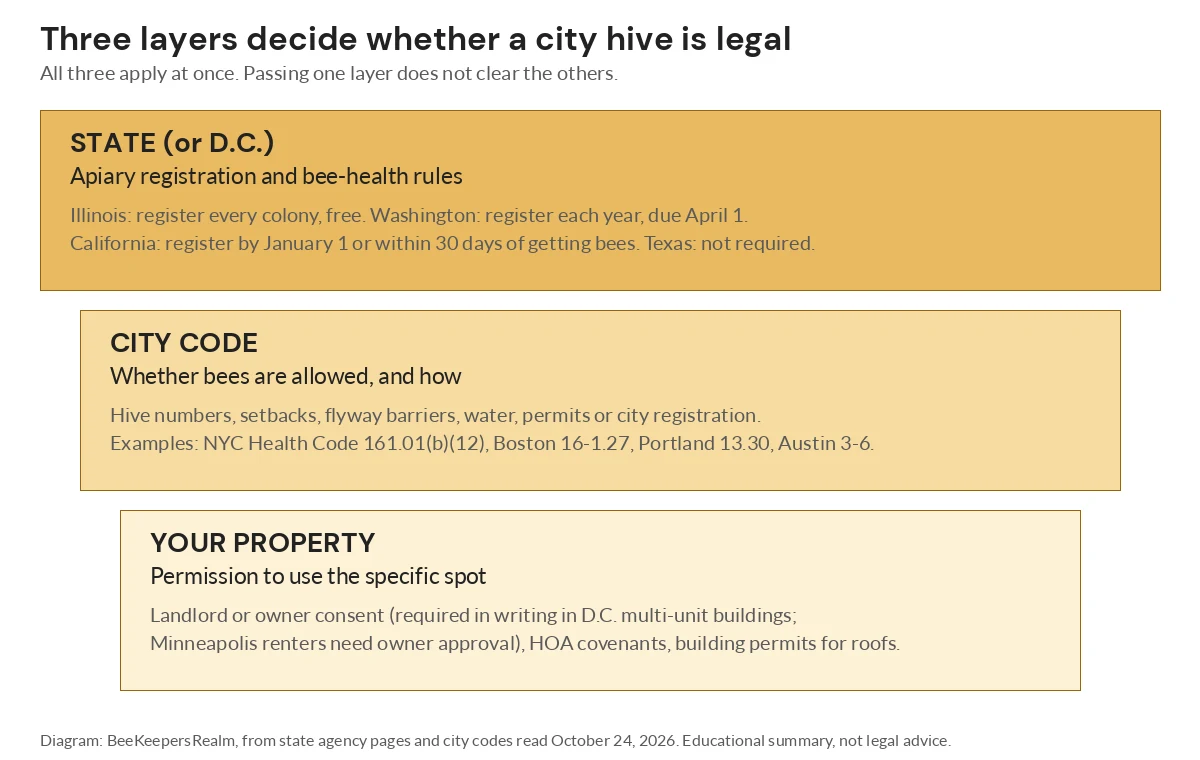
From the state agency pages we read:
- New York: the city’s registration page tells beekeepers to register with the State Department of Agriculture and Markets each year too. See New York beekeeping laws.
- California (Los Angeles, San Diego): San Diego County says state law requires all beekeepers to register by January 1 each year or within 30 days of acquiring bees, and that fees uncollected since 2022 resume in 2026. See California beekeeping laws.
- Illinois (Chicago): the Department of Agriculture says the Bees and Apiaries Act requires registering colonies, one or more, at no charge. See Illinois beekeeping laws.
- Washington (Seattle): the state Department of Agriculture says all beekeepers must register hives each year, due April 1. See Washington beekeeping laws.
- Massachusetts (Boston): the state Apiary Program asks beekeepers to register apiaries so they are notified of confirmed American foulbrood cases within 5 to 6 miles. See Massachusetts beekeeping laws.
- Oregon (Portland): the city code builds in state registration. See Oregon beekeeping laws.
- Minnesota (Minneapolis): the city permit is the main hurdle. See Minnesota beekeeping laws.
- Washington, D.C.: no separate state layer; the District’s code and DOEE rules cover everything.
Texas (Austin) is the clearest exception to the idea, repeated in some search summaries, that registration is mandatory in every state:
“The beekeeping laws in Texas are limited. The state of Texas does not require a beekeeper to register.”
Optional Texas registration costs $35, runs through August 31 and is required for bee removal work; bees brought in from another state need a health certificate and a $200 permit. See Texas beekeeping laws, and for how inspections work once you are registered, our guide to state bee inspector programs.
City Rules in Detail
New York City
New York allows bees by carving them out of the Health Code’s list of prohibited wild animals. Section 161.01(b)(12) bans venomous insects, “including, but not limited to, bees other than non-aggressive honey bees (Apis mellifera).” Beekeepers must file a notice with the Department of Health and Mental Hygiene and report changes within ten business days. In practice that is the city’s beekeeper registration: one free form per hive, filed within 30 days and renewed by May 31 each year, with fines possible for unregistered hives.
The same section requires movable-frame hives in sound condition, a constant and adequate water source, hives placed so bee movement does not become a nuisance, and immediate swarm response. There is no hive cap or distance. Instead, Section 161.02 defines a “beekeeping nuisance” to include aggressive bees, hives or flight paths that interfere with pedestrians or neighbors, and overcrowded, dead or abandoned hives.
Los Angeles
Ordinance 183,920, effective December 6, 2015, made backyard beekeeping an accessory use. Section 12.07 A.13 sets the standards for the RA zone, and Section 12.08 A.10 applies them to the R1 one-family zone. No city permit is needed, but the beekeeper must be registered with the County of Los Angeles Agricultural Commission.
One hive is allowed per 2,500 square feet of lot. Hives stay out of the required front yard, at least 5 feet from every lot line and 20 feet from public rights-of-way or private streets, with entrances facing away from or parallel to the nearest neighboring lot line. A 6-foot wall, fence or hedge must separate hives from neighboring lots unless they sit 8 feet above the neighbor’s ground, and water must be available at all times. The new zoning code (Chapter 1A, Section 5C.2.8) repeats the core standards, so check which chapter covers your parcel. If you live in another city in the county, the county keeps a list of beekeeping ordinances by city.
Chicago
Chicago covers bees in one zoning definition. Section 17-17-0270.7 defines an apiary as the keeping of honeybee colonies and says up to five colonies may be kept as an accessory use to the primary activity on the site. It sets no setback, barrier or water rule and mentions no city permit, so the Illinois registration requirement does most of the formal work. Nuisance rules still apply, so siting matters; our guide to beehive placement covers the choices.

Seattle
Seattle permits beekeeping outright in all zones as an accessory use, provided the hives are registered with the Washington State Department of Agriculture. Section 23.42.052.E allows no more than four hives, each with only one swarm, on lots under 10,000 square feet. Hives may not be within 25 feet of any lot line unless they sit 8 feet or more above the adjacent grade, or stand behind a solid 6-foot fence or hedge running parallel to the lot line and extending at least 20 feet beyond the hive both ways.
Boston
Boston rewrote its rules in 2024. The City Council passed Section 16-1.27 on March 6, 2024 (the mayor approved it March 11), alongside a zoning amendment taking beekeeping out of the zoning code.
Keeping honey bees now requires registration with the Inspectional Services Department (ISD) and a $25 fee. A lot or roof may hold up to five hives, none taller than 6 feet or larger than 24 cubic feet. Where a wall or fence separates the properties, no setback is needed; otherwise hives sit 5 feet from the property line. They may not go in a front yard or a street-side side yard, and must be 10 feet from a public sidewalk. A ground-level hive within 20 feet of a neighbor’s doors or windows must face away from them or have a 6-foot flyway within 3 feet of its entrance. Constant water and swarm response are required. Per the city’s ISD page, ground-level hives need only the registration form with a to-scale sketch, then a one-time inspection.
Portland, Oregon
Chapter 13.30, as amended by Ordinance 192002 effective January 10, 2025, needs no city permit. It does require a letter to owners of properties within 150 feet before you install hives, explaining how you will meet the rules and how to reach you, and you must keep proof you sent it:
“This requirement is meant to allow neighbors an opportunity to become aware of and comment, in an informal manner, before the beehives are installed.”
Any lot may have four hives, lots of 10,000 square feet or more six, plus three extra from April through August for splits and swarms; lots where zoning allows agricultural uses have no cap. Hives must be 3 feet from property lines and 15 feet from public walkways, streets and public outdoor spaces, and on multi-unit lots 15 feet from the walls of every unit. A 6-foot flyaway barrier extending 10 feet past the hives, hives 10 feet up, or existing structures and plants must lift bees to 6 feet. Water is required March through October. Our guide on talking to neighbors about getting bees helps with the letter.
San Diego
The city says no permit is needed, but Section 44.0404 of its municipal code requires registering the apiary with the County Agricultural Commissioner within 30 days and every January after. Only docile Apis mellifera are allowed (see identifying Africanized bees).
Section 44.0408, amended in 2012, splits apiaries by size. One or two hives sit outside the zone’s required setbacks or 15 feet from the property line and 20 feet from public rights-of-way, whichever is greater, inside a 6-foot barrier unless raised 8 feet. They must be hidden from the street, secured, facing the farthest property line, painted a pale color and requeened at least every two years. Three or more hives must be 600 feet from any other home and 100 feet from the right-of-way, a distance few city lots can meet.
Austin
Chapter 3-6, enforced by the city health authority, scales hives to land area. Section 3-6-6 allows two colonies on a quarter acre or less, four on less than half an acre, six on less than an acre and eight on an acre or more, with no cap if every hive is 200 feet from each property line or the tract borders 200 feet of undeveloped land. There is no fixed setback; a colony within 25 feet of a property line needs a 6-foot flyway barrier extending 10 feet past the hives at each end. The chapter also requires Langstroth-type removable-frame hives, a water source, prompt requeening of aggressive colonies with gentle stock, and owner identification on hives unless the owner lives on the tract. Some online summaries give Austin no hive cap and a 10-foot setback; neither appears in the current chapter.
Minneapolis
Section 63.100 says no one may keep honeybees anywhere in the city without a permit from Minneapolis Animal Care and Control (MACC). MACC issues it only after the applicant meets its published educational requirements and shows that every immediately adjacent property owner has been notified; renters also need the owner’s approval. Permits expire January 31 of the following year and must be renewed annually at no charge.
The permit sets the hive number, up to a cap: two colonies on half an acre or less, four up to three-quarters of an acre, six up to an acre, and eight from one to five acres. The property or apiary needs a latching fence, and a colony within 25 feet of a lot line, facing it, needs a 6-foot flyway barrier running 10 feet each way. The city’s older “What’s the Buzz” guide told applicants to get written consent from 80 percent of neighbors within 100 feet; the current section, last amended in 2016, requires notification of adjacent owners instead.
Washington, D.C.
Under D.C. Code Section 8-1825.04, every colony must be registered annually with the Department of Energy and Environment (DOEE), and nobody may start a colony in a building with four or more units without written permission from the manager or owner. If a beekeeper fails to deal with swarms or nuisance conditions, the property owner must, and the beekeeper repays the cost. DOEE’s summary adds: register within 30 days, keep no more than four hives unless the lot exceeds a quarter acre (10,890 square feet) or DOEE agrees, place hives 15 feet from a property line unless other conditions are met, provide constant water, keep no Africanized bees, and get a DOEE permit to move bees or used equipment in or out of the District.
How Many Hives Fit on Your Lot
Hive limits are written per lot, per square foot or by acreage tier, so we applied each code’s text to the same two lots: a typical small city lot of 5,000 square feet and a larger one of 12,000 square feet.
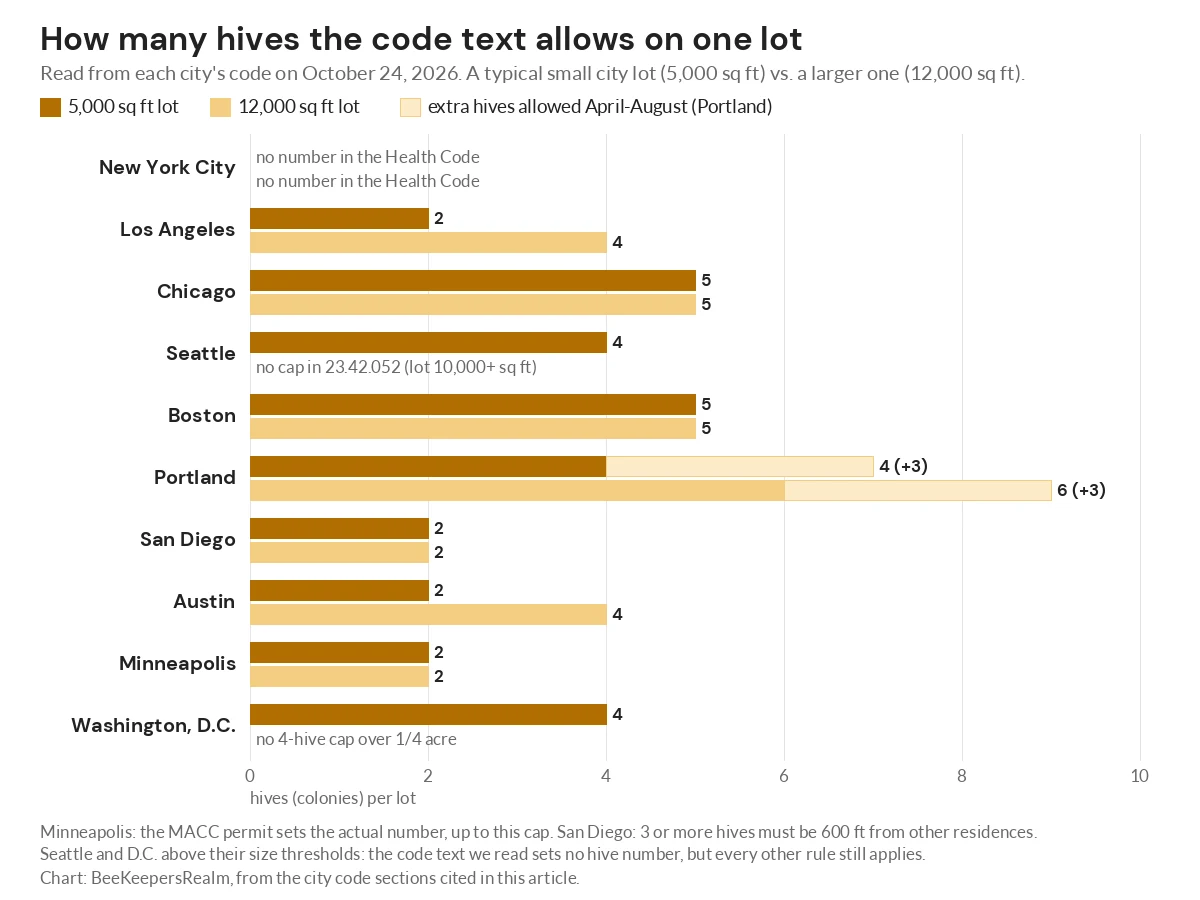
On a small lot the realistic range is two to five hives. Los Angeles, Austin and Portland reward a bigger lot, while Chicago, Boston, San Diego and Minneapolis do not change. Seattle’s and D.C.’s caps apply only below 10,000 square feet and a quarter acre, so on the larger lot the code text we read sets no number, though every other rule still applies. These are maximums; for spacing within the yard, see how close beehives can be to neighbors.
Setbacks and Flyway Barriers Compared
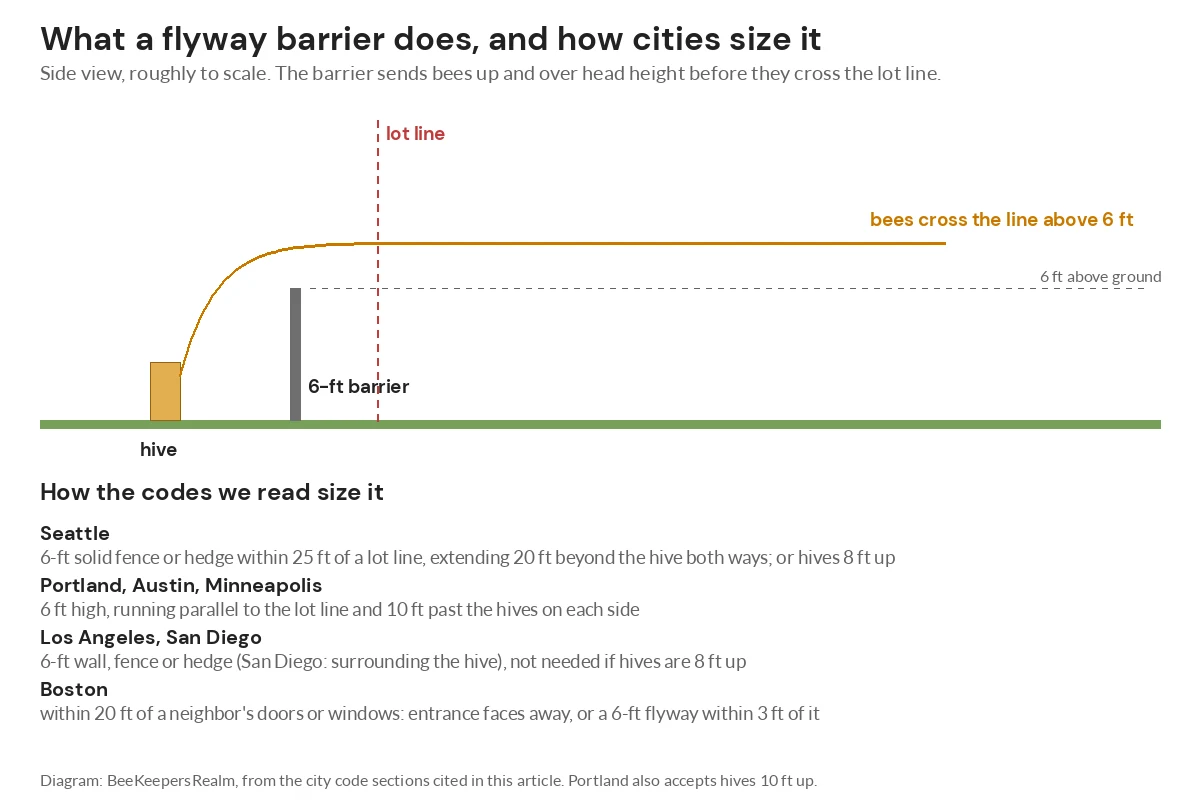
A flyway barrier is a solid fence, wall or dense hedge, usually 6 feet tall, that makes departing bees climb above head height before they cross into a neighbor’s yard. Raising the hives does the same job, which is why several codes accept height instead.
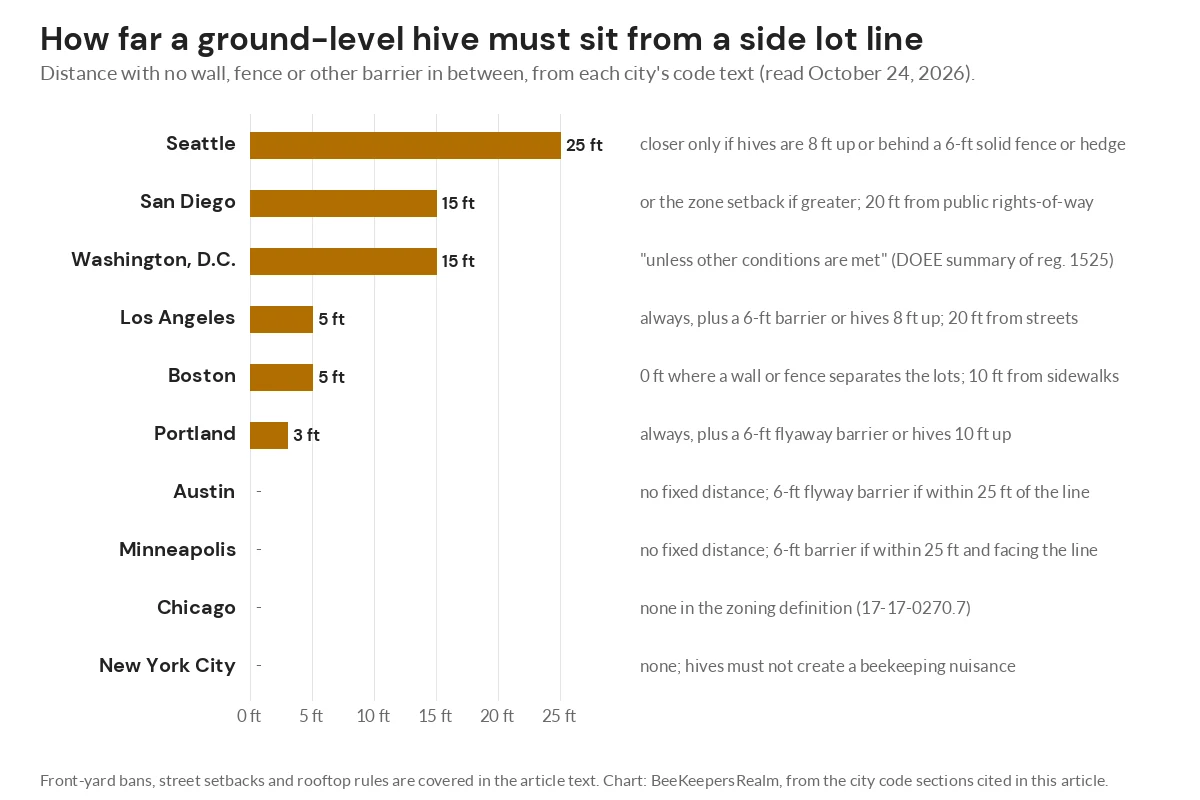
The cities fall into three groups. Seattle, San Diego and D.C. start from a long distance of 15 to 25 feet; in Seattle a fence or raised hives can replace it, while San Diego adds a barrier on top. Los Angeles, Boston and Portland use a short fixed setback of 3 to 5 feet plus a barrier or height rule. Austin and Minneapolis set no distance but require a barrier within 25 feet of a lot line, and Chicago and New York rely on nuisance standards.
Water rules serve the same purpose. New York, Boston and D.C. require a constant source, Los Angeles water at all times, Portland March through October, Austin a source that keeps bees off water used by people, birds and pets, and Minneapolis one while colonies are active. See why bees need a reliable water source.
What the Codes Say About Rooftop Hives
Only some codes address roofs directly. Boston allows up to five hives per roof, 6 feet from the roof edge, only on roofs designed and intended for access and occupancy and permitted by ISD, with the same 20-foot doors-and-windows rule as on the ground. Its ISD page adds that rooftop hives need a building permit, including an engineer-certified load assessment for an existing permitted roof deck.
Elsewhere, height mostly replaces a barrier. Minneapolis drops the flyway barrier for roof hives on a structure with at least one full story, if they sit 5 feet from its side and 15 feet from any adjacent occupied structure, and drops the fence for approved rooftop hives the public cannot reach. Los Angeles, San Diego and Seattle drop the barrier at 8 feet up, and Portland at 10. New York’s Health Code has no roof-specific rule, so a roof comes down to the building owner’s permission, and in D.C. a building with four or more units needs written permission.
Checking the Rules for Your Own Address
If your city is not on this list, the same method works anywhere. Los Angeles County’s agricultural commissioner puts the order of operations simply:
“Make sure to determine if your City has ordinances or zoning restrictions regarding keeping bees before you submit your Annual Apiary Registration and start beekeeping.”
- Confirm which city your parcel is in. A mailing address can name a big city while the lot sits in a suburb or unincorporated county land.
- Search the code in two places: the animal or health title (New York, Austin, Minneapolis, San Diego) and the zoning code (Los Angeles, Chicago, Seattle). Try “bee,” “apiary” and “hive.”
- Note the section number and the date you read it. Boston’s 2024 and Portland’s 2025 changes made many summaries wrong.
- Check state or county registration and whether the city makes it part of its own rule, as Seattle and Portland do.
- Get permission for the spot: landlord, building owner, condo board or homeowners association. See beekeeping and HOAs.
- Sketch the yard to scale with lot lines, sidewalks, neighbors’ doors and windows, barrier and water. Boston requires one, and it tests any city’s distances quickly.
For how zoning and animal-control approaches differ, including hearings and conditional approvals, see our beekeeping zoning laws guide; for every state, see U.S. beekeeping regulations by state.
Frequently Asked Questions
Can you keep bees within city limits?
In all 10 large cities in this guide, yes, with conditions. Every other city and suburb writes its own rules, so check your city’s code before buying bees.
Is it legal to keep bees in New York City?
Yes, for non-aggressive honey bees. Register each hive free with the NYC Health Department within 30 days and every year by May 31, and register with New York State as well.
How many beehives can I have in the city?
On a 5,000-square-foot lot: 2 in Los Angeles, San Diego, Austin and Minneapolis, 4 in Seattle, Portland and D.C., and 5 in Chicago and Boston. New York sets no number.
Do I need a permit to keep bees in my city?
Minneapolis requires a city permit; New York City, Boston and D.C. require registration. The other six cities here need no city permit, though most require state or county registration.
Do I have to register my beehives with the state?
It depends on the state. Illinois, Washington and California require it, and New York City points beekeepers to state registration. Texas does not require it, except for bee removal work.
Do rooftop hives have different rules?
In some cities. Boston allows five per roof, 6 feet from the edge, with a building permit. Minneapolis waives its barrier and fence rules for qualifying rooftop hives. New York’s Health Code has no roof rule.
The Bottom Line
Every big city on this list allows bees, but no two write the rules the same way. Find your city’s section number, apply it to a scale sketch of your yard, register where your state or county requires it, and recheck the code each spring.
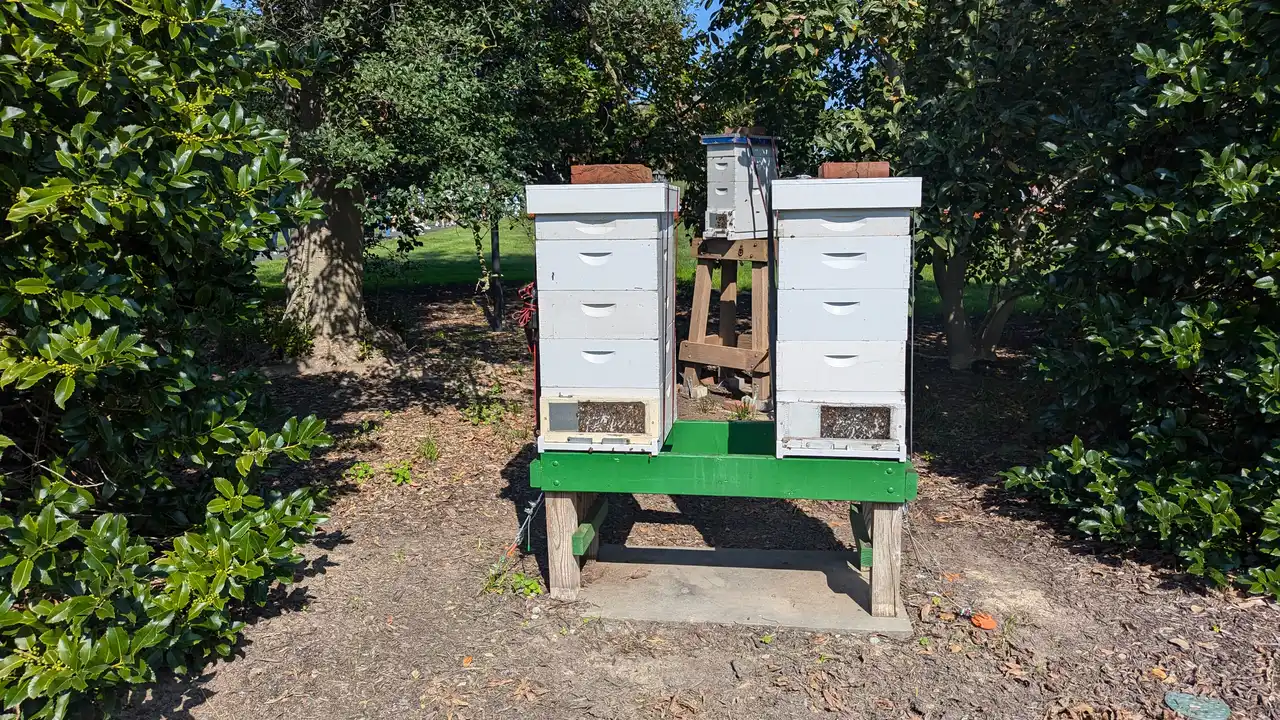
Image credits: Featured photo of hives on the White House South Lawn, Washington, D.C., October 2024: Sdkb, CC BY-SA 4.0, via Wikimedia Commons (File:White House beehive.jpg). Cropped and resized.