Reviewed by Thomas B. · How we review
Yes, for most healthy adult dogs a small amount of plain honey is safe as an occasional treat, but it is not a health food. Honey is about 82% sugar, and one teaspoon carries 21 calories. Skip it for puppies under a year old, dogs with weak immune systems and overweight dogs, and give it to a diabetic dog only when your veterinarian says to.
Each claim below is checked against veterinary, university and FDA sources. For bee stings, see whether bees are dangerous to dogs and other pets.
This is educational information, not veterinary advice. Ask your vet before giving your dog honey or any new food. If your dog may have eaten something toxic, call your vet or the ASPCA Animal Poison Control Center at (888) 426-4435 (a fee may apply).
Written by Michael R.; beekeeping and honey-labeling facts reviewed by Thomas B. Veterinary statements come from the sources named beside them, not from our own expertise.
Key Takeaways
- Honey is not toxic to dogs; the American Kennel Club and PetMD call small amounts safe.
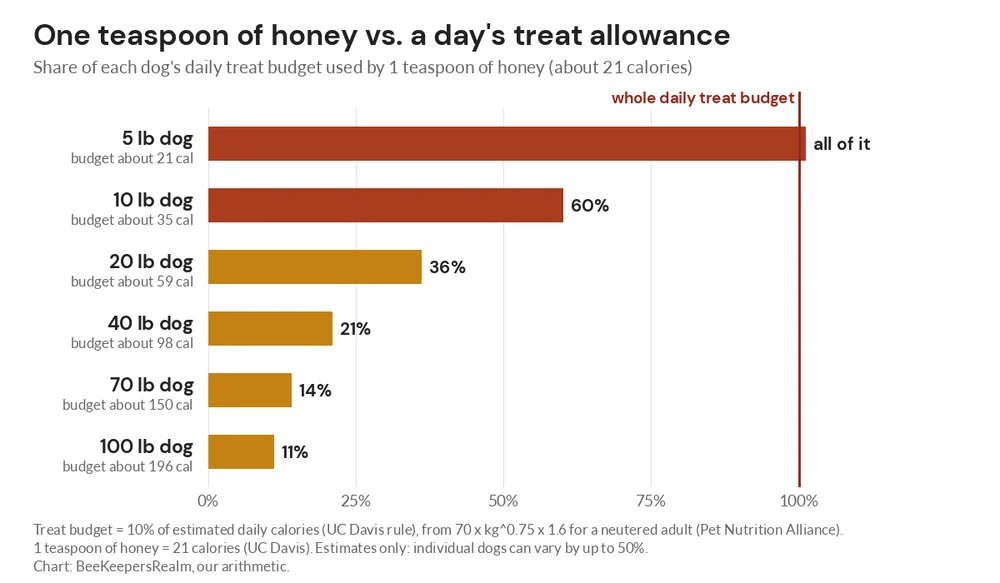
- PetMD’s vet-reviewed limits run from 1/8 teaspoon to 1 tablespoon, once or twice a week. By our arithmetic, a daily teaspoon uses a 5-pound dog’s whole treat allowance.
- No raw honey for puppies under 1 year or dogs with weakened immune systems, because of possible botulism spores.
- No honey treats for diabetic dogs, except in a low-blood-sugar emergency, when an FDA-listed insulin label says to rub corn syrup or honey on the gums.
- Allergy, kennel cough and itchy-skin claims rest on human research or anecdote. Dog studies tested medical-grade honey on skin, ears and wounds, with mixed results.
Table of Contents
- Is Honey Safe for Dogs? What Vets Say
- How Much Honey Can a Dog Have?
- Which Dogs Should Not Have Honey
- Raw, Processed or Manuka: Does the Type Matter?
- Xylitol and the Label
- Allergies, Cough, Itchy Skin and Wounds: The Evidence
- How to Offer Honey Safely
- When to Call Your Vet
- Frequently Asked Questions
- The Bottom Line
Is Honey Safe for Dogs? What Vets Say
The American Kennel Club says “Honey is safe for dogs to eat in small quantities.” PetMD, in an article reviewed by a board-certified veterinarian, says dogs “can have honey in moderation” as an occasional treat. Purina “would advise against feeding it” because honey is “basically pure sugar.” The risk is the sugar, not a poison.
USDA FoodData Central lists honey at 82 grams of sugars and 304 calories per 100 grams. That is about 64 calories in a level tablespoon and 21 in a teaspoon, the figure the UC Davis veterinary hospital’s treat guidelines use.
How Much Honey Can a Dog Have?
UC Davis’s nutrition service says treats and extra foods “should not exceed 10% of the daily caloric intake.” PetMD uses the same rule and adds limits by size: “Based on their size, dogs should eat no more than the following portions of honey once or twice a week”:
| Dog size | PetMD maximum, once or twice a week | Calories |
|---|---|---|
| Extra-small (2 to 10 lb) | 1/8 teaspoon | About 3 |
| Small (11 to 20 lb) | 1/4 teaspoon | About 5 |
| Medium (21 to 50 lb) | 1/2 to 1 teaspoon | About 11 to 21 |
| Large (51 to 90 lb) | 2 teaspoons | About 42 |
| Extra-large (91 lb and up) | 1 tablespoon | About 63 |
Amounts from PetMD’s honey guide (reviewed by Sandra C. Mitchell, DVM, DABVP; updated March 20, 2025). Calories are our arithmetic at 21 per teaspoon.
Why “a teaspoon a day” is too much for small dogs
Other guides, and Google’s AI Overview, quote up to a teaspoon a day for small dogs and a tablespoon for large ones. We checked those against each dog’s treat budget with the Pet Nutrition Alliance’s formula: 70 × (weight in kg)0.75 calories at rest, times 1.6 for a typical neutered adult, then 10%.
| Dog weight | Estimated daily calories | Treat budget | 1 tsp honey uses | 1 tbsp honey uses |
|---|---|---|---|---|
| 5 lb | About 207 | About 21 | All of it | 3 days’ worth |
| 10 lb | About 348 | About 35 | 60% | Almost 2 days’ worth |
| 20 lb | About 585 | About 59 | 36% | More than all of it |
| 40 lb | About 985 | About 98 | 21% | 64% |
| 70 lb | About 1,498 | About 150 | 14% | 42% |
| 100 lb | About 1,958 | About 196 | 11% | 32% |
Individual dogs can vary by as much as 50% from such estimates, the Pet Nutrition Alliance notes, but the pattern holds: a daily teaspoon is a small share for a big dog and a toy breed’s whole allowance.
Which Dogs Should Not Have Honey
Puppies under 1 year and dogs with weakened immune systems
The AKC says raw honey “shouldn’t be fed to puppies or dogs with compromised immune systems, as it may contain the presence of botulism spores.” PetMD extends the warning to dogs on chemotherapy and notes that a puppy’s immune system is not fully developed until about a year old.
The Merck Veterinary Manual says dogs show “relative resistance to botulism,” and our PubMed search on October 24, 2026 found no paper linking honey to botulism in a dog. The rule is a precaution, like the reason honey is not given to human babies, and it costs nothing to follow.

Overweight dogs and dogs with dental disease
The AKC warns that honey’s sugar “can lead to obesity” and tooth decay, and suggests brushing after a honey treat. On a diet, swap it for something like raw baby carrots, which UC Davis lists at 18 calories per 50 grams.
Diabetic dogs, with one exception
The AKC says honey “shouldn’t be given to diabetic dogs.” The exception is when insulin pushes blood sugar too low. The client sheet for Vetsulin, an FDA-approved insulin for dogs and cats, says that if the pet is conscious, “rub approximately 1 tablespoon of corn syrup or honey on your pet’s gums,” then feed and contact the vet (Vetsulin client information, FDA Animal Drugs database). Merck Animal Health’s emergency page names only corn syrup, so ask your vet which to keep at home.
Raw, Processed or Manuka: Does the Type Matter?
“Raw” means strained but not heated or finely filtered (see raw versus processed honey). We found no study showing raw honey does more for dogs than ordinary honey, and the puppy warnings target raw honey.
Manuka honey, from Leptospermum shrubs, contains the antibacterial compound methylglyoxal. That matters on a wound, not in a treat. See how manuka is graded and why its name is disputed. The veterinary studies below used sterilized medical-grade honey, a wound dressing rather than a food.

Xylitol and the Label
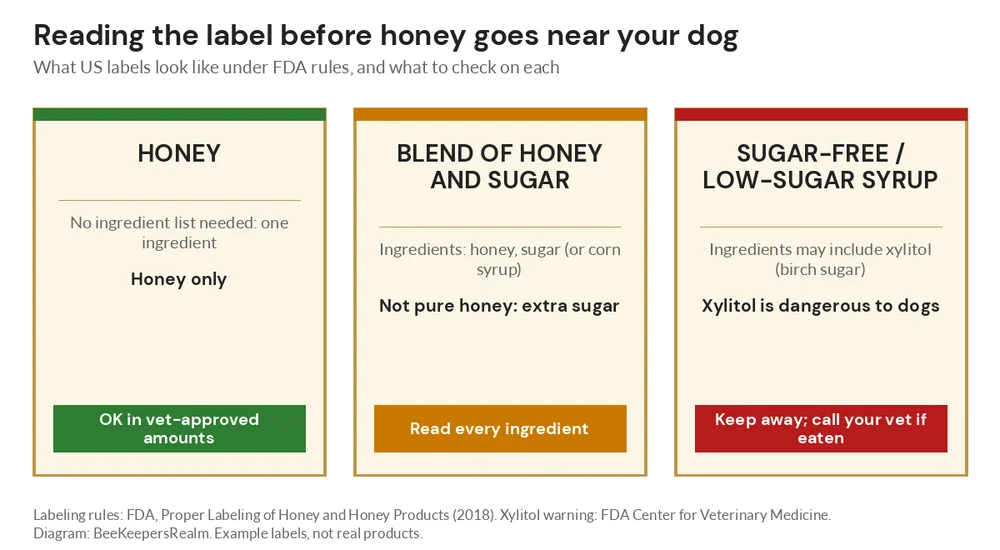
Honey is not on the FDA’s list of products that may contain xylitol, but some peanut and nut butters, cough syrups, sugar-free desserts, baked goods and supplements are. In dogs, the FDA says, xylitol can drop blood sugar within 10 to 60 minutes. Honey often goes into peanut butter for dogs and into human cough syrup, so check those labels, and give human cough medicine only if your vet says to.
“Check the label for xylitol in the ingredients of products, especially ones that advertise as sugar-free or low sugar. If a product does contain xylitol, make sure your pet can’t get to it.”
Under the FDA’s 2018 honey labeling guidance, a jar of only honey is named “honey” and “would not need an ingredient statement because it would only contain one ingredient.” Honey mixed with another sweetener must be named as a blend, such as “blend of honey and sugar,” so read every ingredient on anything else. Buying from a beekeeper? Our guide to vetting real local honey shows what to ask.
Allergies, Cough, Itchy Skin and Wounds: The Evidence
“However, there haven’t been many conclusive scientific studies validating these claims, so many of these claims are anecdotal.”
| Claim | Best evidence in dogs we found | Verdict |
|---|---|---|
| Eases kennel cough or a sore throat | No dog trial; human studies only | Unproven in dogs |
| Local honey relieves seasonal allergies | No dog trial; human trials mixed | Unproven |
| Eating honey soothes itchy skin | No dog trial | Unproven |
| Medical honey on infected nose skin folds | Randomized, blinded trial, 29 dogs (2020) | Placebo did better on lesions |
| Medical honey for ear infections | Pilot study, 15 dogs, no control group (2016) | Promising, unconfirmed |
| Honey on wounds | Small trials; evidence rated “weak” (2020) | Possible benefit; a vet’s call |
| Settles an upset stomach | No conclusive dog studies | Unproven; sugar can loosen stools |
Kennel cough and allergies
Honey has fair evidence for coughs in people, but PetMD says “It’s not clear if honey can help with a dog’s cough the way it does for humans.” For allergies, Purina notes that the pollen a dog reacts to is unlikely to match the pollen in the jar. Beekeepers know why: honey pollen comes mostly from insect-pollinated flowers, while hay-fever pollen is mostly from wind-pollinated grasses, weeds and trees (see does local honey cure allergies).
Itchy skin, ears and wounds
The dog studies used medical-grade honey on the skin, not honey eaten. In a 2020 randomized, blinded PLOS ONE trial, placebo gel beat medical manuka honey on infected nose skin folds in 29 dogs, though owners rated itch lower with honey; the authors said the results “question the value of Manuka honey” there. A 2016 University of Lisbon pilot in Veterinary Dermatology reported that 70% of 15 dogs with ear infections were cured within 14 days on medical-grade honey, with no comparison group.
For wounds, a 2020 knowledge summary in Veterinary Evidence, the peer-reviewed journal of RCVS Knowledge, rated the two randomized dog trials as “weak” evidence:
“At present, the evidence that use of topical honey in canine wounds reduces time to healing is insufficient to warrant a change in clinical practice.”
Purina adds that manuka can make sutures break down faster, one more reason wounds belong with your vet.
How to Offer Honey Safely
- Buy honey labeled only “honey,” measure it with a measuring spoon, stay within PetMD’s weekly amounts and start small.
- Keep it plain: a lick from a spoon, or a little honey in xylitol-free peanut butter frozen in a stuffable toy, as PetMD suggests.
- Store it sealed and out of reach. Honey keeps for years (see our honey storage guide); an open jar on a low table invites a binge.
When to Call Your Vet
- A possible xylitol product was eaten. The FDA says to call your vet, an emergency clinic or poison control right away; signs include vomiting, weakness, staggering and seizures, sometimes delayed 12 to 24 hours.
- Your dog is coughing. PetMD advises a vet call before any home remedy.
- A diabetic dog seems weak or wobbly. Follow your vet’s low-blood-sugar plan; a seizure is an emergency.
- Vomiting or diarrhea continues after your dog raids a jar, or a wound, hot spot or ear problem needs treating.
Manuka grading is explained in how manuka is graded.
Frequently Asked Questions
How much honey can I give my dog?
PetMD’s limits run from 1/8 teaspoon for dogs up to 10 pounds to 1 tablespoon for dogs over 90 pounds, no more than once or twice a week.
Can dogs eat honey every day?
Not routinely. PetMD says honey shouldn’t be a regular part of a dog’s diet.
Does honey stop dog itching?
There is no good evidence that eating honey relieves itchy skin. Itching needs a diagnosis.
Is honey good for dogs with kennel cough?
It is unproven. Honey may soothe a throat slightly, but a coughing dog should see a vet first.
What are the side effects of honey for dogs?
Sugar effects: weight gain, tooth decay, higher blood sugar, and vomiting or diarrhea after a large amount.
Can puppies have honey?
The AKC and PetMD say no raw honey for puppies under 1 year, because of possible botulism spores.
The Bottom Line
A measured lick of plain honey now and then will not hurt most healthy adult dogs, and it will not cure anything. If you hoped it would fix a cough, an itch or a wound, ask your vet about that problem instead.
Image credits: Featured photo: Jernej Furman via Wikimedia Commons, CC BY 2.0, cropped. Other photos are credited in their captions. Charts and diagrams: BeeKeepersRealm.