

Reviewed by Michael R. · Last Updated October 14, 2026 · How we review
Yes, Illinois requires registration: anyone keeping even one honey bee colony must register it with the Illinois Department of Agriculture (IDOA) under the Bees and Apiaries Act (510 ILCS 20). Registration is free, new beekeepers have 10 days to file, and IDOA apiary inspectors check colonies at no charge. Cities set their own rules on top: Chicago allows up to five colonies on a lot, while suburbs such as Darien require a local permit.
Educational information only, not legal advice. Rules change, so confirm current requirements with the IDOA Bees and Apiaries Program (217-782-6297) and with your city or county before you buy bees. We checked the sources below in October 2026.
Key Takeaways
- Every person keeping one or more colonies must register annually (510 ILCS 20/2). There is no fee.
- File within 10 days of getting bees or bringing them into Illinois. The IDOA form requires GPS coordinates for every apiary.
- Mark each hive “IL” plus your registration number, in weatherproof letters at least 1/2 inch tall.
- Unregistered colonies are a legal nuisance. You get 30 days to register before abatement, and a hearing officer can fine you $50 for failing to register.
- Where hives may sit is a local question. Chicago’s zoning code allows up to five colonies; Darien allows two, 15 feet from every lot line.
Table of Contents
- Illinois Bee Rules at a Glance
- How to Register Bees in Illinois
- Marking Hives With Your Number
- Who Inspects Illinois Apiaries
- Moving Bees Into or Around Illinois
- Penalties Under the Bees and Apiaries Act
- Illinois Beekeeping by the Numbers
- City and Village Rules: Chicago and Darien
- Protecting Hives From Pesticide Drift
- Selling Honey in Illinois
- Frequently Asked Questions
Illinois Bee Rules at a Glance
State beekeeping law lives in two places: the Bees and Apiaries Act passed by the legislature, and the IDOA’s rules in 8 Ill. Adm. Code Part 60, last amended in 2002.
| Topic | What the rule says | Source |
|---|---|---|
| Who registers | Every person keeping one or more colonies, every year | 510 ILCS 20/2(a) |
| Fee | None | Part 60.20(h) |
| New beekeepers | Apply within 10 days of acquiring bees or bringing them into Illinois | 60.20(a)-(b) |
| Renewal | During November each year | 60.20(c) |
| Hive marking | “IL” plus registration number, weatherproof, at least 1/2 inch tall, on the hive front | 60.20(f) |
| Inspections | IDOA may inspect any bees, equipment or apiary; inspections are free | 20/2-4; IDOA |
| Unregistered colonies | A nuisance; 30 days to register, then abatement | 20/2-1; 60.20(g) |
| American foulbrood | Combs, frames, honey and bees burned within 10 days of written notice | 60.50(a) |
| Moving bees | Permit or compliance agreement based on an inspection certificate; 10 days’ notice | 20/2a, 2b; 60.60 |
| Hive placement | Set by cities, villages and counties, not the state | Local codes |
How to Register Bees in Illinois
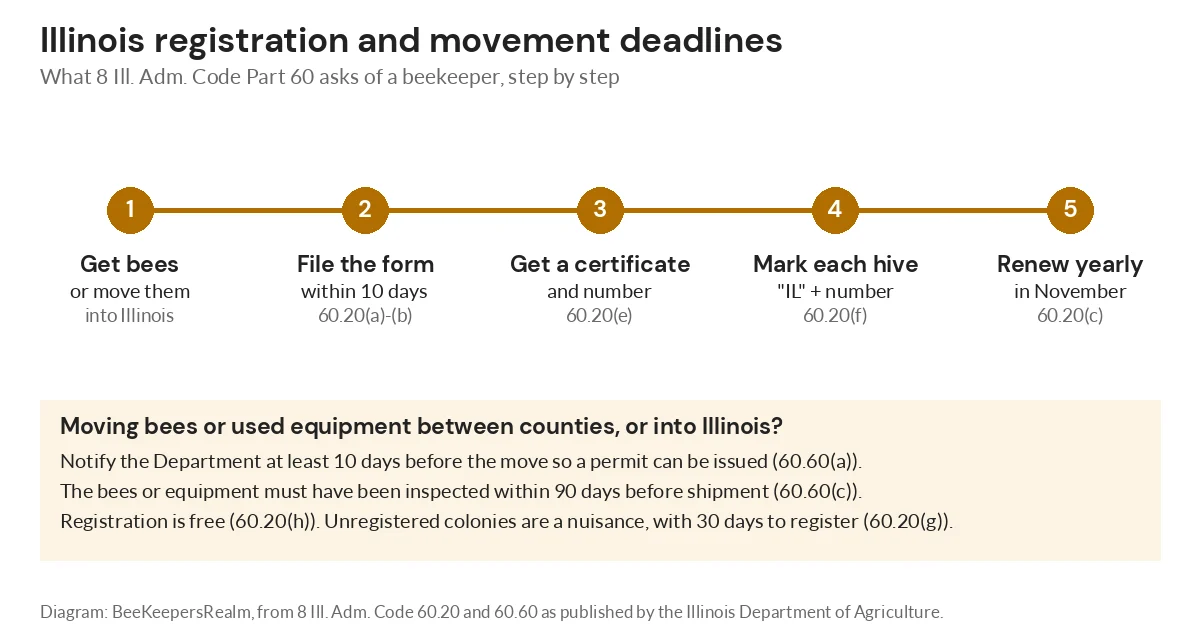
The statute itself is one sentence: anyone keeping one or more colonies registers with the Department annually. The details are in Section 60.20 of the rules. You must file within 10 days of acquiring bees, and anyone moving bees in from another state or country must file within 10 days of arrival.
Registration is a one-page paper form, the Application for Apiary Registration (form IL 406-0286, revised November 2016), linked from the IDOA program page. Besides your contact details, it asks for each apiary’s colony count, county, township, location and landowner. The form says GPS coordinates “are required for registration.” Mail it to the IDOA Apiary Inspection Section, P.O. Box 19281, Springfield, IL 62794-9281.
The IDOA then sends a numbered registration certificate. Under 60.20(e) it stays valid until the Department cancels it because you stopped keeping bees, or you ask it to.
When to renew
Rule 60.20(c) says to file a renewal “during the month of November.” The IDOA’s own fiscal 2026 annual report describes something looser: renewals that “can take place from Jan 1 through October 1,” and new registrants who are not required to renew after their first year. If you are unsure which applies to you, ask the Apiary Inspection Section rather than skipping a year. For other states, see our guide to state bee inspector programs and apiary registration.
Marking Hives With Your Number
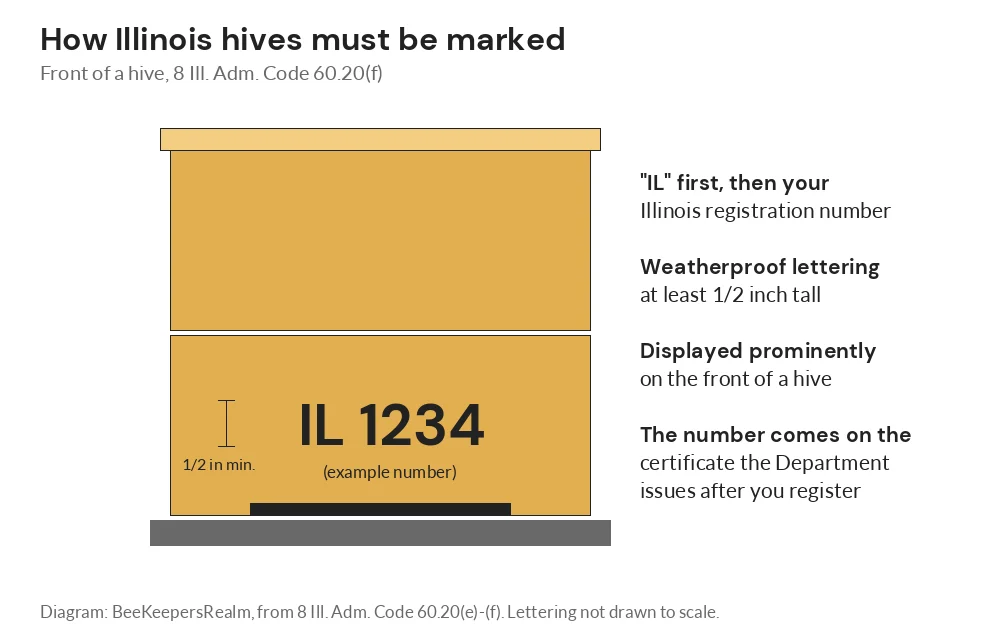
Section 60.20(f) says every apiary must be identified with the state abbreviation “IL” followed by your Illinois registration number. The lettering must be weatherproof, at least half an inch tall, and displayed prominently on the front of a hive. The Act backs this up: Section 2(b) lets the Department require you to post your number in each apiary, and Section 7 sets a $50 penalty for failing to post it.
Who Inspects Illinois Apiaries
IDOA apiary inspectors work in regions across the state. The program page says they examine hives “to detect diseases and pests and provide advice on needed treatments,” and that inspections are free. Section 2-4 of the Act lets the Department inspect any bees, colonies, equipment or apiary and enter beekeeping property during reasonable business hours. When asked, you must tell the Department where all your bees and equipment are and help handle them (60.30).
Three rules matter most in an inspection:
- Hives must be inspectable. A hive whose frames or comb cannot be readily removed, such as a cross-combed hive, is a nuisance under 60.40. You get written notice and 90 days to stop using it, then 7 days to abate it.
- American foulbrood means burning. Combs, frames, honey and bees go into a pit at least 18 inches deep, and the ashes are covered with at least 6 inches of soil, within 10 days of written notice. Boxes, bottoms and covers can be saved by scorching (60.50(a)). If state funds exist, the Act pays $25 for each colony the Department destroys (Section 2-2).
- No exotic strains. Possessing Africanized or other exotic strains is banned, and bees from areas where they occur must be certified European (60.50(c)).
If you are not sure what an inspector would see, compare American and European foulbrood and learn to spot small hive beetle damage. The IDOA’s fiscal 2026 report found the beetle in 915 inspected colonies, up from 696 a year earlier.
Moving Bees Into or Around Illinois
Section 2a bars moving a colony or used bee equipment between Illinois counties without a permit or compliance agreement, issued on the basis of an IDOA inspection certificate. Section 2b applies the same rule to bees and used equipment coming in from another state or country. Packaged bees sold across county lines or brought into Illinois need an inspection certificate (Section 2b-1).
Under rule 60.60 you must notify the Department in person, in writing or by phone at least 10 days before the move. The bees or equipment must have been inspected within 90 days before shipment. A parasite treatment must have been started within 30 days before the move (60.50(b)).
These rules changed in 2026. Public Act 104-0713 (Senate Bill 3116) amended Sections 2-4, 2a and 5 of the Act. Summaries of the enacted text describe a new option for the IDOA to waive the permit for moves to a neighboring Illinois county or a neighboring state, with an inspection certificate still required. The official General Assembly site would not load when we checked, so confirm the current permit rules with the IDOA before any move. If you are crossing a border, read our Indiana and Wisconsin guides too.
Penalties Under the Bees and Apiaries Act
Enforcement starts with a warning period under rule 60.20(g):
“All bees or colonies not registered with the Department shall be declared a nuisance. The beekeeper shall have 30 days in which to register. Failure to comply within 30 days will result in abatement of the nuisance.”
If the Department has to abate a nuisance itself, you owe the cost within 60 days (Section 2-1). After an administrative hearing, with at least 10 days’ written notice (Section 8), a hearing officer may levy these penalties under Section 7:
| Violation | Penalty |
|---|---|
| Failing to register annually | $50 |
| Failing to post your registration number | $50 |
| Moving bees within Illinois without a permit | $50 |
| Keeping hives that cannot be readily inspected | $100 |
| Moving bees interstate without a permit | $100 |
| Failing to abate diseased colonies or exotic strains | $500 |
| Violating a quarantine | $500 |
| Any other violation of the Act | $100 |
A second violation within 3 years of the first doubles the penalty. Final decisions can be appealed to circuit court (Section 9).
Illinois Beekeeping by the Numbers
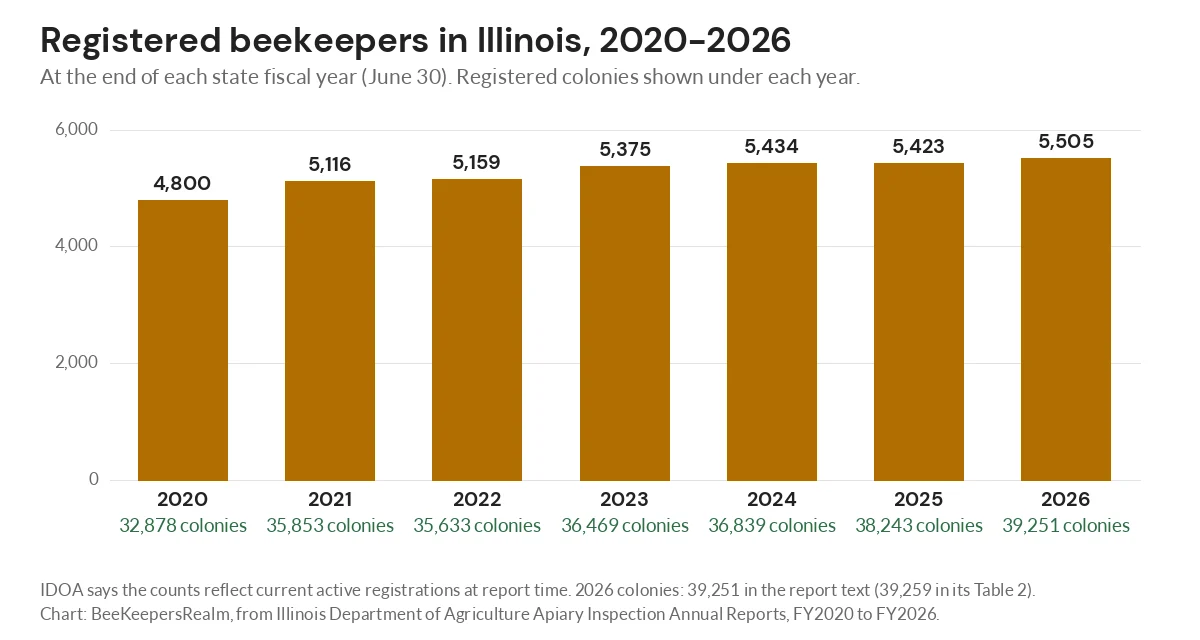
Section 3 of the Act makes the IDOA report to the Governor and the Illinois State Beekeepers Association every July. The fiscal 2026 report, dated July 1, 2026, counts 5,505 registered beekeepers managing 39,251 colonies in 7,138 apiaries, with 418 newly registered during the year. Lake County had the most colonies (3,108), ahead of Will (2,842) and Cook (2,614).
Registrations have grown about 15% since fiscal 2020, from 4,800 to 5,505, and registered colonies about 19%, by our arithmetic from the IDOA figures.
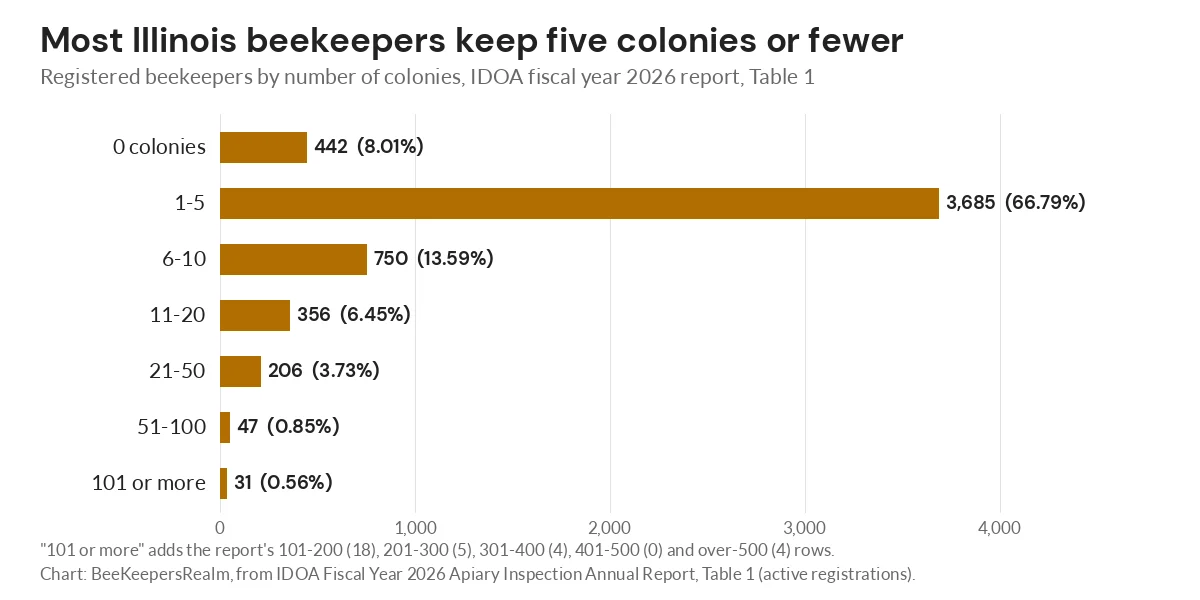
It is a hobbyist state. Almost 89% of registered beekeepers manage 10 colonies or fewer, and only 31 keep 100 or more. Inspectors visited 595 apiaries with 6,407 colonies in fiscal 2026 and opened 4,285 of them. American foulbrood was confirmed in 16 colonies and European foulbrood found in 85, and 16 nuisance hives were abated.
City and Village Rules: Chicago and Darien
A state registration number does not decide where a hive may sit. That is up to your city, village or county, and the rules differ a lot. Chicago puts it in a single definition in its zoning code:
“Keeping or propagation of honeybee colonies for collection of honey or other bee products. Up to five (5) colonies may be kept as an accessory use to the primary activity on the site.”
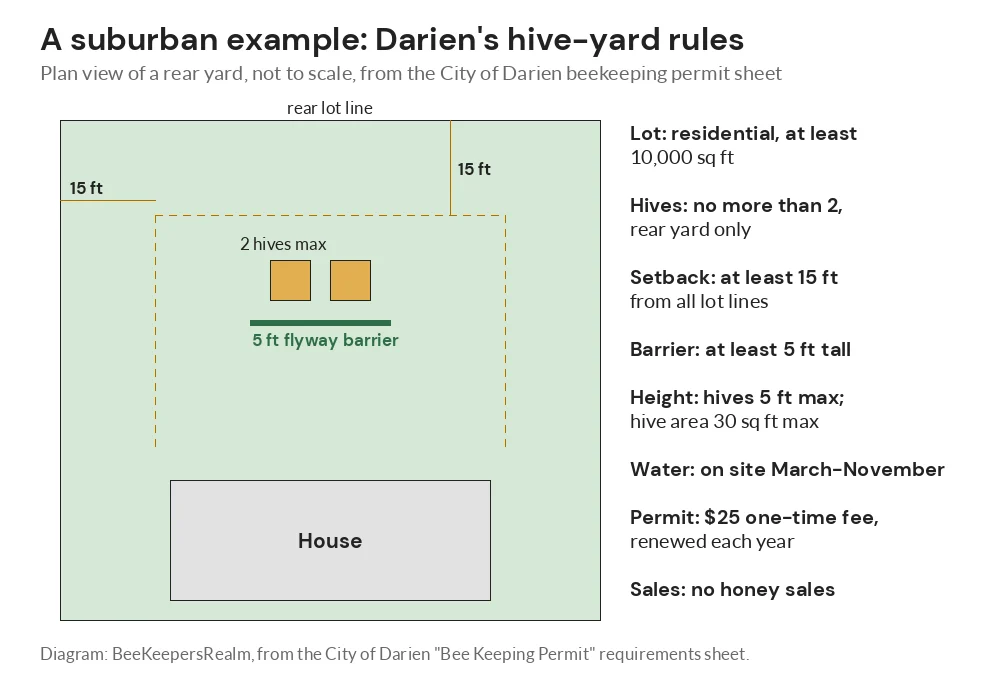
That definition sets no setback and mentions no separate permit, so ask city zoning staff whether anything else applies to your lot. Many suburbs are stricter. Darien’s beekeeping permit sheet allows at most two hives, only on residential lots of at least 10,000 square feet and only in the rear yard. Hives must sit at least 15 feet from every lot line behind a flyway barrier at least 5 feet high. Hives may be no taller than 5 feet, and you need a building-registration permit, an inspection and a $25 one-time permit renewed each year. Darien also bans honey sales.
The state beekeepers’ association gives the same advice in its own guidelines:
“Beekeepers should comply with all homeowner association and local ordinances and regulations pertaining to beekeeping.”
Those guidelines also say not to place a hive directly against a neighboring property unless a fence or dense plant barrier four feet or higher forms the boundary. For general siting, see our beekeeping zoning laws guide, how close beehives can be to neighbors, and how to talk to your neighbors about getting bees.
Protecting Hives From Pesticide Drift
The registration form asks beekeepers to consider registering on DriftWatch. The IDOA says it has added many registered apiaries to that database so pesticide applicators can see them. Its fiscal 2026 report says applicators can find beekeepers’ contact and location details through the FieldWatch system, where beekeepers can also register colonies. Taking part is voluntary. Our guide to DriftWatch and BeeCheck explains how the map works.
Selling Honey in Illinois
Since January 1, 2011 (Public Act 96-1028), plain honey has had its own exemption. Under the Sanitary Food Preparation Act (410 ILCS 650/7), the state may not regulate honey in the comb or honey removed from the comb in an unadulterated condition. If you sell that honey at a local market and pack or sell less than 500 gallons of Illinois honey a year, the state may not regulate or inspect your honey house. The Food, Drug and Cosmetic Act has the same honey exemption (410 ILCS 620/27).
The exemption covers only plain comb or extracted honey. For anything else, and for labels and market rules, ask your county health department. Local zoning can still ban sales from home, as Darien does. Our guides explain how to start selling honey legally and where to sell honey.
Frequently Asked Questions
Can I keep bees in Illinois?
Yes. State law does not ban beekeeping; it requires registration and inspectable hives. Whether a particular address allows hives depends on your city or village code and any homeowners’ association.
Do I have to register just one hive in Illinois?
Yes. The Act covers every person keeping “one or more colonies,” so a single backyard hive must be registered.
How much does Illinois beekeeper registration cost?
Nothing. Rule 60.20(h) says there are no registration fees, and the IDOA form says “There is no charge for registration.” Local permits, such as Darien’s $25 permit, are separate.
How many beehives can I have in Chicago?
Up to five colonies, kept as an accessory use to the main use of the site, under Chicago Zoning Ordinance Section 17-17-0270.7. You still need state registration.
Who is the Illinois state bee inspector?
Inspections are run by the IDOA’s apiary inspection program, with inspectors assigned by region. For an inspection in an area without an inspector, the IDOA lists Apiary Inspection Supervisor Michelle Curby at 217-782-6297.
Do I need a license to sell honey at an Illinois farmers market?
Not for plain comb or extracted honey sold at a local market if you pack or sell less than 500 gallons of Illinois honey a year (410 ILCS 650/7). Check your county health department for anything else.
Is there a tax credit for Illinois beekeepers?
Not in law yet. Senate Bill 4007, filed in February 2026, would give beekeepers an income tax credit for liability insurance premiums, up to $1,000, for tax years starting in 2027. The last action we found was its assignment to the Senate Revenue Committee on February 24, 2026.
Before You Buy Bees
Check your local zoning first, register within 10 days of getting bees, and mark every hive with your IL number. Comparing states? Start with our U.S. beekeeping regulations by state.

.jpg)
.jpg)