Reviewed by Elena P. · How we review
Fire cider is a folk tonic made by steeping grated horseradish, garlic, onion, ginger and hot peppers in apple cider vinegar for several weeks, then straining it and sweetening it with honey. Herbalist Rosemary Gladstar named it in the late 1970s, and no clinical trial has ever tested it. Most recipes steep raw roots in cold vinegar at room temperature. The University of Minnesota (UMN) Extension has published a hot-vinegar method instead, and this guide gives both, with the honey step, storage rules and what the research says about each ingredient.
Educational information only, not medical advice. If you take medicines, especially blood thinners, read the National Institutes of Health’s NCCIH garlic fact sheet and ask your clinician before using herbal preparations. Our reviewer, Elena P., checks the honey and beekeeping details only; the health statements come from the sources linked.
Key Takeaways
- Fire cider is a flavored vinegar: roots, alliums and peppers steeped in apple cider vinegar, with honey stirred in after straining.
- UMN Extension’s safer method pours vinegar heated to 190 to 195°F over about 1 cup of thinly sliced produce per 2 cups of vinegar, then steeps it 10 to 30 days and refrigerates it once opened.
- A PubMed search for “fire cider” returned no studies of the tonic. Honey has the best evidence of any ingredient, and only for easing cough symptoms.
- Storage advice runs from 3 to 12 months depending on the source; Clemson Extension gives 3 months in cool storage and 6 to 8 months refrigerated for flavored vinegars.
- Never give fire cider made with honey to a child under 1 year old. The CDC says honey is not safe for infants.
Table of Contents
- What Fire Cider Is and Where the Name Came From
- A Starting-Point Fire Cider Recipe
- Cold Steep or Hot Pour: Making It Safely
- Honey’s Role and Which Honey to Use
- Storage, Spoilage and the Garlic Question
- What the Evidence Says, Ingredient by Ingredient
- Who Should Be Careful With Fire Cider
- Frequently Asked Questions
- The Bottom Line
What Fire Cider Is and Where the Name Came From
UMN Extension defines fire cider as a flavored vinegar made by infusing apple cider vinegar with onions, garlic, ginger and citrus. Horseradish and hot peppers give it the “fire,” and honey goes in at the end. Because it combines vinegar and honey, Shelburne Farms calls it an oxymel, the same family as the old honey-vinegar syrup in our guide to non-alcoholic honey drinks.
The name belongs to Rosemary Gladstar. Martha Stewart’s editors, who interviewed her, say she came up with the tonic and coined the name in the late 1970s, and Shelburne Farms gives the same decade. Gladstar is candid that the idea is older: in a 2012 video she says she does not know where she first got the recipe, and she compares it to the “four thieves” plague vinegar while adding that nobody knows how true that story is.
The trademark dispute
In 2012 Shire City Herbals, a Massachusetts company, filed to trademark “fire cider” for its bottled tonic, according to BevNET and WAMC. Herbal makers petitioned to cancel the mark in 2014, and Shire City sued three of them for infringement in 2015. In October 2019, Judge Mark G. Mastroianni of the federal court in Massachusetts ruled that “fire cider” is a generic term that cannot be trademarked, so the name is not one company’s property in the United States.
In this 2012 LearningHerbs video, Gladstar grates horseradish, garlic, onion and ginger into a quart jar, using roughly equal parts of the first three and about half a part of ginger. She covers them with unpasteurized apple cider vinegar, adds about a quarter teaspoon of cayenne, steeps the jar for about four weeks and stirs in honey to taste after straining. It shows the traditional room-temperature method; the health effects she describes are her own views, not trial results.
A Starting-Point Fire Cider Recipe
This is a starting point, not a recipe we have tested for a result. The proportions follow Gladstar’s video (equal parts horseradish, garlic and onion, half as much ginger), scaled down to UMN Extension’s limit of about 1 cup of produce per 2 cups of vinegar so the jar is not overpacked.
Makes about 2 cups (one quart jar).
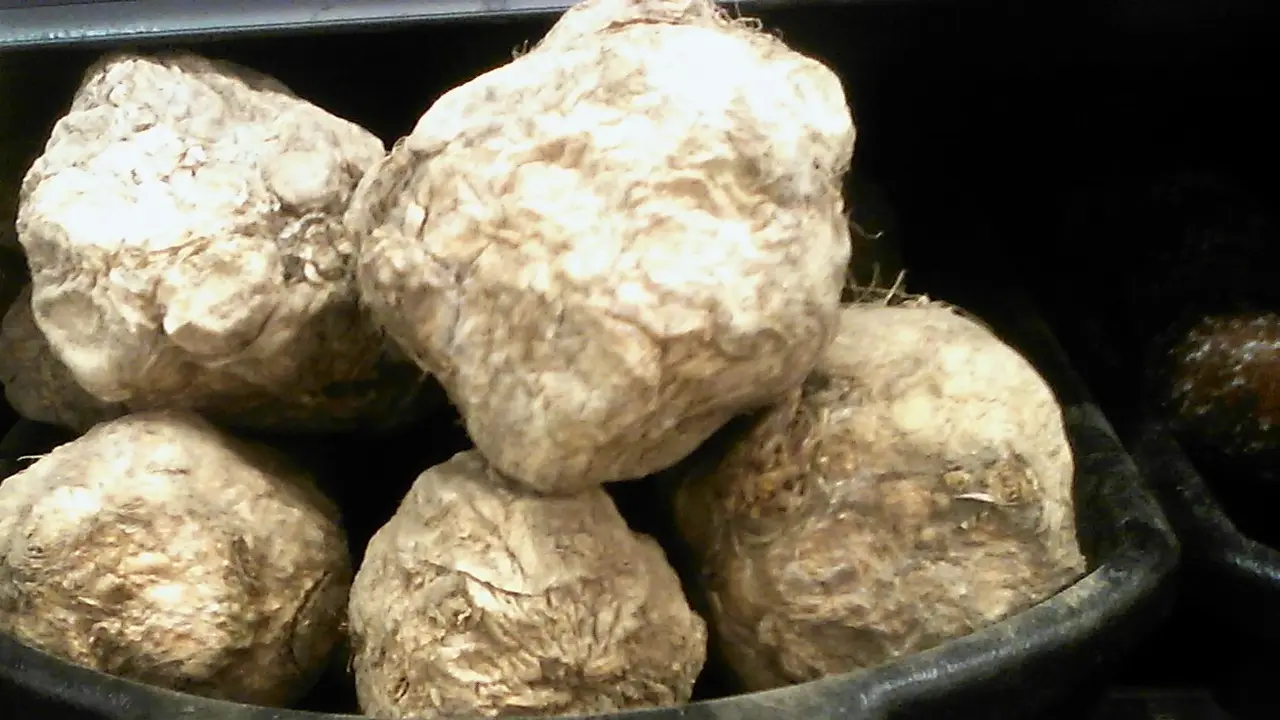
- ¼ cup peeled, grated fresh horseradish
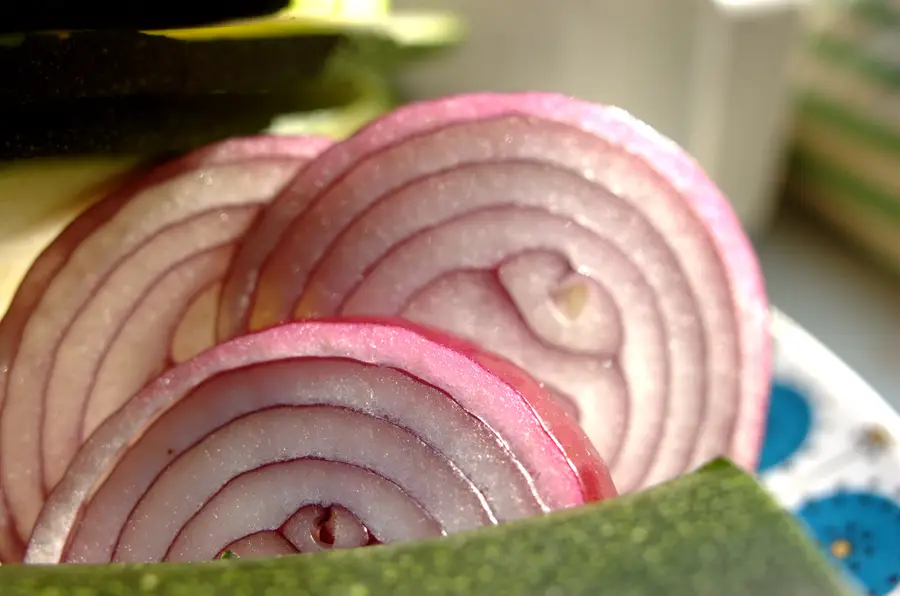
- ¼ cup thinly sliced onion
- ¼ cup thinly sliced garlic
- 2 tablespoons thinly sliced fresh ginger
- 1 small hot pepper, thinly sliced, or ¼ teaspoon cayenne
- Zest of 1 lemon (optional)
- 2 cups apple cider vinegar
- 2 to 4 tablespoons honey, added after straining
Here is how that compares with three published versions:
| Recipe | Jar | Produce | Vinegar | Honey | Steep |
|---|---|---|---|---|---|
| Gladstar’s original, as printed by Shelburne Farms | Half gallon | ½ cup horseradish, ½ cup or more onion, ¼ cup or more each garlic and ginger, cayenne | To cover by 3 to 4 inches | To taste | 3 to 4 weeks, warm spot |
| Gladstar’s winter version, City Market Co-op | Quart | ½ cup each ginger and horseradish, 1 onion, 10 garlic cloves, 2 jalapeños, lemon, rosemary, turmeric | To cover by about 2 inches | ¼ cup, then more to taste | 1 month |
| GoodRx (adapted from Epicurious) | Quart | 1 cup horseradish, ½ cup ginger, 1 onion, 8 garlic cloves, lemon, spices | 2 cups or more | 2 tbsp or more | At least 1 month |
| Our starting point | Quart | About 1 cup in total | 2 cups | 2 to 4 tbsp | 10 to 30 days (UMN) |
The GoodRx version holds 1½ cups of horseradish and ginger alone against 2 cups of vinegar, already past UMN’s ratio before the onion and garlic go in.

Cold Steep or Hot Pour: Making It Safely
None of the nine fire cider recipe pages we read in full heats the vinegar: they pack the jar, cover the produce with raw vinegar and leave it for weeks. UMN Extension’s page, written by food safety educator Autumn Stoll, explains why it takes a different route:
“Pasteurized vinegar on its own poses little food safety risk. However, adding fruits, vegetables and spices can alter the pH and introduce unwanted foodborne illness-causing microorganisms, such as Listeria monocytogenes, which can cause listeriosis.”
The hot-pour method, step by step:
- Clean and sanitize the counter, cutting board, utensils and a quart jar.
- Wash the produce under running water and slice it thin. Aim for about 1 cup of produce to 2 cups of vinegar.
- Heat the vinegar to just below boiling, 190 to 195°F, and pour it over the produce in the jar.
- With a thermometer, check that the center of the solids stays above 165°F for at least 1 minute 12 seconds. Thin slices and a loosely packed jar make this easier.
- Close the jar and rest it in a cool, dark place for 10 to 30 days, depending on the strength you want.
- Strain out all the solids; UMN says a coffee filter is ideal. Stir in the honey (next section) and bottle.
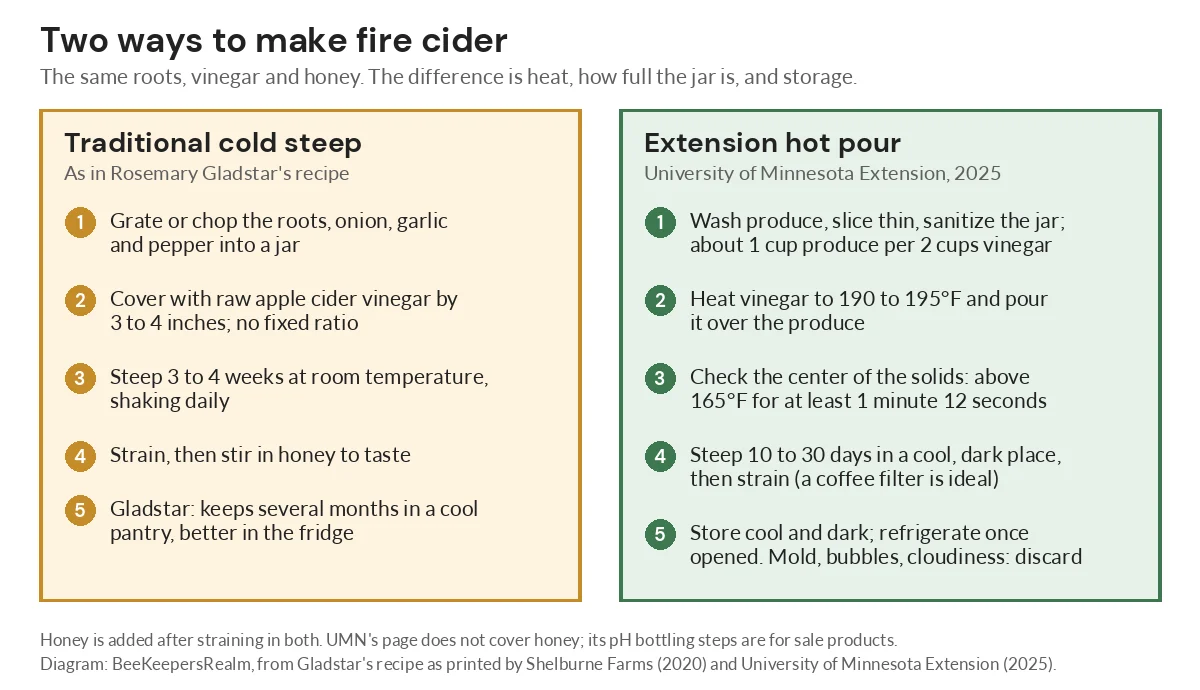
There is a trade-off. Gladstar prefers unpasteurized vinegar for its live enzymes, and the hot pour heats the vinegar. Clemson Extension uses the same 190 to 195°F step for all homemade flavored vinegars, so we treat it as the safer default. UMN also lists pH limits for bottling, but those are for vinegar made for sale; at home, a strained jar in the fridge is the simple route.
Honey’s Role and Which Honey to Use
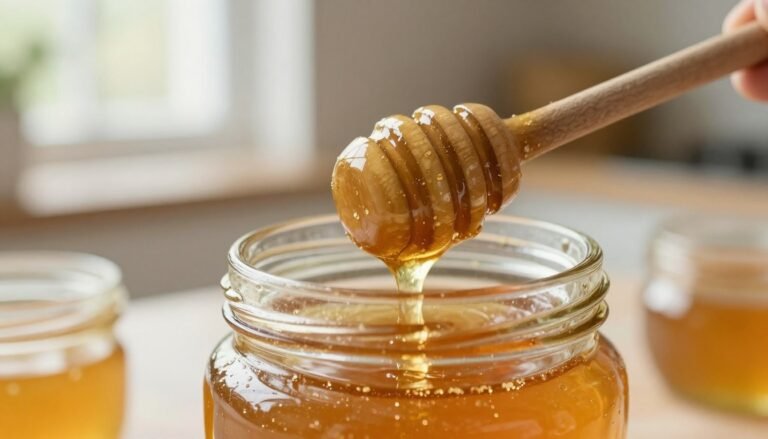
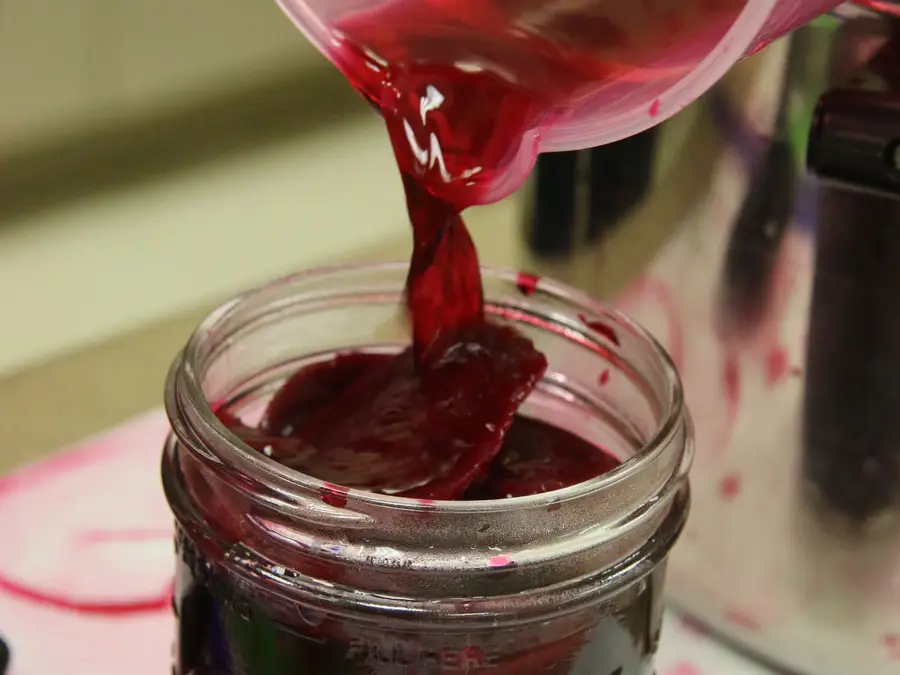
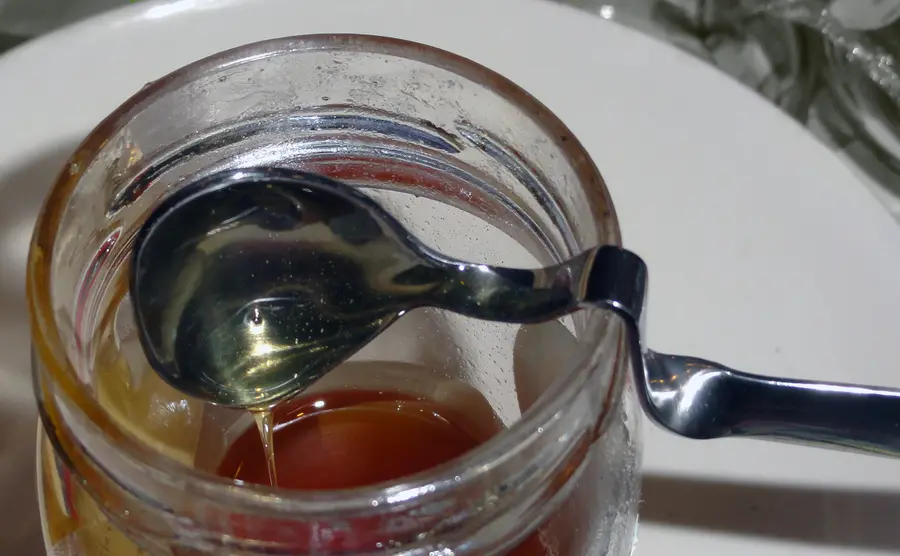
Honey is the last step in every recipe we read, stirred into the strained vinegar. Its job is taste: Gladstar says the finished tonic should be hot, spicy and sweet. Amounts run from 2 tablespoons per 2 cups (GoodRx) to ¼ cup per quart and more to taste (City Market). Add it slowly and taste as you go.
Any liquid honey works. A mild honey such as clover lets the horseradish and ginger lead, and a dark, strong honey such as buckwheat competes with them; that is our judgment, not a tested result. Gladstar asks for raw honey. If you want it to stay raw (see raw vs processed honey), stir it in after the vinegar has cooled, not into hot vinegar. A crystallized jar dissolves more easily if you warm the honey gently first.
We found no extension guidance on how much honey a flavored vinegar can hold; UMN’s fire cider page does not mention honey. If you steep the roots in honey instead of vinegar, you are making an infused honey, and Oregon State Extension’s rules apply: fresh garlic and peppers only in honey held at 140°F or higher, capped at 15% of the weight. Our guides to infusing honey safely and making hot honey cover that method.
Storage, Spoilage and the Garlic Question
Garlic in a jar raises the botulism question. Clemson Extension draws the line between vinegar and oil: unlike vinegar, it says, oils flavored with herbs or garlic may allow Clostridium botulinum to grow. The CDC lists low acid and low oxygen among the conditions the bacteria need, and every fresh vegetable is a low-acid food. That is why UMN warns that added produce can change the pH, and why the 1-to-2 ratio matters.
Vinegar is not sterile either. Clemson Extension notes that “some harmful bacteria may survive and even slowly multiply in vinegars,” so it calls for clean jars, washed produce and cool storage. Its flavored vinegar fact sheet gives the most specific storage figures we found.
| Source | Where to store | How long |
|---|---|---|
| UMN Extension (fire cider) | Cool, dark place; refrigerate once opened | No limit given |
| Clemson Extension (all flavored vinegars) | Cool storage, or refrigerated for best quality | Up to 3 months cool; 6 to 8 months refrigerated |
| Gladstar recipe (Shelburne Farms) | Cool pantry, better in the fridge | “Several months” |
| GoodRx | Refrigerator | About 3 months (recipe); about 6 months (FAQ) |
| Good Food Baddie | Fridge or a dry, cool place | Up to 6 months |
| Old Farmer’s Almanac | Refrigerator | Up to 1 year |
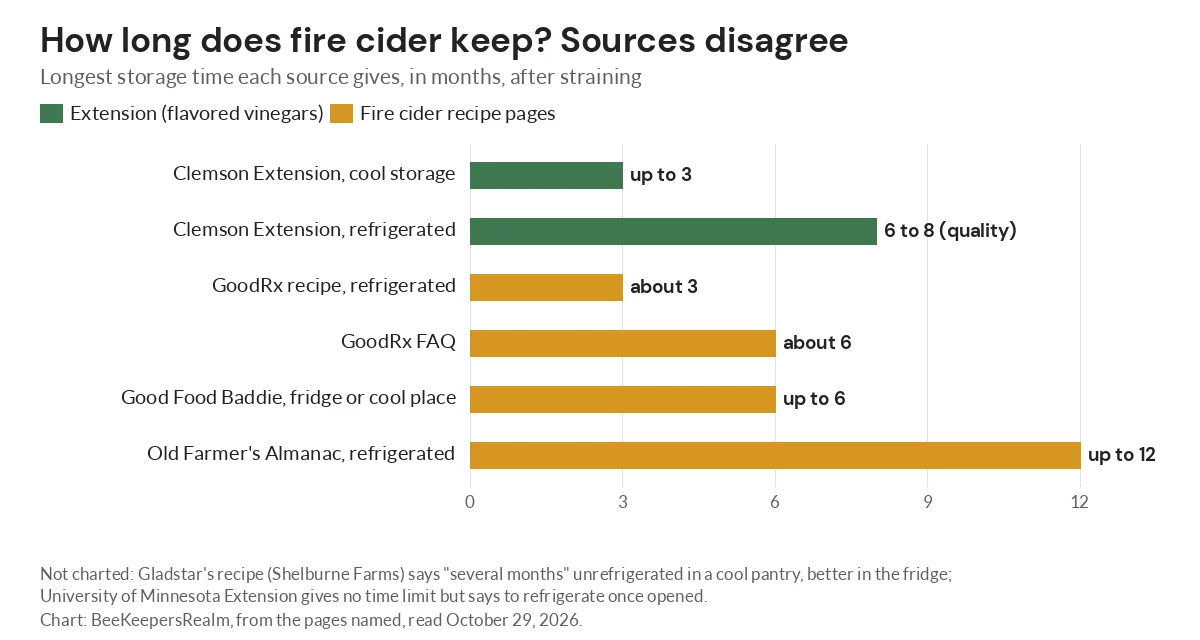
Our rule is the conservative one: refrigerate the strained jar, write the date on it and use it within Clemson’s 6 to 8 month refrigerated window. Throw it out without tasting if you see mold, bubbling, cloudiness or sliminess; UMN and Clemson both name those signs. Our guide to granulation vs fermentation explains why bubbles in a honey product mean yeast at work.
What the Evidence Says, Ingredient by Ingredient
There is no research on fire cider itself. A PubMed search for “fire cider” on October 29, 2026 returned three records, all about fire blight in apple trees. GoodRx and Cleveland Clinic reach the same conclusion. What exists is research on single ingredients, usually as concentrated supplements rather than spoonfuls of vinegar.
| Ingredient | Best evidence we found | What it shows |
|---|---|---|
| Honey | Cochrane review (2018, 6 trials, 899 children); Oxford meta-analysis (2021, 14 studies) | Probably eases cough symptoms more than no treatment or placebo. Symptom relief, not prevention. |
| Garlic | Cochrane review (2014): one trial, 146 participants, daily supplement for 12 weeks | Fewer reported colds in that one trial; evidence judged insufficient. |
| Ginger | NCCIH fact sheet | Studied mainly for nausea and vomiting, not colds. |
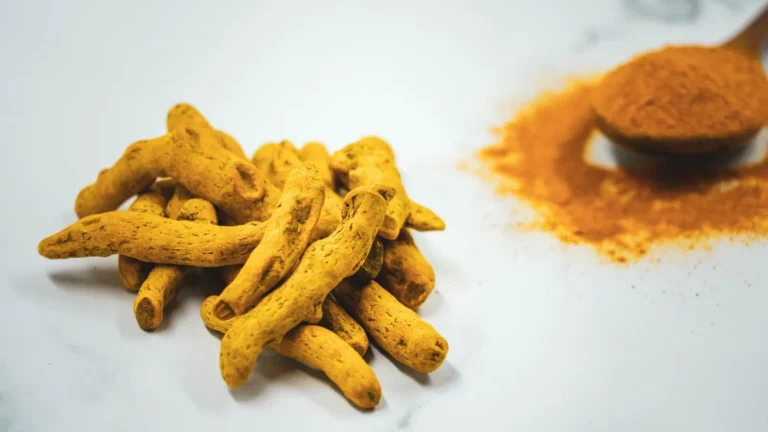
| Turmeric (optional) | NCCIH fact sheet | Not enough evidence to say it helps any health condition. |
| Horseradish, onion, hot peppers, apple cider vinegar | Our PubMed searches, October 29, 2026 | No clinical trials for colds found. |
Garlic is the ingredient people most often credit, and the Cochrane review of garlic for colds is blunt:
“There is insufficient clinical trial evidence regarding the effects of garlic in preventing or treating the common cold.”
NCCIH adds that very little research has looked at garlic supplements as immune boosters. Honey’s cough evidence is real but narrow; see honey for cough and sore throat and honey and immune support. Cleveland Clinic notes that spicy food can make your nose run and briefly clear congestion. That is the honest ceiling: a warming, spicy condiment, not a treatment.
Who Should Be Careful With Fire Cider
These cautions come from the sources named; none of them studied fire cider itself.
- Babies under 1 year. The CDC’s botulism prevention page says not to feed honey to a child younger than 1 year old, and that covers products made with it. See honey and infant botulism.
- Blood thinners or aspirin. NCCIH says garlic supplements may increase the risk of bleeding and asks anyone on anticoagulants or aspirin to talk with a provider before using garlic or other herbal products.
- Heartburn and reflux. NCCIH lists heartburn among ginger’s side effects and acid reflux among turmeric’s. Mayo Clinic warns that apple cider vinegar is highly acidic and may irritate the throat.
- Teeth. Mayo Clinic says acidic drinks can weaken tooth enamel over time.
- Diuretics or insulin. Mayo Clinic says apple cider vinegar may affect these medicines and can lower potassium.
- Pregnancy and breastfeeding. NCCIH says garlic may not be safe in amounts greater than those found in foods, and advises asking a provider before using ginger. Honey itself is fine in pregnancy; see honey during pregnancy.
GoodRx’s physician-reviewed article adds that fire cider should not replace any prescription medicine you already take.
For a vinegar-free version that steeps dried spices in honey instead, see our fire honey recipe.
Frequently Asked Questions
Is fire cider actually good for you?
No study has tested it. Its honey may ease a cough, and its other ingredients are ordinary foods, but no evidence shows that fire cider prevents or shortens colds.
Who should not drink fire cider?
Babies under 1 year (because of the honey), and anyone whose clinician has advised against garlic, vinegar or spicy food, such as people on blood thinners or with reflux. See the cautions list above.
How often should you take fire cider?
There is no tested dose. Gladstar’s recipe suggests a small shot glass daily or teaspoons when a cold starts; that is tradition, not research. For apple cider vinegar alone, Mayo Clinic says some studies suggest up to 2 tablespoons a day is okay.
Do you refrigerate fire cider?
Yes, once it is strained and opened. UMN Extension says to refrigerate after opening, and Clemson Extension says refrigeration keeps flavored vinegars at good quality for 6 to 8 months.
What are the side effects of fire cider?
The sources describe stomach upset and heartburn from the spice and acid, throat irritation and enamel wear from the vinegar, and garlic’s bleeding risk in supplement amounts.
What is the fire cider controversy?
Shire City Herbals trademarked the name in 2012, herbalists challenged it, and a federal court in Massachusetts ruled in October 2019 that “fire cider” is a generic term.
Is fire cider anti-inflammatory?
Not proven. GoodRx notes that horseradish research on anti-inflammatory effects comes mostly from lab studies, and NCCIH says there is not enough evidence to say even turmeric helps any condition, and fire cider has not been tested.
What can fire cider be used for besides drinking it?
Gladstar uses it in salad dressing, and recipe pages add marinades and drizzles over rice or vegetables. Treat it like any strong flavored vinegar.
The Bottom Line
If you make one batch, use the hot pour, keep to about 1 cup of produce per 2 cups of vinegar, add honey after straining and keep the jar in the fridge.
Image credits: Featured photo: horseradish roots by San906, Wikimedia Commons, CC0, cropped. Red onion: Roland Geider, public domain. Ginger: Miansari66, public domain. Pickling jar: Nutrition, Food Safety and Health program, CC0. Honey spoon: Fæ, CC BY-SA 3.0. Diagram and chart: BeeKeepersRealm.