Reviewed by Michael R. · How we review
A honey bee is a social bee of the genus Apis that lives in a year-round colony of one queen, thousands of female workers and, in season, a few hundred male drones. The species most people mean is the western honey bee, Apis mellifera: native to Europe, Africa and the Middle East, carried to the Americas by colonists in the early 1600s, and now found on every continent except Antarctica. It is one of roughly 20,000 bee species, and in North America it is a managed, non-native animal rather than a wild one.
This guide is the hub for everything on the species: what it is, how its three castes differ, how it develops, which races beekeepers choose from, where it lives and why it matters. For the other bees you will meet in the US, see types of bees and how to identify each one.
Key Takeaways
- “Honey bee” means any of the eight or so living species of Apis. Only Apis mellifera and Apis cerana are domesticated, and only A. mellifera is kept worldwide.
- A colony has one queen, 2,000 to 60,000 workers and up to a few hundred drones. Queens and workers are female; drones are male.
- Development from egg to adult takes 15 to 16 days for a queen, 21 for a worker and 24 for a drone (UF/IFAS Extension).
- Published lifespans disagree. A queen is quoted at anywhere from one to seven years, depending on the source and on whether she is in a managed hive.
- The popular claim that honey bees pollinate a third of our food overstates it: about 35% of global crop production comes from crops that benefit from animal pollination, and wild insects are often the better pollinators per visit.
- Varroa mites are the top stressor on US colonies. Beekeepers lost 39.9% of managed colonies between April 2025 and April 2026, down from a record 55.6% the year before.
Table of Contents
- What Is a Honey Bee, and How Many Species Are There?
- The Western Honey Bee: Names and Native Range
- The Three Castes: Queen, Worker and Drone
- Life Cycle: From Egg to Adult and Through the Colony Year
- Honey Bee Anatomy in Brief
- Subspecies and Races: Italian, Carniolan, Russian, Buckfast and More
- Where Honey Bees Live
- Honey Bees vs Bumble Bees and Native Bees
- Why Honey Bees Matter: What the Pollination Numbers Say
- Threats: Varroa, Pesticides, Poor Forage and Losses
- Frequently Asked Questions
- Where to Go Next
What Is a Honey Bee, and How Many Species Are There?
Honey bees are the bees that live in large, long-lived colonies, build wax comb and store honey. Scientifically they are the genus Apis, the only living members of the tribe Apini. According to Wikipedia’s honey bee article, eight living species are currently recognized, although authors have historically accepted anywhere from seven to eleven. That is a very small group inside roughly 20,000 described bee species, as the University of Arkansas Extension notes.
| Species | Common name | Native range | Nest and notes |
|---|---|---|---|
| Apis florea | Red dwarf honey bee | Southern and southeastern Asia | Very small, exposed nests in trees and shrubs |
| Apis andreniformis | Black dwarf honey bee | Southern and southeastern Asia | Same nest style; considerably more aggressive than A. florea |
| Apis dorsata | Giant honey bee | South and Southeast Asia | One or a few exposed combs on high limbs and cliffs |
| Apis laboriosa | Himalayan giant honey bee | Himalayas | Largest living honey bee; nests in the open at altitude |
| Apis cerana | Eastern honey bee | Southern and eastern Asia | Traditional hive bee of Asia; the only other domesticated species |
| Apis koschevnikovi | Koschevnikov’s honey bee | Malay Peninsula, Borneo, Sumatra | Tropical evergreen forest |
| Apis nigrocincta | Philippine honey bee | Philippines | Cavity-nesting |
| Apis mellifera | Western (European) honey bee | Europe, Africa, Middle East | The species kept worldwide; the subject of the rest of this guide |
Species list and nest descriptions summarized from Wikipedia; the count varies with the taxonomic approach used.
Seven of the eight live in Asia. Wikipedia notes that no Apis species lived in the New World in human times before A. mellifera was introduced, so a honey bee in the United States is always the western honey bee. For the largest wild relative, see our guide to the giant honey bee, Apis dorsata.
The Western Honey Bee: Names and Native Range
The western honey bee is also called the European honey bee or common honey bee, but “European” is a historical label rather than a map. UF/IFAS Extension’s species profile (EENY568) says A. mellifera naturally occurs in Europe, the Middle East and Africa and has at least 20 recognized subspecies, none native to the Americas. The University of Arkansas Extension says the species originated in Africa, spread across that continent and into Europe and the Middle East, and over centuries split into regional races with recognizable differences in behavior, appearance and temperament.
People began keeping it early. The Arkansas page records that Egyptian beekeepers floated barges of hives up and down the Nile, following the bloom. Europeans then carried the bee to every other continent, and UF/IFAS reports it is now naturalized on all of them except Antarctica.
The Three Castes: Queen, Worker and Drone
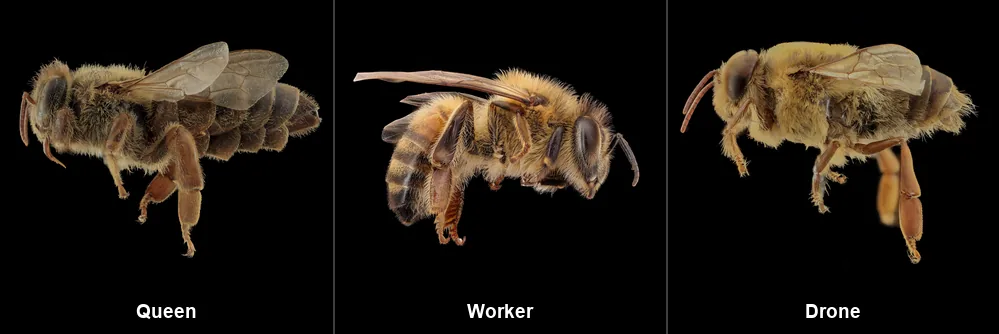
A “caste” is a type of colony member with its own body and job. The sex rule is simple, per UF/IFAS: fertilized eggs develop into females, unfertilized eggs into drones (males). Whether a female becomes a worker or a queen is decided by what she is fed as a larva.
| Queen | Worker | Drone | |
|---|---|---|---|
| Sex and origin | Female; fertilized egg, larva fed a rich royal jelly diet | Female; fertilized egg, standard larval diet | Male; unfertilized egg |
| Body | Longer, plumper abdomen; head and thorax like a worker’s; about 2 cm | Smallest caste; about 1.2 cm | Larger head and thorax, big eyes touching on top, blunt abdomen; about 1.5 cm |
| Number per colony | 1 | 2,000 to 60,000 (University of Georgia); 20,000 to 60,000 (UC Riverside) | 0 to 500 in spring and summer (Georgia); 300 to 600 (UC Riverside) |
| Adult lifespan | Often 1 to 2 years in managed hives; up to 5 to 7 in reports | 5 to 6 weeks in spring and summer; months if reared in fall | 25 to 90 days; evicted before winter |
| Main job | Lays all the colony’s eggs; her pheromones signal that the colony has a queen | All other work: nursing, comb building, food handling, guarding, foraging | Mates with a virgin queen from another colony |
| Stinger | Yes, with reduced barbs; survives a sting | Yes, barbed; dies after stinging a thick-skinned target | None; only females have one |
| Egg to adult | 15 to 16 days | 21 days | 24 days |
Sources: body, sting and development details from UF/IFAS Extension EENY568; lengths and the second set of counts from UC Riverside’s Center for Integrative Bee Research; colony counts and the first set from the University of Georgia Bee Program; lifespans from the sources discussed below.
The queen
Under normal conditions the queen is the colony’s only reproductive female. UF/IFAS puts her output at up to 1,500 eggs a day; the University of Arkansas says “as many as 2000” at her peak, and UC Riverside says 3,000. The spread is a reminder that these are maximums, not averages. Her pheromones tell the colony she is present: the Arkansas page says workers notice her absence within hours and begin rearing an emergency queen from larvae one to three days old.
A new queen mates early. UF/IFAS describes her mating with about 15 drones in the first two weeks of life, in the air at drone congregation areas, then storing the sperm for the rest of her life. The Arkansas page adds that older queens may produce excessive drones, one reason beekeepers often replace them every year or two; see how queen age affects colony performance.
Workers
Workers are non-reproductive females and the smallest caste, but by far the most numerous. They perform every maintenance task, and in a predictable order by age, which UF/IFAS calls age-related polyethism. The Georgia page gives the sequence: clean cells, circulate air with the wings, feed larvae, practice flying, receive pollen and nectar from foragers, guard the entrance, then forage. The Arkansas page adds that workers spend roughly the first two weeks of adult life as house bees and the rest as field bees. Our guide to worker bee jobs by age covers each stage.
Workers cannot mate, but in a hopelessly queenless colony some begin laying unfertilized eggs, which can only become drones. The Arkansas page calls such a colony effectively doomed.
Drones
Drones feed themselves from honey cells or beg food from workers, do no colony work, and spend their days eating, resting and patrolling drone congregation areas. UC Riverside describes them as “suicidal maters” that die in their first and only copulation. Both the Georgia and Arkansas pages say drones are driven out of the hive around winter. For more, see what drone bees do.
How a female larva becomes a queen
Queens and workers both develop from fertilized eggs. The University of Arkansas page explains that workers feed all larvae royal jelly for the first three days, after which worker and drone larvae switch to a pollen and honey mixture, while a female larva fed royal jelly continuously develops into a queen. The Georgia page states it plainly: the only difference between workers and queens is the quality and quantity of the larval diet. UC Riverside’s version: royalty is not a bloodline but access to royal food.
How long do honey bees live? Why sources disagree
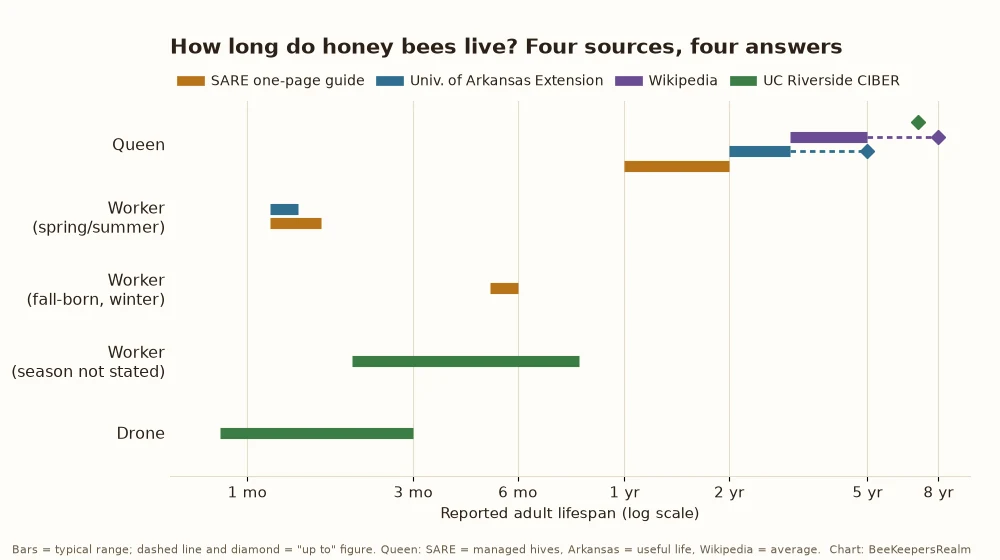
The chart shows why a single “lifespan” is misleading. Workers differ by season: the Arkansas page says those reared in spring and early summer live five to six weeks, while workers that mature in late fall may live well into spring because they keep the cluster warm. Queens differ by management: the same page says a queen can live up to five years but her period of usefulness rarely exceeds two or three, and many beekeepers replace her every year or two. The SARE guide agrees, putting managed queens at “often 1-2 years.” Wikipedia’s article gives an average of three to five years and reports of up to eight. These numbers measure different things. For more on workers, see how long honey bees live in a colony.
Life Cycle: From Egg to Adult and Through the Colony Year
Egg, larva, pupa, adult
All honey bees undergo complete metamorphosis, with four stages: egg, larva, pupa and adult. Development time differs by caste:
| Stage | Queen | Worker | Drone |
|---|---|---|---|
| Egg | 3 days | 3 days | 3 days |
| Larva (open cell) | 5.5 days | 6 days | 6.5 days |
| Pupa (capped cell) | 8 days | 12 days | 14.5 days |
| Egg to adult | 15 to 16 days | 21 days | 24 days |
Source: UF/IFAS Extension EENY568, revised November 2024. The stage lengths are rounded averages, which is why the queen’s add up to 16.5 against a stated total of 15 to 16.
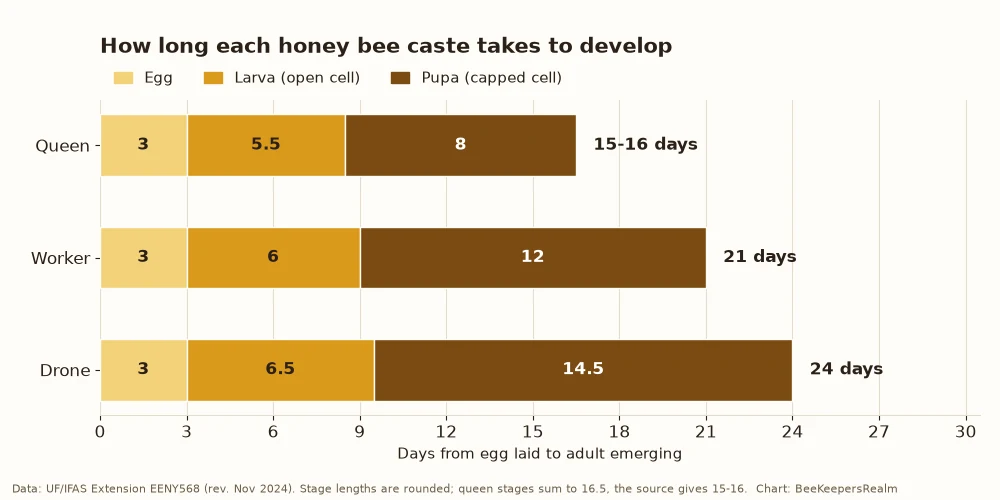
These are averages from the literature, not promises. The University of Georgia page warns that they do not always apply locally: workers in Georgia commonly emerge in 19 days and queens in 15.
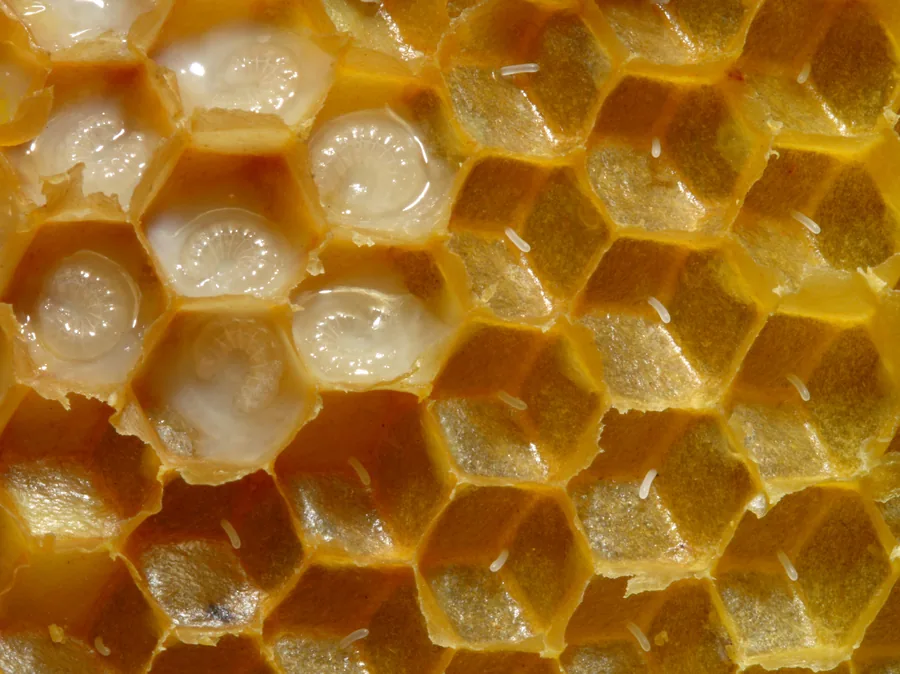
What a beekeeper sees at each stage, per UF/IFAS: the egg is 1 to 1.5 mm long, like a tiny grain of rice, and hatches after three days. The larva is white and curled in a C at the bottom of the cell; because the cell is still open, beekeepers call larvae “open brood”. Nurse bees then cap the cell with wax, and the pupa develops inside “capped brood” until the new bee chews its way out. For the same timeline in simple terms, see our bee life cycle guide.
The colony year
Unlike social wasps and bumble bees, the Georgia page notes, honey bee colonies live year after year, so most of what they do is aimed at surviving the next winter. In winter the bees cluster in a tight ball; in January the queen begins laying in the center of the nest. Stores can run low in late winter, when brood rearing has started but plants are not yet producing nectar or pollen. When the spring flow begins, populations grow fast. For what the bees do through the cold months, see where bees go in winter.
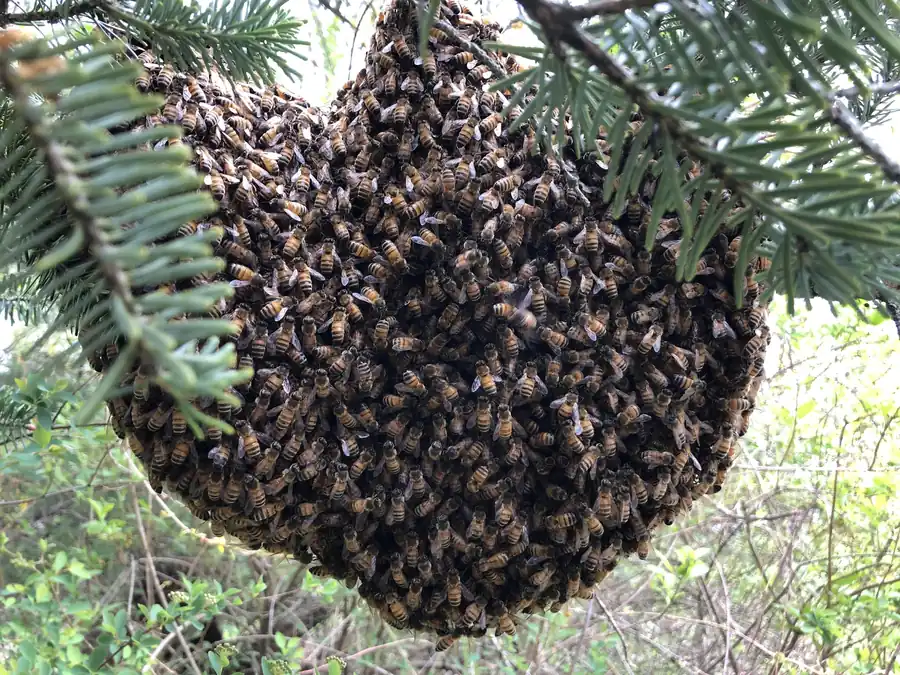
A crowded colony reproduces by swarming. UF/IFAS explains that honey bees reproduce “not by producing more individual bees, but rather by producing more colonies.” The colony raises 10 to 20 daughter queens; just before they emerge, the mother queen and about two-thirds of the workers leave and cluster on a branch while scouts look for a cavity such as a tree hollow. The University of Georgia puts the departing share at up to 60 percent of the workers, so published shares run up to about two-thirds. Back at the old nest the first daughter queen to emerge either kills her sisters or fights until one remains, then mates and takes over.
After the swarming season the bees concentrate on storing honey and pollen for winter, which is the instinct that makes the species such a productive honey producer. See how bees mate and colonies multiply for the details.
Honey Bee Anatomy in Brief
Like every insect, a honey bee has three body regions: head, thorax and abdomen. UF/IFAS notes the “waist” created by a constriction of the second abdominal segment. The features that set a worker apart:
- Eyes: each compound eye has over 6,500 facets, per the University of Arkansas, plus three simple eyes (ocelli) on top of the head. Bees see ultraviolet light as a color and cannot see red.
- Wings: two pairs, coupled in flight by a row of small hooks called hamuli. The Arkansas page says workers can forage up to three miles from the hive and fly about 15 miles per hour.
- Hair: the body is covered in branched hairs that catch pollen.
- Pollen baskets: each hind leg has a corbicula, a flattened, hair-fringed section for carrying pollen home.
- Wax glands: workers produce wax scales from the underside of the abdomen and build comb with them.
- Stinger: a modified ovipositor, so only females have one. A worker’s barbed stinger is torn out with its venom sac, and she dies.
- Honey stomach: the crop stores nectar for the trip home without digesting it.
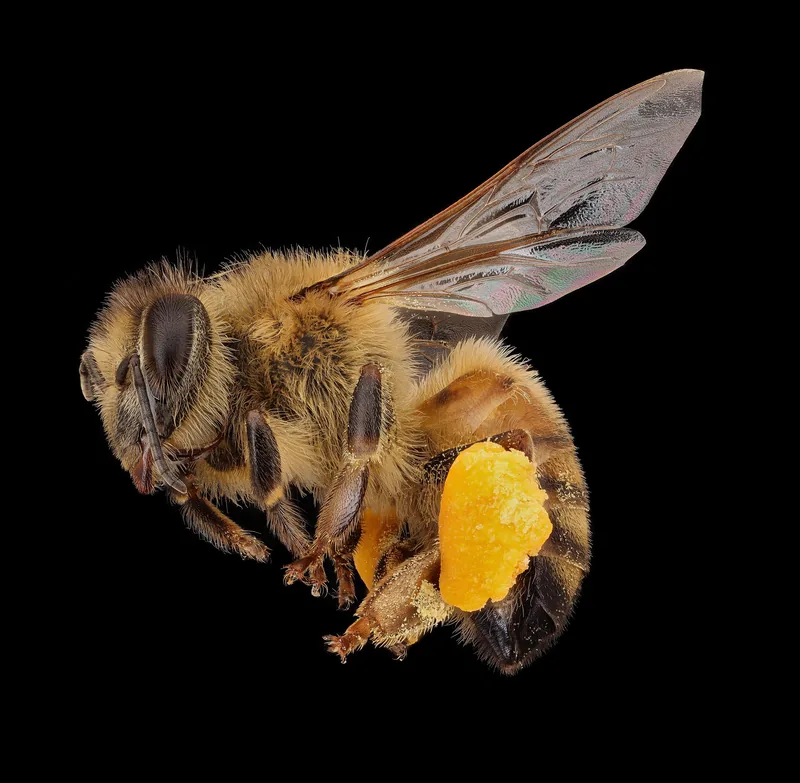
For every organ and gland, see our honeybee anatomy guide; how bees use pollen and nectar is covered in how honey bees collect and carry pollen.
Subspecies and Races: Italian, Carniolan, Russian, Buckfast and More
UF/IFAS counts at least 20 recognized subspecies of A. mellifera, and the “European” bees in the US are a complex of interbreeding ones, including ligustica (Italian), carnica (Carniolan), mellifera (the German or dark bee) and caucasia. Beekeepers also talk about “stocks”: groups of bees bred for a package of traits, which may be a race, a region or a breeding line. NC State Extension’s apiculture specialists David Tarpy and Jennifer Keller compare the common ones in a publication that is the basis for the table below.
| Race or stock | Gentleness | Spring buildup | Overwintering | Excess swarming | Varroa resistance | Known for |
|---|---|---|---|---|---|---|
| Italian (A. m. ligustica) | Moderate | Good | Good | OK | Below average | Honey production; heavy robbing |
| German or dark (A. m. mellifera) | Low | Low | Very good | OK | Below average | Hardy but defensive; now rare |
| Carniolan (A. m. carnica) | High | Very good | Good | High | Below average | Explosive spring growth; swarm-prone |
| Buckfast (hybrid) | Low to moderate | Low | Good | Low | Below average | Bred by Brother Adam from largely Italian stock |
| Caucasian (A. m. caucasica) | High | Very low | OK | Low | Below average | Very long tongue; heavy propolis |
| Russian | Low to moderate | OK | Very good | OK | Above average | Fewer than half the mites of standard stocks |
Ratings are NC State Extension’s, in publication AG-654 (Tarpy and Keller), which also describes the Italian bee arriving in the US in 1859 and the Russian stock being imported by the USDA lab in Baton Rouge in 1997. The publication cautions that any generalities about a stock should be treated with caution because there are always exceptions.
“There is no best strain of honey bee, as the traits favored by one beekeeper may differ significantly from another beekeeper’s preference.”
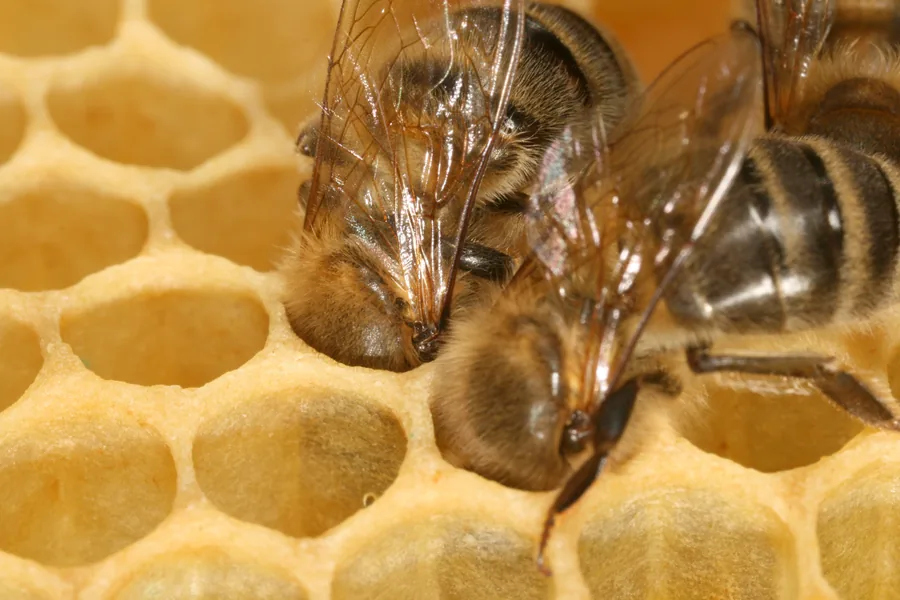
Two cautions. First, the races blur: the Arkansas page notes that stocks are moved around the country constantly and that queens mate far from the hive, so pure strains are practically impossible without instrumental insemination or very isolated apiaries. Second, the table covers the stocks NC State rates, not every bee in the species, such as the Cape honey bee.
Africanized bees are the best-known hybrid. The Arkansas page tells the story: Brazilian scientists imported A. m. scutellata from Tanzania in 1956, some escaped in 1957 and bred with European bees, and the hybrids spread through Central America and Mexico; the first were detected in Texas in 1990 and in Arkansas in 2005. See Africanized bees vs European honey bees.
For deep dives on each stock, see our guides to Italian, Carniolan, Russian and Buckfast bees and to the German dark bee. If you are choosing for an apiary, our breed comparison and buying guide is the practical follow-up.
Where Honey Bees Live
In the wild, A. mellifera nests in enclosed cavities. UF/IFAS names a tree hollow, the University of Georgia a hollow tree or wall void; a colony in a house wall is a nuisance colony. Beekeepers house colonies in boxes with removable frames, and UF/IFAS says the Langstroth hive is the most widely used in the US.
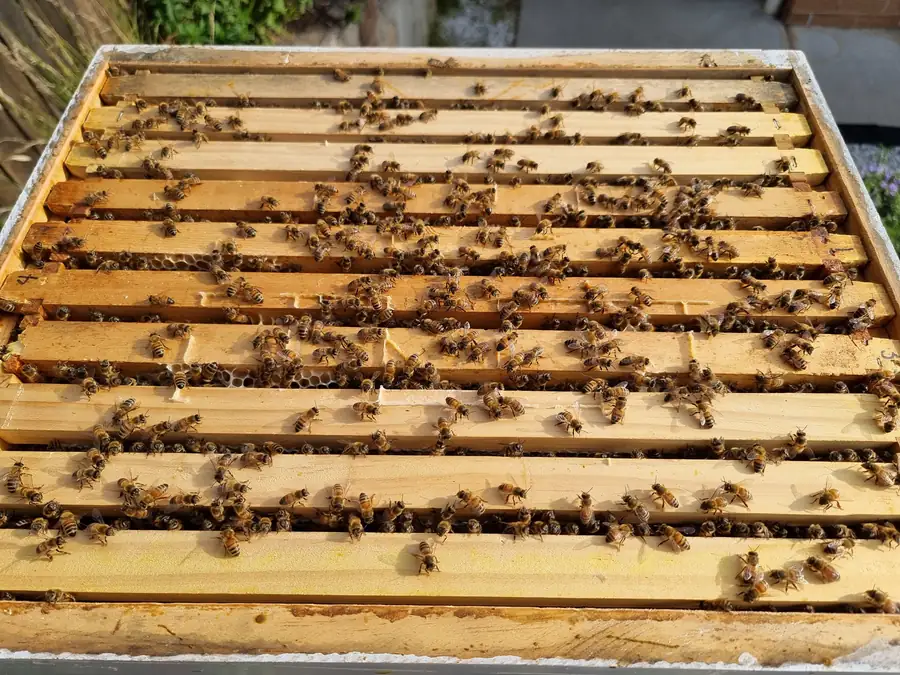
The species reached what is now the US with English colonists. UF/IFAS dates the first introductions to 1622, and the Arkansas page says colonists brought A. m. mellifera to Jamestown in the early 1600s; the full story is in how honeybees came to America. NC State adds that the dark bee once dominated the feral population but that newly introduced diseases have nearly wiped out most wild colonies.
The USDA’s National Agricultural Statistics Service counted 2.81 million US colonies on January 1, 2026 on operations with five or more colonies, up 6 percent from a year earlier. California held the most, at 885,000. Those colonies are tended by beekeepers: an apiary is simply a place where bees are kept, and a healthy one is judged by honey yield per hive and by how colonies come through the cold months; see how to prepare bees for winter.
Honey Bees vs Bumble Bees and Native Bees
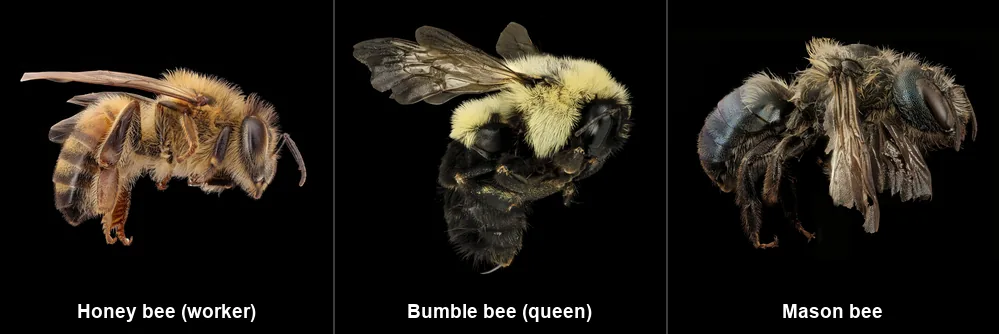
| Honey bee | Bumble bee | Other native bees | |
|---|---|---|---|
| Native to North America? | No; brought by colonists in the 1600s | Yes; native bumble bees | Yes; about 4,000 native species in the US (USGS) |
| Colony cycle | Perennial: the colony lives year after year (Georgia) | Annual: a new queen and nest location every year (USGS) | Varies by species; many nest alone |
| Species | About eight in Apis; one in North America | Over 250 species worldwide (USGS) | About 20,000 bee species worldwide |
Sources: USGS Fort Collins Science Center for the native, annual-colony and species figures; the University of Georgia Bee Program for the perennial colony. For the full comparison, see our bumble bee guide, the native bee species overview and the winter comparison of honey, bumble and solitary bees.
A managed species in North America
The honest summary is that honey bees here are livestock. UF/IFAS says none of the A. mellifera subspecies is native to the Americas, NC State points out that North America has about 4,000 native bee species of its own, and the USGS notes that native bumble bees renew the colony every year while honey bees may keep the same hive and queen for years. Managed colonies are bred, moved, fed and replaced by beekeepers, which is why their losses are tracked as a management issue (see the threats section below), while conservation concerns focus mostly on wild bees.
That does not make honey bees unimportant. Whether managed hives harm wild bees through competition is actively debated; our summary is in competition between honeybees and native bees.
Why Honey Bees Matter: What the Pollination Numbers Say
Honey bees are a major managed pollinator, and UF/IFAS estimates that bees pollinate up to $15 billion worth of US crops each year. The oft-repeated claim that honey bees pollinate a third of our food needs care, because the number comes from a study of all animal pollinators, not honey bees alone.
That study, by Alexandra-Maria Klein and colleagues in Proceedings of the Royal Society B (2007), found that fruit, vegetable or seed production from 87 of the leading global food crops depends on animal pollination, while 28 crops do not. By volume, however, 60% of global production comes from crops that do not depend on animal pollination, mainly wind- or self-pollinated cereals and sugarcane, and 35% from crops that do.
“because most of these crops are not entirely dependent on animal pollination, the amount of production directly attributable to animals is lower than this value.”
Honey bees are also not the only, or always the best, pollinator. A 2013 analysis in Science by an international team led by Lucas Garibaldi covered 41 crop systems worldwide, noting that growers often add honey bees to crops as an agricultural input. Fruit set rose with honey bee visits in only 14% of them, and an extra visit by a wild insect raised fruit set about twice as much as an extra honey bee visit.
“pollination by managed honey bees supplemented, rather than substituted for, pollination by wild insects.”
So the fair statement is that honey bees are a major, portable pollinator that growers add where flowers need more visits, and that wild insects contribute independently. Beyond pollination, colonies produce honey, wax, pollen, royal jelly and propolis, as UF/IFAS lists; see how much honey one hive produces for the USDA yield data.
Threats: Varroa, Pesticides, Poor Forage and Losses
The EPA says the prevailing scientific view, shared with USDA, is that declining honey bee health reflects interacting stressors: pests, pathogens and viruses; poor nutrition from lost forage; pesticide exposure; management practices such as long migratory routes; and limited genetic diversity.
Of these, the Varroa mite leads. The USDA NASS Honey Bee Colonies report says varroa was the number one stressor for operations with five or more colonies in every quarter surveyed in 2025, affecting as much as 28.3% of colonies in January through March 2025; the figure was 21.8% for the same quarter of 2026. UF/IFAS describes Varroa as a parasite from Asia and lists deformed wing virus, chalkbrood, Nosema and foulbrood among the other infections. See our Varroa mite life cycle guide and how pesticides interact with honeybees.
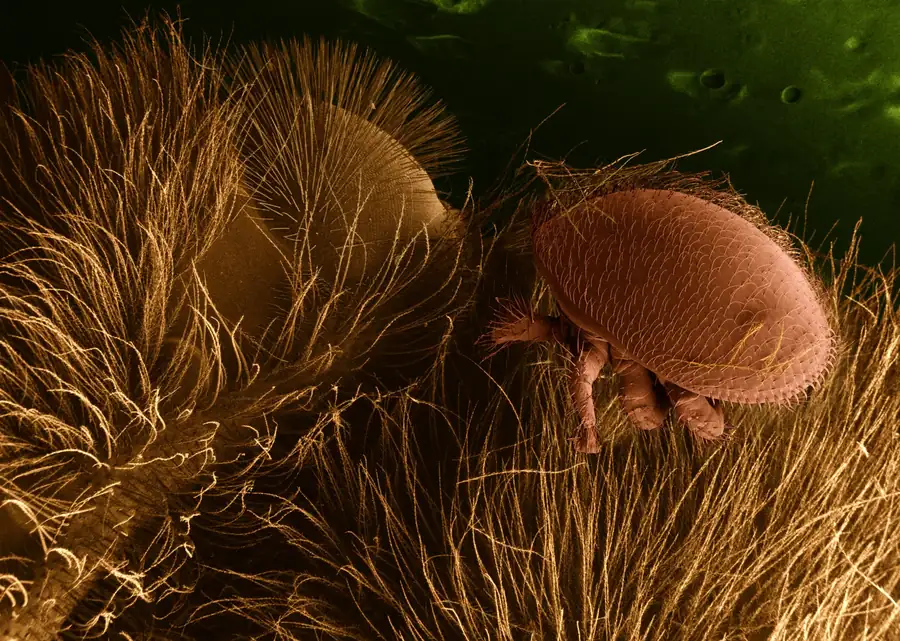
The losses are large but easy to misread. The Auburn-led US Beekeeping Survey estimated 39.9% managed colony loss from April 2025 to April 2026, following record annual losses of 55.1% and 55.6%. The survey team’s technical abstract warns that loss rates are a mortality rate, not a change in population size, because beekeepers can replace lost colonies. NASS’s colony counts bear that out: January 1 colonies rose 6 percent in 2026. Beekeepers lost more colonies in winter than summer, and the American Honey Producers Association’s president called losing nearly 40% of colonies in a year “a crisis in slow motion”, against an acceptable level he put at 15 to 20%. For colony survival in cold months, see how to tell if a beehive is dead in winter.
Frequently Asked Questions
What is the difference between a honey bee and a bumble bee?
Honey bees live in perennial colonies and are not native to North America; bumble bees are native, and a bumble bee colony is renewed every year, according to the USGS. See the comparison above.
Do honey bees sting?
Yes, but defensively. UF/IFAS says European honey bees rarely sting without provocation, and the Arkansas page says they are reluctant to sting unless they or their nest are threatened. A worker dies after stinging; our bee sting vs wasp sting guide explains why.
How can you tell a honey bee from a wasp?
Look for the body hairs and the pollen baskets: UF/IFAS describes honey bees as covered in branched hairs, and the Arkansas page notes that these feathery hairs are unique to bees. It adds that many harmless flies mimic the yellow-and-black warning colors. Our bee vs wasp identification guide has photos.
Are honey bees aggressive?
UF/IFAS says European honey bees rarely sting without provocation. Africanized hybrids are often more aggressive, according to Wikipedia; see the section on races above.
How long does a honey bee live?
A summer worker lives about five to seven weeks, a fall-reared worker several months, a drone weeks to a few months and a queen from one to five years or more, depending on the source. The chart above compares the figures.
Is the honey bee native to North America?
No. The western honey bee is native to Europe, the Middle East and Africa and was brought to North America by colonists in the early 1600s.
How many honey bees are in a hive?
A colony has one queen, 2,000 to 60,000 workers and up to a few hundred drones, depending on season and source.
Are honey bees endangered?
Managed colonies face high annual losses, but beekeepers replace them, and NASS counted 6 percent more colonies on January 1, 2026 than a year earlier. Conservation concern is higher for some native bees: the USGS says as many as 1 in 4 US bumble bee species may be at risk of extinction. Our guide to which bees are endangered lists the nine US bees with federal protection.
Where to Go Next
To go deeper on behavior, read honeybee behavior; to see how bees tell each other where food is, honeybee dance dialects. If you are weighing whether to keep bees yourself, start with the best bee species for beginners. This guide reflects the sources listed throughout; where they disagree, we have shown the range rather than picking a number.
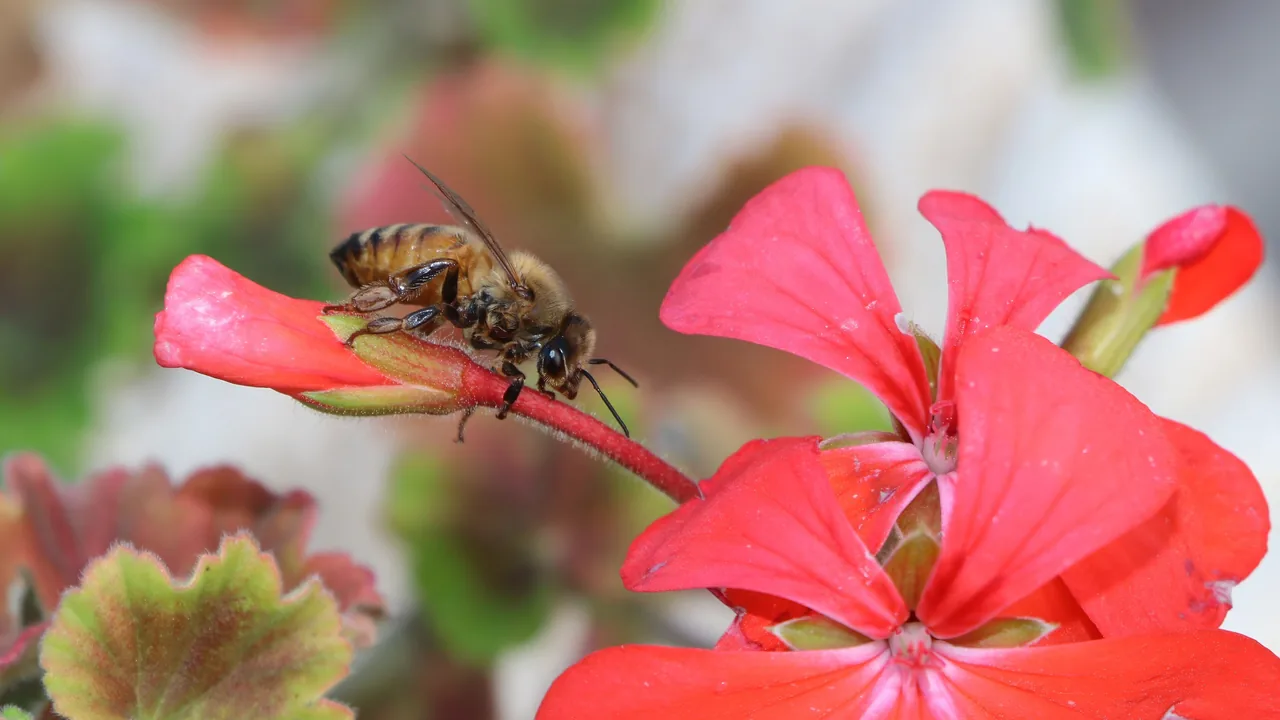
Image credits: featured image, Italian honey bee (Apis mellifera ligustica) on a geranium, photo by ImagePerson via Wikimedia Commons, CC BY 4.0, cropped to 16:9 and resized.