Reviewed by Michael R. · How we review
Bees as a group are not endangered, and the honey bee is not endangered at all: it is a managed farm animal, and the US had 2.81 million colonies on January 1, 2026, up 6% in a year. Some wild native bees are a different story. Nine US bee species are federally listed as endangered: seven Hawaiian yellow-faced bees (2016), the rusty patched bumble bee (2017) and Franklin’s bumble bee (2021). A tenth, Suckley’s cuckoo bumble bee, has been proposed for listing, and several others are under federal review. The statuses below were checked against the Federal Register on November 5, 2026.
Key Takeaways
- The Western honey bee (Apis mellifera) is not listed under the Endangered Species Act. Colonies die at high rates, but beekeepers replace them.
- US beekeepers lost 39.9% of their colonies from April 2025 to April 2026, yet USDA counted more colonies in January 2026 than a year before.
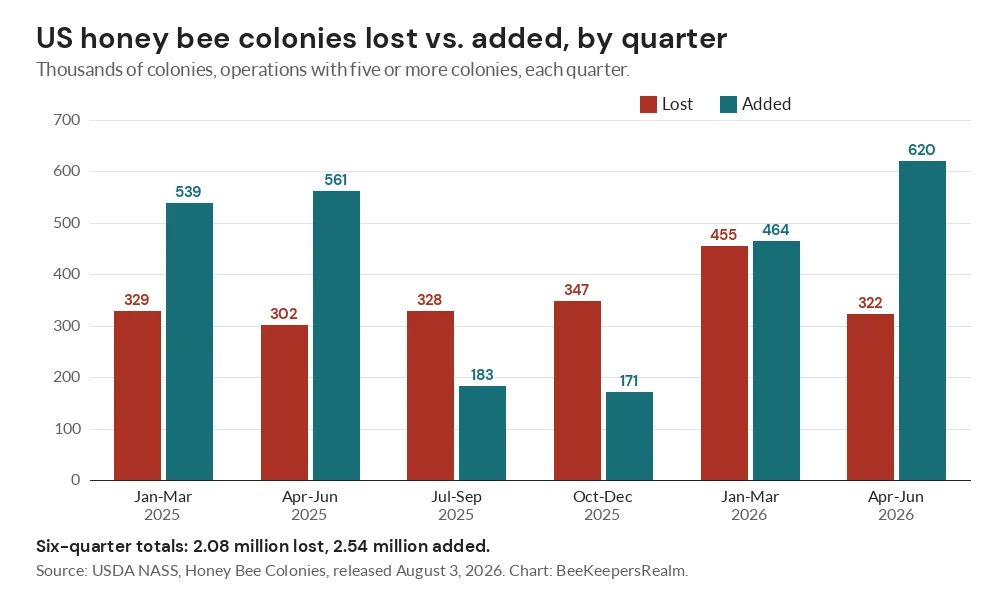
- In USDA’s quarterly data, beekeepers added about 2.54 million colonies and lost about 2.08 million from January 2025 to June 2026.
- Nine US bees are federally endangered: seven in Hawaii and two bumble bees on the mainland. Suckley’s cuckoo bumble bee was proposed in December 2024.
- A 2017 Center for Biological Diversity review found that about 1 in 4 of the North American and Hawaiian native bees with enough data to judge is imperiled.
- Habitat loss, pesticides, pathogens and climate change drive the declines. Native flowers, nest sites and fewer pesticides help most.
Table of Contents
- Are Honey Bees Endangered?
- Which US Bees Are Endangered?
- How Many Native Bees Are at Risk?
- Why Some Bees Are Declining
- What Actually Helps Native Bees
- Frequently Asked Questions
- The Bottom Line
Are Honey Bees Endangered?
No. Honey bees are not native to the Americas, and in the US they live almost entirely in hives that people own, move and replace. The USDA’s National Agricultural Statistics Service (NASS) counts them like livestock. Its August 2026 Honey Bee Colonies report put colonies on operations with five or more hives at 2.81 million on January 1, 2026, up from 2.64 million on January 1, 2025.
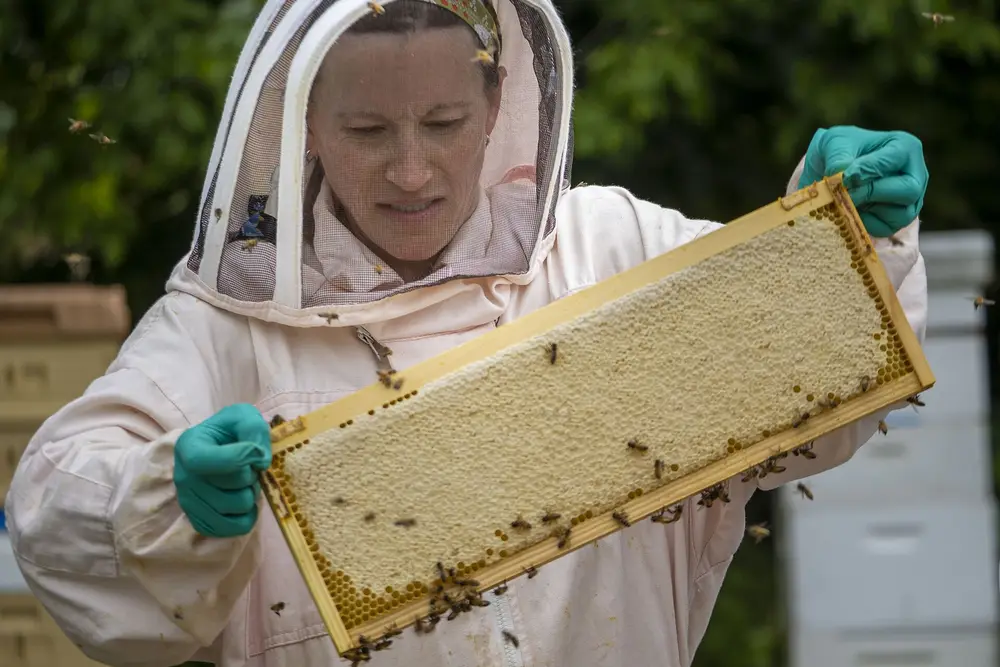
That does not mean honey bees are healthy. The national US Beekeeping Survey, run by Auburn University, Oregon State University and the Apiary Inspectors of America, estimated that beekeepers lost 39.9% of their colonies between April 2025 and April 2026. That followed two record years of 55.1% and 55.6%. Varroa mites were the top stressor NASS recorded in every quarter of 2025; our varroa mite life cycle guide explains why they are so hard to control.
“Loss rates should not be interpreted as a change in population size, but rather as a mortality rate. High levels of loss do not necessarily result in a decrease in the total number of colonies managed because beekeepers can potentially replace lost colonies during the year.”
This short Encyclopaedia Britannica video makes the same split between managed and wild bees.
What the video covers: In under two minutes, Britannica notes that only about two dozen of the world’s 20,000-plus bee species were formally listed as endangered as of 2024, and that honey bees are not likely to go extinct. It points to wild species such as bumble bees and Hawaii’s yellow-faced bees, threatened by invasive ants, as the bees at real risk.
Why colony numbers hold steady despite heavy losses
Beekeepers rebuild. They split strong colonies into two, install packages and nucs, and requeen weak hives. NASS tracks this directly. From January 2025 through June 2026, operations with five or more colonies lost 2,082,340 colonies across six quarters but added 2,537,770, by our sum of the NASS quarterly figures. Additions peak from January to June, the season when beekeepers make most of their splits; our guide to when and how to split a hive shows how it is done.
The catch is cost. Every replacement colony takes bees, a queen, labor and money, so high losses can sink a beekeeping business without shrinking the national herd.
Wild honey bees in Europe are a separate case
In October 2025, a team led by Honey Bee Watch reassessed wild, free-living honey bee colonies in the European Union for the IUCN Red List, moving them from Data Deficient to Endangered. The bee research network COLOSS welcomed the reassessment, citing parasites, pathogens, pesticides, habitat loss and hybridization. The listing covers wild colonies in the EU only, not managed hives, and the wider pan-European status stayed Data Deficient. Our summary of the 2026 European Red List of Bees covers the rest of that assessment.
Which US Bees Are Endangered?
Of an estimated 4,000 native bee species in the US, only nine have federal protection under the Endangered Species Act. Several more are in the listing pipeline. This table shows every bee with a federal listing action we found in the Federal Register, as of November 5, 2026.
| Bee | Where | Federal status | Year | Federal Register |
|---|---|---|---|---|
| Seven Hawaiian yellow-faced bees (Hylaeus anthracinus, H. assimulans, H. facilis, H. hilaris, H. kuakea, H. longiceps, H. mana) | Hawaii | Endangered | 2016 | 81 FR 67786 |
| Rusty patched bumble bee (Bombus affinis) | Upper Midwest and East | Endangered; critical habitat 2026 | 2017 | 82 FR 3186 |
| Franklin’s bumble bee (Bombus franklini) | Southern Oregon and northern California | Endangered | 2021 | 86 FR 47221 |
| Suckley’s cuckoo bumble bee (Bombus suckleyi) | Western and northern North America | Proposed endangered | 2024 | 89 FR 102074 |
| Western bumble bee (Bombus occidentalis) | Western US, Alaska and western Canada | Under review; 12-month finding pending | 2016 | 81 FR 14058 |
| Gulf Coast solitary bee (Hesperapis oraria) | Coastal Mississippi, Alabama and the Florida Panhandle | Under review | 2019 | 84 FR 69713 |
| American bumble bee (Bombus pensylvanicus) | Most of the lower 48 | Under review | 2021 | 86 FR 53937 |
| Variable cuckoo bumble bee (Bombus variabilis) | Much of the lower 48 | Under review | 2022 | 87 FR 7079 |
| Yellow-banded bumble bee (Bombus terricola) | Northern US and Canada | Not warranted | 2019 | 84 FR 41694 |
| Mojave poppy bee (Perdita meconis) | Mojave Desert | Not warranted | 2026 | 91 FR 63250 |
“Under review” means the US Fish and Wildlife Service found that a petition may be warranted and opened a status review; it is not protection. “Not warranted” means the agency decided against listing.
Hawaii’s yellow-faced bees were listed first
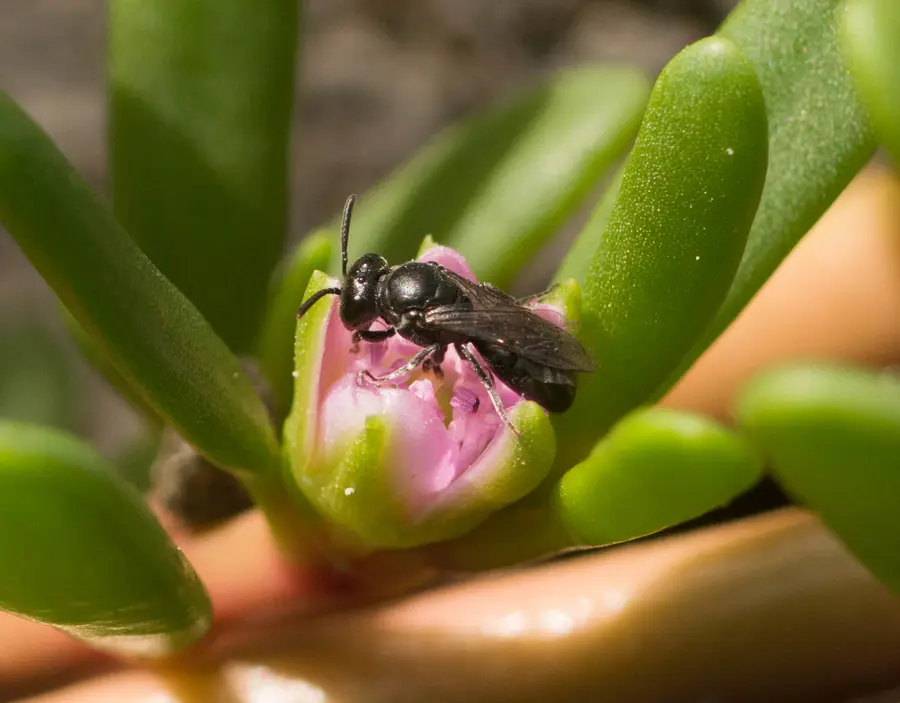
The seven Hawaiian yellow-faced bees were listed on September 30, 2016, about four months before the rusty patched bumble bee. The listing rule names threats that are mostly invasive: nonnative ants that prey on bee eggs, larvae and pupae and compete with the bees for nectar, nonnative plants and grazing animals that destroy native host plants, and wildfire.
Two mainland bumble bees, and one more proposed
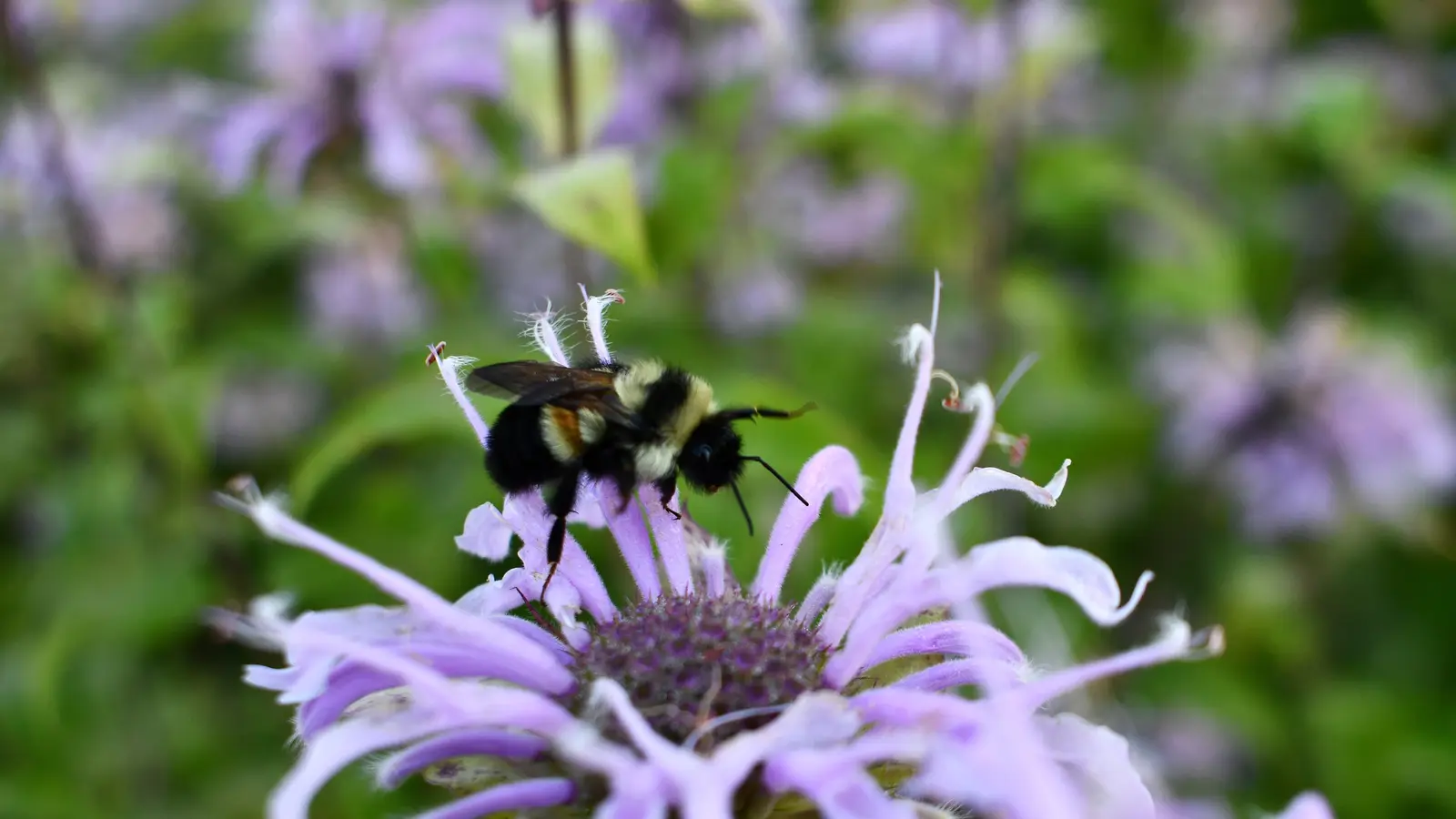
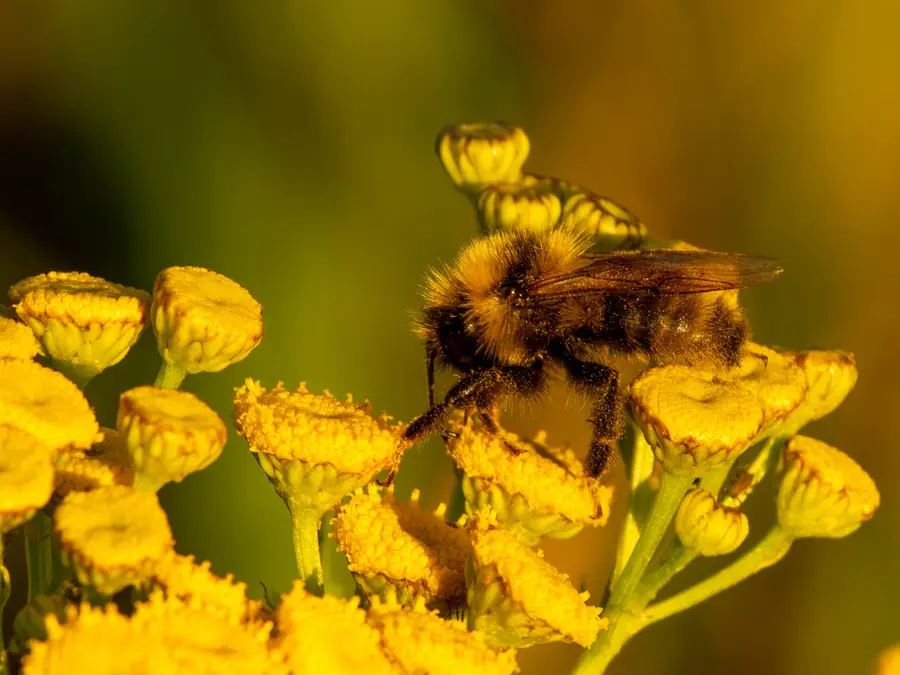
The rusty patched bumble bee was the first bumble bee listed. Its 2017 rule found it gone from about 87% of its historical range, and a 2026 rule designated about 1,534,951 acres of critical habitat in six states. Franklin’s bumble bee, listed in 2021, has not been seen since 2006, according to its listing rule. Suckley’s cuckoo bumble bee is a social parasite: it produces no workers and depends on other bumble bees’ colonies to raise its young, so it declines when hosts such as the western bumble bee decline. Our guide to cuckoo bumblebees explains that way of life. USFWS proposed it as endangered in December 2024; we found no final rule as of this check.
How Many Native Bees Are at Risk?
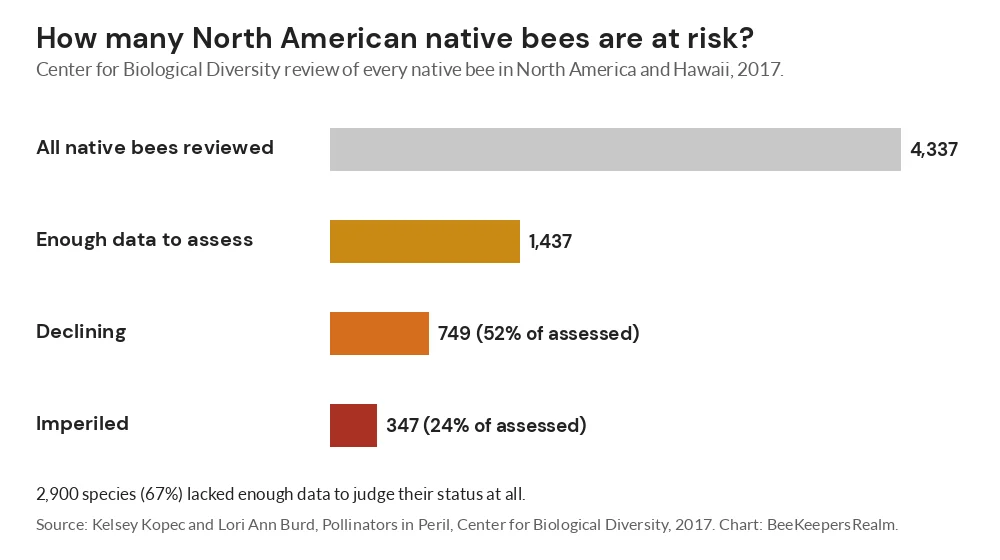
Nobody has a complete count, because most native bees have never been surveyed well enough to judge. The broadest US estimate comes from the Center for Biological Diversity’s 2017 report Pollinators in Peril. It reviewed all 4,337 native bees of North America and Hawaii. Of the 1,437 species with enough data to assess, 749 (52%) were declining and 347 (24%) were imperiled, at risk of extinction. For bumble bees, the US Geological Survey says some estimates put as many as 1 in 4 US species at risk of extinction.
The strongest single piece of evidence for bumble bees is a nationwide study led by Sydney Cameron at the University of Illinois, which compared more than 73,000 museum records with new field surveys.
“We show that the relative abundances of four species have declined by up to 96% and that their surveyed geographic ranges have contracted by 23–87%, some within the last 20 y.”
One of those four was the rusty patched bumble bee. Others, like the common eastern bumble bee, held steady. That is the pattern across native bees: some species crash while their neighbors do fine, which is why our guide to US bumblebee species separates the common from the rare.
Why Some Bees Are Declining
No single cause explains the losses. USFWS named the same main stressors for the rusty patched bumble bee that it lists for pollinators in general:
- Habitat loss. Prairie, meadow and other flower-rich land has been replaced by roads, lawns and crops, and what is left is cut into small, isolated patches.
- Pesticides. Insecticides are designed to kill insects, bumble bees included, and herbicides reduce the flowers bees feed on.
- Pathogens and spillover. The rusty patched bumble bee’s crash from the mid-1990s coincided with the collapse of commercially bred western bumble bees, raised to pollinate greenhouse tomatoes. The listing rule says spillover of the parasite Nosema bombi from those colonies through shared flowers was suggested, but the evidence is still debated. Whether managed honey bees pass diseases to wild bees is the question our article on whether backyard beekeeping hurts wild bees weighs.
- Climate change. USFWS says North American bumble bee numbers have fallen nearly 50% since 1974, with the biggest losses where temperatures rose most.
- Invasive species. In Hawaii, nonnative ants, wasps and plants are the main threats.
“Although the relative contributions of pesticides, pathogens, loss of floral resources, and other threats to the species’ past and continued decline are not known, the prevailing data indicate that threats are acting synergistically and additively and that the combination of multiple threats is likely more harmful than a single threat acting alone.”
What Actually Helps Native Bees
Keeping a hive of honey bees does not help native bees, because it adds more of a species that is not at risk. What helps is what the USFWS threat list implies in reverse:
- Plant native flowers that bloom from spring to fall. A bumble bee colony starts with a lone queen in early spring and raises new queens in late summer and early fall, so it needs flowers the whole time. Our list of the best US native plants for pollinators is a starting point.
- Leave places to nest. Most native bees in North America are solitary and nest in the ground, so patches of bare, undisturbed soil matter. Hollow stems and leaf litter help other species.
- Use pesticides only when needed. USFWS advises using the minimum effective amount and targeting it so only the intended pest is affected.
- Think about where hives go. If you keep honey bees near remnant prairie or other rare habitat, our article on competition between honeybees and native bees covers what the research shows.
Frequently Asked Questions
Are bees protected in the USA?
Only listed species get federal protection. For the nine endangered bees, the Endangered Species Act makes it illegal to “take” them, which includes harming, killing or collecting them. Common bees, including honey bees, have no ESA protection.
Are honey bees endangered in 2026?
No. NASS counted 2.81 million US colonies on January 1, 2026, up 6% from 2025, even though beekeepers lost 39.9% of colonies over the survey year. Wild honey bee colonies in the EU were classed as Endangered on the IUCN Red List in 2025, but that does not cover managed hives.
Are bumble bees endangered?
Some are. Two US bumble bees, the rusty patched and Franklin’s, are federally endangered, Suckley’s cuckoo bumble bee is proposed, and several others are under review. Many common species are stable.
What is the most endangered bee in the US?
Franklin’s bumble bee may be. It lived in a small area of southern Oregon and northern California and has not been seen since 2006, according to its 2021 listing rule.
Will bees go extinct?
Bees as a group will not, and honey bees are not close to it. Individual species can disappear, and Franklin’s bumble bee may already have.
Does keeping honey bees help save the bees?
Not the bees in trouble. It adds honey bees, which are not endangered. Our look at whether beekeeping is sustainable covers the evidence on hives and wild bees.
The Bottom Line
If someone tells you the bees are endangered, ask which bees. Honey bees are not, though beekeepers pay heavily to keep their numbers up. The bees that need help are wild ones, and the most useful things anyone can do are planting native flowers, leaving nest sites and cutting back on pesticides.
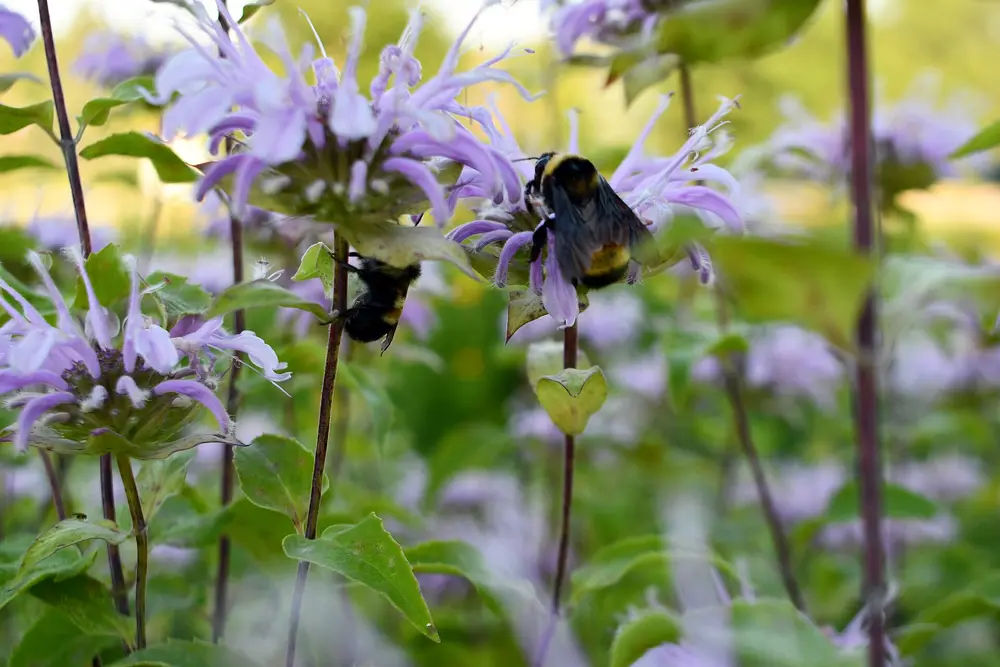
Image credits: featured photo and wild bergamot photo by Mara Koenig, U.S. Fish and Wildlife Service, public domain; beekeeper photo by Preston Keres, USDA, public domain; Hylaeus anthracinus by Kevin Faccenda, CC BY 4.0; Suckley’s cuckoo bumble bee from iNaturalist, CC0. All via Wikimedia Commons, resized. Charts by BeeKeepersRealm from USDA NASS and Center for Biological Diversity data.