Reviewed by Thomas B. · How we review
Pollinators link plant life, soil function, and carbon cycling through steady pollination that keeps flowering species productive. Healthy plant cover captures CO2, feeds roots, and builds organic matter that supports stable soil aggregates.
Nearby fields, woodlands, and farms form an interconnected system where species interactions drive resilience. By helping maintain diverse plant communities, pollinators support deeper roots and better moisture retention that reduce erosion and enhance carbon storage.
This introduction previews links between pollination, soil microbiomes, and climate regulation. For evidence on plant-soil carbon dynamics see a peer-reviewed review at a scientific summary. For practical context on pollination and food systems consult Beekeepers Realm.
Key Takeaways
- Pollinators sustain plant reproduction that drives carbon flow from air to soil.
- Diverse flowering plants strengthen soil structure and boost organic matter.
- Robust plant communities help buffer climate variability and protect crops.
- Soil health, plant vigor, and pollination form a tight ecological feedback loop.
- Local management that favors continuous floral resources enhances ecosystem services.
Table of Contents
- How pollinators power carbon-rich soils and environmental balance
- The role of bees in carbon-rich soils
- Why this matters now in the United States
- Conclusion
- FAQ
How pollinators power carbon-rich soils and environmental balance
When insects move pollen, they spark a cascade: more flowers, deeper roots, and richer ground. This simple step links pollination to longer-term carbon storage.
From pollination to carbon sequestration: the plant-bee-soil feedback loop
Pollination sustains flowering plants so photosynthesis can fix atmospheric carbon. Roots then send sugars into soil where microbes convert them into stable organic matter.
Soil microbiomes, root exudates, and why thriving plants matter for carbon
Root exudates feed microbes that build soil aggregates. Those aggregates improve water retention and protect carbon from oxidation, strengthening soil health.
The United States context: food systems, biodiversity, and climate resilience
Honey bees account for a large share of crop pollination, supporting fruits, vegetables, and alfalfa that feed livestock and American food systems. Small annual gains, like France’s 4 per 1000 idea, show how steady plant growth and pollination can boost carbon sequestration at scale.
- Pollinators keep plant communities diverse, which supports species interactions and landscape resilience.
- Sustained cover cuts erosion, lowers soil carbon loss, and helps buffer climate variability.
- Integrating pollinator-friendly practices links food security with better carbon outcomes; see more on pollination and climate.
The role of bees in carbon-rich soils
Healthy pollinator communities help sustain plant cover that protects soils and stores carbon. That living cover limits erosion and keeps roots active through seasons.
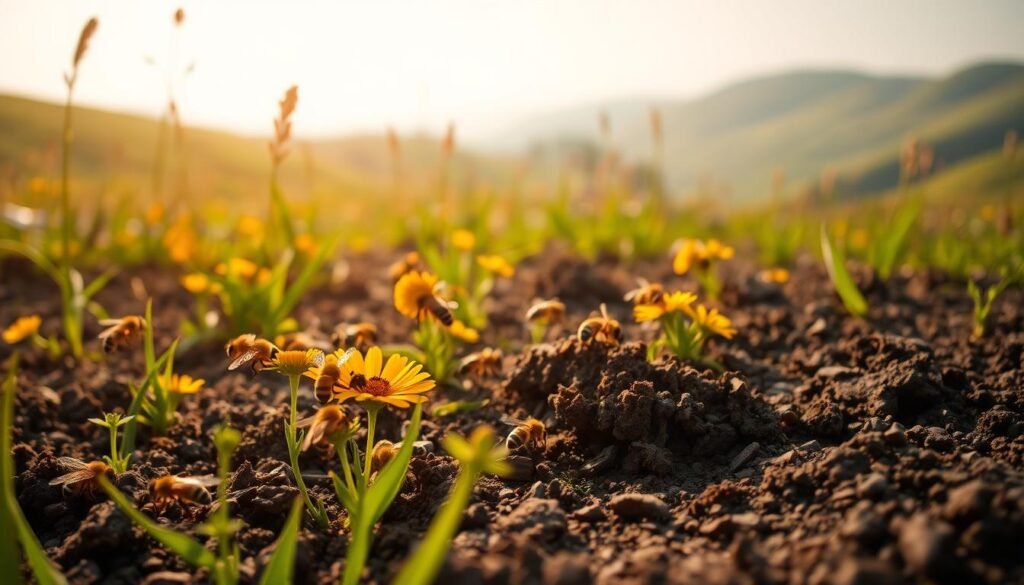
Bee-driven plant reproduction supports deep roots
Bees boost seed set for perennial and annual species. Those plants form deeper root networks that bind aggregates and improve infiltration.
Flowering landscapes reduce runoff and hold moisture
Continuous blooms, aided by honey bee activity, maintain ground cover. More cover means less runoff, better moisture retention, and sustained soil biological activity.
Photosynthesis to long-term carbon sequestration
More flowers lead to more biomass, larger roots, and steady inputs to soil organic matter. Reliable pollination amplifies carbon sequestration across farm and wild land.
Practical agriculture practices
Aligning agriculture with pollinator needs means using cover crops, no-till, diverse rotations, and reduced synthetic inputs. Compost plus rotations can add ~1.0 ton C/acre/year, while heavy synthetic nitrogen has driven losses in long-term trials.
- Trees and hedgerows supply blossoms and long-lived carbon sinks.
- Legumes boost microbial biomass and help sequestration.
- Reduced pesticides protect pollinators and preserve soil carbon.
Why this matters now in the United States
Today’s declines in key pollinators have immediate economic and ecological consequences. Honey bee losses threaten crop yields and rural incomes, and they raise risks for national food supply.
Economic stakes: pollination underpinning billions in U.S. crop production
In the United States, honey bees support about $15 billion in annual crop production value. That figure shows how vital pollination is to food systems and market stability.
Population declines and drivers: habitat loss, pesticides, disease, and climate timing
Recent years have seen annual declines in pollinator populations near 22–30%, up from 5–10% in the 1980s. These drops link to habitat fragmentation, pesticide exposure, disease, and mismatches caused by climate change.
Ranges have contracted nearly 200 miles across North America and Europe. Native specialists tied to single plants face the highest extinction risk as habitats fragment.
Action pathways: bee-friendly habitats, chemical-free practices, and strategic tree planting
Practical steps yield quick benefits. Plant bee gardens and flowering corridors to supply nectar and pollen near fields. Remove synthetic pesticides and favor organic soil-building practices to protect pollinators and microbes.
- Plant trees that offer abundant blossoms, nesting material, and long-term structure.
- Build habitats close to crops to help agriculture recover stable pollination services.
- Diversify bloom periods to buffer timing shifts tied to climate change.
Local action matters. City, suburban, and rural programs that expand habitats and cut chemical stressors boost species richness and strengthen the environment for people and farms.
Conclusion
Active pollinators keep plant communities productive, and that productivity drives how much carbon soil can hold.
Healthy bees and other pollinators help flowering plants send sugars belowground. Those inputs feed microbes, build aggregates, and boost long-term carbon sequestration while improving moisture and reducing erosion.
Managing honey bees alongside habitat restoration and agroecological practices — cover crops, reduced tillage, compost, diverse rotations, and hedgerows — delivers measurable gains for soil health and farm resilience.
Expand habitats across urban, suburban, and rural areas, cut chemical pressures, and time field work to protect bloom windows. Learn practical steps for resilient beekeeping and landscape design at beekeeping in different climates.
Act now: scale habitat, reduce pesticides, and align agriculture with nature to protect pollination services and build lasting carbon stores.
FAQ
How do pollinators power carbon-rich soils and environmental balance?
Pollinators enable flowering plant reproduction, which increases plant cover and root biomass. More roots and leaf litter feed soil microbes and build soil organic matter. That organic matter stores carbon, improves water retention, and supports biodiversity. Together, these processes stabilize ecosystems and help landscapes resist erosion and drought.
What is the plant-bee-soil feedback loop?
Bees pollinate flowers, enabling seed and fruit production. Successful reproduction increases plant abundance and diversity, especially deep-rooted species. These plants deposit carbon into soil via roots and residues. Healthy soils then support more robust plant growth, creating a reinforcing cycle that boosts carbon sequestration and habitat quality.
Why do soil microbiomes and root exudates matter for carbon?
Root exudates feed soil microbes, which transform plant carbon into stable organic matter. Diverse microbial communities speed nutrient cycling and build soil structure. That process locks carbon into mineral-associated organic matter, enhancing long-term storage and improving soil health for future plant growth.
How does this play out in U.S. food systems and climate resilience?
In the United States, pollination supports many specialty crops and contributes to national food security. Diverse, pollinator-friendly landscapes increase on-farm carbon storage and buffer crops from extreme weather. Combined with agroecological practices, this approach improves resilience to drought, floods, and shifting growing seasons.
How do bees support deep-rooted vegetation and soil stability?
By enabling reproduction of perennials, native grasses, and trees, bees help expand populations of deep-rooted plants. Those roots bind soil, reduce erosion, and draw carbon deeper into the profile, where it is more likely to persist for decades to centuries.
Can flowering landscapes reduce erosion and boost soil moisture?
Yes. Dense flowering cover protects soil surface from raindrop impact and runoff. Root networks increase infiltration and retain moisture. These benefits lower erosion risk and improve conditions for crops and native plants, supporting continuous carbon input to soils.
How does pollination amplify carbon sequestration through photosynthesis and biomass?
Pollination increases seed set and plant recruitment, which raises overall biomass production. More biomass means higher rates of photosynthesis and greater transfer of atmospheric carbon into plant tissues. When plant residues decompose or roots die, much of that carbon becomes soil organic matter.
What agricultural practices align with pollinators and soil health?
Practices that benefit both include cover cropping, reduced tillage or no-till, crop rotation, hedgerows, and field margins with native flowering plants. These approaches enhance habitat, increase soil carbon inputs, and lower disturbance to soil communities and pollinator populations.