Reviewed by Sofia T. · Last Updated October 8, 2026 · How we review
Beekeeping can be sustainable, but only at a scale the local flowers can feed and only when colonies are kept alive rather than constantly replaced. The research does not show that a few hives harm nature. It does show that dense apiaries can crowd wild bees off the flowers and pass viruses to them, and that honey bees are livestock, not an endangered species.
The question splits in two. Can beekeepers keep colonies going without buying replacements every spring? And does beekeeping cost wild pollinators more than it gives back? This guide weighs both, with figures from the studies themselves.
Key Takeaways
- Managed honey bees are not disappearing. FAOSTAT counts rose from 58.8 million hives worldwide in 2000 to 102 million in 2022.
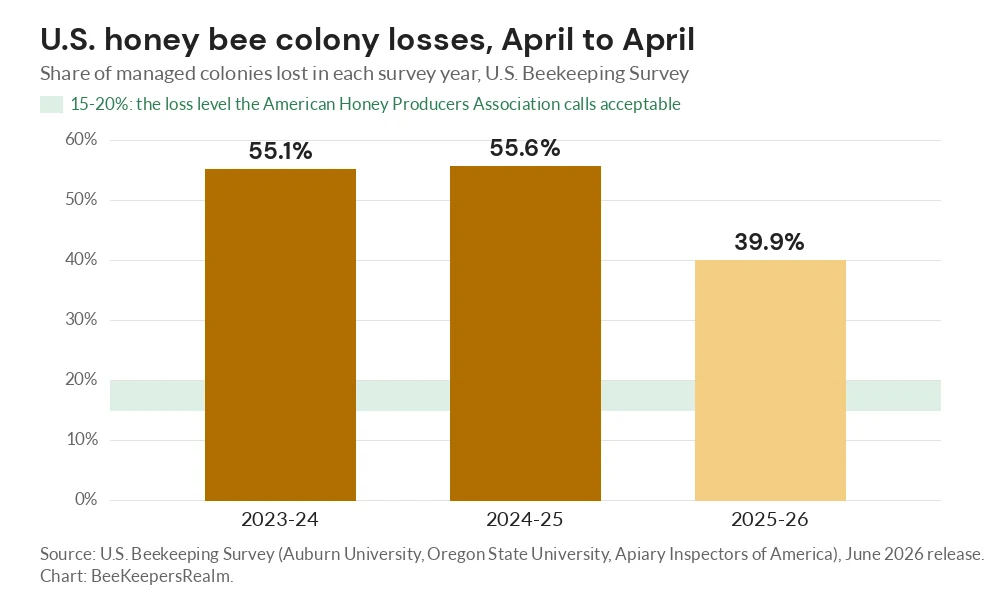
- The weak point is colony survival. U.S. beekeepers lost 55.1% and 55.6% of colonies in 2023-24 and 2024-25, then 39.9% in 2025-26.
- In a 2022 review, 66% of competition studies and 79% of pathogen studies reported negative effects of managed bees on wild bees.
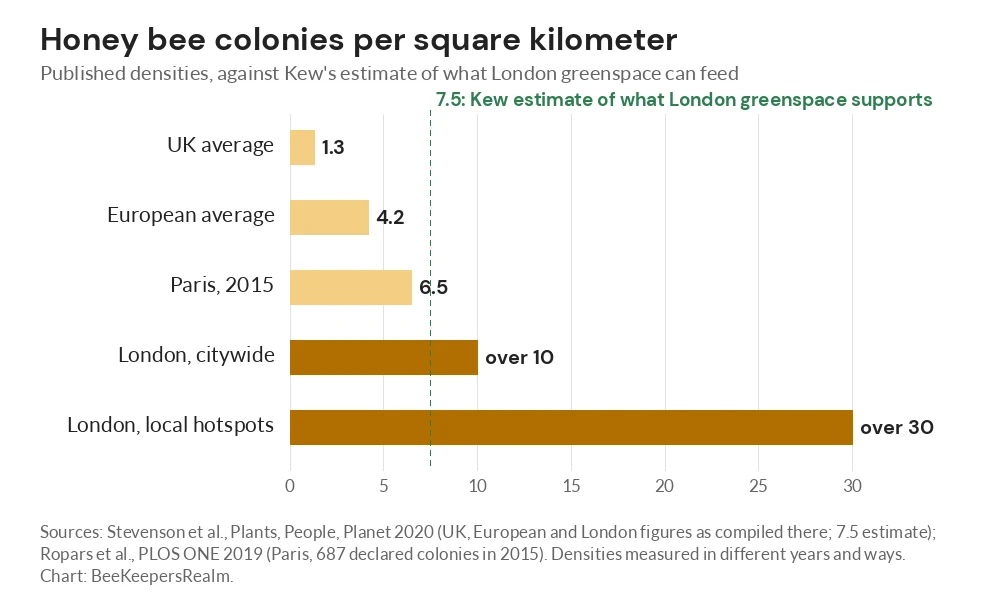
- Density is the hinge. Kew researchers estimated London greenspace can feed about 7.5 colonies per square kilometer; parts of the city exceed 30.
- Beekeepers’ own federation, Apimondia, says there is no evidence honey bees are a primary cause of wild pollinator declines at large scales.
Table of Contents
- Sustainable for the Bees, or for Nature?
- The Case That Beekeeping Is Sustainable
- The Weak Link: Colonies That Do Not Survive
- Do Honey Bees Harm Wild Bees?
- Hive Density: Where Sustainable Tips Into Unsustainable
- Common Claims Against the Evidence
- What Makes an Apiary More Sustainable
- Frequently Asked Questions
- The Bottom Line
Sustainable for the Bees, or for Nature?
People who ask whether beekeeping is sustainable usually mean one of two things.
- Is the practice self-sustaining? An apiary that loses half its colonies each winter and restocks with shipped packages runs on imports. One that replaces losses from its own splits does not.
- Is it good for the environment? Honey bees pollinate crops and wildflowers, but they also eat the same pollen and nectar wild bees need, and they carry diseases.
The honest answer differs for each, so we take them one at a time. If you mainly want the practical checklist, see our guide to sustainable beekeeping practices in the United States.
The Case That Beekeeping Is Sustainable
As a species, the western honey bee is not in trouble. FAOSTAT data compiled by Popescu and colleagues at the University of Agricultural Sciences and Veterinary Medicine Bucharest (2024) show 69.2 million hives worldwide in 1990, 58.8 million in 2000 and 102 million in 2022. Asia holds 44.6% of them and the Americas 11.4%.
Pollination is the strongest argument for keeping bees. In a 2018 Science article, Jonas Geldmann and Juan P. González-Varo note that about 75% of globally important crops depend to some degree on pollination, which adds about 9% to global crop production. Not all of that is honey bee work, and the staples are another story: wind- and self-pollinated grasses make up around 60% of global food production and need no animal pollinators, according to a 2021 review in Ambio by Patel and colleagues. So the claim that food would collapse without honey bees is an overstatement. Fruit, nut and seed crops would suffer badly. Wheat, rice and corn would not.
Beekeepers’ organizations also push back on the idea that honey bees are behind wild bee declines. In a 2026 statement on managed and wild pollinators, the international beekeeping federation Apimondia wrote:
“[W]hile localized competition for floral resources and pathogen transmission risks may arise, especially at high colony densities or when floral resources are limited, there is no evidence to support the view that managed honey bees are a primary cause of wild pollinator declines at large scales.”
The researchers who are most critical of honey bees largely agree on that point. Iwasaki and Hogendoorn’s 2022 review lists habitat loss first among the threats to wild bees. The dispute is about local harm, not global blame.
The Weak Link: Colonies That Do Not Survive
The self-sustaining question is where U.S. beekeeping looks worst. The U.S. Beekeeping Survey, run by Auburn University with Oregon State University and the Apiary Inspectors of America, put annual losses at 55.1% in 2023-24 and 55.6% in 2024-25, both records. In its June 2026 release, losses for April 2025 to April 2026 fell to 39.9%, which the survey team called a return to levels beekeepers “have been accustomed to for more than a decade.”
“While it’s encouraging to see colony loss rates come down from last year’s historic highs, losing nearly 40% of managed colonies in a single year is not a victory—it’s a crisis in slow motion”
Coy put the acceptable level at 15 to 20%. The same release puts the USDA’s estimate at 2.4 million honey-producing colonies in 2025, down from about 2.6 million before the two record years. The national herd survives because beekeepers split strong colonies and buy packages and queens to rebuild. That works, but it costs time and money, and it is the opposite of self-sustaining.
The main driver is the Varroa mite. A 2019 study led by Samuel Ramsey at the University of Maryland found that Varroa feeds mainly on the bee’s fat body, the organ that stores food and breaks down pesticides, not on its blood, as long assumed. The mites also spread viruses. After commercial beekeepers lost over 60% of their colonies between summer 2024 and early 2025, about 1.7 million colonies and an estimated $600 million, USDA Agricultural Research Service scientists found high levels of deformed wing virus A and B and acute bee paralysis virus in all the bees they sampled. They found signs of resistance to amitraz, a key miticide, in virtually all the mites they collected.
Small operations are not immune. The 2025-26 survey found that backyard beekeepers with fewer than 50 colonies lost more than commercial beekeepers running over 500.
Do Honey Bees Harm Wild Bees?
This is the environmental half of the question, and two systematic reviews frame it. In 2017, Rachel Mallinger, Hannah Gaines-Day and Claudio Gratton at the University of Wisconsin reviewed studies of managed honey bees and bumble bees. In 2022, Jay Iwasaki and Katja Hogendoorn at the University of Adelaide repeated the search with the same terms. Honey bees accounted for 78% of the study outcomes in the newer review.
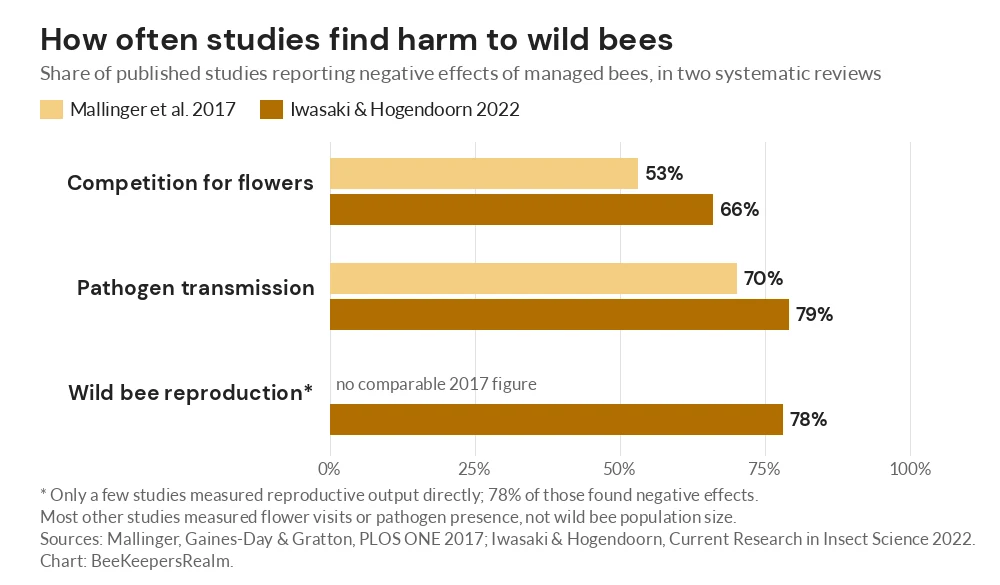
- Competition: 53% of studies reported negative effects in 2017. By 2022, 66% did.
- Pathogens: 70% of pathogen studies reported potential negative effects in 2017, and 79% in 2022.
- Reproduction: only a few studies measured wild bee reproductive output directly, and 78% of those found harm.
There is a catch both reviews state plainly. Most studies recorded flower visits or the presence of pathogens, not changes in wild bee populations. Mallinger’s team also found that honey bees in their native range competed less, while their pathogen effects could be greater. In the Americas, honey bees are introduced; Apimondia’s statement says they “may behave as an invasive species” there.
“Taken together, the evidence increasingly suggests that managed and introduced bees negatively affect wild bees, and this knowledge should inform actions to prevent further harm to native ecosystems.”
How much pollen does an apiary take?
A strong colony gathers a lot. In a 2017 paper in Conservation Letters, bee biologists James Cane and Vincent Tepedino calculated that a 40-hive apiary on wildlands for three months collects the pollen equivalent of four million wild bees. That is an estimate of pollen removed, not of bees lost, but it shows why siting matters more than the number of hives a beekeeper owns. For the study-by-study detail, see our deeper look at whether backyard beekeeping hurts wild bees and the island experiment in competition between honeybees and native bees.
Disease spillover near apiaries
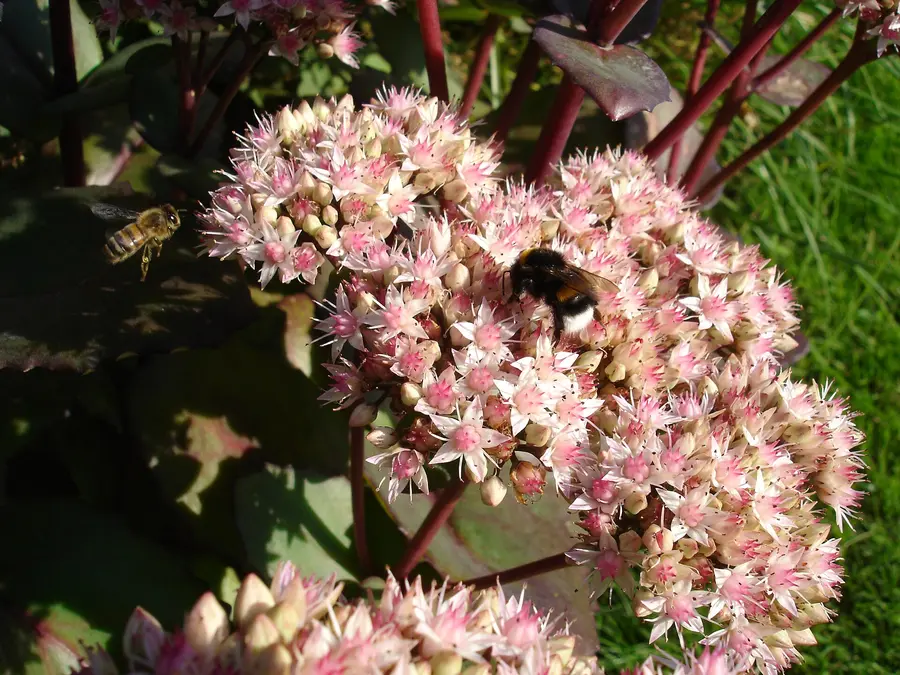
Vermont supplies one of the clearest U.S. examples. In 2015, researchers sampled bumblebees, honey bees and flowers at 7 sites with commercial apiaries within 300 meters and 12 sites with none within a kilometer. In the resulting 2019 study, led by Samantha Alger, deformed wing virus was more common, and more actively infecting, in bumblebees near apiaries. The team found no deformed wing virus in bumblebees where honey bee foragers and apiaries were absent, and detected viruses on 19% of flowers, all from apiary sites.
Hive Density: Where Sustainable Tips Into Unsustainable
Every study above points to the same variable: how many colonies share how many flowers. Cities have become the test case.
In a 2020 paper in Plants, People, Planet, Kew’s Phil Stevenson and colleagues reported that London’s honey bee density exceeds 10 colonies per square kilometer, locally more than 30. That is more than twice the European mean of 4.2 and nearly eight times the UK figure of 1.3. Their estimate was that each colony needs 13.28 hectares of London greenspace, or 7.5 colonies per square kilometer. By that measure, they concluded, beekeeping is unsustainable in most locations in London.
Paris shows the effect on wild bees. The city went from around 300 declared colonies in 2013 to 687 in 2015, or 6.5 per square kilometer. Ropars and colleagues (PLOS ONE, 2019) found that wild pollinator visits fell as colony density rose within 500 and 1,000 meters of their sites. Honey bees made 50% of the 32,694 flower visits they recorded.
No equivalent figure exists for U.S. cities, and London’s number does not transfer to a Midwest farm town. The method does: count the colonies within foraging range, then ask what is in bloom. Our guide to how far bees travel to forage covers the radius, and the urban beekeeping guide covers city siting.
Common Claims Against the Evidence
| Claim | What the evidence says | Verdict |
|---|---|---|
| “Honey bees are going extinct.” | Hives worldwide rose from 58.8 million in 2000 to 102 million in 2022 (FAOSTAT). | False |
| “Keeping hives helps save the bees.” | It adds honey bees. Wild bees need habitat and flowers, and dense hives compete with them. | Mostly false |
| “Without honey bees, our food supply collapses.” | About 75% of important crops benefit from pollination, adding about 9% to output; staple grains need none. | Overstated |
| “Any hive harms wild bees.” | Harm shows up mainly at high density, with scarce flowers, or near sensitive habitat. | Depends on density |
| “Honey bees spread disease to wild bees.” | 79% of pathogen studies report potential harm; Vermont bumblebees near apiaries carried more virus. | Likely near apiaries |
| “Honey bees caused the wild bee decline.” | Habitat loss is the main driver; no evidence of honey bees as a primary cause at large scales. | Not supported |
| “Today’s beekeeping is self-sustaining.” | U.S. annual losses were 39.9% to 55.6% in the last three surveys, made up by splits and purchases. | Not yet |
Sources: Popescu et al. 2024 (FAOSTAT data); Geldmann and González-Varo, Science 2018; Patel et al., Ambio 2021; Iwasaki and Hogendoorn 2022; Alger et al., PLOS ONE 2019; Apimondia 2026; U.S. Beekeeping Survey 2026.
What Makes an Apiary More Sustainable
Each step below answers one of the problems the research identified.
- Keep mites low. Varroa and the viruses it carries drive most losses. Count mites regularly through the season with an alcohol wash or sugar roll and treat when counts call for it. Healthier colonies also mean less virus on shared flowers.
- Replace losses from your own stock. Splitting strong colonies and overwintering nucs keeps an apiary from relying on shipped packages every spring.
- Match hive numbers to forage. More hives in the same spot means more competition. In a city, check how many colonies are already registered nearby before adding more.
- Keep apiaries away from sensitive habitat. The Bumblebee Conservation Trust urges a precautionary approach and careful hive placement so rare wild bees are not harmed. In practice, keep hives out of nature reserves and known rare-bee sites, especially when bloom is thin.
- Plant for wild bees too. Flowers and nesting sites help both groups. See our guide to wild bee habitats.
- Harvest only surplus. Leave enough stores to winter; our guide to how much honey bees need for winter gives the numbers.
For the personal benefits of beekeeping, weighed against costs, see our benefits guide.
Frequently Asked Questions
Is beekeeping good or bad for the environment?
Neither by default. A few well-managed hives in a flower-rich area do little harm. Dense apiaries near scarce forage or rare wild bees can do real harm.
Does keeping honey bees help save the bees?
It adds honey bees, which are not endangered. Helping wild bees means habitat, flowers and fewer pesticides.
Are bees harmed when honey is harvested?
Not if the beekeeper takes only surplus and leaves enough stores for winter. Over-harvested colonies must be fed or risk starving.
What are the downsides of beekeeping?
High colony losses, constant mite control, time and cost, and, at high hive densities, competition and disease risk for wild bees.
How many hives is too many?
There is no universal number. Kew researchers estimated London greenspace can support about 7.5 colonies per square kilometer; the right figure depends on local bloom.
Is beekeeping sustainable in the United States?
Not yet as a self-sustaining system. Losses of 39.9% to 55.6% a year are made up by splits and purchases, and honey bees are introduced in the Americas.
The Bottom Line
Keep few enough hives for your area, keep them alive, and treat them as livestock you are responsible for, not as conservation. To help wild bees directly, start with habitat.