Reviewed by Michael R. · How we review
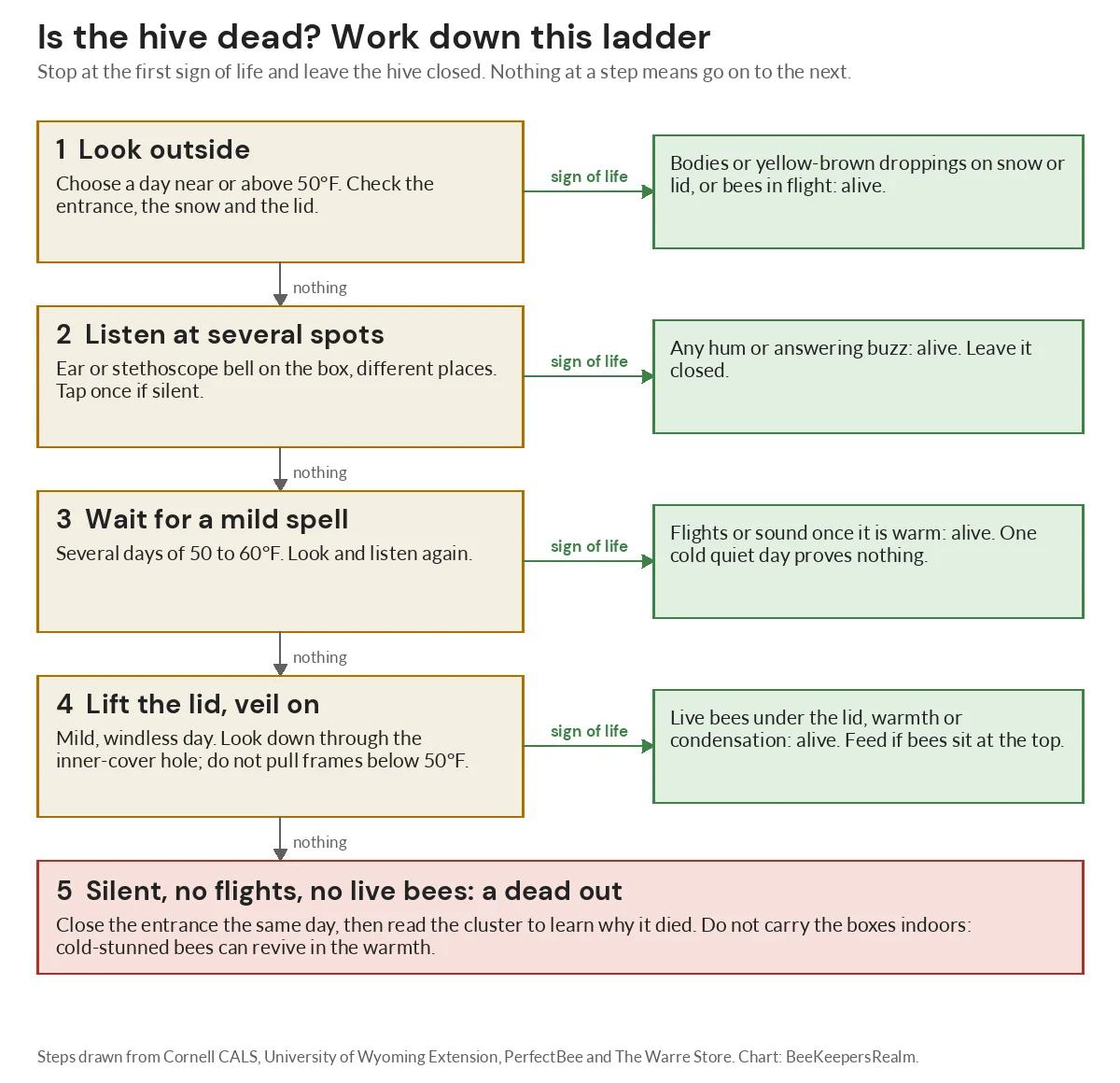
A beehive is dead when it stays silent at several listening spots, shows no flights or droppings across mild days, and has no living bees under the lid on a warm afternoon. No single sign proves it. A quiet cluster and a dead one look identical from the yard, and cold-stunned bees can revive when warmed. Work through the checks below before you pull a frame.
This guide is for US beekeepers in cold winters. Beekeepers lost 30.3% of their colonies over winter in the 2025-26 U.S. Beekeeping Survey led by Auburn University, so most of us will face this check.
Key Takeaways
- Dead bees and brown droppings on the snow are good news: a living colony is cleaning house.
- Cornell says a silent hive is a dead hive, but only after listening at several spots; other guides warn that a small cluster can be too quiet to hear.
- Pulling frames waits for 50°F or warmer. Confirming a death takes a mild spell and a quick look under the lid, veil on.
- Cold and starvation leave overlapping clues, so read the whole box: bees, stores, brood, floor and lid.
- Close the entrance the same day, and call your state apiary inspector before touching anything if you suspect American foulbrood.
Table of Contents
- Start Outside: Bodies, Droppings and Flight
- Listen at Several Spots, Then Tap Once
- Dead or Just Quiet? What Each Sign Proves
- The Lid-Up Look That Settles It
- Why It Died: Read the Whole Box
- The First Days After You Find a Dead Hive
- Restocking: Order Early, Mind the Queen
- Frequently Asked Questions
- The Bottom Line
Start Outside: Bodies, Droppings and Flight
Look before you touch anything. On a mild day, check the snow, landing board and lid. Cornell’s northeast beekeeping calendar calls dead bees scattered on the snow “a good sign,” because on warm days the colony clears bodies off the bottom board. Our guide to dead bees in front of the hive covers when a pile is too big.
“Curiously dead bees outside the hive are good news because bees in the colony are dying all the time.”
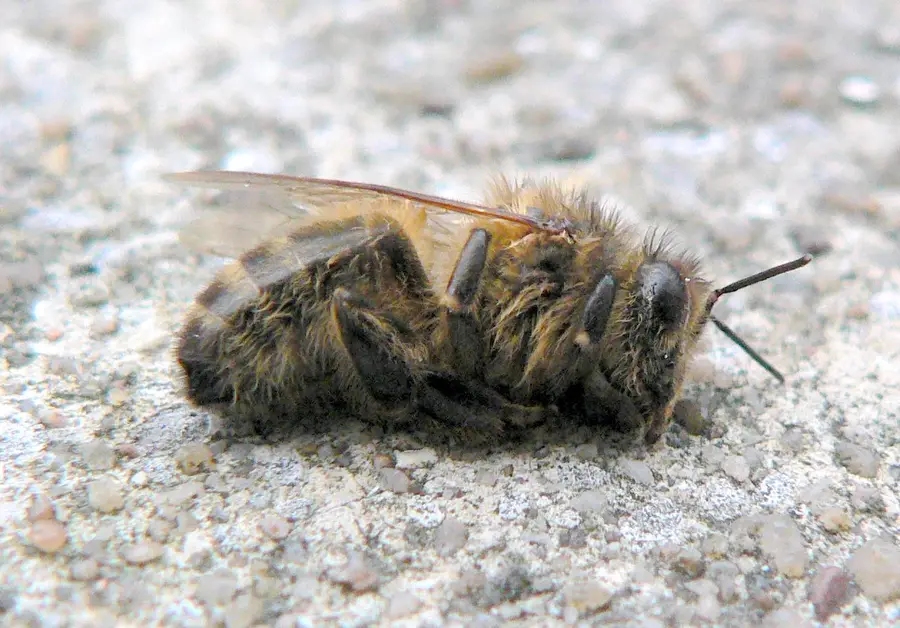
Yellow-brown spots on snow or lid are cleansing-flight droppings. Cornell puts those flights at roughly 50°F and above on sunny days, so one cold, quiet day proves nothing. Several mild days with no flights, bodies or droppings while neighboring hives are active is worth a closer look.
Two traps: ice or a plug of dead bees can block the entrance (Cornell says to clear ice), and busy-looking traffic at a weak or dead hive can turn out to be robbing, the National Bee Unit warns.
In this three-minute Betterbee video, the presenter says dead bees and droppings on the snow show a colony recently flew to relieve itself and clear its dead, and that hives with no such evidence by the door are the ones known to be dead. The presenter then listens for a buzz and lifts the lid to see whether bees sit at the inner-cover hole, a sign they have eaten up through their stores.
Listen at Several Spots, Then Tap Once
Press an ear or a stethoscope against the upper box. Cornell’s overwintering guide says to use the bell end, twisted 180 degrees until it clicks, and expect a faint hum. If you hear nothing, move the bell and listen again, since the cluster may be audible at only one or two places.
“Live bees always make some sounds. A hive that is silent is a dead hive.”
Cornell’s calendar adds a tap on the outside, to which the bees should respond. Tap once, not repeatedly; our no-open winter check guide explains why knocking can hurt a cold cluster.
Heft tells you about food, not life. A hive that proves dead on the other tests and is still heavy has honey left, a clue to the cause below. A light one may simply have been robbed; see how much honey bees need for winter for weights.
Dead or Just Quiet? What Each Sign Proves
Guides disagree here. Cornell treats silence as death, while PerfectBee says that with no buzzing the colony “may have perished or may just be too quiet to hear.” The Warre Store notes that “hives that appear dead aren’t always dead.” This table grades each sign by what it can and cannot prove.
| Sign | What it suggests | How it can mislead |
|---|---|---|
| Bodies or droppings on snow or lid | Alive | A strong sign of life. Absence on a cold day proves nothing. |
| No flights, bodies or droppings over several mild days | Possibly dead | Ice or dead bees may block the door, or days may be too cool to fly. |
| Silence at several spots on a calm day | Probably dead | One spot is not enough, and a very small cluster can be too quiet to hear. |
| No bees visible under the lid | Unclear | Either well fed and lower down, or dead (Cornell). |
| Cold, motionless bees on comb | Not proof | Chilled bees can revive when warmed. |
| Live bees, warmth or condensation under the lid | Alive | Close up and leave them. |
“The temperature of the outermost bees of a winter cluster may go down to 50 F. Any colder than that and they go into a “chill coma” and cannot restart working their muscles to get warm again without an application of heat.”
That is why a “dead” box carried into a warm house can come alive; The Warre Store warns the bees can wake by the thousands. Keep suspect boxes outdoors.
The Lid-Up Look That Settles It
Wait for a mild spell. The Warre Store says that after a day or two in the 60s with no activity and no sound, you can assume a dead out. Wyoming Extension calls the first warm-day check the alive/dead check. Cornell allows opening on a relatively warm, windless day but no pulling frames or breaking the cluster below 50°F; our temperature guide covers a seconds-long peek in the 30s°F.
Put on a veil and lift the lid. The American Bee Journal’s “Dealing With Dead-Outs” says to watch for live bees and listen with your head near the top bars; a sudden appearance of bees, urgent buzzing or alarm pheromone means alive. PerfectBee says warmth or condensation means the cluster is likely alive: close up. If bees sit under the cover, feed solid sugar now. If you see none, Cornell says either they are fine below or they have died, so listen again.
With no sound, no flights and no bees at the top on a mild day, Wyoming says the hive can be opened to find the cause of loss. By then the evidence says dead, so lifting frames above 50°F costs little.
Why It Died: Read the Whole Box
Start with when. The National Bee Unit’s post-mortem guide says the first question is when the colony died, and that some “winter losses” show clear signs of failure in autumn. The American Bee Journal adds that a colony dead since early winter will usually be moldy with mushy black bees whatever killed it, so mold alone does not convict moisture.
| Likely cause | What you find | Caution |
|---|---|---|
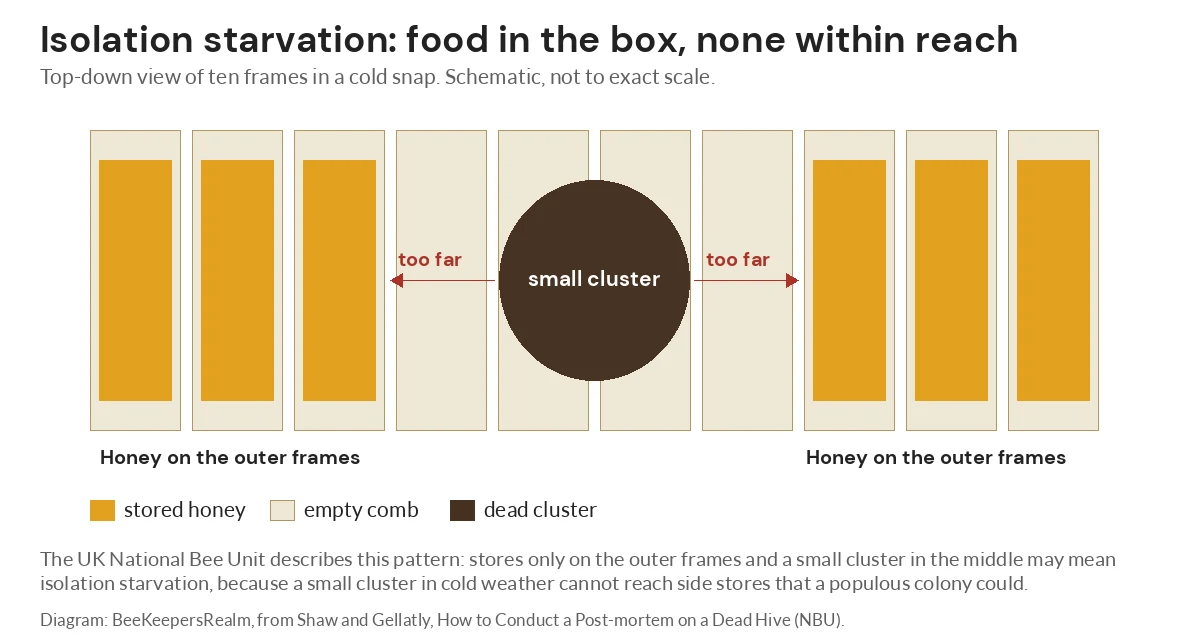
| Starvation | Little or no honey, or honey only on outer frames away from a small cluster; bees head-down in cells | Head-down bees can also be chilled bees, and the NBU says both can occur on the same frames. |
| Cold, small cluster | A small cluster, with many bees fallen onto the floor | Cold alone does not usually kill bees, says Beekeeping Made Simple. |
| Mites and viruses | Mite bodies or white mite droppings in cells, deformed wings, perforated cappings; death in fall or early winter | Live mites are rare on dead bees. An alcohol wash of the dead bees can still estimate levels. |
| Moisture | Soaked, moldy inner cover over a soggy cluster | Mold grows on any dead cluster. |
| Queen failure | No dead brood at all; raised drone cappings in worker cells | A dead queen on a frame only shows the colony was queenright when it died. |
| Robbed after death | Ragged cell rims, wax debris, no stores | Missing honey is not starvation if robbers took it. |
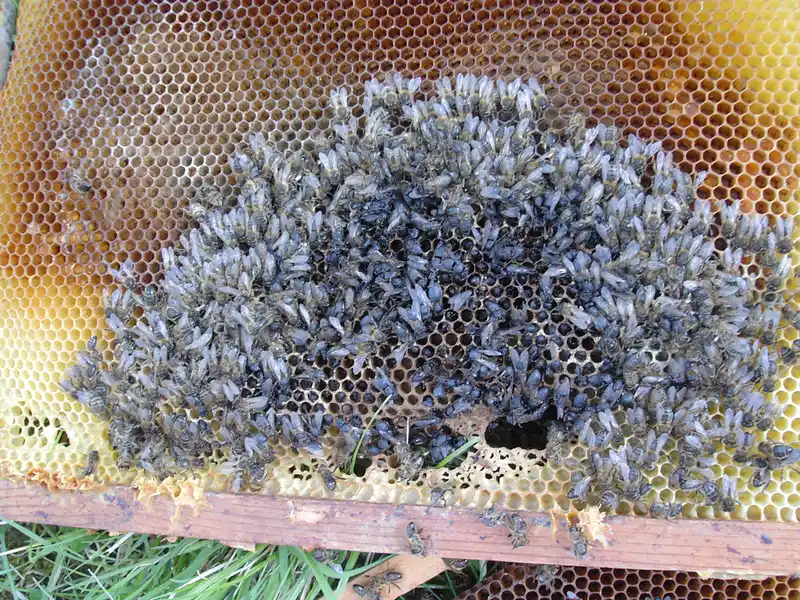
Honey in the box does not rule out starvation. The NBU describes isolation starvation: stores sit only on the outer frames, and a small cluster in the middle cannot reach them in cold weather, though a larger colony could.
Check the floor for mites. One rule of thumb from Beekeeping Made Simple: if only one hive in three or more died, varroa is a less likely cause.

For the full teardown, use our deadout autopsy checklist. Moisture fixes are in reducing moisture in winter hives, and mite follow-up in what to do after a high mite count.
The First Days After You Find a Dead Hive
- Close the entrance today. The National Bee Unit says to block a dead hive’s entrance and move it out of the apiary soon, and Mann Lake notes that unprotected honey invites robbing.
- Autopsy within days, on a cool day. PerfectBee says robbers can clean out a dead hive and erase the evidence, and that hasty cleanup destroys it too.
- Rule out American foulbrood first. Bee Culture’s James Tew says to contact the state apiary inspector if foulbrood has been a problem. If you suspect it, stop and see how to quarantine a suspect diseased hive. This is educational, not professional advice; your state apiary program decides.
- Sort comb and honey by cause. See how to clean a deadout and what is safe to reuse.
Restocking: Order Early, Mind the Queen
PerfectBee advises ordering packages or nucs soon, as spring availability shrinks. Tew suggests refilling winter-killed equipment with splits from surviving colonies and a mated queen, or with packages or bought splits. The Warre Store calls repopulating the easiest course, since new bees inherit a nest. See package bees vs nucs to choose.
Frequently Asked Questions
How can I tell if my beehive is still alive in winter?
Look for bodies and droppings on snow, listen at several spots, then lift the lid on a mild day.
How cold is too cold to check a hive?
Skip pulling frames below 50°F. A seconds-long peek under the lid is done in the 30s°F.
How do you know if a bee is asleep or dead?
Outer cluster bees chilled below about 50°F go into a coma and revive with warmth, so a still bee on a cold day may not be dead.
Should I remove dead bees from the entrance?
Only a plug of bodies or ice that blocks the door. A few on the snow are a good sign.
Can I harvest honey from a hive that died over winter?
If disease or poisoning did not kill it, the honey can feed other bees.
What month do hives usually die?
No single month. Mite-weakened colonies fail in fall or early winter; The Bee Supply puts starvation at winter’s end.
Will a bee hive die in the winter?
Many survive by clustering, but not all do: the 2025-26 survey found a 30.3% winter loss.
The Bottom Line
Call a hive dead only after listening at several spots and looking under the lid on a mild day. Then seal it, find out why, and plan next spring’s order.