

Reviewed by Thomas B. · Last Updated September 23, 2026 · How we review
To disinfect hive tools after disease, first scrape and scrub off every trace of wax and propolis, then use a method strong enough for the disease you found. For European foulbrood, chalkbrood, Nosema and viruses, a 20-minute soak in washing soda solution with added bleach works. For American foulbrood, soak the clean tool for at least 20 minutes in 0.5% sodium hypochlorite, or flame the working surfaces thoroughly. Rubbing alcohol and a spell in the smoker do not kill AFB spores.
That last point is where most online advice goes wrong. Methods that are fine between healthy colonies are not strong enough after an AFB diagnosis. This guide matches the method to the disease, with bleach dilutions worked out for US bottles.
Key Takeaways
- Clean first, disinfect second. Bleach and heat can’t reach pathogens under propolis and wax.
- For EFB and non-spore diseases, use the UK National Bee Unit’s field recipe: soda crystals plus a small dose of bleach, with tools soaked at least 20 minutes.
- For AFB, you need spore-killing strength: 0.5% sodium hypochlorite (5,000 ppm) for 20 to 30 minutes, or thorough flaming of bare metal.
- Isopropyl alcohol does not kill bacterial spores, according to CDC disinfection guidance. Putting the tool in your smoker isn’t effective either.
- Leather gloves and heavily pitted, rusted or wooden-handled tools that touched AFB are cheaper to replace than to trust.
Table of Contents
Why the Disease Changes the Method
Most honey bee pathogens are fairly easy to kill once they’re exposed. Melissococcus plutonius, the bacterium behind European foulbrood, doesn’t form true spores. Chalkbrood fungus, Nosema and bee viruses can all be handled by solid routine hygiene. The exception is Paenibacillus larvae, the cause of American foulbrood. It forms spores that survive drying, heat and many common disinfectants. The UK National Bee Unit’s fact sheet Disinfecting a hive after disease notes that AFB spores can stay viable for decades.
Think of disinfection strength as three levels:
| Disease found | What you’re killing | Minimum method for hive tools | Replace the tool instead? |
|---|---|---|---|
| No diagnosed disease (routine) | Low background pathogen load | Scrape, then soda solution; alcohol wipe is acceptable between healthy colonies | No |
| European foulbrood | Non-spore bacteria | Soda + bleach solution, 20-minute soak minimum | Rarely |
| Chalkbrood, Nosema, viruses (DWV etc.) | Fungal spores, microsporidia, viruses | Soda + bleach solution, 20-minute soak; dry fully | No |
| American foulbrood (confirmed or suspected) | Highly resistant bacterial spores | Scrub, then 0.5% sodium hypochlorite 20 to 30 minutes, or flame the bare metal thoroughly | Yes, if the tool is pitted, rusty or has a wooden or plastic handle |
Varroa and small hive beetle aren’t carried on a clean hive tool in any meaningful way, but the viruses varroa spreads can be. Treat a deadout from a varroa collapse at the “viruses” level.
If you haven’t confirmed which disease you have, disinfect at the AFB level until you know. A rope test or a lateral-flow field test kit gives you an answer in the field. Our comparison of American vs. European foulbrood covers the visual signs.
Step 1: Remove Every Trace of Wax and Propolis
No chemical or flame works well through a crust of propolis. Organic matter protects pathogens and uses up bleach before it reaches them. The NBU makes this point repeatedly: scrape before you disinfect.

- Work over newspaper or cardboard. Scrape the tool with a second scraper or a putty knife and catch the debris. Bag or burn that debris. Don’t leave it where bees can reach it.
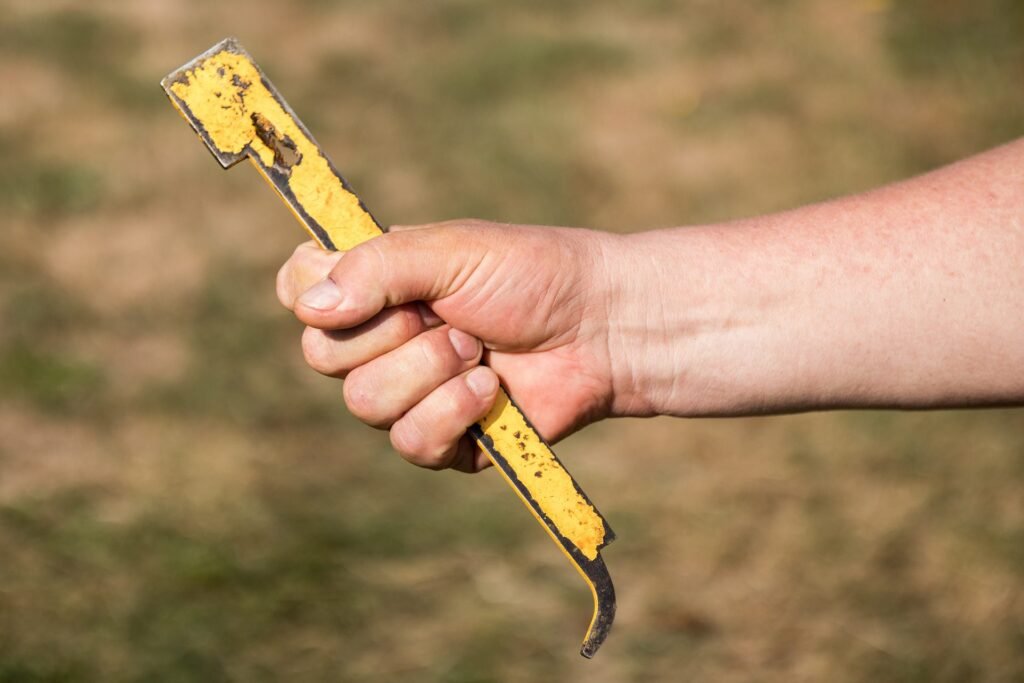
- Soak in hot washing soda solution. The NBU recipe is 1 kg of soda crystals (sodium carbonate, sold in the US as washing soda) in 4.5 liters of hot water, about 2.2 lb in 1.2 gallons, with a dash of dish soap. Soda softens propolis and lifts wax.
- Scrub with a stainless-steel pan scourer or wire brush until the metal is bare, including the hooked end and the underside of the lip, where propolis builds up.
- Rinse and inspect. If you see amber residue in the pitting, go back to step 3.
Wear rubber gloves and eye protection. Hot washing soda is alkaline enough to irritate skin and eyes.
Step 2A: EFB, Chalkbrood, Nosema and Viruses
For anything except AFB, the NBU’s inspector recipe does the job. According to its Apiary hygiene and quarantine fact sheet, inspectors add 150 ml of 4.5% bleach to the soda solution above. That gives about 0.125% sodium hypochlorite, which kills the bacteria that cause EFB when tools soak for at least 20 minutes. The alkaline soda keeps the bleach stable for about 24 hours.
US bleach is usually stronger than 4.5%. To match the NBU dose, add about 1/2 cup of 6% bleach or 1/3 cup of 8.25% bleach to a 1.2-gallon batch of soda solution.
After soaking, rinse with clean water, dry the tool completely, and wipe it with a little food-grade mineral oil if it’s carbon steel. Keep two or three hive tools in rotation so one is always soaking. It’s the same principle as our apiary tool bucket setup.
Step 2B: American Foulbrood
AFB is a statutory notifiable disease in the UK and a regulated disease under many US state apiary laws. In North Dakota, contact the Department of Agriculture’s Apiary Program, which inspects for AFB on request. Elsewhere, start with your state apiarist. Deal with the colony first. The tools come after. Our guide to burning comb after AFB covers the colony side.
Until the diagnosis is settled, give the suspect colony a hive tool of its own and leave it with that hive, rather than carrying one tool through the whole yard. The NBU’s apiary hygiene guidance describes keeping equipment for the sole use of one colony as a good barrier against spreading disease, and suggests marking that equipment with the colony number. A strip of bright tape on the handle does the same job for a tool, so nobody picks it up by mistake. Treat that tool at the AFB level below before it goes anywhere else.
Option 1: 0.5% bleach soak
The NBU states that research has shown immersion for 20 minutes in 0.5% sodium hypochlorite kills AFB spores. It recommends about 30 minutes of contact for hive surfaces. That concentration equals 5,000 ppm. The CDC’s guidance on chemical disinfectants cites 5,000 ppm bleach inactivating a million C. difficile spores in 10 minutes or less, so this level is widely used against tough bacterial spores.
- Scrub the tool to bare metal (Step 1). This matters more for AFB than for anything else.
- Mix 0.5% bleach in cool water. Hot water breaks down hypochlorite faster.
- Submerge the tool completely for 30 minutes.
- Rinse well with hot water, dry completely, and oil carbon-steel tools to slow rust.
Option 2: Flame
On an all-metal tool, a propane torch is quick and leaves no chemical residue. Clean the tool first, then heat both faces, both ends and the edges until any remaining residue has visibly burned off and the steel is too hot to touch for a long time. A quick pass isn’t enough. The tool must get hot through its whole length, not just where the flame touched. Flame can’t treat plastic-coated or wooden handles, and repeated heating softens tempered steel over time. See bleach vs. flame sterilization for the trade-offs between the two methods.
Option 3: Replace it
A standard hive tool costs about the same as a few jars of honey. If the tool you used on an AFB colony has a painted, rubber-gripped or wooden handle, deep pitting or rust, replace it and burn or discard the old one with the colony’s other infected materials. Heavily pitted steel holds residue that neither bleach nor a torch can reliably reach.
Bleach Dilutions for US Bottles
Many online guides say “one part bleach to nine parts water gives 10% bleach.” That’s a mix-up. It makes a 10% dilution of the product, which is only about 0.6 to 0.8% sodium hypochlorite. Always check the label percentage. Here’s how to hit 0.5% sodium hypochlorite:
| Label strength | Parts bleach : parts water | For about 1 gallon of 0.5% solution |
|---|---|---|
| 4.5% (UK/EU typical) | 1 : 8 | about 1 3/4 cups bleach + water to 1 gallon |
| 6% (older US regular) | 1 : 11 | about 1 1/3 cups bleach + water to 1 gallon |
| 7.5% | 1 : 14 | about 1 cup bleach + water to 1 gallon |
| 8.25% (current US “concentrated”) | 1 : 15.5 | about 1 cup bleach + water to 1 gallon |
The formula: parts of water per part of bleach = (label % ÷ 0.5) − 1. Mix fresh on the day. Bleach loses strength in an opened bottle, and faster once diluted. Never mix bleach with vinegar, ammonia or acidic cleaners.
The same 0.5% solution works beyond hive tools. The NBU recommends submerging plastic hive parts and polystyrene boxes in 0.5% sodium hypochlorite for 20 to 30 minutes, since they can’t be scorched. Rinse and dry them the same way. Wooden boxes are a different job, covered in our guide to disinfecting wooden hive equipment after disease.
Methods That Don’t Kill AFB Spores
- Isopropyl (rubbing) alcohol. Some extension guides recommend alcohol for tools between colonies, and for routine hygiene that’s reasonable. But the CDC is clear that alcohols “do not destroy bacterial spores.” After AFB, alcohol isn’t enough.
- Your smoker. The NBU states plainly that putting a hive tool in the smoker is not an effective way to disinfect it. The smoker’s barrel is hot enough to stay clean itself, but a tool sitting in smoldering fuel doesn’t reach a reliable, even temperature.
- General farm disinfectants alone. In a 2022 study in Frontiers in Veterinary Science, Virkon S reached about 87 to 88% efficacy against P. larvae spores in suspension at 5 and 15 minutes, not full kill. Use products with proven results against AFB spores, or stick to bleach and flame.
- Acetic acid fumigation. The NBU notes it works on stored comb for chalkbrood, Nosema and wax moth, but not for AFB, EFB or viruses.
- Freezing. Freezing kills wax moth and small hive beetle stages. It does nothing to bacterial spores.
Gloves, Brushes and the Rest of Your Kit
A tool is only one of the ways disease travels. After working a diseased colony:
- Gloves: the NBU advises disposing of leather gloves that have contacted foulbrood and bagging used nitrile or dishwashing gloves before disposal, so foraging bees aren’t drawn to the honey on them. See disinfecting gloves between inspections.
- Bee brush: bristles hold honey and spores. After AFB, replacement is simpler. After other diseases, follow our bee brush disinfection guide.
- Frame grips, queen catchers and scrapers: clean and disinfect them the same way as the hive tool, at the level matched to the disease.
- Extracting gear: if you extracted supers from the colony, spores are in the honey residue. See sanitizing extractors after sick colonies.
- Boxes and woodenware: covered in disinfecting wooden hive equipment after disease.
Once you’re past the outbreak, go back to routine hygiene between colonies. Our guide to sanitizing hive tools between colonies covers the everyday version.
Frequently Asked Questions
Does rubbing alcohol kill American foulbrood spores?
No. Alcohols kill many bacteria, fungi and viruses but do not destroy bacterial spores, according to CDC disinfection guidance. Use 0.5% sodium hypochlorite or thorough flaming after AFB.
Can I sterilize my hive tool by putting it in the smoker?
No. The UK National Bee Unit states that placing a hive tool in the smoker is not an effective way to disinfect it. Scrub the tool, then soak or flame it properly.
What bleach concentration kills AFB spores on hive tools?
0.5% sodium hypochlorite (5,000 ppm) for at least 20 minutes, after the tool has been scraped clean. With 8.25% US bleach, that’s roughly 1 part bleach to 15.5 parts water.
Can I reuse a hive tool after American foulbrood?
Yes, if it’s all metal, in good condition, and has been scrubbed to bare steel and then bleached or flamed. Replace tools with wooden or rubber handles, deep pitting or rust.
How long should hive tools soak in disinfectant?
At least 20 minutes for the NBU soda-and-bleach solution used against EFB. For AFB, 20 to 30 minutes in 0.5% sodium hypochlorite. Rinse and dry afterward.
Do I need to disinfect hive tools after chalkbrood or Nosema?
Yes, but a routine-strength clean is enough: scrape, then soak in soda solution with a little bleach, rinse and dry. Spore-level disinfection is only essential for AFB.
The Bottom Line
Scrape to bare metal, then match the method to the disease. Soda plus a little bleach handles EFB and most other problems. AFB needs 0.5% bleach or proper flaming, and alcohol or a smoker won’t do it. When a tool is pitted or has a handle you can’t disinfect, replace it.


.jpg)