Reviewed by Thomas B. · Last Updated September 24, 2026 · How we review
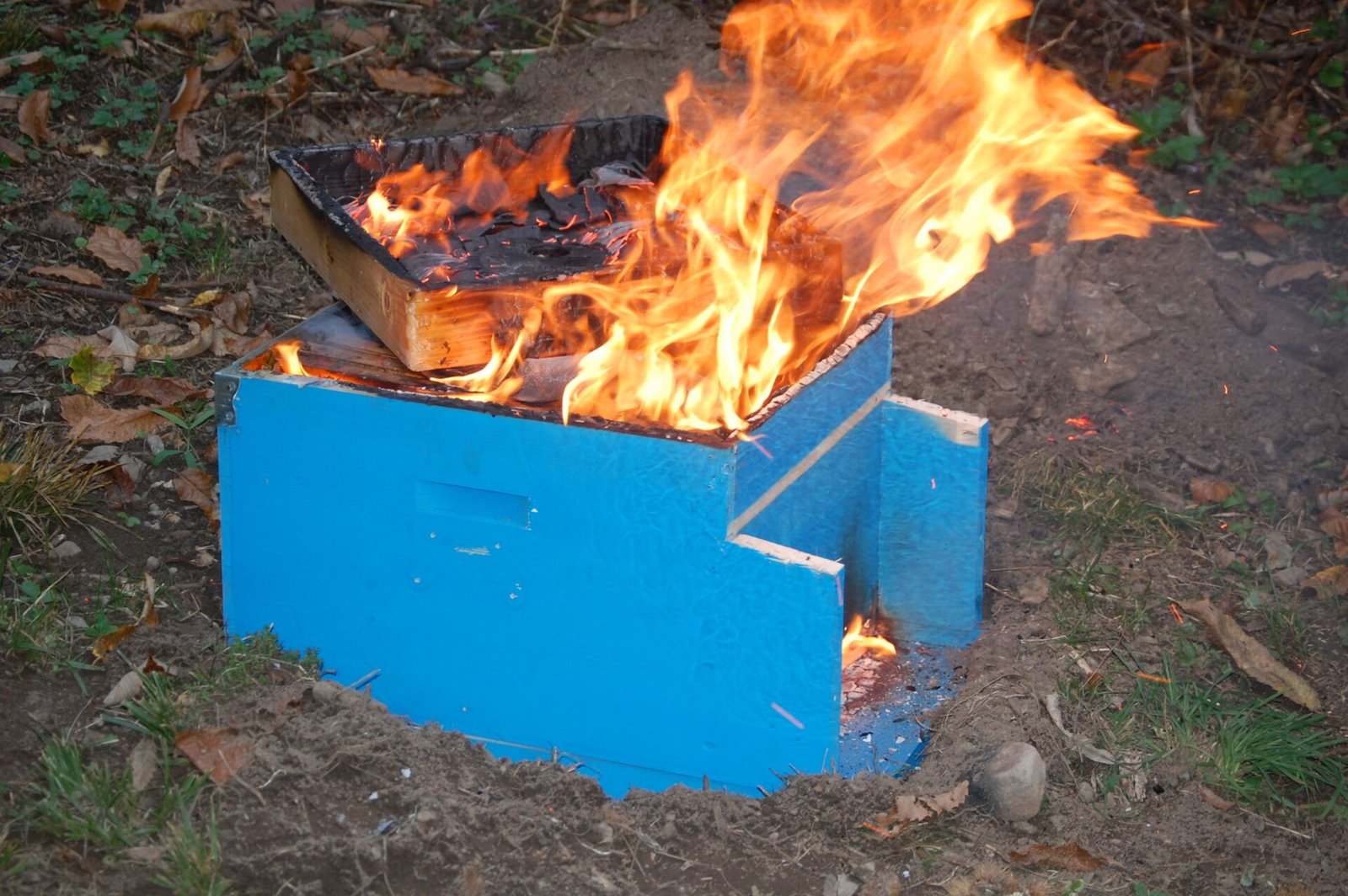
To disinfect wooden hive equipment after disease, scrape every surface down to bare wood first. Then treat it at the level the disease demands. After American foulbrood (AFB), scorch the inside of each box, bottom board and cover until the wood turns an even coffee-brown, including the corners. The alternatives are a 30-minute soak in 0.5% sodium hypochlorite, a 10-minute dip in paraffin wax at 160°C (320°F), or a boil in lye. Frames and comb from an AFB or EFB colony don’t get disinfected at all. They get burned. For chalkbrood, Nosema, viruses and deadouts from mites or starvation, careful scraping plus a hot washing-soda scrub or a light scorch is enough.
This guide covers boxes, bottom boards, covers and other woodenware only. For metal hive tools, see our guide to disinfecting hive tools after disease. For deciding which frames from a dead colony are worth keeping, see reusing frames from a dead colony.
Key Takeaways
- Scraping is part of disinfection, not optional prep. Propolis and wax shield pathogens from both flame and bleach.
- After AFB, the standard options for wooden boxes are scorching, 0.5% bleach for 30 minutes, paraffin dipping at 160°C for 10 minutes, or boiling in lye. Frames, comb and honey are burned.
- Scorching treats only the surface. It’s the most accessible method, but it’s also the easiest to do badly in corners, joints and cracks.
- Freezing and acetic acid kill wax moth, and acetic acid also handles chalkbrood and Nosema on comb. Neither touches AFB spores.
- Burn any woodenware that’s rotten, split or impossible to scrape clean. It can’t be disinfected reliably.
- In North Dakota, AFB is a regulated disease. Contact the Department of Agriculture’s apiary program before you burn or reuse anything.
Table of Contents
Match the Method to the Disease
How much disinfection you need depends on the pathogen. Most honey bee pathogens die once they’re exposed. American foulbrood is the exception: Paenibacillus larvae forms spores that survive drying, heat and most household cleaners. Penn State Extension’s American foulbrood fact sheet notes that spores can stay dormant in used equipment for 70 years or more. So a box from an AFB colony is a risk until it’s properly treated, however old it is.
| Cause | Boxes, bottom boards, covers | Frames and comb |
|---|---|---|
| American foulbrood (confirmed or suspected) | Scrape, then scorch, 0.5% bleach for 30 min, paraffin dip, or lye boil. Burn if damaged. | Burn frames, comb and honey |
| European foulbrood | Scrape, then scorch or 0.5% bleach | Burn brood frames (UK National Bee Unit guidance) |
| Chalkbrood, Nosema | Scrape, then soda scrub or light scorch | Replace old brood comb; acetic acid fumigation for comb you keep |
| Viruses, varroa collapse | Scrape, then soda scrub | Reuse clean comb after inspection |
| Starvation, cold, queen failure | Scrape and dry | Reuse; freeze first to kill wax moth |
If you haven’t confirmed which disease you’re dealing with, treat the equipment at the AFB level until you know. Our comparison of American vs. European foulbrood covers the field signs. A rope test or a lateral-flow kit will give you an answer in the field.
Step 1: Scrape to Bare Wood
Neither flame nor bleach works well through propolis and wax. Wax insulates spores from a quick pass of flame, and organic matter uses up bleach before it reaches the wood. The UK National Bee Unit’s fact sheet Disinfecting a hive after disease (updated September 2026) sets out the order:
- Freeze first if wax moth is present. The NBU suggests -20°C (-4°F) for at least 24 hours. That deals with pests only. It’s not disinfection.
- Work over cardboard or newspaper. Scrape inside an upturned roof or on sheets you can burn afterwards. Every flake of propolis from an AFB box can carry spores.
- Scrape walls, corners and frame rests hard. The NBU singles out internal corners and frame runners as the places pathogens hide. Consider pulling metal frame rests and fitting new ones. Remove any plastic parts before scorching.
- Scrape bottom boards and covers the same way. The bottom board collects debris, dead brood and scale from the whole colony, so it’s often the dirtiest piece.
- Burn the scrapings and disinfect the scraper. Our guide to disinfecting hive tools after disease covers the tool itself.
Scrape when it’s cold if you can. Propolis is brittle in the cold and chips off. On a warm day it smears.
Step 2: Scorching Wooden Boxes
Scorching is the method most small-scale beekeepers use, because it needs only a propane torch and a stable, non-flammable surface. It’s suitable for wood only, never for plastic or polystyrene hives.
“Light the blowtorch and scorch the timber until it darkens to a uniform coffee-brown colour.”
UK National Bee Unit, “Disinfecting a hive after disease” fact sheet
Penn State Extension gives the same target in US terms: burn the surface until it is light brown, and include the corners. Some practical points:
- Brown, not black. You’re heating the surface enough to boil off propolis and kill what’s on it, not burning the box. Charring weakens thin walls and handholds.
- Corners, joints and frame rests take the longest. Use the tip of the blue flame and go slowly. Most of the risk that survives scorching sits in those places.
- Inside surfaces are what matter. The outside of the box was never in contact with brood. Scorching the painted exterior only damages the paint.
- Keep a bucket of water beside you. Scorched wood can smolder unseen in a crack. Douse any glow before you stack boxes.
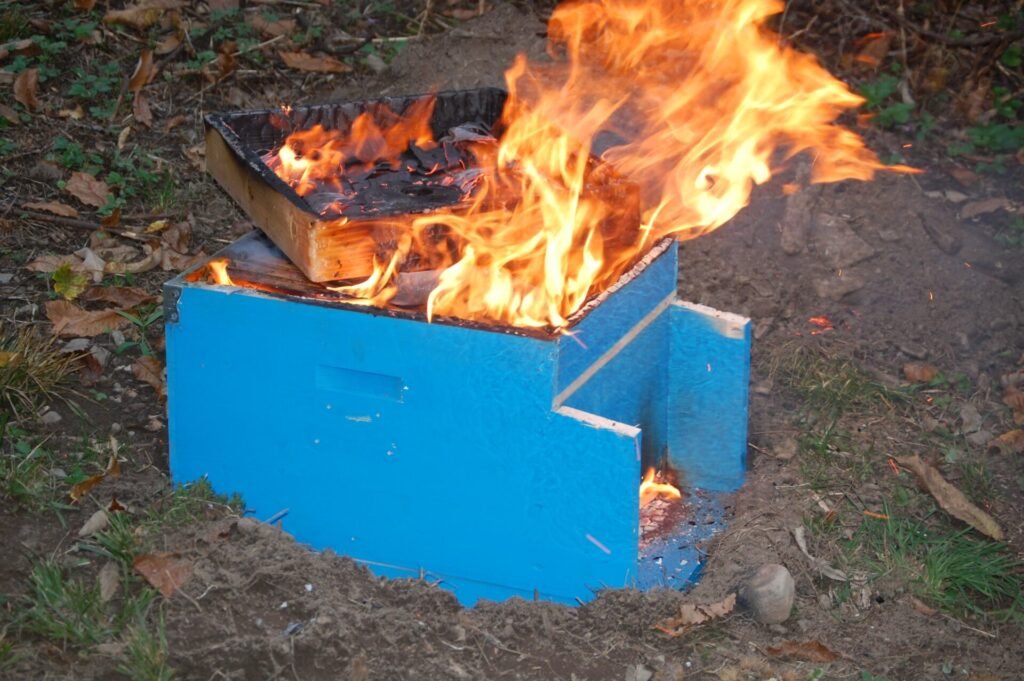
For a large amount of equipment, Penn State describes stacking supers five to eight high and setting the stack alight just long enough to lightly char the interior. The Honey Bee Health Coalition’s foulbrood guide says to work with state apiary officials and the local fire marshal before burning equipment. That applies to a scorching stack too.
Scorching’s weakness is that it treats the surface only. It won’t reach deep into a split or a gapped joint. New Zealand, which runs a national AFB elimination program, specifies paraffin wax dipping for wooden hive parts instead (see below). Scorch carefully, and burn any box with cracks you can’t get the flame into.
Bleach, Lye and Wax Dipping
Bleach at 0.5% sodium hypochlorite
The NBU states that research has shown immersion for 20 minutes in 0.5% sodium hypochlorite kills AFB spores. It recommends about 30 minutes of contact for each hive surface. For a box, set it in a shallow tray such as a potting tray, soak one wall at a time, and rotate. Mix the solution in cool water, because heat breaks hypochlorite down. Afterwards, rinse well with hot water and let the wood dry completely before bees go back in. US bleach strengths vary between brands, so check the label percentage. Our hive tool guide has a dilution table for common US bottle strengths.
Bleach is the only reliable home option for plastic and polystyrene hives. For wood, it works, but only on a surface that’s been scraped properly. It also leaves the wood wet for days, which is a problem in a cold garage. For the trade-offs between the two main methods, see bleach vs. flame sterilization.
Boiling in lye
Penn State gives the recipe as 1 pound of lye (sodium hydroxide) in 10 gallons of water, with the equipment boiled for 20 minutes. It penetrates better than a torch, but boiling caustic solution in a tank big enough for a deep box is dangerous. It needs chemical-resistant gloves, face protection and a setup most hobbyists don’t have. It also strips paint.
Paraffin wax dipping
Mark Goodwin and Cliff Van Eaton’s manual for New Zealand’s AFB program, Elimination of American Foulbrood Without the Use of Drugs, specifies dipping non-plastic hive parts in paraffin wax at 160°C for at least 10 minutes. It stresses that both time and temperature are critical, so you need a thermometer and a timer. The hot wax drives moisture out of the wood and soaks in, which also preserves the timber. It’s the most thorough method for woodenware. It’s also a real fire and burn hazard, so it’s a job for an established dipping setup, not a kitchen stove.
Gamma irradiation
The Honey Bee Health Coalition lists gamma irradiation as an option, but notes that few facilities will accept bee equipment and it isn’t cost-effective. For most beekeepers in our region it isn’t a practical choice.
Methods That Don’t Kill AFB Spores
- Freezing. It kills wax moth and small hive beetle stages. It does nothing to bacterial spores.
- Acetic acid fumigation. According to the NBU, it’s effective against chalkbrood and Nosema apis, and it kills wax moth. It does not work against AFB, EFB or viruses.
- Washing soda alone. A hot soda scrub is excellent for cleaning and for non-spore diseases. It isn’t an AFB treatment unless it’s followed by bleach or flame.
- Pressure washing, sun and time. These remove debris, but spores that survive decades in storage won’t be killed by a season in the sun.
- Antibiotics. They don’t treat equipment, and the Honey Bee Health Coalition notes they only mask AFB symptoms in a colony.
When to Burn Instead
Some items can’t be disinfected reliably, or cost less to replace than to treat:
- All frames, comb and honey from an AFB colony. Penn State and the Honey Bee Health Coalition both call for burning and burying them. Our guide to burning comb after American foulbrood covers how to do it.
- Brood frames from an EFB colony. The NBU says brood frames that have been in contact with AFB or EFB should be burned, not reused.
- Zinc slotted queen excluders after either foulbrood, per the NBU.
- Boxes you can’t clean. This includes rotten or soft wood, split corners, open finger joints, and boxes so heavily propolized that scraping won’t reach bare wood.
- Cheap wooden parts. Entrance reducers, cleats and worn-out inner covers are rarely worth the risk.
In North Dakota, the state’s apiary rules (N.D. Admin. Code 7-02-02-00.2) require colonies with American foulbrood to be treated with an approved antibiotic or destroyed. Before burning or reusing anything, call the North Dakota Department of Agriculture’s apiary program. In Minnesota or elsewhere, start with your state department of agriculture. Check county burn restrictions as well. Open burning is restricted during dry, windy spells on the plains.
Doing This in a Northern Climate
In eastern North Dakota and western Minnesota, most diseased or dead equipment turns up at the worst time for this work: late fall or early spring, when it’s too cold to rinse and dry bleached wood outdoors, and when wind makes a torch hard to control. A workable sequence:
- Step 1: Close it up immediately. The day you suspect disease, close the entrance so robbers can’t carry spores to other colonies. Our deadout cleanup guide explains why that first day matters.
- Step 2: Isolate and label. Stack suspect equipment bee-tight, well away from your apiary, and mark it clearly. See how to label quarantined hives.
- Step 3: Burn frames and comb when conditions and permission allow. Don’t let infected comb sit where bees or wax moths can reach it.
- Step 4: Scrape in the cold, scorch on a calm day. Winter is good for scraping. Wait for a still day above freezing for scorching or bleach.
- Step 5: Reassemble with new frames and foundation. Put the treated boxes back into service in spring. Check that colony’s brood closely through the first season.
If disease has already appeared in one yard, the same care applies to everything moving between yards. Our guides on preventing disease spread between apiaries and the used equipment quarantine checklist cover the rest of the process.
In New Zealand these steps are set by law; see New Zealand's AFB pest management rules.
Frequently Asked Questions
Can wooden hive boxes be reused after American foulbrood?
Often, yes, if they’re sound and properly treated. That means scraping to bare wood, then scorching, bleaching at 0.5% for 30 minutes, paraffin dipping or boiling in lye. Frames, comb and honey from the colony can’t be reused. Check with your state apiary program first. In North Dakota, AFB is a regulated disease.
How brown should I scorch a hive box?
An even coffee-brown or light brown on every inside surface, including the corners and frame rests. You don’t need to char it black. Heavy charring weakens the wood and isn’t more effective than even browning.
Can I use bleach on wooden hive boxes?
Yes. The UK National Bee Unit recommends about 30 minutes of contact with 0.5% sodium hypochlorite per surface, after thorough scraping. Rinse with hot water and let the wood dry completely before reuse. On plastic or polystyrene hives, bleach is the right method and scorching isn’t.
Does freezing sterilize hive equipment?
No. Freezing kills wax moth and small hive beetle stages but not bacterial spores or other pathogens. Use it as a pest step before cleaning, not as disinfection.
Do I need to disinfect boxes from a colony that died of varroa or starvation?
Not to the AFB standard. Scrape off debris and dead bees, check the brood comb for any sign of foulbrood, and make sure everything is dry. Freeze the comb you keep to kill wax moth.
Should I burn the whole hive after AFB?
Burn the frames, comb, honey and bees, and any wooden parts that are rotten, cracked or can’t be scraped clean. Sound boxes, bottom boards and covers can usually be kept once they’ve been properly treated, if your state apiary program agrees.
The Bottom Line
Disinfecting wooden hive equipment comes down to three things: scrape to bare wood, match the method to the disease, and be honest about what can’t be saved. After American foulbrood, a careful coffee-brown scorch or a 30-minute 0.5% bleach soak makes sound boxes reusable, and paraffin dipping is more thorough if you have access to it. Frames and comb go on the fire. For anything short of foulbrood, a hard scrape and a soda wash usually do the job.