Reviewed by Michael R. · Last Updated September 27, 2026 · How we review
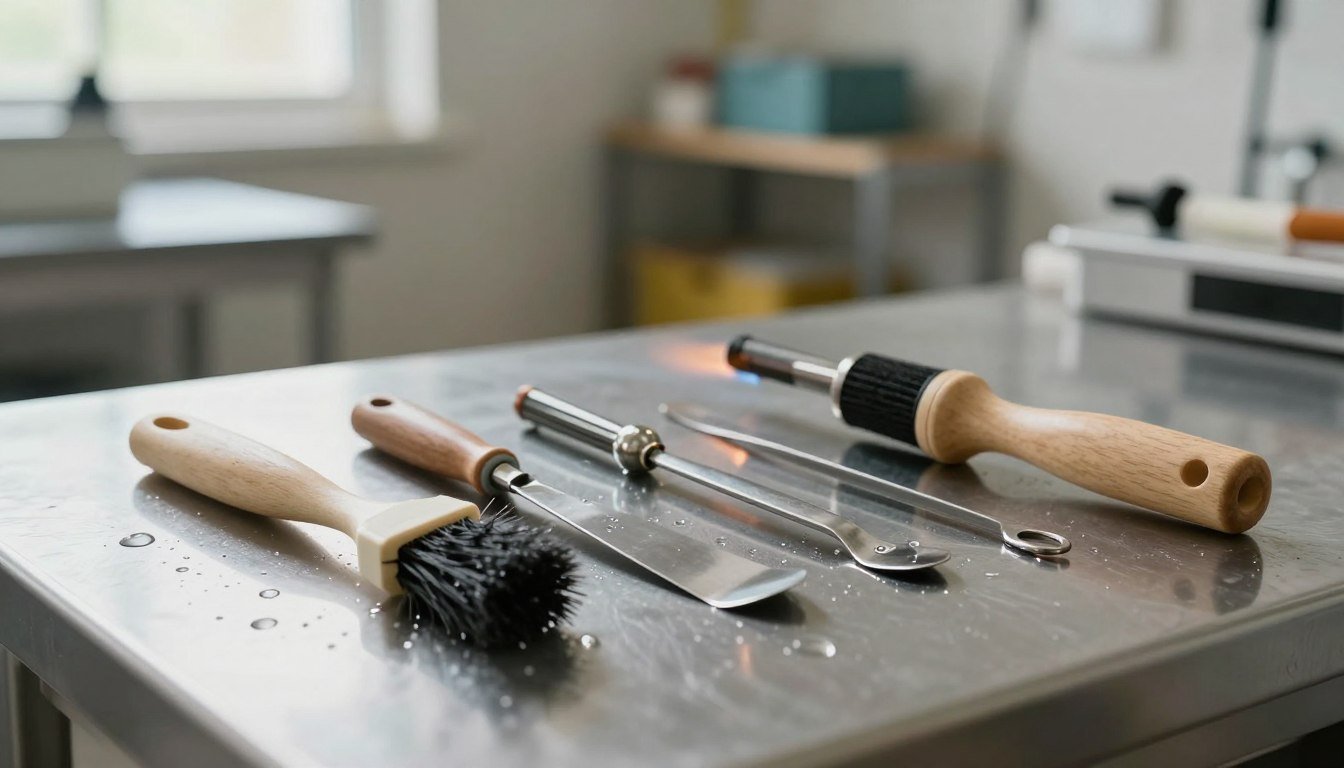
Both bleach and flame can sterilize a hive tool, but only once it has been scraped down to bare metal, and each suits a different job. A 20- to 30-minute soak in 0.5% sodium hypochlorite is the method with published evidence against American foulbrood (AFB) spores. It is the better choice after disease and for tools with plastic or wooden handles. Flame is faster and leaves no residue, so it suits all-metal tools in the field, but only if the whole working surface gets properly hot. Repeated red heat can also soften the steel. For routine work between healthy colonies, you need neither: a soda-and-bleach bucket does the job.
This page compares the two methods side by side. For the full step-by-step after a disease diagnosis, see our guide to disinfecting hive tools after disease.
Key Takeaways
- Scrape first. Neither bleach nor flame works reliably through wax and propolis.
- The UK National Bee Unit (NBU) cites research showing 20 minutes in 0.5% sodium hypochlorite kills AFB spores. That is the best-documented method.
- Flame is quick and residue-free on bare steel. It can’t be used on plastic-coated or wooden handles, and a quick pass isn’t enough.
- Putting a hive tool in your smoker is not an effective way to disinfect it, according to the NBU.
- Bleach corrodes carbon steel, and repeated high heat softens it. Rinse, dry and oil after either one.
Table of Contents
Which to Use, by Situation
| Situation | Best choice | Why |
|---|---|---|
| Between healthy colonies in one yard | Neither: scrape, then a soda-and-bleach bucket | Routine hygiene; keeps several tools rotating |
| Between yards | Bleach soak, or flame on an all-metal tool | Stops carrying anything to a new yard |
| After European foulbrood, chalkbrood or viruses | Soda-and-bleach soak, 20 minutes or more | The NBU recipe is enough for non-spore diseases |
| After suspected or confirmed AFB | 0.5% bleach for 20 to 30 minutes; flame as an alternative on bare steel | Bleach at this strength has research support against spores |
| Tool with a rubber, plastic or wooden grip | Bleach only | A torch will melt or char the handle |
| Deeply pitted or rusted tool after AFB | Replace it | Neither method reliably reaches residue in pits |
The routine bucket is the NBU’s inspector recipe: 1 kg of soda crystals (washing soda) in 4.5 liters of water with 150 ml of 4.5% bleach, for about 0.125% sodium hypochlorite. According to the NBU’s apiary hygiene fact sheet, that kills the bacteria behind EFB if tools soak for at least 20 minutes, and stays effective for 24 hours. In the yard, that means a lidded bucket of the mix, a stainless-steel pan scourer to lift propolis (the NBU’s own suggestion), and two or three hive tools so one is always soaking. Keep a separate lidded bucket for scraped brace comb, too: the same fact sheet warns that open containers holding traces of honey attract robbing bees. If you wear washing-up gloves rather than disposable nitrile, the NBU says they can go through the same soda solution between colonies along with the tool.
Bleach vs Flame: Head to Head
| Factor | Bleach (0.5% soak) | Flame (propane torch) |
|---|---|---|
| Evidence against AFB spores | Research-backed at 0.5% for 20 minutes (NBU) | Widely used, but no published time or temperature standard for hive tools |
| Time per tool | 20 to 30 minutes, plus rinse and dry | A few minutes of steady heating |
| Field practicality | Needs a lidded bucket and spare tools | Needs a torch, fuel and a safe surface |
| Handles and coatings | Safe for most plastics and rubber | All-metal tools only |
| Effect on the steel | Corrodes carbon steel if left wet | Repeated red heat can soften hardened steel |
| Residue | Must be rinsed off | None |
| Main hazard | Skin, eyes and fumes; never mix with ammonia or acids | Burns and grass fires |
| Running cost | A few cents per batch | Propane |
What the Evidence Says About Bleach
The NBU’s fact sheet on disinfecting a hive after disease states that research has shown 20 minutes’ immersion in 0.5% sodium hypochlorite kills AFB spores and other bacteria. It recommends about 30 minutes of contact for equipment surfaces. Three practical limits come with that result:
- Organic matter uses it up. The CDC’s guidance on chemical disinfectants lists inactivation by organic matter as a disadvantage of hypochlorite. Propolis and wax left on the tool protect spores and use up the chlorine.
- Heat breaks it down. The NBU notes that bleach is less effective in hot water because sodium hypochlorite decomposes faster when heated. Mix in cool water, then rinse with hot.
- It loses strength over time. The CDC notes diluted hypochlorite in closed containers can lose up to 40 to 50% of its available chlorine over a month. Mix a fresh batch for each job.
US bleach is stronger than the NBU’s 3 to 5% figures. With 8.25% “concentrated” bleach, about 1 cup topped up to 1 gallon with cool water gives roughly 0.5%. Our tool disinfection guide has a dilution table for other label strengths. The same 0.5% soak is what the NBU recommends for plastic hive parts and polystyrene boxes. For wooden boxes, see disinfecting wooden hive equipment after disease.
What the Evidence Says About Flame
Flame has less formal backing for hive tools than most beekeepers assume. The NBU gives scorching instructions for wooden boxes and wire queen excluders: heat until the wood is an even coffee-brown and any remaining propolis boils off. It gives no equivalent standard for hive tools. What it does say is clear about one popular shortcut:
“Placing a hive tool in the smoker to disinfect it is not an effective method for getting rid of microorganisms.”
A tool resting in smoldering fuel doesn’t reach an even, reliable temperature. A propane torch, used properly, does. Scrape first, then heat both faces, the edges and both ends until any remaining residue has burned off and the whole working surface is uniformly hot, not just where the flame touched.
Flame’s real advantage is speed in the yard. Its drawback is the tool. Most quality hive tools are made from hardened, tempered steel so they can pry without bending. Heating hardened steel beyond the temperature it was tempered at softens it. Bringing it to red heat again and again and letting it cool slowly anneals it and makes it softer still. You’ll notice this as a tool that bends when you pry apart stuck boxes. Keep the flame moving and don’t hold any spot at a glow.
In eastern North Dakota, spring and fall yards are often dry grass. The state’s burn restrictions and fire danger ratings change daily and by county. On high fire-danger days, do flame work on gravel or at home, and keep water on hand, as the NBU advises when scorching.
A Routine That Uses Both
Most beekeepers don’t need to pick one method forever. A simple season-long routine uses each where it is strongest:
| When | What to do | Time needed |
|---|---|---|
| During an inspection, between colonies | Scrape the tool, drop it in the soda-and-bleach bucket, pick up the next clean tool | Seconds |
| Leaving a yard | Scrape all tools; torch the all-metal ones, or bag them for a bleach soak at home | 5 minutes |
| End of the day | Scrub in hot soda solution, soak 20 minutes in fresh 0.5% bleach, rinse, dry, oil | 30 minutes, mostly waiting |
| After a suspect or diseased colony | Treat that tool at the AFB level before it touches another hive, or keep it with that hive | 30 minutes |
| End of season | Check every tool for pitting and bends; replace any you can’t get clean | 10 minutes |
Three or four inexpensive tools make this easy, because none has to be rushed out of a soak. If you keep a suspect colony in quarantine, give it its own tool, as described in our guide to quarantining a suspect diseased hive. And if you’re not sure whether a colony has AFB, the rope test is the quick field check that tells you which cleaning level you need.
Protecting the Tool From Either Method
- Scrape and scrub first. Hot soda solution and a stainless-steel scourer take propolis off faster than any disinfectant.
- Rinse bleach off completely with clean water. The CDC lists corrosion of metals at concentrations above 500 ppm as a hypochlorite disadvantage, and 0.5% is 5,000 ppm.
- Dry immediately and wipe carbon steel with a little food-grade mineral oil.
- Let flamed tools cool in air on a bare, non-flammable surface.
- Keep two or three tools in rotation so none has to be rushed out of a soak.
- Retire pitted tools. Pits hold residue that neither method reliably reaches.
Your smoker needs less attention than you might expect. The NBU notes that the barrel gets hot enough to kill pathogens on its own, so only the bellows need a scrub with washing-soda solution between apiary visits. That heat still doesn’t make the smoker a way to clean your hive tool, for the reason above.
A tool is only one route disease can take. See our guide to disinfecting gloves between inspections and the wider rules in preventing disease spread between apiaries.
Frequently Asked Questions
Is bleach or flame better for sterilizing a hive tool?
Bleach at 0.5% sodium hypochlorite for 20 to 30 minutes has the stronger published evidence against AFB spores and works on any handle. Flame is faster and residue-free but only suits all-metal tools. Both need a scraped, clean tool.
Does putting my hive tool in the smoker sterilize it?
No. The UK National Bee Unit states that placing a hive tool in the smoker is not an effective way to get rid of microorganisms. Use a proper bleach soak or a torch.
Will flaming a hive tool ruin the steel?
Occasional flaming won’t. Repeatedly heating it to a glow can soften the hardened steel over time, so the tool bends more easily. Keep the flame moving and let the tool cool in air.
Will bleach rust my hive tool?
It can if you leave it wet. Rinse the bleach off with clean water after soaking, dry the tool straight away, and wipe carbon steel with mineral oil.
What bleach strength kills American foulbrood spores?
0.5% sodium hypochlorite (5,000 ppm) for at least 20 minutes, according to the NBU. With 8.25% US bleach, that is roughly 1 cup made up to 1 gallon with cool water.
Can I use rubbing alcohol instead of bleach or flame?
For routine wipes between healthy colonies, alcohol is acceptable. But the CDC states that alcohols do not destroy bacterial spores, so after suspected AFB use 0.5% bleach or flame.
How should I clean my hive tool between colonies?
Scrape it, then use a bucket of washing soda solution with a little bleach and rotate two or three tools so each soaks for at least 20 minutes. Save full-strength bleach or flame for between yards and after disease.
The Bottom Line
Scrape first, then choose by situation. Use 0.5% bleach after disease and for any tool with a handle you can’t flame. Use a propane torch for quick, residue-free work on bare steel in the field. Skip the smoker. Replace a tool that is too pitted to clean.