Honeycomb candy gets its airy, bubble-filled structure from a genuine chemical reaction, not a trick of whipping or folding — and the same reason honey glazes scorch easily is exactly why honey needs careful handling in this recipe too. Known regionally as cinder toffee, sponge candy, hokey pokey, or seafoam candy, it’s one of the simplest candies to make and one of the easiest to ruin without understanding what’s actually happening in the pot.
Featured photo: cinder toffee, also called sponge or honeycomb toffee, broken into pieces showing the bubble structure this guide explains. Photo: Londonsista, public domain, via Wikimedia Commons.
Key Takeaways
- Honeycomb candy’s bubbles come from real chemistry: baking soda begins breaking down above about 176°F, releasing carbon dioxide gas that gets trapped in the molten sugar as it hardens.
- The sugar syrup needs to reach hard-crack stage — around 300°F (150°C) — before the baking soda goes in, or the candy won’t set with a crisp, glassy texture.
- Honey can replace some or all of the corn syrup in a honeycomb recipe (both prevent the sugar from crystallizing), but honey is more prone to scorching because of its fructose content — the same caramelization chemistry that makes honey glazes burn if applied too early.
- Despite the name, honeycomb candy contains no real honeycomb or beeswax — it’s named for its visual resemblance to a bee’s wax comb structure, not its ingredients.
- A collapsed or dense honeycomb almost always traces back to one of two things: too much or too little baking soda, or the sugar not reaching a high enough temperature before it went in.
Table of Contents
- What Honeycomb Candy Actually Is (and Isn’t)
- The Real Chemistry Behind the Bubbles
- Honey’s Actual Role in the Recipe
- How to Make Honeycomb Candy
- Troubleshooting Common Failures
- Why So Many Regional Names for the Same Candy
- Frequently Asked Questions
What Honeycomb Candy Actually Is (and Isn’t)
Honeycomb candy is a light, brittle candy made by adding baking soda to hot sugar syrup, which causes it to foam up into a porous, bubble-filled structure that hardens as it cools. Despite the name — and despite genuinely resembling the inside of a real honeycomb once broken into pieces — it has nothing to do with actual honeycomb or beeswax. The name comes entirely from the visual pattern of trapped air bubbles, not from any shared ingredient with the wax structure honeybees build. Anyone looking for the real thing — the wax comb bees actually produce, still filled with honey — is looking for cut comb or comb honey instead, which our comb honey vs. extracted honey guide covers in detail.
The candy goes by several other names depending on where it’s made and sold: cinder toffee and honeycomb toffee in the UK, sponge candy in parts of the northeastern US, seafoam candy in the Pacific Northwest, and hokey pokey in New Zealand and parts of Australia. Despite the different names, the underlying recipe and chemistry are the same candy wearing different regional labels.
The Real Chemistry Behind the Bubbles
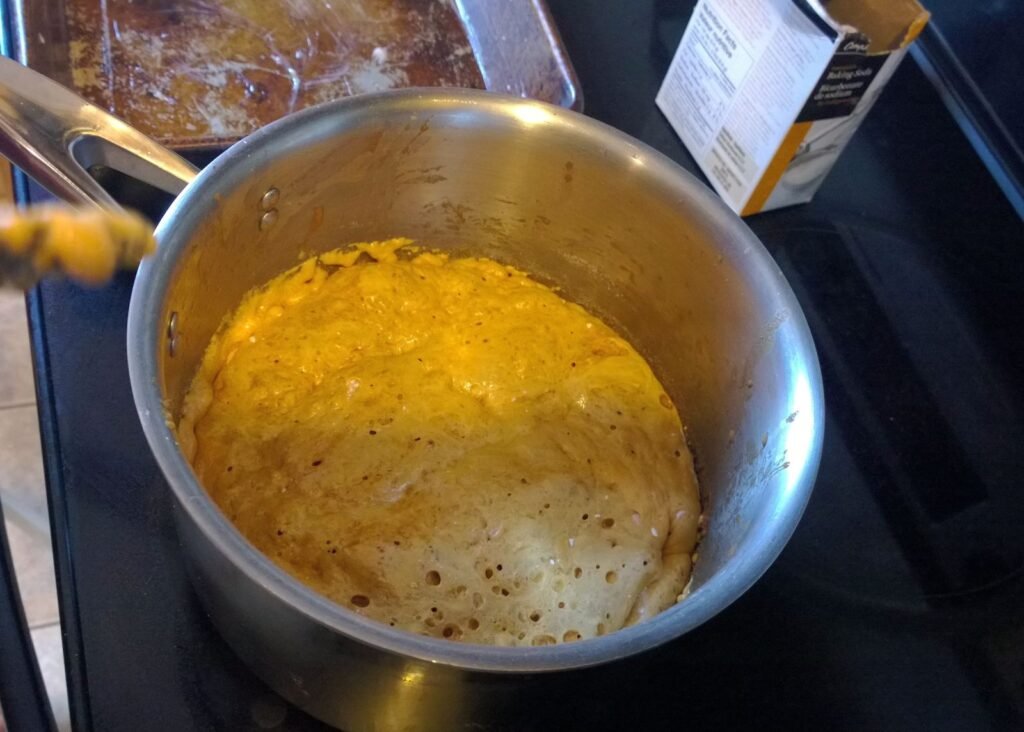
The bubbles aren’t whipped or folded in — they’re generated by an actual chemical reaction happening inside the hot sugar. Baking soda (sodium bicarbonate) begins thermally decomposing at around 176°F, breaking down into sodium carbonate, water vapor, and carbon dioxide gas — a reaction explained in detail by FoodCrumbles’ food-science breakdown of honeycomb candy. Because the sugar syrup it’s stirred into is already well above that temperature — typically around 300°F, or hard-crack stage — the reaction happens almost instantly and violently once the baking soda hits the pot, flooding the thick syrup with CO2 gas bubbles all at once rather than gradually.
Timing and syrup viscosity are what actually trap those bubbles in place rather than letting them simply escape. At hard-crack stage, the sugar syrup is thick and has lost most of its water content, so the CO2 gas gets caught in a matrix that’s already close to setting; by the time the mixture cools those few seconds later, the bubble structure is locked in permanently as a rigid, glassy solid. This is also why the syrup has to reach true hard-crack stage first — a syrup that’s too cool or too wet is more fluid, and the same gas release just bubbles up and escapes instead of getting trapped, leaving a denser, less airy candy.
Honey’s Actual Role in the Recipe
Plain sucrose (table sugar) crystallizes readily at the high concentrations a candy recipe cooks it down to, which would ruin the smooth, glassy texture honeycomb candy depends on. Corn syrup is the traditional fix, since its longer sugar chains physically interfere with sucrose crystal formation. Honey can do the same job — it’s a mix of fructose and glucose that similarly disrupts crystallization — and it adds a real flavor dimension a neutral corn syrup can’t.
The tradeoff is heat sensitivity. Honey’s fructose content makes it more prone to scorching than corn syrup at the same temperature — the identical caramelization chemistry covered in our guide to cooking with honey, where fructose begins caramelizing at a much lower temperature than plain sucrose. In a honeycomb recipe that has to reach a full 300°F, that means honey-based syrups need closer attention and slightly more conservative heat than a corn-syrup version to avoid a scorched, bitter batch. Golden syrup is a third option that behaves similarly to honey (both are partially inverted sugars) but tends to leave the finished candy a bit stickier in humid conditions.
How to Make Honeycomb Candy
The basic method is short and has very few steps, which is exactly why precision matters more than it would in a longer, more forgiving recipe:
- Combine sugar, corn syrup (or honey), and a small amount of water in a deep, heavy-bottomed pot — deep, because the mixture expands dramatically once the baking soda goes in.
- Cook over medium heat without stirring once the sugar dissolves, using a candy thermometer to track progress rather than guessing by color or time.
- Bring the syrup to hard-crack stage, about 300°F (150°C). This is the single most important checkpoint in the entire recipe — a syrup that’s under-temperature won’t trap the gas properly.
- Remove from heat immediately and whisk in baking soda (typically around 1–2 teaspoons per cup of sugar used, though exact ratios vary by recipe) as quickly and evenly as possible — the reaction starts the instant it touches the hot syrup.
- Pour immediately onto a lined baking sheet without spreading or pressing it down, which would knock out the trapped air. Let it cool undisturbed, ideally for at least an hour.
- Break into pieces once fully cooled and hardened. Store in an airtight container — honeycomb candy readily absorbs moisture from the air, which turns its crisp texture sticky and soft within hours if left uncovered.
Troubleshooting Common Failures
| Problem | Likely cause | Fix |
|---|---|---|
| Candy collapses or deflates | Too much baking soda, or the syrup wasn’t hot enough to hold the bubble structure | Use less baking soda next batch; confirm hard-crack stage (300°F) with a thermometer before adding it |
| Dense, few bubbles | Not enough baking soda, or it wasn’t mixed in quickly/evenly enough | Increase the baking soda slightly; whisk it in fast and fully as soon as the pot comes off heat |
| Sticky instead of crisp | Syrup didn’t reach full temperature, or the finished candy absorbed humidity during storage | Cook to a true 300°F; store in an airtight container immediately once fully cooled |
| Scorched, bitter flavor | Overheated syrup, especially in honey-based versions where fructose caramelizes at a lower temperature | Watch honey-based batches more closely near the end; pull at 300°F rather than pushing further |
| Won’t fully harden | Not enough moisture was cooked out of the syrup before the baking soda went in | Continue cooking a little longer at the proper temperature before removing from heat |
Why So Many Regional Names for the Same Candy
The proliferation of names — cinder toffee, sponge candy, seafoam, hokey pokey, honeycomb toffee — reflects independent regional candy-making traditions rather than one recipe spreading under different labels from a single source. The candy itself is old and simple enough (sugar, a crystallization inhibitor, and baking soda are all that’s required) that it’s plausible for very similar versions to have developed independently in different places, and each region kept its own name once industrial candy makers started selling it commercially. Chocolate-covered versions are common in several of these traditions, dipping the plain honeycomb pieces in melted chocolate once fully cooled — this both adds flavor and helps protect the moisture-sensitive candy underneath from going soft as quickly.
Frequently Asked Questions
Does honeycomb candy actually contain real honeycomb or beeswax?
No. The name refers only to its visual resemblance to a bee’s wax comb once broken into pieces — the bubble structure comes from a baking soda reaction in hot sugar syrup, not from any beeswax or honeycomb ingredient.
Why did my honeycomb candy collapse after I poured it out?
This is almost always too much baking soda relative to the amount of syrup, or the syrup not reaching a true hard-crack stage (300°F) before the baking soda was added. A candy thermometer, rather than judging by eye, is the most reliable fix.
Can I use honey instead of corn syrup in a honeycomb recipe?
Yes — honey performs the same anti-crystallization function as corn syrup. It’s more prone to scorching due to its fructose content, so watch a honey-based batch more closely as it approaches 300°F rather than leaving it unattended.
Why does my honeycomb candy go soft and sticky after a day?
Honeycomb candy is highly hygroscopic — it readily absorbs moisture from the air. Storing it in a truly airtight container immediately after it fully cools is the main defense; in humid climates, it may still soften faster than in a dry climate regardless of storage.
What’s the difference between honeycomb candy and actual comb honey?
They’re completely different things that happen to share a name. Honeycomb candy is a sugar-and-baking-soda confection with no bee involvement at all; comb honey is the real wax honeycomb bees build, still filled with honey, that beekeepers harvest and sell intact.
Do I need a candy thermometer to make this successfully?
Realistically, yes. Hitting hard-crack stage (about 300°F/150°C) accurately is the single biggest factor separating a properly airy, crisp honeycomb from a collapsed or dense one, and that’s very difficult to judge reliably by color or time alone.