Reviewed by Elena P. · How we review
Japanese knotweed honey is a dark, red-tinged fall honey that tastes like a milder buckwheat honey, made from the late-summer flowers of an invasive plant that several states and provinces regulate as a noxious weed. Northeastern beekeepers often sell it as bamboo honey. Labels that lean on the plant’s resveratrol overstate what is in the jar.
We write from eastern North Dakota, where knotweed is not on the state’s 13-species noxious weed list. Across the Red River, Minnesota has listed it as a prohibited-control noxious weed since 2014, and Manitoba requires landowners to destroy it. So we treat it as a honey to buy, never a plant to grow.
Key Takeaways
- Expect a dark, reddish honey, softer than buckwheat, sometimes with a minty finish.
- Lab samples ran wet, 17.4% to 21.0% moisture, so check ripeness before extracting.
- Resveratrol reaches the honey only in traces: at most 1.69 mg per kilogram in a 2024 study.
- Never plant knotweed for forage. Minnesota and Manitoba regulate it.
In this five-minute 2015 video, Geoff MacLean of Red Brook Honey in southern Maine films bees working knotweed. He says his crimson-red knotweed honey won a blue ribbon at the Maine State Beekeepers Association’s 2014 blind tasting and that the bloom runs from late August into early September.
Taste, Color and the “Bamboo Honey” Name
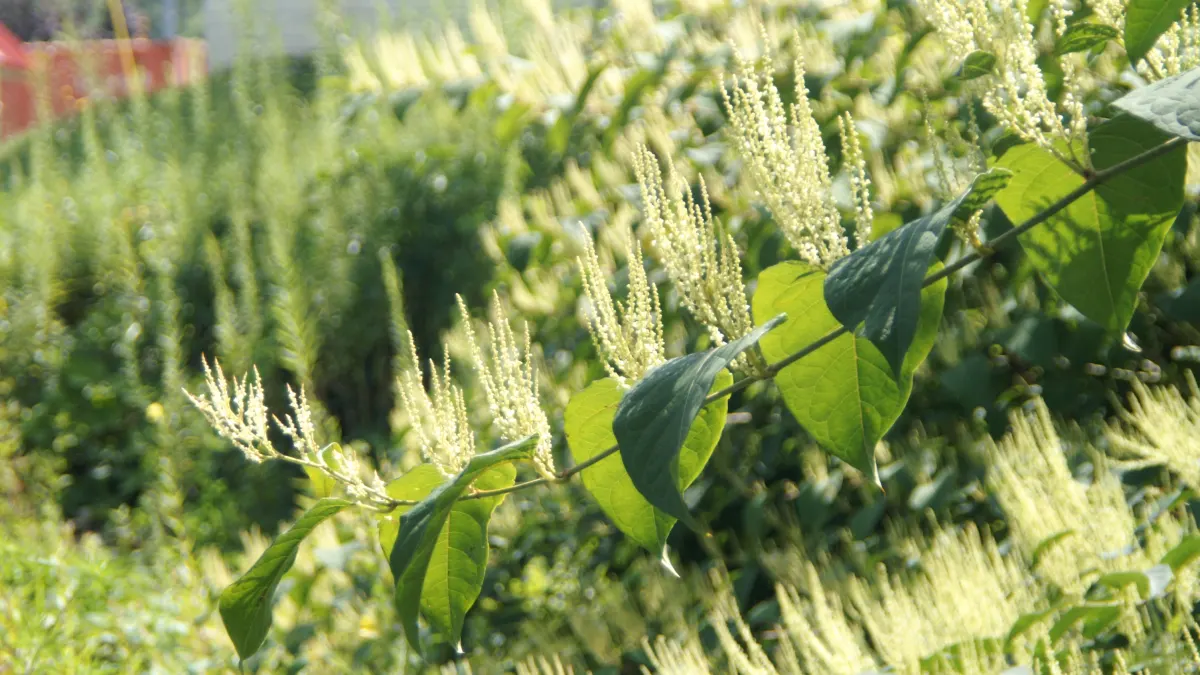
The nickname comes from the hollow, jointed, reddish stems, though the plant belongs to the buckwheat family. Cornell’s Dyce Lab for Honey Bee Studies calls it “a dark red, flavorful honey that is often a best seller at farmers markets.” Most tasters find it less sharp than buckwheat honey. A lab tasting panel in Cluj-Napoca, Romania, described:
“…a medium sweet taste, with a metallic and refreshing aftertaste of fresh mint.”
What the Lab Numbers Show
The only American analysis we found is sample 69 in the USDA’s Composition of American Honeys (Technical Bulletin 1261, 1962), filed as “Japanese bamboo.” It came off a Gainesville, Florida, hive on December 1, 1956, labeled Polygonum sachalinense, the name for giant knotweed. It graded Extra Light Amber, far paler than modern descriptions, so it may have been a blend. Fuller data come from nine Romanian knotweed honeys made in September 2022.
| Measurement | Romanian knotweed honey (9 samples) | USDA “Japanese bamboo” (1 sample) | USDA average (490 U.S. honeys) |
|---|---|---|---|
| Color | Brown-caramel, reddish-brown shades | Extra Light Amber (light half) | White (dark half) |
| Glucose | 28.06 to 37.79% | 29.27% | 31.28% |
| Moisture | 17.4 to 21.0% | 19.1% | 17.2% |
| Crystallization | Fine crystals in almost all samples | Few scattered crystals after 6 months | Few clumps of crystals |
Sources: USDA Technical Bulletin 1261, Tables 1, 26 and 27 (codes per its legend; glucose listed as dextrose); Cucu et al., Foods (2024).
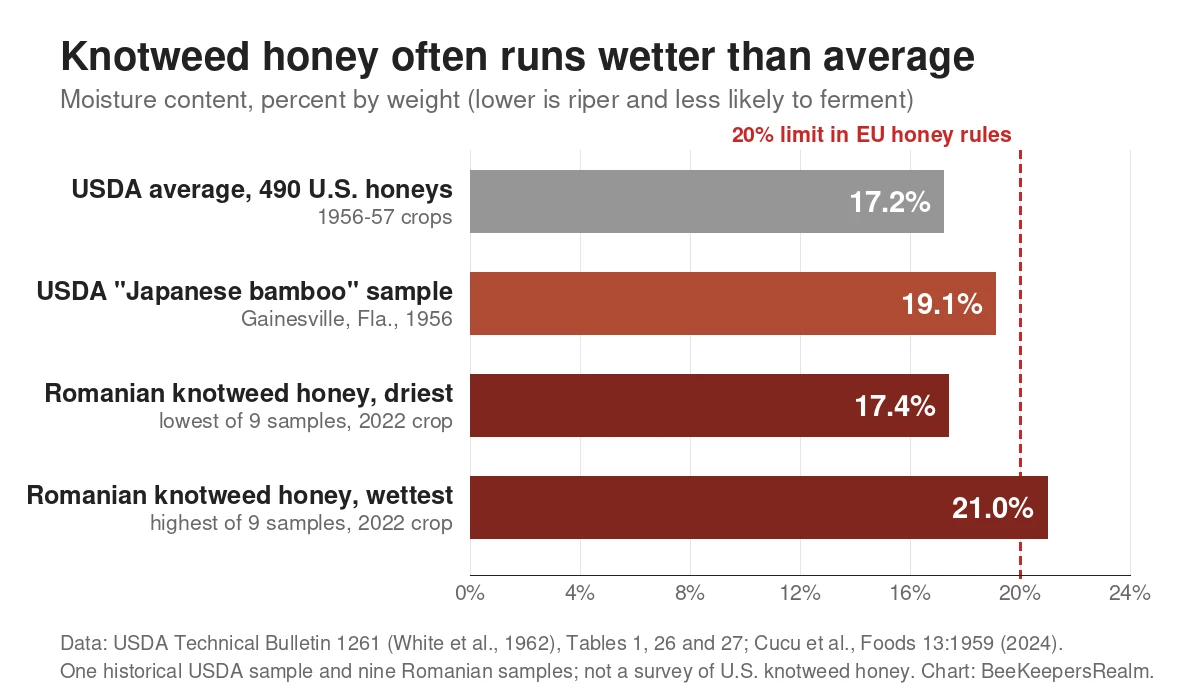
Two of the nine Romanian honeys topped 20% water. The flow comes late, so test frames with a refractometer before pulling supers; see our ripe honey moisture targets. Crystallization varies: the USDA sample’s glucose-to-water ratio was 1.53, below the 1.7 the bulletin links with honey that stays liquid, which is why some jars set and others don’t. Our explainer on why some honeys crystallize faster covers the ratio.
Is Knotweed Honey Good for You?
Educational information, not medical advice. Never give honey to a baby under one year old.
The Romanian honeys showed antioxidant activity similar to buckwheat honey in test-tube assays, and in a companion study they inhibited several bacteria in lab dishes. Neither shows an effect in people, and we found no human trial.
Resveratrol is real but tiny. The companion study found it in eight of nine honeys at 0.17 to 1.69 mg per kilogram, about 0.04 mg in a 21-gram tablespoon at the highest level. The same team measured 320 to 1,234 mg/kg in knotweed roots. Labels that borrow the root’s reputation describe the plant, not the honey.
Why Beekeepers Should Never Plant It
“All plant material should be removed and properly disposed of as new plants can sprout from very small fragments.”
Knotweed forms dense stands that crowd out native plants. Regulation differs sharply across the Red River Valley:
| Jurisdiction | Status of Japanese knotweed |
|---|---|
| North Dakota | Not on the 13-species state noxious weed list |
| Minnesota | Prohibited-control noxious weed since 2014; must be controlled to prevent spread |
| Manitoba | Tier 1 noxious weed province-wide; owners must destroy it (Noxious Weeds Act, s. 3(1)(a)) |
Checked October 3, 2026. Educational information, not legal advice; confirm with your state or provincial agriculture department.
For late-season forage, plant native asters and goldenrods instead; our list of fall-blooming flowers for bees has options.
Buying Knotweed Honey
Most listings we found came from small producers in New York, New England and Pennsylvania, at about $8 to $16 for a small jar. Origin is hard to prove: no pollen type passed 45% in any Romanian sample, and color proves little, as the pale USDA sample shows. Buy from a beekeeper who can say where the hives sat.
Frequently Asked Questions
Is knotweed honey good for you?
Its antioxidant activity matches buckwheat honey in lab tests, but no human study shows a specific health benefit.
What does Japanese knotweed honey taste like?
Like a milder buckwheat honey: dark and rich but less sharp, sometimes with a minty or metallic finish.
Why is it called bamboo honey?
Knotweed’s hollow, jointed stems look like bamboo. The plant is not a bamboo.
Does knotweed honey contain resveratrol?
Yes, in traces: 0.17 to 1.69 mg per kilogram in eight of nine samples in a 2024 study.
Should I plant Japanese knotweed for my bees?
No. It is a regulated noxious weed in many places and regrows from small fragments.