Reviewed by Daniel M. · How we review
Honey butter is softened butter beaten with honey and a pinch of salt, usually about one-third honey by weight. Any mild liquid honey works, it keeps best in the refrigerator, and it is not safe for babies under 1 year old. It is a dairy spread, not the dairy-free creamed honey that some sellers give the same name.
Key Takeaways
- Across eight published recipes, honey is 27% to 43% of the butter-plus-honey weight (our calculation). We start at 36%.
- Creamed (whipped) honey is honey only. Honey butter contains dairy.
- Honey choice is about flavor: the National Honey Board’s study found processing did not change nutrient or antioxidant content.
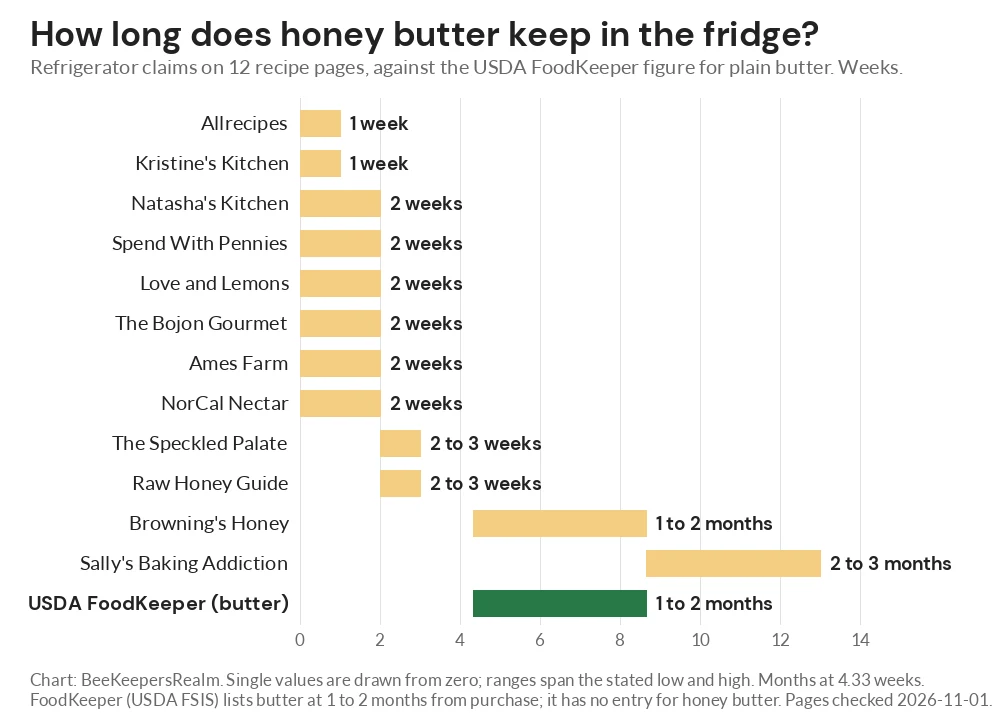
- Fridge claims on 12 recipe pages run from 1 week to 2 to 3 months, and none cites an agency. The USDA’s FoodKeeper has no honey butter entry, so we plan on 2 weeks.
- The CDC says not to give honey, or products made with it, to a child under 1 year old.
Table of Contents
- What Honey Butter Is, and What It Is Not
- How Much Honey to Add to Butter
- Which Honey to Use: Raw, Crystallized, Creamed or Mild Liquid
- Whipped, Stirred or Melted: Choosing a Texture
- How Long Honey Butter Keeps, and What the USDA Says
- Our Starting Recipe: 5-Minute Whipped Honey Butter
- Serving It for Thanksgiving and Holiday Baking
- Frequently Asked Questions
- The Bottom Line
What Honey Butter Is, and What It Is Not
Honey butter is a sweet compound butter: softened butter beaten with honey, usually with salt. It contains milk. Two other products share the name.
Creamed honey is honey and nothing else, crystallized on purpose so it spreads. The National Honey Board (NHB), an industry-funded body that calls itself an instrumentality of the USDA, puts it this way:
“While all honey will eventually crystallize, whipped honey is brought to the market in the crystallized form so that it can be spread like butter at room temperature.”
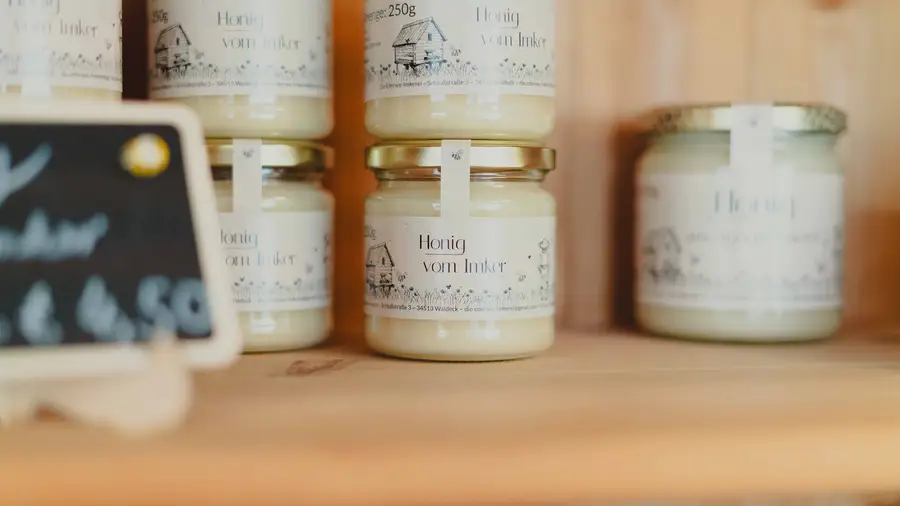
Our guide to creamed honey versus whipped honey covers how it is made and notes it is sometimes sold as “honey butter,” so check the label for butter or cream.
Store-bought spread is a third thing. Land O’Lakes Honey Butter Spread lists butter, sugar, canola oil, water and then honey, with 4 g of added sugars per 13 g tablespoon.
How Much Honey to Add to Butter
We converted eight popular recipes to weight, using the grams a recipe gave or USDA FoodData Central’s weights (butter 227 g per cup, honey 339 g per cup).
| Recipe | Butter | Honey | Honey share | Also in the bowl |
|---|---|---|---|---|
| Allrecipes | 3/4 cup | 1/4 cup | 33% | Nothing |
| Spend With Pennies | 3/4 cup | 1/4 cup | 33% | Vanilla, optional cinnamon |
| Sally’s Baking Addiction | 1 cup (226 g) | 1/3 cup (113 g) | 33% | Confectioners’ sugar, salt |
| Natasha’s Kitchen | 1/2 cup | 1/4 cup | 43% | Vanilla, optional cinnamon |
| The Bojon Gourmet | 8 tbsp (113 g) | 1/4 cup (84 g) | 43% | 1/4 tsp salt |
| Love and Lemons | 1/2 cup | 3 tbsp | 36% | 3/4 tsp sea salt |
| The Speckled Palate | 1/2 cup | 3 tbsp | 36% | 1 tsp kosher salt |
| Raw Honey Guide | 1/2 cup | 2 to 3 tbsp | 27% to 36% | Pinch of salt |
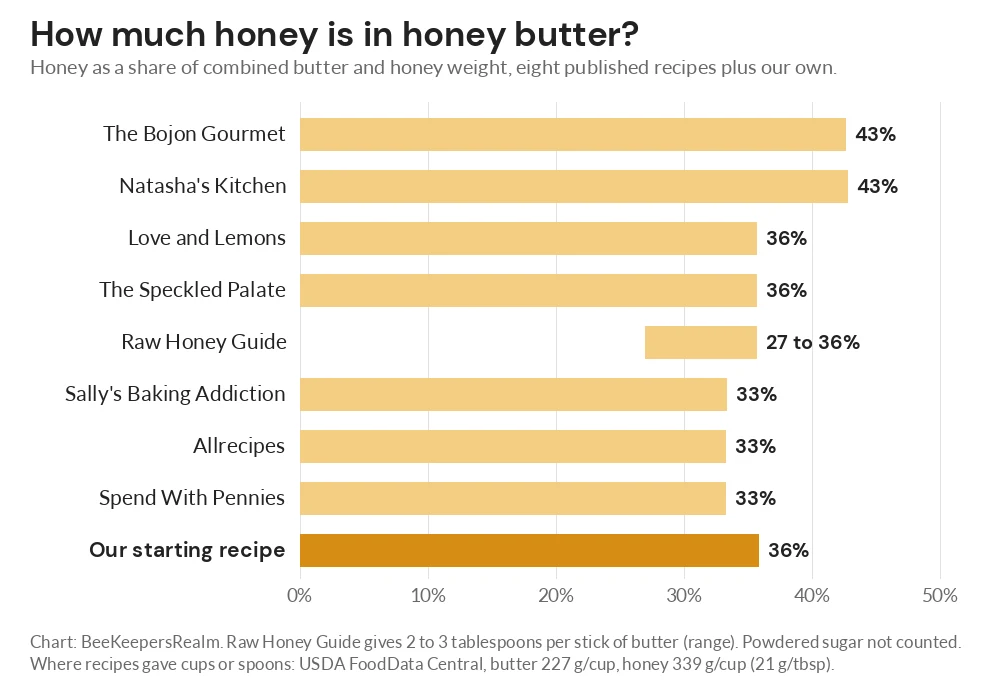
We start at 1/2 cup of butter to 3 tablespoons of honey, 36%, mid-range. A 15 g serving then holds about 5 g of honey and 4 g of carbohydrate by USDA data, close to the 4 g of sugars on the Land O’Lakes label.
In this 3 minute 54 second video, Karen Breyer of Cooking Lessons for Dad beats 1 cup of butter with 1/4 to 1/3 cup of honey and a pinch of salt, per the video description. Its chapters run from ingredients to a taste test on bread.
Which Honey to Use: Raw, Crystallized, Creamed or Mild Liquid
Most recipes say any honey works; Sally’s lists wildflower, clover, raw and tupelo. The NHB says light honey is generally milder and dark honey stronger (see 16 popular U.S. honey varieties). This table collects what published sources say, not our own tests.
| Honey | What sources say |
|---|---|
| Clover, wildflower | NHB: clover has a “pleasing, mild taste” and wildflower is “extremely versatile.” NorCal Nectar prefers them so the butter shows through. |
| Orange blossom | NHB: “pronounced orange aroma.” |
| Buckwheat | NHB: “marked molasses and malt flavors.” NorCal Nectar: a bolder, molasses-like spread. |
| Crystallized | NorCal Nectar: crystals mostly dissolve as you beat, leaving a slightly grainy texture; stand the jar in warm (not hot) water first for smooth butter. See how to reliquefy honey gently. |
| Creamed | Raw Honey Guide: mixes in without streaking. The Speckled Palate whips the honey first, then adds butter. |
Raw or pasteurized? The NHB’s FAQ says:
“While there is no official U.S. federal definition of “raw” honey, it generally means honey that has not been heated or filtered.”
An NHB study found processing cut pollen but “did not affect the nutrient content or antioxidant activity.” Honey butter never heats the honey, so raw keeps its flavor, but buy for taste, not nutrition. See raw vs. manuka vs. local honey and strained vs. filtered honey.
Whipped, Stirred or Melted: Choosing a Texture
Stirred versus whipped is mostly beating time, from 1 to 2 minutes (The Bojon Gourmet) to at least 5 (Sally’s). NorCal Nectar says whipped softens faster, so it suits the breakfast table, while unwhipped holds its shape better on hot corn. We found no test comparing them.
Melted is a way to serve it, not to mix it. Ames Farm warns that melted butter gives a greasy or runny result, and NorCal Nectar says melted edges will not whip back up. Start with softened butter, then let hot food melt it, as Natasha’s Kitchen suggests over warm banana bread. For heat, stir hot honey into softened butter.
How Long Honey Butter Keeps, and What the USDA Says
Recipe pages disagree. Of 12 we read, the refrigerator figure runs from 1 week to 2 to 3 months, and none cites a food-safety agency.
| Where | What recipe pages say | USDA FoodKeeper, plain butter |
|---|---|---|
| Counter | 2 hours while serving (NorCal Nectar) to 3 days (The Real Food Dietitians) | 1 to 2 days |
| Refrigerator | 1 week (Kristine’s Kitchen, Allrecipes) to 2 to 3 months (Sally’s) | 1 to 2 months, from purchase |
| Freezer | 2 months (Natasha’s Kitchen, Epicurean Butter) to 6 months (Sally’s) | 6 to 9 months, from purchase |
The FoodKeeper, the USDA Food Safety and Inspection Service’s storage guide, has no honey butter entry. It gives honey 2 years in the pantry, and the NHB’s FAQ says “for practical purposes, a shelf life of two years is often stated.” Our inference is that the butter is the perishable part; see how to store honey and whether honey expires.
Our rule is judgment, not an agency figure. Leave it out no more than 1 to 2 days, the FoodKeeper limit for butter. Refrigerate it covered for up to 2 weeks: ten of the twelve pages say 2 weeks or more, well inside butter’s 1 to 2 months. Freeze the rest. NorCal Nectar puts fresh garlic and herb versions at about 1 week.
Babies. The CDC is direct:
“Do not feed honey to a child who is younger than 1 year old.”
It extends that to “products made with” honey, which includes honey butter; see why honey is unsafe for infants. This is educational information from USDA, CDC and NHB pages, not medical advice.
Our Starting Recipe: 5-Minute Whipped Honey Butter
We built this from the ratios and methods above and have not test-made this exact batch, so treat times as estimates and taste before serving. It makes about 2/3 cup, roughly 10 to 12 tablespoon servings.
Ingredients
- 1/2 cup (113 g, 1 stick) unsalted butter, softened until a finger leaves a dent but it is not shiny or melted
- 3 tbsp (63 g) mild liquid honey, such as clover
- 1/4 tsp fine salt (skip it if you use salted butter)
Method
- Beat the butter alone for 1 to 2 minutes until smooth and pale.
- Add the honey and salt. Beat on medium-high for 2 to 3 minutes, scraping the bowl once, until light and fluffy. Taste, and add a teaspoon more honey if you want it sweeter.
- Spoon into a jar or roll into a log in parchment. Refrigerate, and take it out 15 to 20 minutes before serving.
For cinnamon honey butter, beat in 1/2 teaspoon of ground cinnamon; recipes range from 1/4 teaspoon (Natasha’s Kitchen) to 1 teaspoon (Raw Honey Guide) per half cup of butter. By our arithmetic from USDA FoodData Central values, 15 g of the plain version has about 85 calories, 5 g of saturated fat and 4 g of carbohydrate. It is not a lab analysis, and it is a treat, not a health food.
Serving It for Thanksgiving and Holiday Baking
Sally’s suggests biscuits, rolls, cornbread and pancakes, and Epicurean Butter adds dinner vegetables. If you bake the rolls with honey, see swapping honey for sugar.
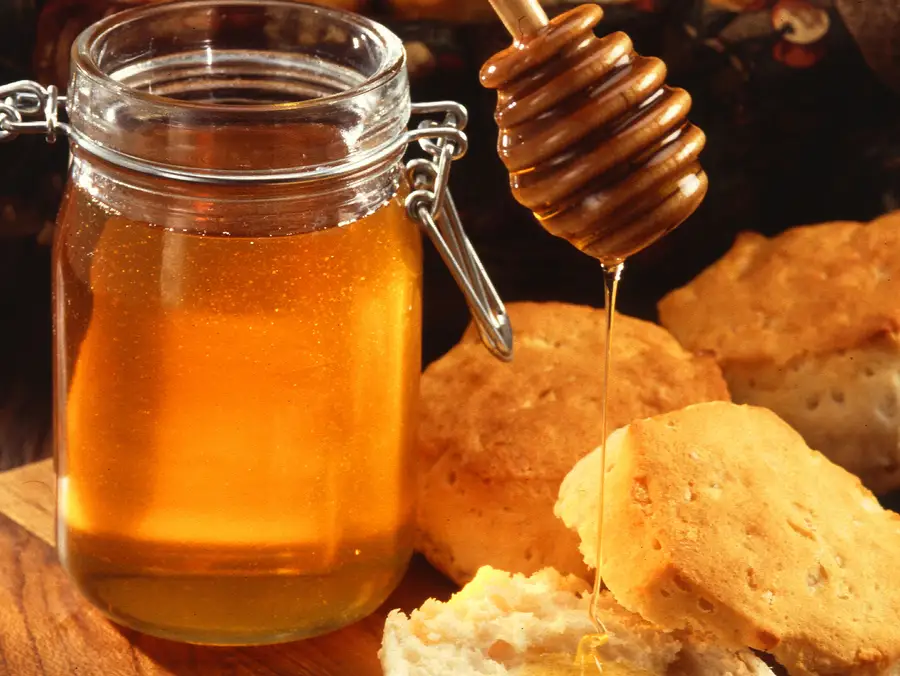
Make it ahead: six of the seven pages that give a freezer time say 2 to 3 months. NorCal Nectar rolls it into a log in parchment and slices coins straight from the freezer; Sally’s thaws it in the refrigerator first.
Frequently Asked Questions
What is honey butter?
Softened butter beaten with honey and usually salt, sometimes with vanilla or cinnamon. At its simplest it is just butter and honey, and it contains dairy.
How much honey do you add to butter?
Eight popular recipes use 27% to 43% honey by weight. We start with 3 tablespoons per stick of butter.
Should honey butter be refrigerated?
Yes, beyond a day or two. The FoodKeeper allows plain butter 1 to 2 days on the counter. We plan on 2 weeks in the refrigerator.
Can you make honey butter with salted butter?
Yes. The Real Food Dietitians say to reduce or omit the added salt, and Sally’s says you may need no more than 1/4 teaspoon.
Is honey butter healthy?
It is a treat. By our arithmetic, a tablespoon has about 85 calories and 5 g of saturated fat, and the honey supplies about 4 g of carbohydrate.
Can babies eat honey butter?
No. The CDC says not to give honey or products made with it to a child under 1 year old.
The Bottom Line
Start with 3 tablespoons of mild honey per stick of soft butter, refrigerate it, and keep it from babies.