Reviewed by Thomas B. · How we review
The best beehive for a cold climate is a standard-frame Langstroth hive with insulated walls and a well-insulated top. Sellers rate polystyrene and other foam hives at roughly five times the insulation of a pine box, and USDA trials found polyurethane hives warmer and drier than wood, with colonies losing less weight. A wooden hive with a foam top and a wrap is a cheaper route that works. Neither material replaces a strong, mite-free colony with enough honey.
This guide is about buying hive bodies for zones with long freezes. Whether insulation helps at all, in summer as well as winter, is covered in our look at insulated beehives.
Key Takeaways
- Sellers rate polystyrene and foam hive walls at R 6 to R 7, against about R 1.2 for a wooden hive.
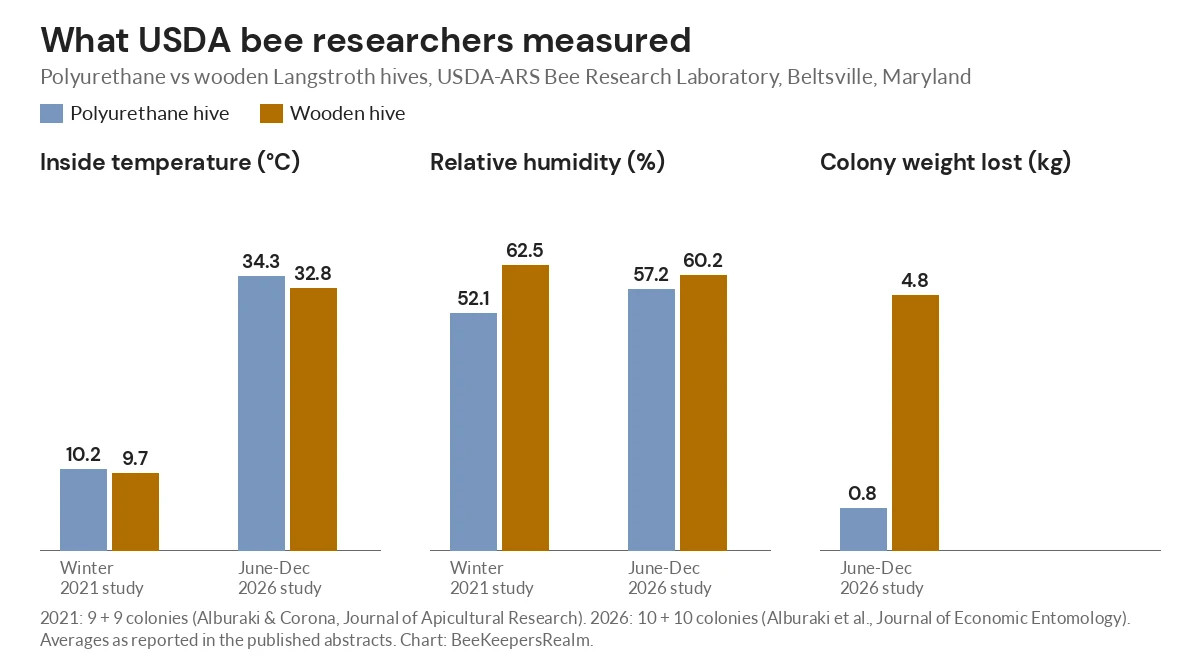
- Two USDA studies found polyurethane hives slightly warmer and less humid than wood; in one, colonies lost 0.8 kg against 4.8 kg in wood from June to December.
- Survival evidence is thinner and mixed: one Turkish trial found colonies did better in wood.
- Heat escapes fastest through the bottom and top. Insulate the top first, whatever the box is made of.
- Check fit before you buy: BeeMax and Apimaye boxes stack with standard 10-frame boxes; Lyson and HiveIQ use their own box systems.
Table of Contents
- Which Hive Suits Your Winter
- Wood vs Foam: What Tests Measured
- Insulated Hives Sold in the US, Side by Side
- Bottom, Top and Moisture Matter More Than Walls
- Trade-Offs Beyond Warmth
- Warré and Long Hives in the Cold
- Frequently Asked Questions
- The Bottom Line
Which Hive Suits Your Winter
This is our reading of the evidence below, not a test of our own.
| Your situation | Good choice | Why |
|---|---|---|
| Long, hard winters (Upper Midwest, northern New England, mountain West) | Insulated Langstroth boxes, or wood plus top insulation and a wrap | UMN Bee Lab advises heavier insulation in very cold regions |
| Cold winters and hot, humid summers (Ohio Valley, mid-Atlantic) | Either; with foam, plan summer ventilation | Foam holds summer heat too |
| Small colonies and nucs | Foam | Mitchell links better-insulated nests to survival of smaller colonies |
| You already own 10-frame wooden gear | Keep it and add insulation, or add BeeMax boxes | BeeMax stacks with 10-frame wood |
| Lifting is your limit | 8-frame boxes or all mediums | Foam saves less weight than people expect |
For small colonies the case for foam is strongest; see insulated vs standard nuc boxes.
Worker & Hive, a bee supply shop in Calgary, Alberta, opens this beginner video with wood versus polystyrene (EPS) boxes, per its chapter list. Later chapters cover bottom boards, boxes and supers, queen excluders, and lids and inner covers. It comes from a seller, so treat it as an orientation rather than evidence.
Wood vs Foam: What Tests Measured
Insulated hives are not new. In 1915, USDA apiculturist E. F. Phillips tested every double-walled hive then on the American market; all beat a single-walled hive, but none, as beekeepers used them, insulated a colony well at low temperatures, he wrote in USDA Department Circular 222 (1922). Modern studies point the same way on warmth and split on survival.
| Study | Setup | Result |
|---|---|---|
| Phillips, USDA, 1922 | Lab tests of commercial double-walled hives | All better than single walls; most heat lost through the bottom |
| Mitchell, 2016 | Hives vs models of tree nests | Heat loss 4 to 7 times higher in common hives than a tree cavity in winter |
| Alburaki and Corona, 2021 (USDA-ARS) | 9 polyurethane vs 9 wooden Langstroth hives, winter | 10.2°C vs 9.7°C inside; 52% vs 62.5% humidity; steadier temperatures in foam |
| Alburaki et al., 2026 (USDA-ARS) | 10 vs 10, June to December | 34.3°C vs 32.8°C; 57% vs 60% humidity; 0.8 kg vs 4.8 kg weight lost; no difference in brood, varroa or virus levels |
| Dodologlu et al., 2004 | Wood vs polystyrene, Turkey | Wood did better on overwintering survival, winter population loss and brood area |
| Erdoğan, 2019 | 10 each of wood, polystyrene and composite insulated, Turkey | Composite gave the most honey, about 35% more than wood and 14% more than polystyrene |
| Latshaw, SARE FNC08-700, 2009 to 2010 | Polystyrene nucs, central Ohio | 33 of 36 nucs survived winter (91.67%), against about 25% in his wooden nucs in earlier years; not a side-by-side trial |
The thermal case is consistent. Derek Mitchell’s 2016 study in the International Journal of Biometeorology found heat leaves a common hive four to seven times faster than a tree cavity in winter. The 2026 USDA-ARS study, in the Journal of Economic Entomology, found foam hives held about 1.5°C (2.7°F) more heat. In the 2021 winter study the gap was smaller, about 0.5°C (0.8°F), but temperatures in the wooden hives swung much more.
Survival is a different matter. No study above follows enough colonies over enough cold winters to prove that foam saves colonies, and the Turkish wood-versus-polystyrene trial found the opposite. Warmth is measured; survival is still an open question.
Insulated Hives Sold in the US, Side by Side
These are the insulated systems we found sold to US beekeepers, with the figures each seller publishes. Prices are from the linked pages, checked October 7, 2026; expect them to change.
| Hive | Walls | Stated insulation | Frames and fit | Price checked |
|---|---|---|---|---|
| Standard wooden 10-frame (e.g. Mann Lake deep) | About 3/4-inch pine | About R 1.2 (Betterbee estimate) | The standard; fits everything | $39.99 per assembled deep |
| BeeMax (Betterbee) | Polystyrene | R 6.5 | Standard deep frames; stacks with 10-frame wooden boxes | $34.89 per unassembled deep |
| Lyson 10-frame (Betterbee) | Polystyrene, metal latches | No figure on the kit page | 10 frames per box; Lyson boxes only | From $152 per unassembled hive |
| HiveIQ | 1.6-inch high-density EPS | “More than six times” a wooden hive | 9 standard deep frames per box; own lid, base and excluder | $65.99 per deep body |
| Apimaye Ergo | Insulated (maker gives no wall material on the pages checked) | R 7 (deep super) | 10 standard frames; fits 10-frame boxes, but its bottom board fits only its own brood box | From $395 per two-deep set |
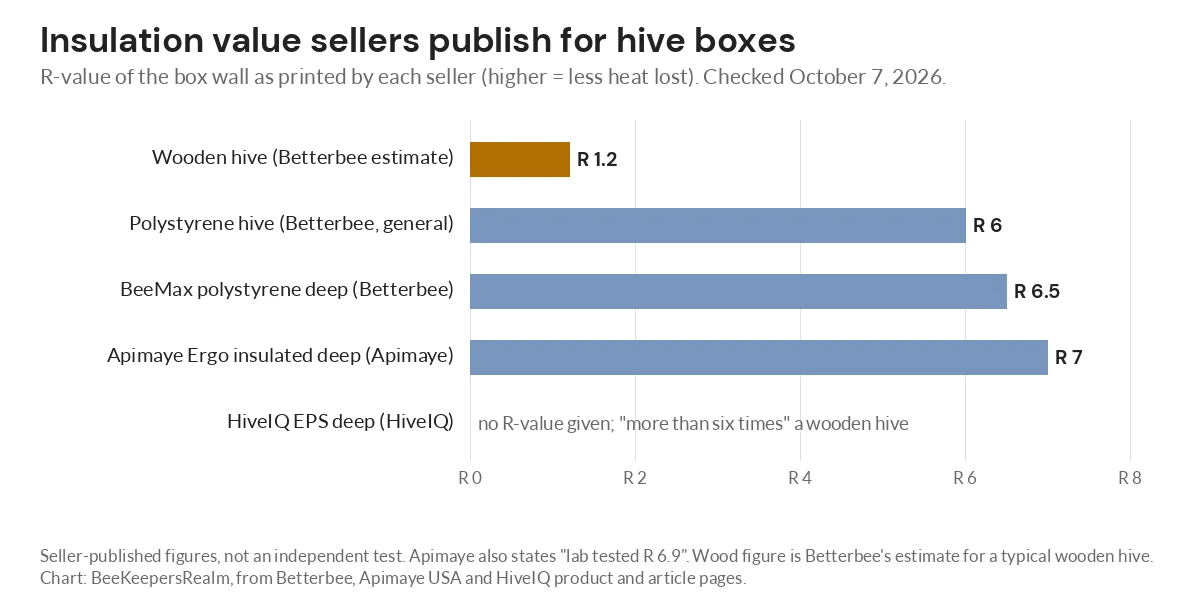
None of these sellers links to an independent test of its figure, and HiveIQ gives no R-value at all. Its page also says beekeepers “report” up to 35% more honey, without a source. Treat the numbers as a ranking, not a guarantee.
Bottom, Top and Moisture Matter More Than Walls
Phillips’s 1915 tests found what many beekeepers still miss:
“The loss of heat is most rapid through the bottom of all the insulated hives tested”
Thick walls do little if heat pours out of an open screened bottom or a thin cover. The University of Minnesota Bee Lab’s guide to beekeeping in northern climates suggests a 2-inch foam board above the inner cover, and says that with top insulation the sides should have a lower R-value than the top.
“While the health of the colony is the most important factor in overwintering success, insulation can improve chances of colony survival.”
The same guide says smaller colonies and those in very cold regions benefit from heavier insulation, “especially on top of the hive.” For the top layer itself, compare a quilt box vs moisture board. A wooden hive can get most of the benefit this way; our hive wrap guide for cold climates covers the sides.
Trade-Offs Beyond Warmth
- Summer heat. Insulation works both ways. Ohio beekeeper Joseph Latshaw found his Canadian-designed foam nucs needed extra ventilation to avoid overheating.
- Weight. Betterbee says foam boxes are lighter than wood, “but not by all that much.”
- Sun and paint. Betterbee says polystyrene still needs exterior latex paint, because UV light degrades it.
- Damage. Polystyrene dents more easily than pine, and bees can chew it at seams; see our poly nuc box guide.
- Lock-in. Lyson and HiveIQ boxes work best with their own parts. Mixing systems later costs money.
“While polystyrene provides great insulation in the winter, it provides unwanted insulation during the summer months.”
Warré and Long Hives in the Cold
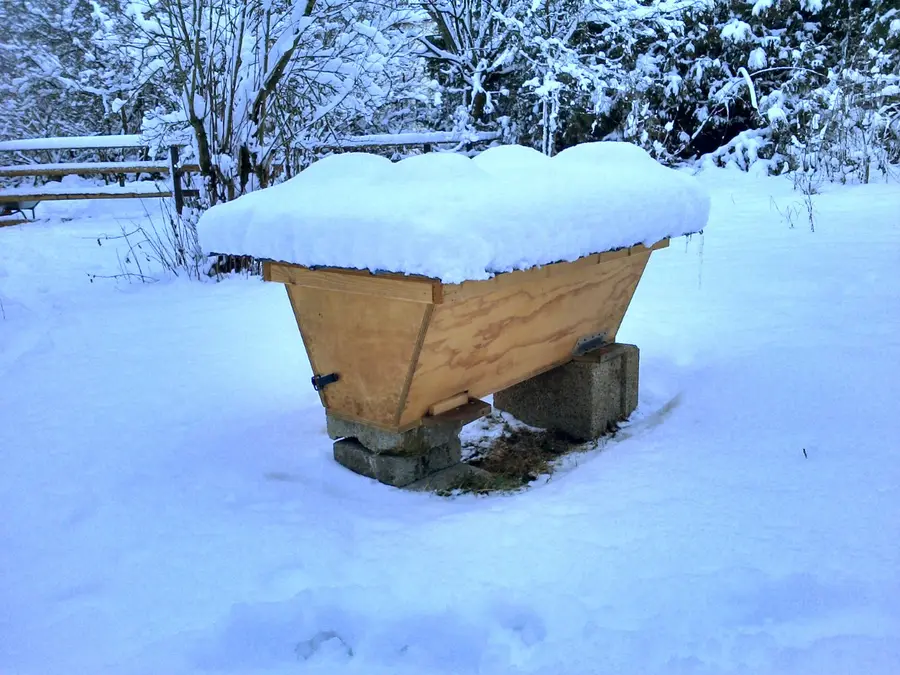
Langstroth is the practical choice because frames, nucs and help are easy to find. Warré sellers argue their small boxes suit a winter cluster, though you give up much of the frame-by-frame control. Long hives are never lifted, so their walls can be built thick or packed with foam. Our guide to beehive types compares all three styles.
Frequently Asked Questions
Are insulated beehives worth it in a cold climate?
For warmth and humidity, yes; studies agree. For survival, the evidence is mixed, so stores and mite control still come first.
Do polystyrene hives need wrapping in winter?
Usually not; Betterbee says the insulation is built in. Top insulation still pays off in very cold regions.
Can you mix polystyrene and wooden boxes?
With BeeMax and Apimaye 10-frame boxes, yes. Lyson boxes don’t mix with other brands.
Do poly hives overheat in summer?
They can without extra ventilation, as Latshaw found in Ohio.
What R-value does a wooden hive have?
About R 1.2, by Betterbee’s estimate, against about R 6 for polystyrene.
Is an 8-frame hive better for cold climates?
Not proven. Honey above the cluster matters more than width.
How cold is too cold to open a hive?
The UMN guide says remove frames with bees only above 55°F. See how cold is too cold to open a beehive.
The Bottom Line
In a hard winter, buy insulated boxes that take standard frames, or insulate the top of the wooden hive you have. Either way, leave the colony at least the 75 pounds of honey the UMN guide asks for; see how much honey bees need for winter.