Reviewed by Thomas B. · How we review
Ground wasps are wasps that nest in soil, and the fastest way to tell them apart is to count how many use one hole. Many wasps streaming in and out of a single plain hole is a yellowjacket colony, which defends itself and can sting repeatedly. One wasp per hole, in a patch of separate holes, is a solitary wasp such as a cicada killer or a digger wasp, which rarely stings and is gone within weeks. The table below sorts twelve common US ground-nesting wasps by size, nest entrance, season and sting risk.
Educational information, not medical or pest-control advice. If a sting is followed by trouble breathing, a swelling throat or tongue, or dizziness, call 911. We recommend no products; any pesticide must be used exactly as its label says.
Key Takeaways
- Many wasps at one plain hole means yellowjackets, the only common ground nesters that defend a colony. Many separate holes with one wasp each means solitary wasps.
- “Ground hornet” is a folk name, not a species. In practice it means ground-nesting yellowjackets or cicada killers; true hornets do not nest underground.
- Solitary ground wasps are beneficial hunters that are active for weeks. Males cannot sting, and females sting mainly if handled or stepped on.
- Yellowjacket colonies peak in late summer and fall and stay a sting hazard until a hard frost.
- For a yellowjacket nest where people walk or mow, or anyone is allergic, extension sources point to a professional. Do not pour gasoline or water down the hole.
- In our pull of US iNaturalist records, 80% of cicada killer sightings fall in July and August, while yellowjacket sightings peak in September.
Table of Contents
- The One-Hole Test
- Ground Wasp Identification Table
- Ground Hornets: What the Name Usually Means
- Are Ground Wasps Dangerous?
- Velvet Ants: The Wingless Wasp on Bare Ground
- When Each Ground Wasp Is Active
- What to Do About Ground Wasps
- Ground Bee or Ground Wasp?
- Frequently Asked Questions
- The Bottom Line
The One-Hole Test
Watch one hole for a minute from several feet away. The Missouri Department of Conservation says that yellowjacket nests are most often underground and that all most people ever see is the entrance hole with yellowjackets flying in and out of it. Solitary ground wasps look different at the door:
“Their individual, almost secretive behavior at their burrow entrance separates them from the busy, sometimes even crowded nest openings of yellowjackets.”
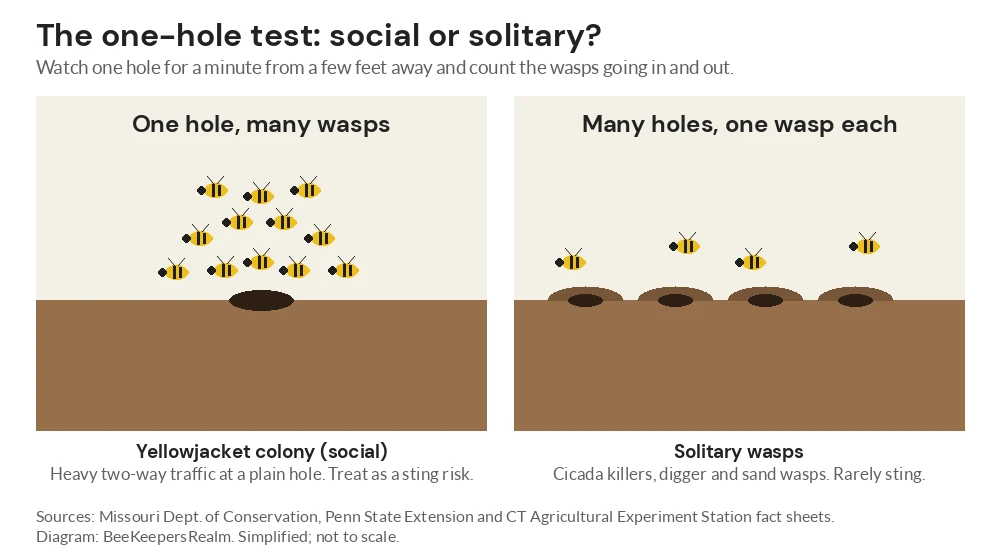
A busy patch is not the same as a colony. Penn State Extension makes the point about cicada killers: many wasps in one area have found the same soil, not formed a nest together.
“If you find many wasps in one area, it is because they have all found the conditions to their liking, not because they are forming a social colony.”
Purdue Extension says cicada killer areas may hold from a few to a hundred or so separate burrows. A yellowjacket nest is the opposite: one entrance serving 1,500 to 15,000 wasps by species, according to UC IPM. See our yellow jackets guide for more.
Ground Wasp Identification Table
Most ground wasps in a US yard are one of the twelve below. “Peak sightings” come from our iNaturalist pull, explained in the seasonal section.
| Wasp | Size and look | Nest entrance | Social or solitary | When active | Sting risk | Source |
|---|---|---|---|---|---|---|
| Eastern yellowjacket (Vespula maculifrons) | Worker about 1/2 inch; black and yellow with a wide anchor-shaped black mark on the first abdominal segment | Plain hole in lawns, woods and pastures with heavy traffic | Social | Nest starts May or June in Pennsylvania; peak sightings September | High; defends the nest, stings repeatedly | Penn State |
| Southern yellowjacket (V. squamosa) | Large and orangish, with lengthwise black and yellow stripes on the plate behind the head | Usually underground, often in burrows taken from eastern yellowjackets | Social | Active later in spring than the eastern species | High | Missouri Dept. of Conservation (MDC) |
| Western yellowjacket (V. pensylvanica) | 1/2 to 1 inch; jagged bright yellow and black stripes, barely visible waist | Often old rodent burrows | Social | Defensiveness rises through the season | High; UC IPM calls ground nesters the most troublesome | UC IPM |
| German yellowjacket (V. germanica) | Diamond-shaped mark on the first abdominal segment | Usually wall voids and attics, so rarely a lawn hole | Social | Colony peaks in fall | High | MDC; Penn State |
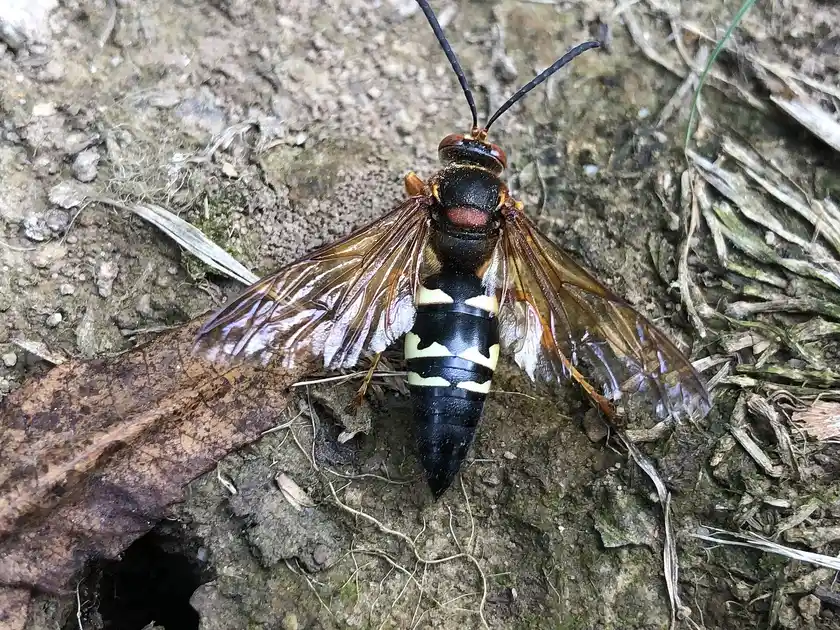
| Cicada killer (Sphecius speciosus) | 1.5 to nearly 2 inches; black with yellow bands, orange-tinged legs and wings | Hole about 1.5 inches wide with a horseshoe-shaped soil mound | Solitary, often in groups of burrows | July and August; adults die by mid-September | Low; males cannot sting | Univ. of Kentucky; Purdue |
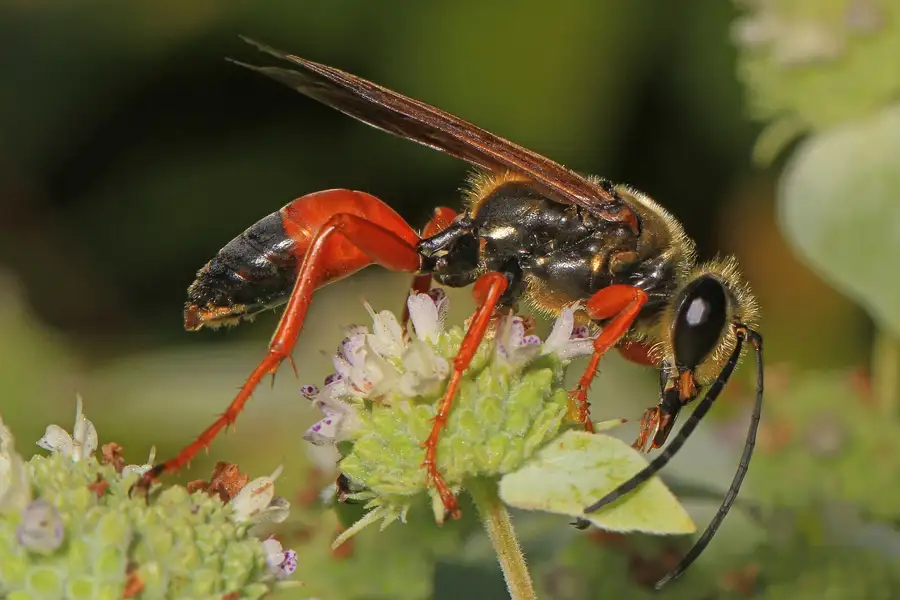
| Great golden digger wasp (Sphex ichneumoneus) | Large; golden hairs on head and thorax, orange-rust front abdomen, black tip | Burrow in sandy soil; groups of a few to rarely hundreds of females | Solitary | Adults live 1 to 2 months in summer; peak sightings July | Low; not aggressive | MDC |
| Great black wasp (Sphex pensylvanicus) | Strikingly large; satiny black with smoky wings that shine blue | Hole the female digs in the ground | Solitary | July through September; peak sightings August | Low; stings only if mistreated | MDC |
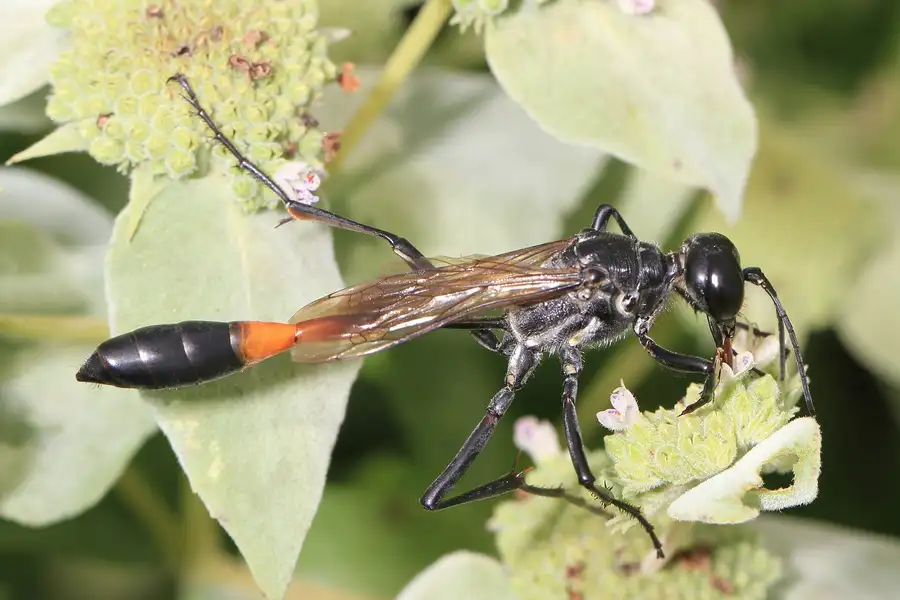
| Thread-waisted wasps (Ammophila) | Medium and slender; black with orange on the abdomen and a very narrow waist | Burrow in bare soil or leaf litter | Solitary | Several broods a year; peak sightings September | Low; stings only if mishandled | MDC |
| Sand wasps (Bembix and kin) | Banded yellow or white and black, often with greenish marks | Short tunnels in open sandy ground, often clustered | Solitary | Summer; peak sightings July | Low; almost never sting people | MDC |
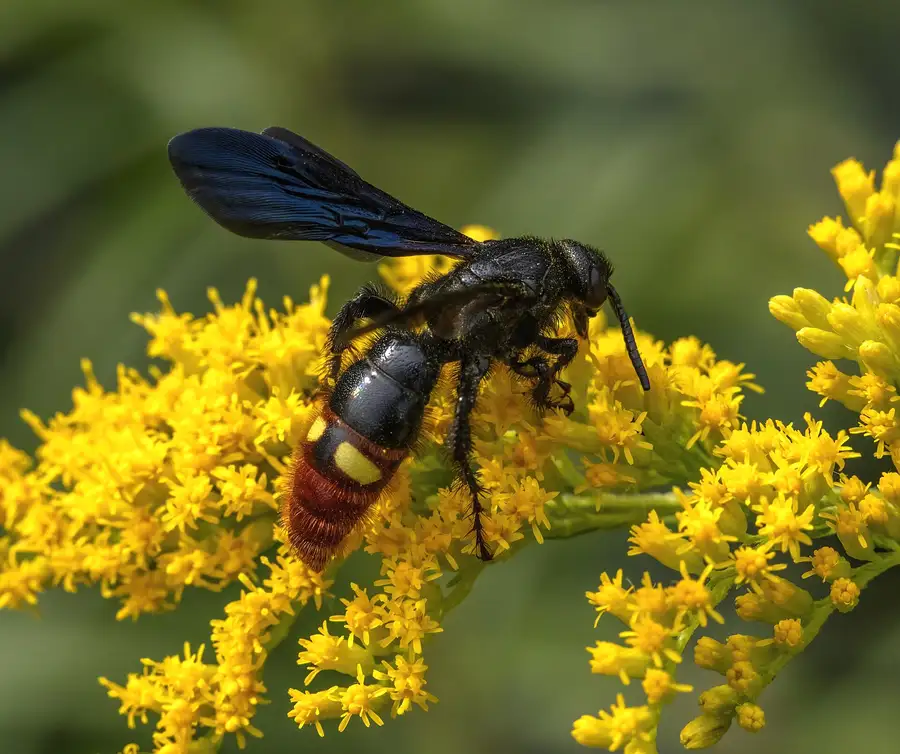
| Scoliid wasps (blue-winged wasp, Scolia dubia) | About 3/4 inch; blue-black wings, rusty fuzzy abdomen tip with two yellow spots | No nest hole: the female tunnels through soil to find beetle grubs | Solitary | August on flowers; peak sightings August and September | Low; not aggressive | MDC; Univ. of Maryland |
| Spider wasps (Pompilidae) | Dark or blue-black with long spiny legs and nervously flicking wings | Some dig a burrow; others use mud cells or existing holes | Solitary | Summer; peak sightings August | Low to moderate; painful sting if handled | MDC |
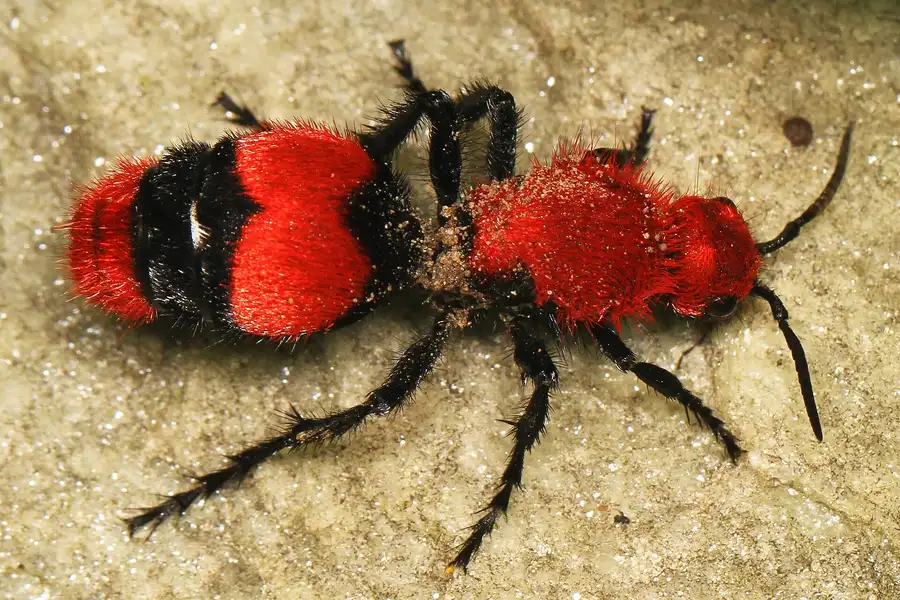
| Velvet ants (Mutillidae) | Fuzzy, wingless females in red or orange and black that run on bare ground | None of their own; they enter nests of other ground-nesting insects | Solitary | Summer; peak sightings August | Painful sting if held or stepped on | MDC |
Our predatory wasp comparison chart covers more species.
Ground Hornets: What the Name Usually Means
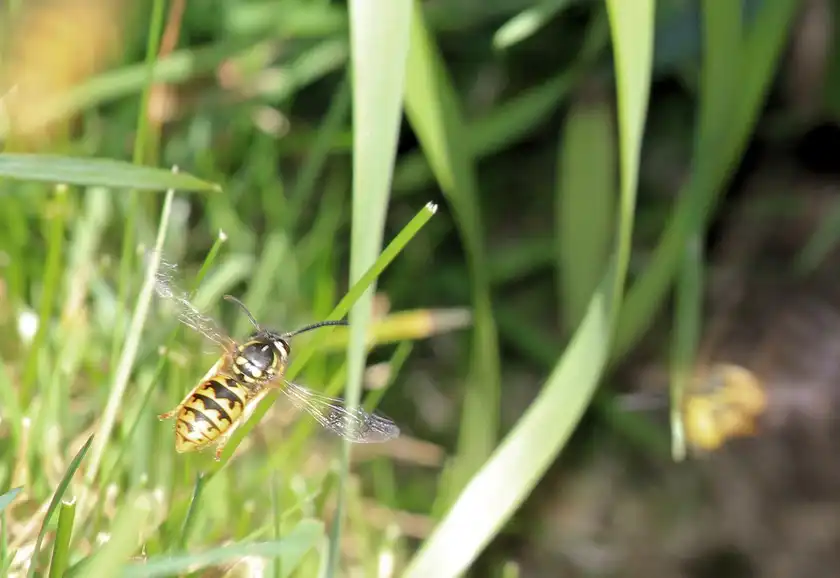
“Ground hornet” is not a species. UF/IFAS notes that, in general, “hornet” is used for species that nest above ground and “yellowjacket” for those that make subterranean nests, so the phrase contradicts itself. People use it for two different insects:
- Ground-nesting yellowjackets are the usual meaning when the hole is busy and the wasps are small and striped. Our hornet vs wasp guide explains the naming.
- Cicada killers are the other meaning. Purdue says they look like a giant hornet or huge yellowjacket, yet they are solitary. Several pest-control sites use “ground hornet” only for cicada killers,.
The real hornet in the US, the European hornet, does not nest underground; the Missouri Department of Conservation says its nests are typically built in dark hollow places such as hollow tree trunks.
Are Ground Wasps Dangerous?
Only some of them. Yellowjackets earn the reputation: Penn State says the eastern yellowjacket will aggressively defend its nest and can sting repeatedly, and the University of Kentucky calls yellowjackets arguably the most dangerous stinging insects in the United States because they usually sting if the nest is disturbed.
Solitary ground wasps have no colony to guard. Kentucky says cicada killer stings are almost always from someone stepping on or grasping the wasp, and that the males that hover near people have no stinger.
Allergy changes the picture for every group. The University of Kentucky reports that allergic reactions to wasp and hornet stings account for about 225,000 emergency room visits and as many as 100 deaths a year in the US. Anyone with a known venom allergy should keep away from all nests. For first aid, see how to treat a bee or wasp sting; to judge which insect stung you, see bee sting vs wasp sting.
Velvet Ants: The Wingless Wasp on Bare Ground
A fuzzy red-and-black “ant” crossing a bare patch is usually a velvet ant, which is a wasp. Missouri says the females are wingless for life, run quickly on the ground and will sting if held or stepped on with bare feet; the sting is excruciating, which explains the name cow killer. Their young develop in the nests of other ground-nesting insects, such as bumble bees and cicada killers.
When Each Ground Wasp Is Active
The calendar is a second clue. Extension sources agree on the yellowjacket year: Penn State says overwintered queens start nests in May or early June, workers appear in June, and males and new queens follow in August and September. Ohio State says their food preferences shift from protein to sweets from August to October. Cicada killers fly in July and August, according to Kentucky, and Purdue says the adults die by mid-September. See when wasps die off for the end of the season.
To check this against real sightings, we pulled US research-grade iNaturalist observations for each group on 16 November 2026 and counted them by month.
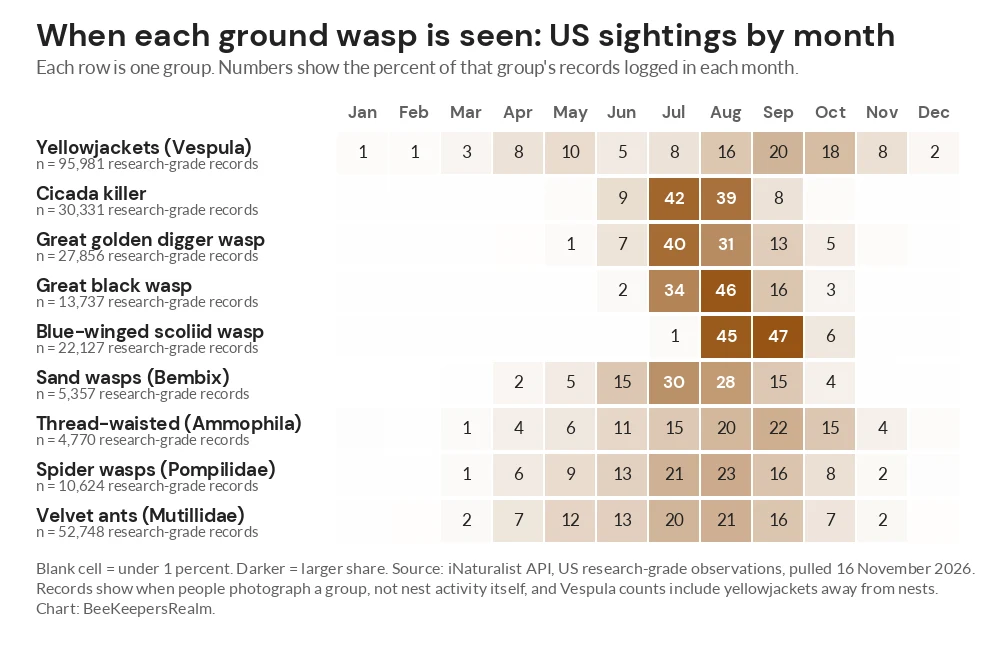
The pattern is sharp. In July and August fall 80% of cicada killer records, 79% of great black wasp records and 71% of great golden digger records. The blue-winged scoliid is later, with 92% in August and September. Yellowjackets run longest: 62% of their records fall between July and October and the single biggest month is September. These counts show when people photograph insects, not when nests are active, so treat them as a guide to the season rather than a nest calendar.
What to Do About Ground Wasps
Leave solitary wasps alone
University of Maryland Extension says that, for cicada killers, nest building is temporary and that an insecticide should be a last resort. If the holes bother you, it recommends thickening thin lawn by overseeding in fall and running a sprinkler over the area, or covering bare beds with 2 to 3 inches of mulch.
Yellowjacket nests: when to act and when to call a pro
A yellowjacket nest that is out of the way can be ignored. Penn State says an eastern yellowjacket nest needs no action unless it is close to a building entrance, in a mowed lawn or where the public is likely to meet it, and that anyone with a known sting sensitivity should have nests near the home removed by professionals. UF/IFAS says that when nests are large or hard to approach, the safest procedure is a pest control operator. The University of Kentucky is blunter: a botched treatment is the scariest pest-control scenario, so call a professional, especially when the nest is hard to reach. Our wasp nest removal guide covers costs and who to call.
If you still decide to treat a nest yourself, extension guidance is consistent on timing and technique. Kentucky says to work at night, when most yellowjackets are inside, to mark the entrance in daylight, and not to shine a flashlight into the hole because the beam draws the wasps out; set it to the side or on the ground. We do not name products or amounts: use only a product labeled for yellowjackets and follow its label.
What not to do
Kentucky warns against the folk remedies:
“‘Folk’ remedies such as dousing nests with gasoline or a garden hose are seldom successful and can result in multiple stings.”
Do not plug a hole either. Penn State’s rule for yellowjackets in a wall is never to seal the opening, because the wasps can chew through drywall into the house.
Ground Bee or Ground Wasp?
Small, fuzzy insects in dozens of spring holes are almost always bees, covered in our guide to ground bees. A single busy hole in late summer is likelier yellowjackets; the Missouri Department of Conservation notes that some people call yellowjackets “ground bees”. Large, fuzzy bees using one hole in a rodent burrow are bumble bees (see bumble bee nest in the ground). For body-shape clues, see bee vs wasp.
One wasp per hole in a lawn in July and August is often a cicada killer, which stocks its burrow with annual cicadas.
Frequently Asked Questions
Are ground wasps dangerous?
Yellowjackets are, because they defend the colony and sting repeatedly. Solitary ground wasps rarely sting; Kentucky says cicada killer stings almost always follow someone stepping on or grasping the wasp.
Are “ground hornets” a real species?
No. It is a folk name, usually for ground-nesting yellowjackets and sometimes for cicada killers. True hornets, such as the European hornet, nest in hollow trees and other cavities rather than underground.
Why are so many wasps coming out of one hole in the ground?
That is the sign of a yellowjacket colony. UC IPM puts a colony at 1,500 to 15,000 wasps by species, all using one entrance.
Will ground wasps go away on their own?
Yes. Adult cicada killers die by mid-September, per Purdue, and Clemson says yellowjacket colonies do not normally survive the winter.
Is it safe to mow over a ground wasp nest?
Not if it is a yellowjacket nest. Penn State lists a nest in a mowed lawn as a reason to have it dealt with, and Kentucky says yellowjackets usually sting if the nest is disturbed.
Can I pour gasoline, bleach or water down the hole?
No. Kentucky says dousing nests with gasoline or a garden hose is seldom successful and can lead to multiple stings. None of the extension pages we read for this article recommend bleach.
Are ground wasps just yellowjackets?
No. Yellowjackets are one social group. Cicada killers, great golden digger wasps, great black wasps, thread-waisted wasps, sand wasps, scoliid wasps and spider wasps are solitary.
How deep is a ground wasp nest?
It depends on the wasp. Purdue says a cicada killer tunnel runs 12 to 18 inches and reaches a depth of 6 to 10 inches. UC IPM says a yellowjacket nest can sit well back from the visible entrance, beyond the reach of a spray.
The Bottom Line
Count the wasps at one hole before you decide anything. One insect per hole is a harmless hunter that will leave on its own; a steady stream at one plain hole is a yellowjacket colony, and anyone allergic or mowing nearby should call a professional.
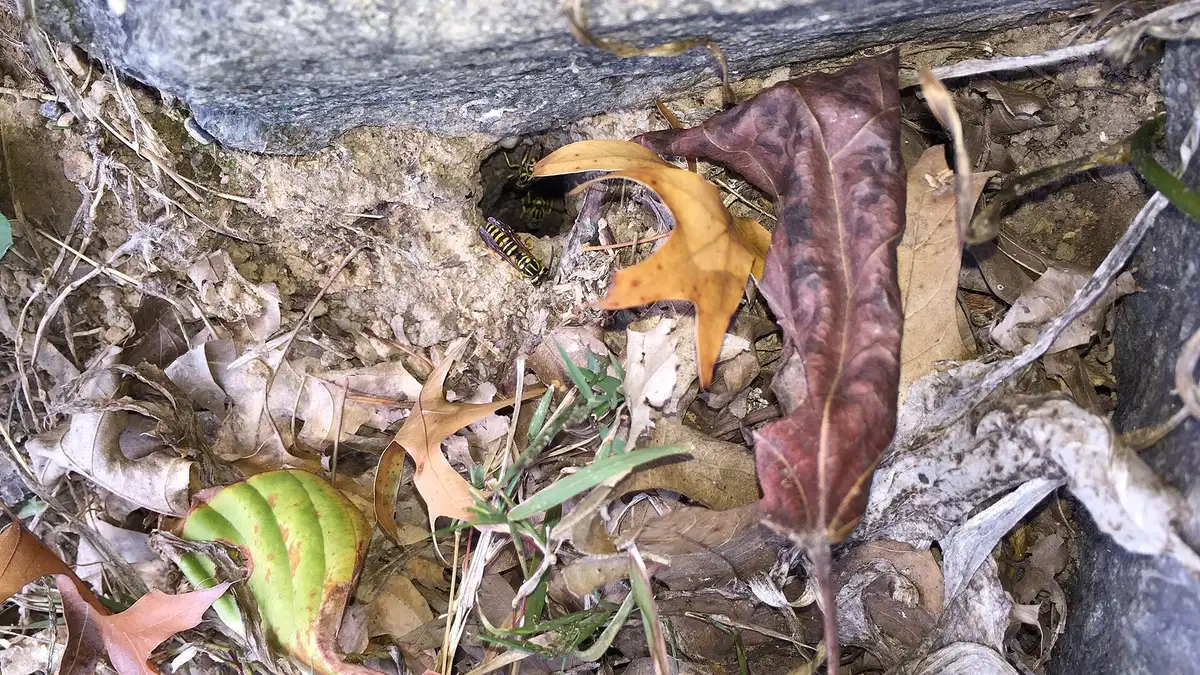
Image credits: Featured photo: a yellowjacket at a below-ground nest entrance in Ewing, New Jersey, October 2015. Photo: Famartin, via Wikimedia Commons, CC BY-SA 4.0, cropped. The sightings chart uses US research-grade iNaturalist observations pulled 16 November 2026.