Reviewed by Sofia T. · How we review
A cicada is a large, stout-bodied insect in the order Hemiptera, the true bugs, and the family Cicadidae, best known for the loud buzzing of the males. The US has two kinds: periodical cicadas (genus Magicicada), which spend 13 or 17 years underground and emerge together, mostly in May and June, and annual or dog-day cicadas, which appear every summer. Neither bites or stings. The next periodical emergence is Brood XXII, a 13-year brood due in spring 2027 in parts of Louisiana, Mississippi, Kentucky and Ohio.
This guide sorts the two types, lists the broods due next with their sources, and adds a chart built from iNaturalist observations showing when each type is photographed in the US. Where sources disagree, we say so.
Key Takeaways
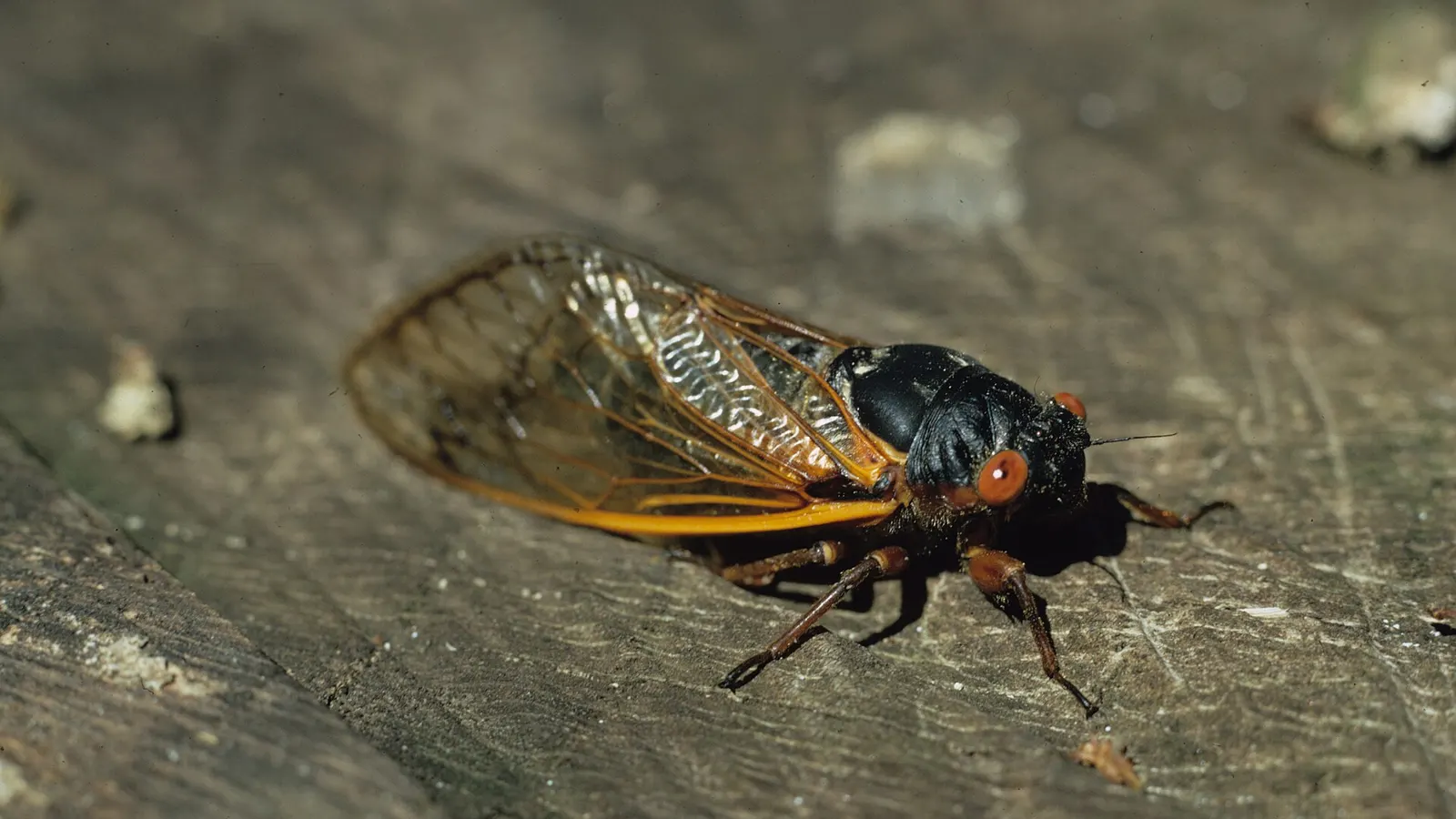
- Periodical cicadas (Magicicada, seven species) are black with red eyes and orange wing veins. Dog-day cicadas (Neotibicen) are greenish with black markings and sing in mid to late summer.
- UConn’s brood table lists Brood XXII for 2027 (13-year, Louisiana, Mississippi, Ohio, Kentucky), then Brood XXIII in 2028 and Brood I in 2029. Small off-schedule “straggler” groups can appear in any year.
- Cicadas do not bite or sting, are not poisonous and are not dangerous to pets, according to the EPA. The real risk is egg-laying damage to young trees, which fine netting prevents.
- The EPA says not to spray: pesticides are generally ineffective, and so many cicadas emerge at once that more move in.
- In our iNaturalist pull, 92% of US periodical cicada observations fall in May and June, while dog-day cicada observations peak in August.
- “17-year locusts” are not locusts. True locusts are a type of grasshopper, and cicadas are true bugs.
Table of Contents
- What Is a Cicada?
- Periodical vs Annual Cicadas
- Cicada Broods: Which Emerge in 2027 and After
- When Each Type Shows Up: iNaturalist Observations
- Cicada Life Cycle: Eggs, Nymphs, Molting and Shells
- Why Cicadas Are So Loud
- Are Cicadas Harmful?
- Cicadas and Other Insects: Wasps, Fungus and Lanternflies
- Cicadas vs Locusts
- Frequently Asked Questions
What Is a Cicada?
Cicadas belong to the order Hemiptera, the true bugs, and are closely related to aphids and leafhoppers, says University of Wisconsin Extension. They are stout, wedge-shaped insects with wide-set eyes, short antennae and clear, veined wings held like a roof over the body. Clemson Extension puts adults at about 1 to 2 inches long. The nymphs live underground and suck xylem sap from roots. UConn’s Periodical Cicada project adds that adults feed too, by sucking plant fluids, and die if they have no living woody plants to feed on.
How many species exist depends on who is counting. UConn estimates more than 5,000 cicada species worldwide, counting those still being discovered. On iNaturalist, 167 species have at least one research-grade US record (our pull, November 16, 2026). Fewer than 10 cicada species anywhere are periodical, and seven of those are the Magicicada of eastern North America, per UConn.
Cicadas are often lumped with other sap-feeders. The spotted lanternfly, for example, is an invasive planthopper with its own life cycle, covered in our spotted lanternfly guide.
Periodical vs Annual Cicadas
Every cicada you meet in the US is one of two practical types. Periodical cicadas are the famous 13- and 17-year groups. “Annual” cicadas are all the others, called annual because adults appear somewhere every year, even though UConn notes they typically have multi-year life cycles underground.
| Type | Genus | Life cycle | Color | When adults appear | Where | Source |
|---|---|---|---|---|---|---|
| 17-year periodical | Magicicada: M. septendecim, M. cassini, M. septendecula | 17 years underground; emerges as a brood | Black body, red eyes, orange wing veins, black “W” near forewing tips | Mostly May and June | Generally the northern part of the eastern US range; 12 broods | UConn, UW Extension |
| 13-year periodical | Magicicada: M. tredecim, M. neotredecim, M. tredecassini, M. tredecula | 13 years underground; emerges as a brood | Same black, red-eyed look | About late April to early June; earlier in the south | Southern and midwestern states; 3 broods | UConn, USFS |
| Dog-day (annual) | Neotibicen, such as N. canicularis and N. tibicen | Adults every year; the dog-day cicada normally completes development in two years | Greenish body with black markings, about 1.5 in | Mid to late summer, usually June through August | Found throughout the US in summer | UW Extension, UConn |
| Other annual cicadas | Diceroprocta, Okanagana and others | Multi-year, with adults emerging every year | Some Okanagana are black and orange | Somewhat later than Magicicada, with some overlap | Varies by species | UConn |
Sources: UConn (species, colors, seasons, Okanagana and Diceroprocta), UW Extension (dog-day size, color and timing), USDA Forest Service (13-year species list and emergence window). The length of the “annual” cycle varies by source: UW says 2 to 9 years, while Clemson says 1 to 3 years between emergences.
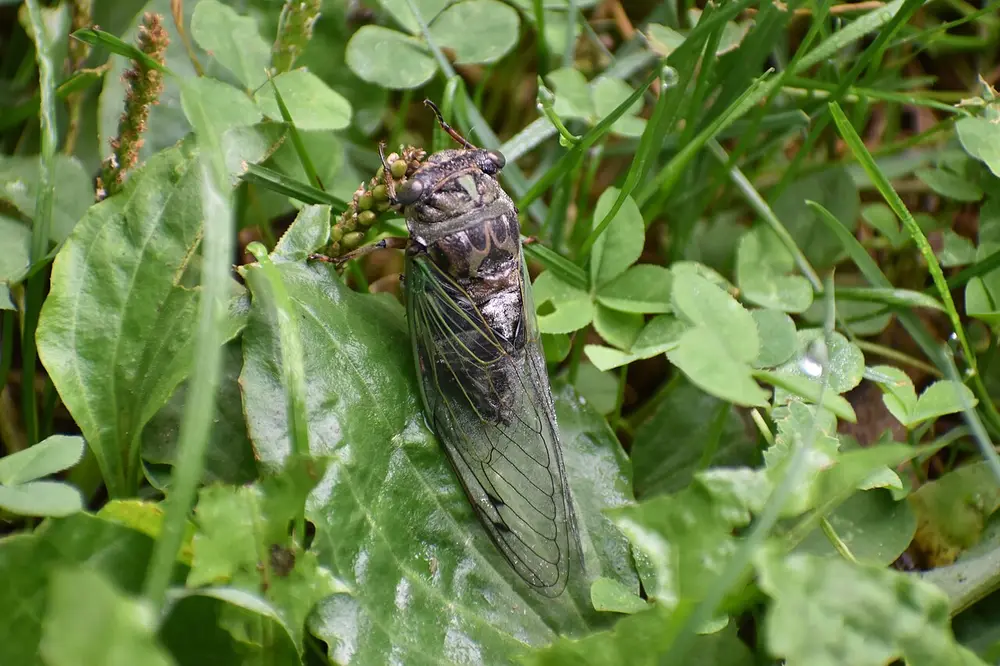
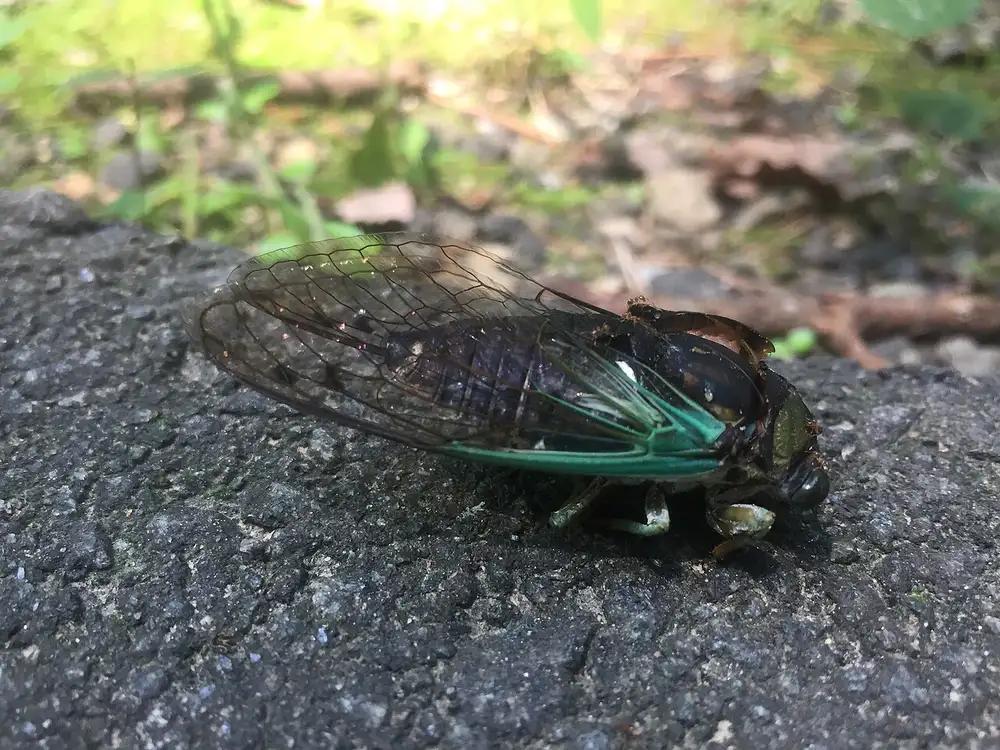
Color is the quickest first check, and sound is the reliable one: UConn says the best way to identify cicada species is by their songs, because songs are nearly always species-specific. Some annual species, especially Okanagana, are the most likely to be mistaken for periodicals because a few share the black-and-orange coloring.
Cicada Broods: Which Emerge in 2027 and After
A brood is every periodical cicada emerging in a given area in a given year on a set cycle. UConn calls the concept “a bookkeeping construct” more than a biological reality, and says broods are neither species nor single populations. There are 15 recognized broods: 12 on a 17-year cycle and 3 on a 13-year cycle, according to UConn and the USDA Forest Service. Roman numerals I to XVII were set aside for 17-year broods and XVIII to XXX for 13-year broods, so Brood XIII is a 17-year brood and Brood XXII is a 13-year brood.
Brood XXII is due in 2027
Brood XXII, the Baton Rouge Brood, is the only brood on UConn’s schedule for 2027. It is a 13-year brood with three species: M. tredecim, M. tredecassini and M. tredecula. UConn’s brood table lists Louisiana, Mississippi, Ohio and Kentucky. Its Brood XXII page describes a small brood near Baton Rouge with a surprising disjunct population in southern Ohio and northern Kentucky that lacks M. neotredecim. Sources differ at the edges: Wikipedia’s Brood XXII entry places it only in southeast Louisiana and southwest Mississippi, so treat the Ohio and Kentucky population as less well established than the Louisiana core.
Timing follows the ground. UConn says local emergences occur when soil about 7 to 8 inches down reaches roughly 64°F, so southern populations emerge before northern ones. The USDA Forest Service gives roughly 64°F as well, with emergence from April to early May in the south of the range and May to early June in the north. Neither source gives an exact 2027 date, so check local records from the 2014 emergence or ask longtime residents, as UConn suggests.
Next brood emergences, 2027 to 2033
| Year | Brood | Cycle | States (UConn) |
|---|---|---|---|
| 2027 | XXII | 13-year | LA, MS, OH, KY |
| 2028 | XXIII | 13-year | AR, IL, IN, KY, LA, MO, MS, TN |
| 2029 | I | 17-year | TN, VA, WV |
| 2030 | II | 17-year | CT, GA, MD, NC, NJ, NY, OK, PA, SC, VA |
| 2031 | III | 17-year | IA, IL, MO |
| 2032 | IV | 17-year | IA, KS, MO, NE, OK, TX |
| 2033 | V | 17-year | MD, OH, PA, VA, WV |
Source: UConn Cicadas, Guide to Periodical Cicada Broods. Brood XXIII’s 2028 date matches Wikipedia’s Brood XXII entry, which lists XXIII for 2028 and XIX for 2037, and Clemson Extension also gives 2037 for Brood XIX. The 13-year Brood XIX emerged in 2024 alongside the 17-year Brood XIII.
Stragglers: cicadas out of schedule
Periodical cicadas sometimes miscount. UConn says off-cycle “stragglers” are typically few and most often appear 1 or 4 years early or late, in both 13- and 17-year cicadas. Brood III is due in 2031, so by that pattern a few could surface four years early in 2027 in Iowa, Illinois or Missouri; that is our reading of UConn’s rule, not a forecast from the brood table. Most stragglers are quickly eaten, UConn adds.
When Each Type Shows Up: iNaturalist Observations
To see the two types on one calendar, we pulled iNaturalist’s public API on November 16, 2026 for research-grade US observations of Magicicada (periodical cicadas, 46,202 observations) and Neotibicen (dog-day cicadas, 48,634). Research grade means the community agreed on the identification.
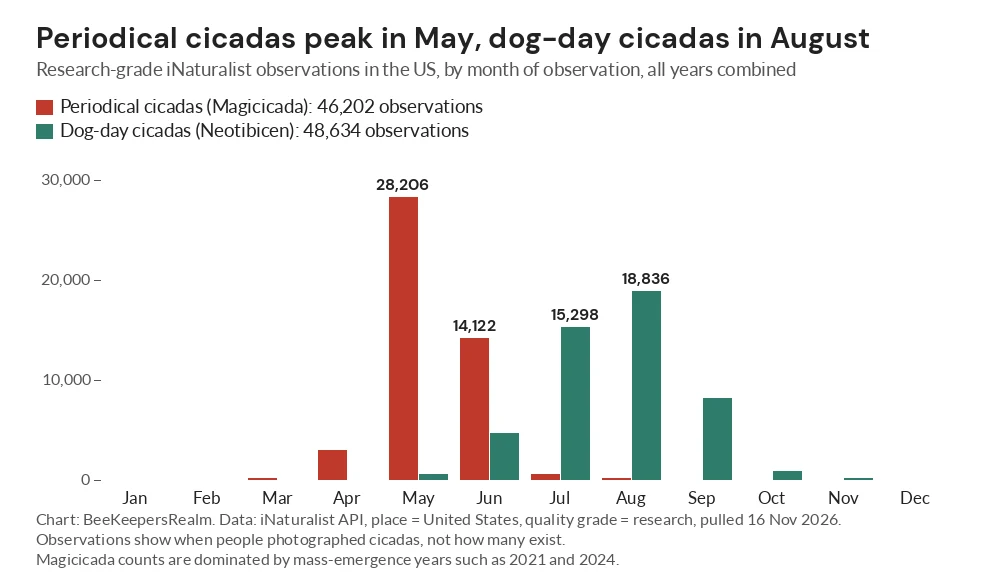
May holds 28,206 periodical cicada observations, 61% of the total, and May and June together hold 92%. Dog-day cicadas peak later: August has 18,836 observations, and July and August together hold 70%, with September still at 8,138. That fits the seasons described by UConn and UW Extension, where periodical cicadas come first and dog-day cicadas sing through the summer heat. iNaturalist files the larger Megatibicen cicadas separately (19,475 observations, also peaking in August), so they are not in the chart.
Read the chart with care. Observations record when people photographed cicadas, not how many exist. The periodical count is dominated by mass-emergence years: 20,347 observations are from 2021 and 14,349 from 2024, together 75% of the total, while 2022 has only 229 and 2026 only 692.
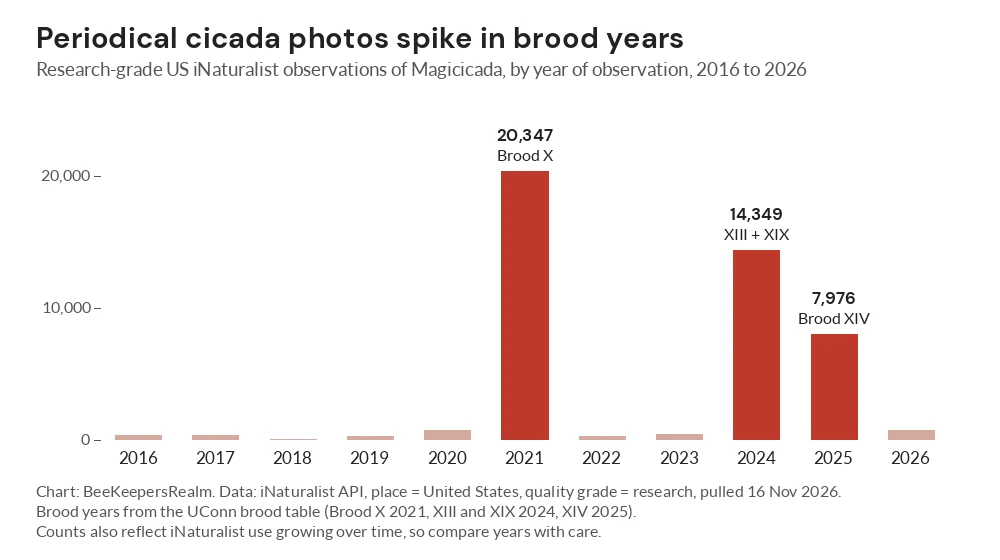
The spikes line up with the brood table: Brood X emerged in 2021, Broods XIII and XIX in 2024 and Brood XIV in 2025. One year can look quiet and the next explosive, and Brood XXII, which UConn calls a small brood, is unlikely to produce a spike like 2021 or 2024.
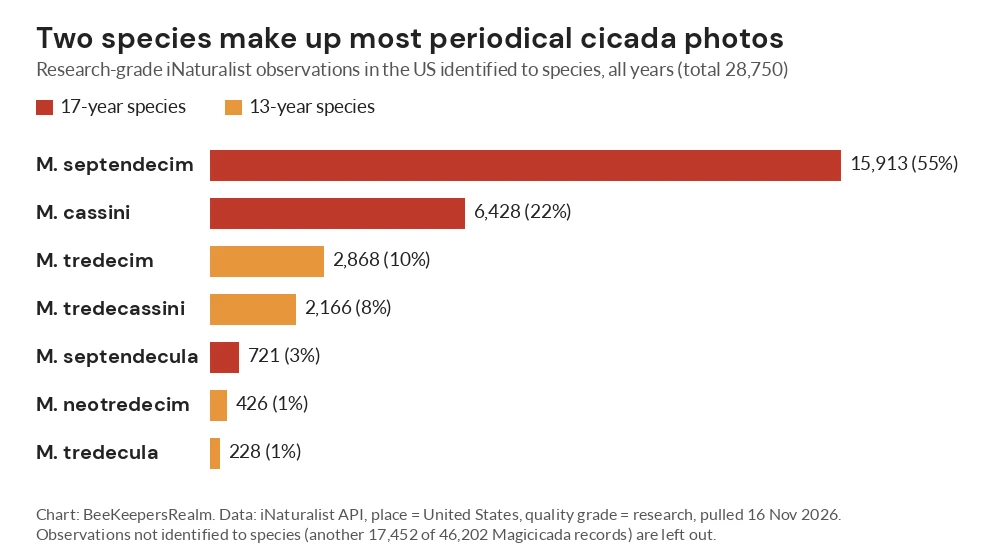
Of the seven periodical species, two account for most records: M. septendecim (15,913) and M. cassini (6,428) make up 22,341 of 28,750 species-level observations, or 78%. Both are 17-year species. The rarest, M. tredecula with 228, is a 13-year species.
Cicada Life Cycle: Eggs, Nymphs, Molting and Shells
Eggs in twig slits
After mating, a female cuts slits into living twigs with a saw-edged ovipositor and lays her eggs inside. UConn says a mated periodical female excavates a series of Y-shaped egg nests and lays up to 20 eggs in each, as many as 600 in all. The EPA says the twigs used range from pencil diameter to half an inch. Eggs hatch after about 6 to 10 weeks, per UConn, UW Extension and Clemson Extension, and the new nymphs drop to the ground.
Nymphs underground
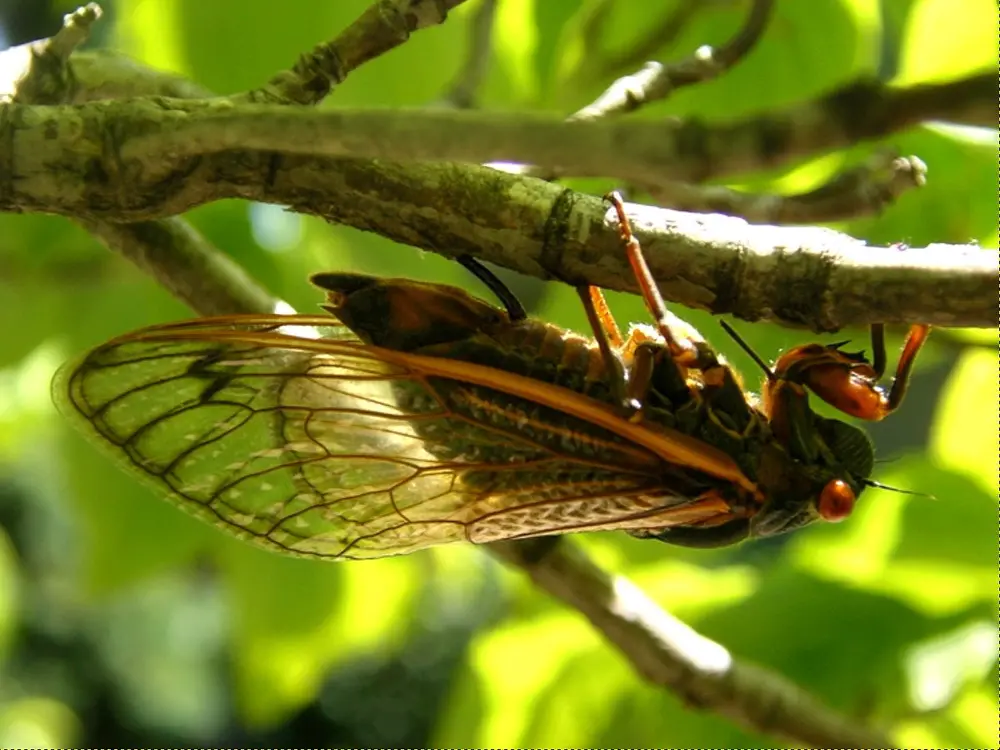
Nymphs burrow down, find a rootlet and feed on xylem sap. Their front legs are enlarged for digging. Counts of juvenile stages differ by source: UConn says periodical cicadas pass through five underground stages, while Clemson Extension describes four instars. Over 13 or 17 years a periodical nymph grows from about the size of a small ant to nearly the size of an adult, per UConn.
What triggers emergence
A few weeks before emergence the nymphs dig exit tunnels about half an inch wide, which show up as small holes in the soil. UConn says emergence happens when soil at 7 to 8 inches reaches about 64°F, and that soil temperature “probably plays an important role” in which night they climb out, though the exact cues are not well understood. Nymphs usually leave after sunset, so the first sign of an emergence is often a yard of holes and, by morning, empty shells.
Molting and the shells left behind
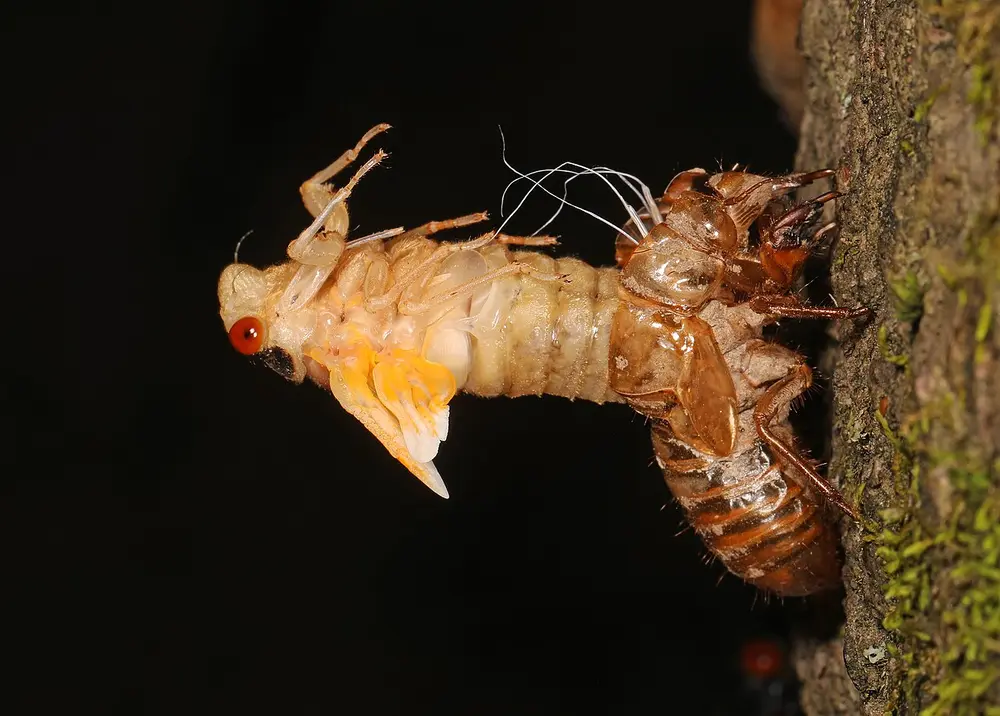
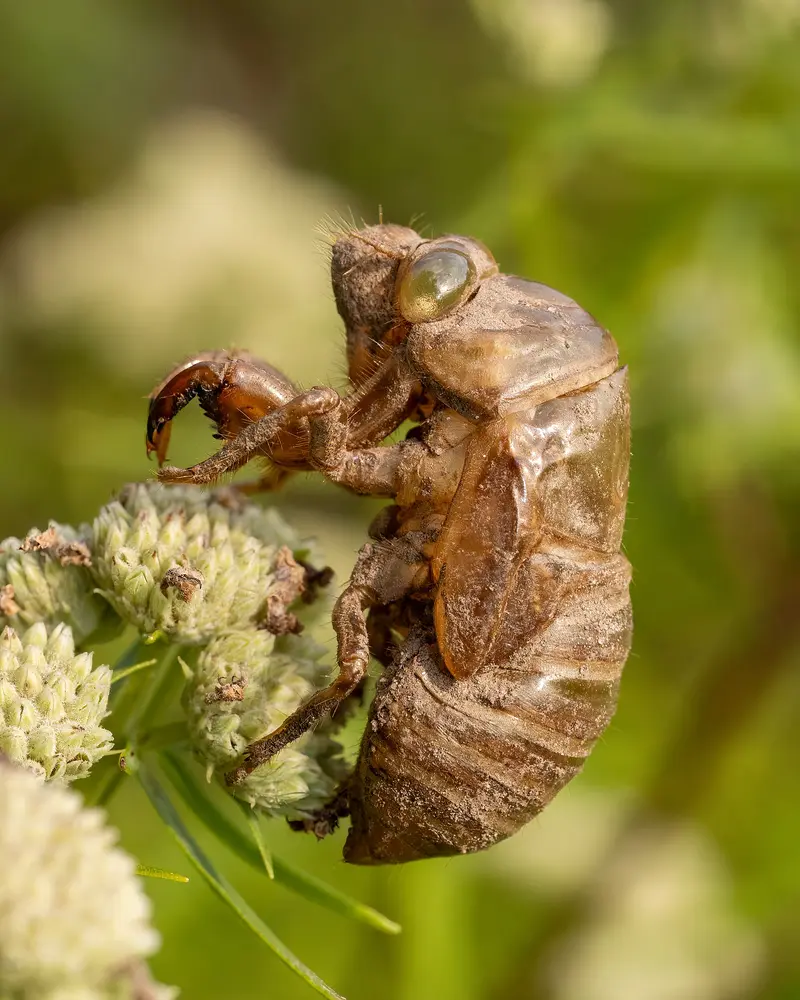
The nymph climbs a tree or other vertical surface, its back splits and the winged adult pulls itself out, leaving the empty nymphal skin, called an exuvia, clinging in place. Newly emerged adults are pale and soft. UConn says they spend roughly four to six days as “teneral” adults while the body hardens, and Clemson says the wings can take from 30 minutes to several hours to dry.
How long adults live
Not long. The USDA Forest Service says adults live for just a few weeks to buzz, feed and breed, and Clemson says they die shortly after mating. By the time the eggs hatch, the adults are dead, so the next generation never meets its parents.
Why Cicadas Are So Loud
Only males sing. They flex drum-like membranes called tymbals on the sides of the abdomen, and the hollow abdomen amplifies the sound, per UConn and UW Extension. Females lack tymbals. Each species has its own song, which is why sound is the best identification tool, and UW describes the dog-day cicada’s call as a loud, high-pitched whine similar to a power saw cutting wood.
Volume figures come with a caveat. UW Extension says some cicadas produce sounds over 100 decibels. The USDA Forest Service says that where so many cicadas call at once, sound levels might reach “upward of 90 to 120 decibels”, which it compares to a gas-powered lawnmower or motorcycle. Those are statements about the loudest places, not a typical yard.
Timing is predictable. After the teneral period, UConn says males begin species-specific calling songs and form choruses, alternating singing with short flights until they find receptive females. The Forest Service notes cicadas sing during the day. Periodical choruses last for the few weeks adults live, while dog-day cicadas supply the late-summer soundtrack.
Are Cicadas Harmful?
Biting, stinging and handling
No. The EPA says cicadas do not bite or sting and are not poisonous or venomous. UConn explains why: the ovipositor is used only for laying eggs and the mouthparts only for feeding.
“periodical cicadas can hurt you only if they mistake you for a tree branch!”
The Forest Service adds detail in an interview with its Eastern Region forest health coordinator: a held cicada “may attempt to feed and can penetrate the skin, which will hurt,” but this is not a defense and is unlikely. Neither source reports any venom or disease.
Are cicadas dangerous to dogs and cats?
Not toxic, but a poor snack in bulk. The University of Illinois College of Veterinary Medicine says cicadas are not toxic to dogs, cats or people, yet their exoskeletons can irritate the digestive tract and cause drooling, vomiting or diarrhea, and eating a large number could cause an intestinal obstruction. The EPA is more relaxed about small amounts, saying there is no need to worry if a pet eats a few. Call a veterinarian if a pet eats many or seems unwell. This is general information, not veterinary advice.
Damage to trees and shrubs: flagging
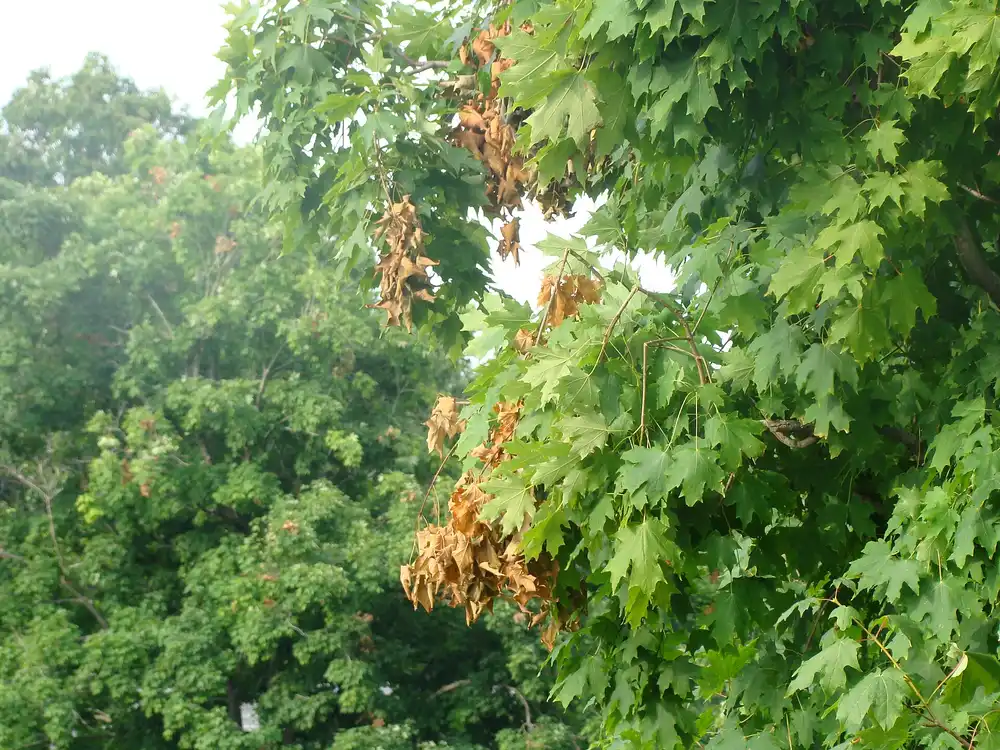
The harm that is real comes from egg-laying. The slits weaken twigs, and the leaves beyond them wither and turn brown in mid-summer, which is called flagging. The EPA says cicadas are not typically considered destructive pests, and cannot harm larger, established trees. UW Extension makes the same distinction between tree sizes.
“established trees can tolerate a fair amount of flagging and is often considered a form of natural pruning.”
Young trees are the exception. The Forest Service says ovipositing females can kill small trees, and that the damage can be prevented by covering high-value young trees with netting before emergence. The EPA specifies mesh or netting with openings of one quarter inch or smaller. UW Extension adds that severely damaged twigs can be removed and destroyed, and that delaying pruning of ornamentals from the fall before a predicted emergence until after the damage reduces how much has to be cut. Netting only makes sense for periodical emergences, because Clemson Extension notes that annual emergences cannot be predicted.
Should you spray cicadas?
No, according to the EPA.
“Pesticides are generally ineffective in keeping cicadas away. So many cicadas emerge at once that more will inevitably move in.”
The EPA also warns that spraying can harm other organisms, including animals that eat cicadas, and expose pets and people. It says cicadas will not eat leaves, flowers, fruits or garden produce, and may even help: they feed birds and other predators, can aerate lawns and add nutrients to the soil as they decompose.
Cicadas and Other Insects: Wasps, Fungus and Lanternflies
Cicada killer wasps. The large solitary wasp that stocks its burrow with paralyzed annual cicadas is the best-known cicada predator, and it has its own page: see our cicada killer wasp guide for identification, burrows and sting facts. Because it hunts annual cicadas, you see it in July and August rather than during a May periodical emergence. Lawns dotted with holes and big wasps in summer are often it, as the ground wasps guide explains (a crowd of wasps at one hole points to ground-nesting yellow jackets instead), and people sometimes report cicada killers as Asian giant hornets; our murder hornet guide shows how to tell them apart, and the European hornet guide compares that look-alike with a cicada killer. If you are unsure whether a big buzzing insect is a bee or a wasp, start with bee vs wasp.
Other predators. UW Extension lists birds, bats, cicada-hunter wasps, ground beetles, dragonflies, spiders and robber flies among the animals that eat cicadas. UConn says Magicicada have no specialized predators and survive by “predator satiation”: so many emerge that predators eat their fill without reducing the population, and predator numbers cannot build up on a food source that appears only every 13 or 17 years. Other hunting wasps take different prey; the predatory wasp comparison chart sorts them by prey, such as the great black wasp, which hunts katydids, and the great golden digger wasp, which takes crickets and grasshoppers.
The Massospora fungus. Clemson Extension says periodical cicadas can be infected by the parasitic Massospora fungus, which develops in the abdomen and makes the cicada behave strangely, often staying on the ground and spreading spores. Infected males answer other males’ calls as if they were females, spreading it further. Late in the cicada’s life the abdomen starts to fall off, revealing a white fungal mass, and the fungus makes the insect infertile. Clemson adds that the fungus is harmless to people.
Spotted lanternflies. The spotted lanternfly also feeds on plant sap, but it is an invasive planthopper, not a cicada, and its life stages and treatment are different, as the guide linked near the top explains.
Cicadas vs Locusts
Periodical cicadas are widely called “17-year locusts” or “13-year locusts,” but UConn says they are not true locusts, which are a type of grasshopper. Cicadas are true bugs (Hemiptera) that pierce plants and suck sap; true locusts are grasshoppers that chew foliage. That difference matters for gardeners: a cicada emergence will not strip a garden the way a locust swarm does, and the EPA says cicadas will not eat leaves, flowers, fruits or garden produce.
Frequently Asked Questions
Do cicadas bite or sting?
No. They have no stinger and no biting mouthparts, only a sap-sucking beak. A cicada may probe a hand or arm that it mistakes for a branch, which can hurt a little but is not a defense (UConn, EPA, USDA Forest Service).
Are cicadas harmful to people, pets or plants?
Not to people. Pets that eat many can get an upset stomach. Plants are only at risk from egg-laying, mostly on young trees, which netting prevents (EPA, University of Illinois veterinary college).
What is the difference between periodical and annual cicadas?
Periodical cicadas (Magicicada) spend 13 or 17 years underground and emerge in large synchronized broods in May and June, with red eyes and a black body. Annual cicadas, such as dog-day cicadas (Neotibicen), have adults every summer and are greenish with black markings (see the table above).
Which cicada brood emerges in 2027?
Brood XXII, a 13-year brood, per UConn’s brood table, in parts of Louisiana, Mississippi, Ohio and Kentucky. Brood XXIII follows in 2028 and Brood I in 2029.
Why are cicadas so loud?
Males flex tymbals, drum-like membranes in the abdomen, and the hollow abdomen amplifies the sound to attract females. UW Extension says some species exceed 100 decibels.
Why do periodical cicadas come out every 13 or 17 years?
Nobody knows for certain. UConn says glacial cycles and predation pressure are the leading explanations, but neither alone explains why so few insects are periodical, so some unknown factor was probably involved. Emerging together also overwhelms predators.
How long do adult cicadas live?
A few weeks. Adults mate, females lay eggs in twigs, and the adults die; the nymphs hatch about 6 to 10 weeks later and burrow underground.
What are the brown shells on trees?
They are the nymph’s last skin, called an exuvia, left behind when the adult climbed out of it at night. The shells are empty and harmless, and they decompose into organic matter (Clemson Extension).
Are cicadas locusts?
No. True locusts are a type of grasshopper, while cicadas are true bugs in the order Hemiptera (UConn, UW Extension).
The Bottom Line
Cicadas are loud, short-lived and harmless to people, so the only action worth taking is netting young trees before a periodical emergence. If you live near Baton Rouge or in southern Ohio or northern Kentucky, watch for Brood XXII in spring 2027, and do not spray.
Image credits: featured photo of a red-eyed cicada, USDA, public domain, via Wikimedia Commons; the dog-day cicada photo by John Stockla (CC BY-SA 4.0); the swamp cicada photo by NCBioTeacher (CC0); the molting cicada by Judy Gallagher (CC BY 2.0); the shell photo by Rhododendrites (CC BY-SA 4.0); the egg-laying photo by peterwchen (CC BY 4.0); the flagging photo by dankeck (CC0). All via Wikimedia Commons, resized or cropped. Charts by BeeKeepersRealm, from iNaturalist data.