Reviewed by Daniel M. · How we review
Most wasps do not make honey. Yellowjackets, hornets and paper wasps feed their young chewed-up insects, and the adults drink nectar and other sugars without storing it as honey. A few Neotropical social wasps do store honey, most famously the Mexican honey wasp (Brachygastra mellifica), found from Central America and Mexico north to South Texas. One paper wasp studied in Texas, Polistes annularis, also stores honey in autumn to get through the winter.
Educational information based on university extension and journal sources, not medical or pest-control advice. Not sure whether the insect you saw is a bee or a wasp? Start with our bee vs wasp identification guide.
Key Takeaways
- Yellowjackets, hornets and common paper wasps do not make or store honey. Their larvae eat insects, and their colonies usually last one season.
- The wasps that do store honey are social paper wasps in the genera Brachygastra and Polybia. Only one of them, the Mexican honey wasp, reaches the United States, in South Texas.
- Their honey is made from flower nectar and kept in comb inside an enclosed paper nest. It is paper comb, not wax comb.
- Wild wasp honey can be poisonous when the wasps visit toxic flowers. Do not harvest it.
- Yellowjackets and hornets raid beehives for protein, and yellowjackets can rob resources from weak colonies, but they do not make honey.
Table of Contents
- Which Wasps Make Honey and Which Do Not
- Honey Bee, Wasp and Bumble Bee Compared
- Why Honey Bees Make Honey and Most Wasps Do Not
- The Mexican Honey Wasp in Detail
- Do Hornets and Yellowjackets Make Honey?
- Frequently Asked Questions
Which Wasps Make Honey and Which Do Not
Yellowjackets, paper wasps and hornets are social wasps that build paper nests. UC IPM says their larvae need large amounts of protein, so workers forage mainly for insects, plus some sugars. Ohio State adds that adult yellowjackets live on fruit, nectar and tree sap, while the larvae secrete a sugary liquid the adults drink.
The honey-storing wasps are a small exception. A 2025 peer-reviewed study in mBio by University of Texas at Austin researchers says honey wasps feed on and store honey, documented in three Brachygastra species: B. mellifica, B. lecheguana and B. scutellaris. Wikipedia’s entry for the subfamily adds that some Polybia species store honey in the comb too, and Texas Entomology quotes a 1970 wasp textbook saying Polybia occidentalis honey is eaten in Mexico.
Species counts vary: Texas A&M AgriLife Extension says 16, Texas Entomology cites a 1968 revision that recognized 12, and Wikipedia’s genus page lists 17. Both extension-style sources agree that only B. mellifica has been reported in Texas.
A Texas paper wasp that stores honey for winter
The surprise is a more familiar kind of wasp. The same mBio paper says Polistes annularis, a paper wasp, is the only wasp known to store honey in order to overwinter. The study behind that statement was published in Science in 1979, and its abstract says the females store honey in their nests in autumn, return on warm winter days to eat it and defend it from non-sisters:
“Honey deprivation decreases numbers surviving the winter; females that do survive without honey build smaller spring nests.”
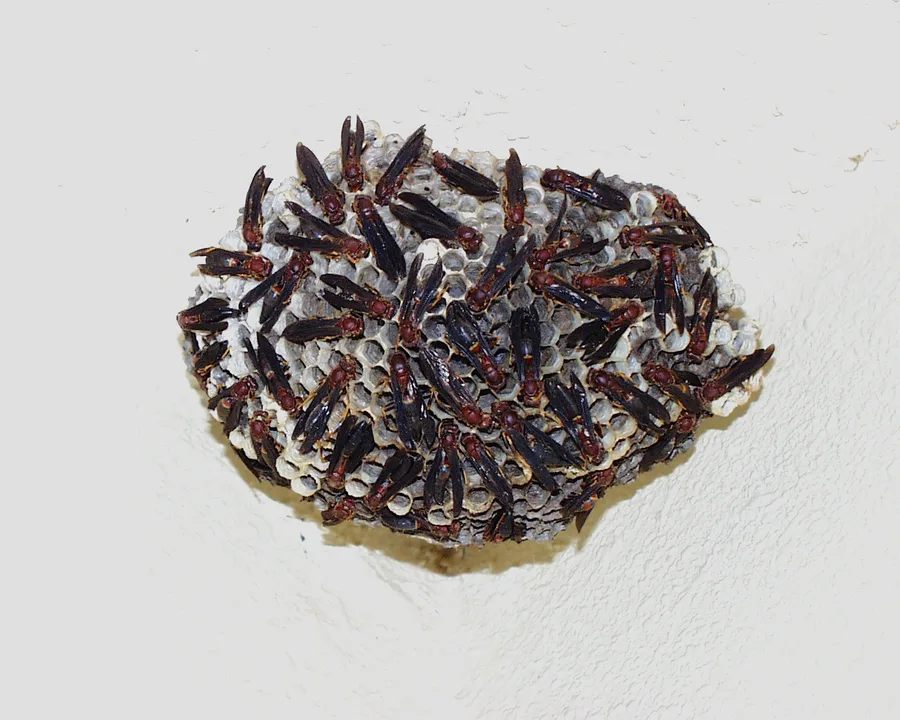
Wikipedia’s summary of the species says the reproductive females store concentrated nectar in open cells of the nest as the workers die off, and the mBio authors add that Mischocyttarus wasps store honey only short term. That is a seasonal pantry, not a perennial hive-style honey store.
Honey Bee, Wasp and Bumble Bee Compared
The table sets the honey makers beside the wasps people usually mean when they ask. Each cell comes from the source named in the last column.
| Insect | Makes or stores honey? | Comb material | Colony lasts | What larvae eat | Source |
|---|---|---|---|---|---|
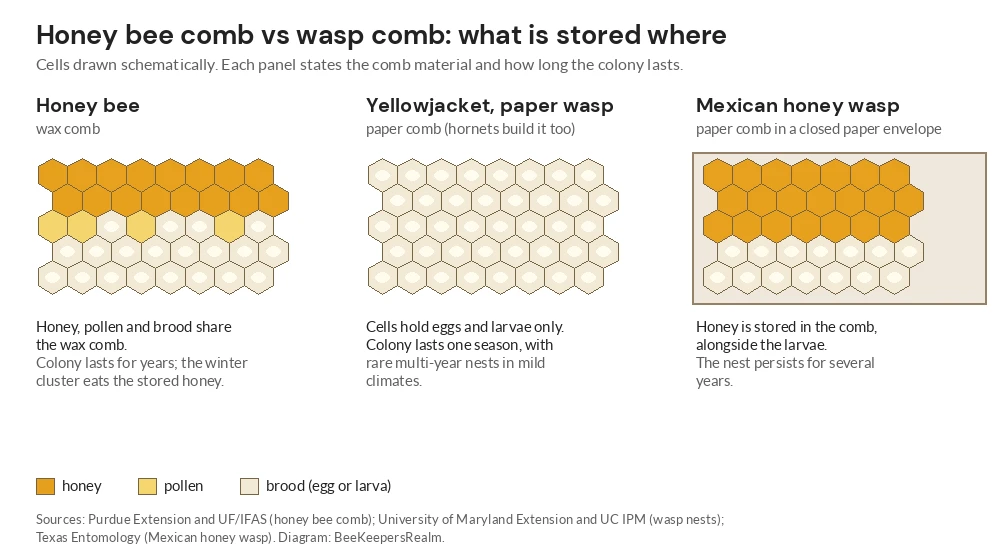
| Honey bee (Apis mellifera) | Yes, large stores | Beeswax from abdominal glands | Perennial; the winter cluster lives on stored honey | Brood jelly; older larvae also get chewed pollen and diluted honey | UF/IFAS; Penn State Extension; Purdue Extension; Wikipedia |
| Stingless bees (Meliponini) | Yes, in pots (“pot-honey”) | Cerumen, a mix of wax and plant resin | Perennial colonies | Pollen and nectar sealed in each cell with an egg | Popova et al. 2021 (Foods); Wikipedia |
| Bumble bee (Bombus) | Only small, short-term nectar stores | Empty cocoons reused for storage | One season; queens overwinter | Pollen and nectar | USDA Forest Service; Missouri Dept. of Conservation |
| Mexican honey wasp (B. mellifica) | Yes | Paper comb inside an enclosed paper nest | Several years | Sources differ: honey and pollen, or insect prey | Texas Entomology; Holley et al. 2025 (mBio) |
| Yellowjacket | No | Paper from chewed wood pulp | One season; rare multi-year nests in mild climates | Chewed insects and meat | Ohio State; UC IPM; Penn State Extension |
| Paper wasp (Polistes) | No, apart from the winter cache of P. annularis | Paper, in open cells | One season | Insects | UC IPM; Strassmann 1979 |
| Hornet | No | Paper, with a covering envelope | One year | Insects, including bee brood taken in raids | University of Maryland Extension |
Why Honey Bees Make Honey and Most Wasps Do Not
A colony that has to survive winter
Honey is a winter fuel supply. Penn State Extension describes honey bees forming a thermoregulating winter cluster that moves through the hive to reach its stored honey. The colony keeps its workers alive through the cold, so the stores matter. Most wasps work the opposite way, as the University of Maryland Extension puts it:
“Social wasp colonies only last one year, dying off each winter.”
The same page says only a handful of fertilized queens overwinter, each starting a new nest from scratch in spring, so there is no worker cluster to feed. Our guide to when wasps die off covers that cycle. UC IPM and Penn State note that in mild winters some yellowjacket nests survive for several years, and neither page mentions honey stores in them. The Mexican honey wasp is different: Texas Entomology says its nest is perennial, lasts several years, and the wasps survive the off-season on their stored honey.
Wax comb versus paper comb
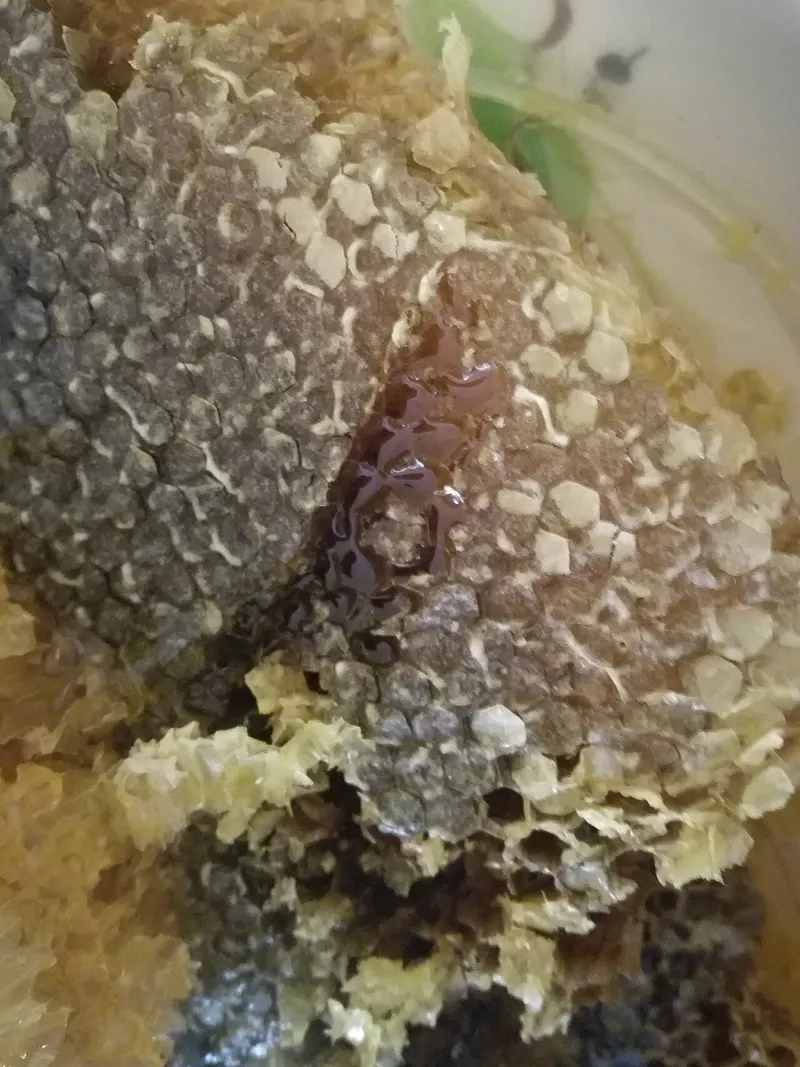
UF/IFAS says honey bees have glands on the underside of the abdomen that secrete beeswax, which they chew and shape into comb. The University of Maryland Extension says wasp nests are built from a paper-like material made from chewed wood pulp and saliva. The same page describes the cells as the brood cells where the larvae live, and Ohio State describes the larvae in yellowjacket nests as white and grub-like.
Turning nectar into honey
Purdue Extension says the conversion starts in the forager’s honey stomach, where the enzyme invertase begins breaking sucrose into glucose and fructose. The rest of the pipeline is laid out in our guide to how bees make honey. The University of Texas study adds that honey wasps get their protein from insect prey and do not consume pollen, a different diet from a bee’s.
The Mexican Honey Wasp in Detail
Range and size
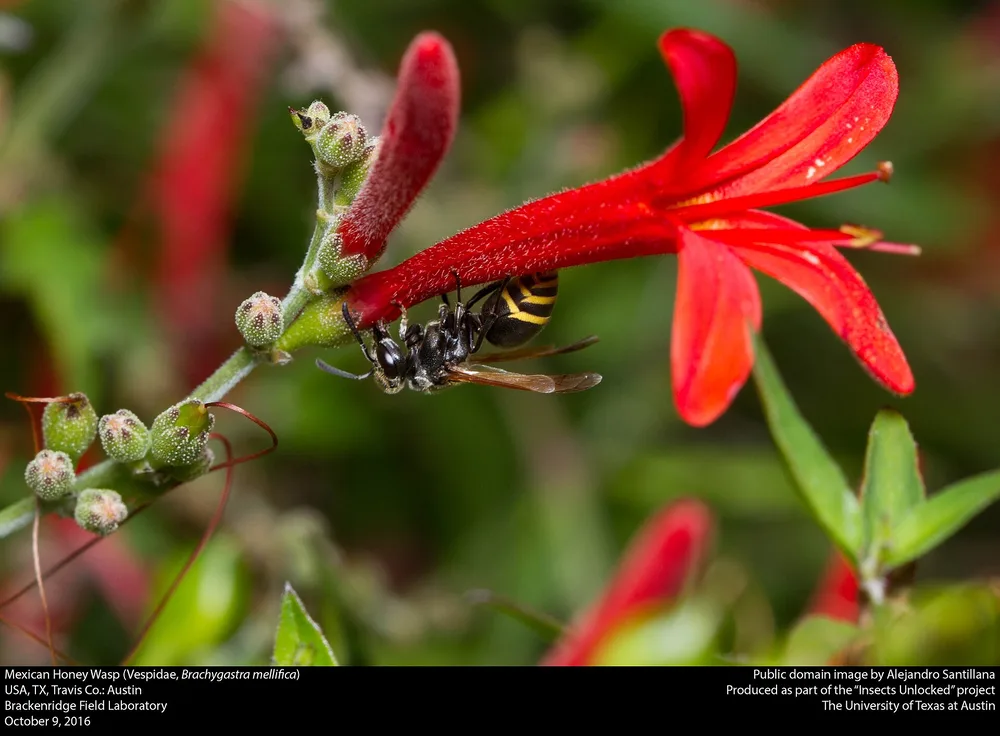
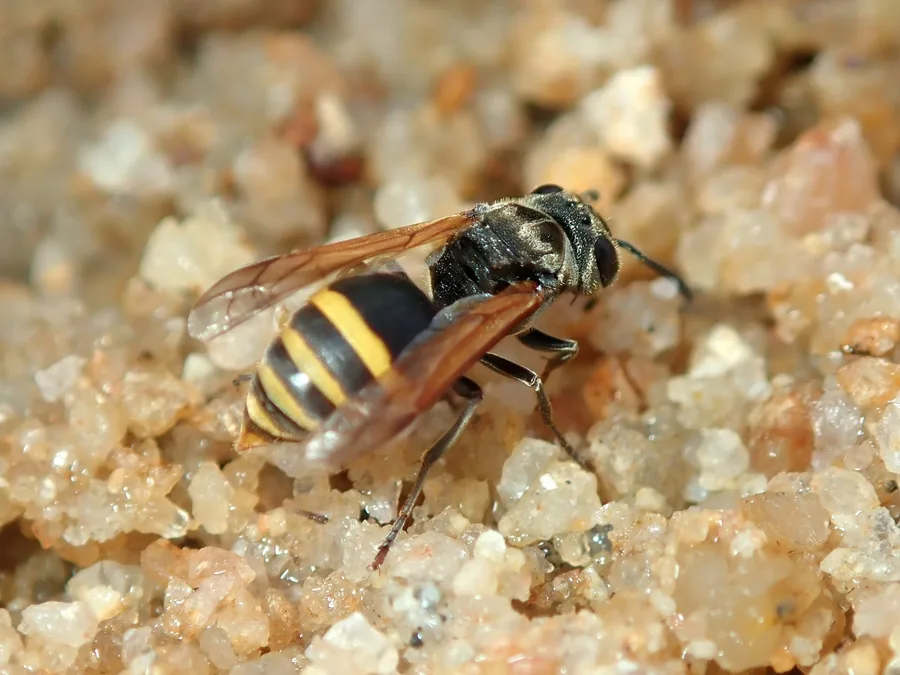
Texas A&M AgriLife Extension says the Mexican honey wasp ranges from Texas to Nicaragua and is 1/4 to 1/3 of an inch long, with a dark thorax and head and yellow and dark bands on the abdomen. Texas Entomology lists records across South Texas counties, northernmost near central Austin in October 2016. Wikipedia also gives southeastern Arizona, but Texas Entomology mentions only a 1907 Arizona record that may have been collected south of the border, so treat Arizona as unconfirmed.
The nest
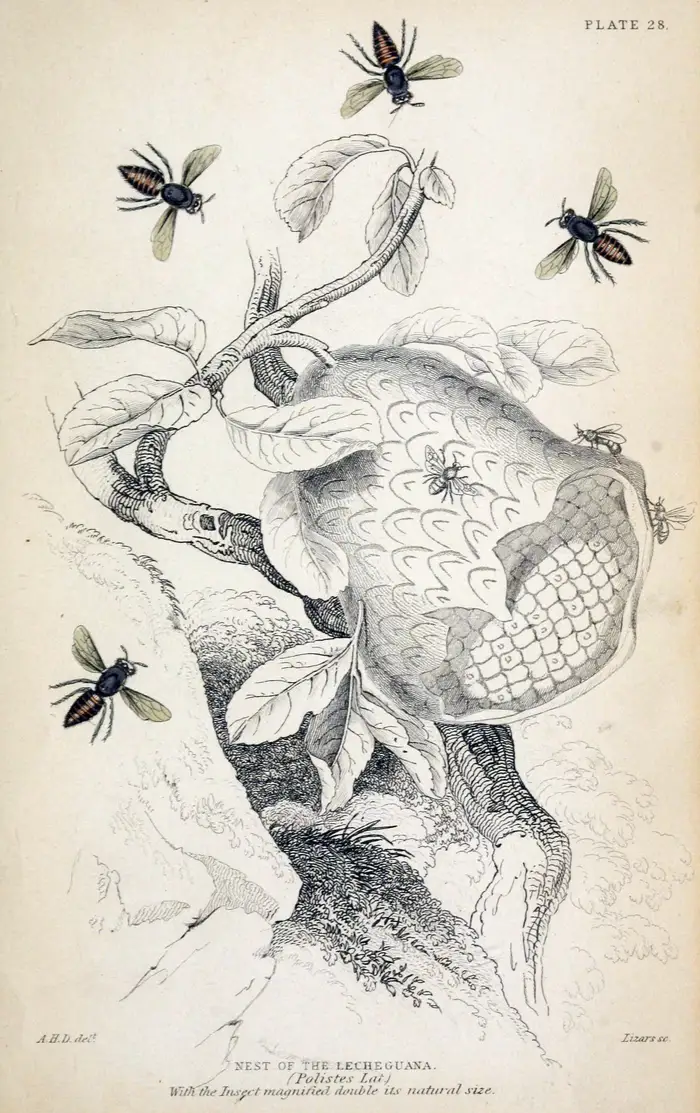
The nest is paper, hung from a branch in the canopy of a tree or shrub. Texas Entomology puts nests 1 to 9 meters above the ground, with a thin envelope and an entrance at the lower end. Mature nests are 40 to 50 cm long and hold several large combs, fewer than 10 and up to 20, arranged concentrically inside. Six mature Rio Grande Valley nests held between 3,496 and 18,698 wasps and between 60 and 1,529 queens. A yellowjacket colony, by contrast, is started by a single overwintered queen, according to UC IPM.
The honey, and its use by people
Workers gather flower nectar and store it as honey in the nest, which Texas Entomology says sustains the wasps through the off-season. A 1993 account quoted there says it is strongly scented and said to crystallize faster than bee honey. People have long used it. The same page quotes a wasp textbook describing Mexican “vespiculturists” who transplant young B. lecheguana nests, smoke the wasps out, take the honey and let the colony rebuild. Texas A&M adds that the honey and larvae are documented as a delicacy of the Popolocas people of Los Reyes Metzontla, Mexico.
Texas Entomology says a honey-filled nest may weigh several kilograms, and that a nest-founding swarm of a few hundred wasps can build a 10 to 15 cm nest in a few days. It also reports that the larvae appear to be fed honey and pollen, although the 2025 mBio paper says honey wasps do not consume pollen, so the sources disagree on that point.
When the honey is toxic
The poisoning cases are documented, not folklore. Texas Entomology quotes a 1993 entomology text:
“When Datura or other toxic blooms are available, the honey may be tainted, and cases of poisoning are not rare.”
The 1970 textbook quoted on the same page says the honey of B. lecheguana is occasionally poisonous because of nectar from certain flowers, and advises consumers to buy from a trustworthy harvester. A wild nest has no such assurance, and opening one means facing a defended colony.
Stings and safety
Texas A&M calls the wasp nonaggressive when left undisturbed, but it has a stinger and uses it if the nest is threatened, such as when branches are trimmed near it or the nest is sprayed with a hose. Texas Entomology says workers sting hard when provoked and the barbed stinger can stay in the wound. AgriLife adds that a nest high in a tree can usually be left alone, while one near the ground or near children should be removed by a professional, because these wasps can sting through a tight bee suit.
Pollinator and pest predator
AgriLife lists the wasp as a nectar gatherer and pollinator that feeds on harmful insects, including the Asian citrus psyllid, which spreads citrus greening. A 2013 Florida Entomologist paper by Reyes-Rosas and colleagues studied the wasp’s feeding behavior and preferential predation on psyllid life stages in Mexico. For the wider picture of wasps and flowers, see our guide on whether wasps are pollinators.
Do Hornets and Yellowjackets Make Honey?
No. Ohio State says yellowjacket larvae need protein from insects and meat, and the University of Maryland Extension says social wasps, hornets included, build brood cells and a nest envelope from paper-like material. Our guides to yellow jackets, paper wasps and hornets versus wasps cover their biology and identification.
Yellowjackets do take resources from bees, though. Oregon State Extension says that in late summer yellowjackets can become a problem for honey bees by robbing resources from colonies and preying on adult bees. The northern giant hornet raids hives for brood, and the University of Maryland Extension says honey is rarely taken back to its nest. Beekeepers can read how to protect beehives from yellow jackets. For the one bee that stores only a little nectar, see our bumblebee guide.
Frequently Asked Questions
Do wasps make honey?
Most do not. A few social wasps, mainly Brachygastra species such as the Mexican honey wasp, store honey, and the paper wasp Polistes annularis stores honey for winter.
What is a Mexican honey wasp?
It is a social wasp, Brachygastra mellifica, 1/4 to 1/3 of an inch long, that builds paper nests in tree and shrub canopies and ranges from Texas to Nicaragua, according to Texas A&M AgriLife Extension. It is one of the few insects other than honey bees that produce and store honey.
Do any wasps make honey?
Yes. The 2025 mBio paper documents honey storing in B. mellifica, B. lecheguana and B. scutellaris. Only B. mellifica is reported in Texas.
Why don’t wasps make honey?
Most wasp colonies last one season and winter as lone queens, they feed larvae insects and they build paper, not wax. Honey bees keep a whole colony alive through winter on stored honey.
Is wasp honey edible?
People in Mexico and Brazil have eaten honey from Brachygastra nests, and Polybia occidentalis honey is eaten in Mexico, but Texas Entomology says it can be poisonous when the nectar comes from toxic flowers such as Datura. Do not harvest wild nests.
Do wasps eat honey?
Wasps are attracted to sugar, and Oregon State Extension says yellowjackets can rob resources from honey bee colonies. Adults feed only on sugars, according to the Natural History Museum in London.
Do hornets make honey?
No. The University of Maryland Extension says honey is rarely carried back to a hornet nest, even after a raid on a honey bee hive.
Do solitary wasps produce honey?
Not in the sources reviewed here. The mBio paper compared honey wasps with non-honey-feeding wasps from six families, and the Natural History Museum says solitary wasp adults feed only on sugars.
The Short Version
Nearly every wasp nest in the United States holds brood in paper cells. The exceptions are the Mexican honey wasp’s nests in South Texas and the autumn honey cache of the red paper wasp. For beekeepers, the practical issue is defending hives from raiders, not finding wasp honey.
Featured image: a Mexican honey wasp (Brachygastra mellifica) in San Antonio, Texas. Photo: Alex Wild, via Wikimedia Commons, CC0, cropped.