Reviewed by Daniel M. · How we review
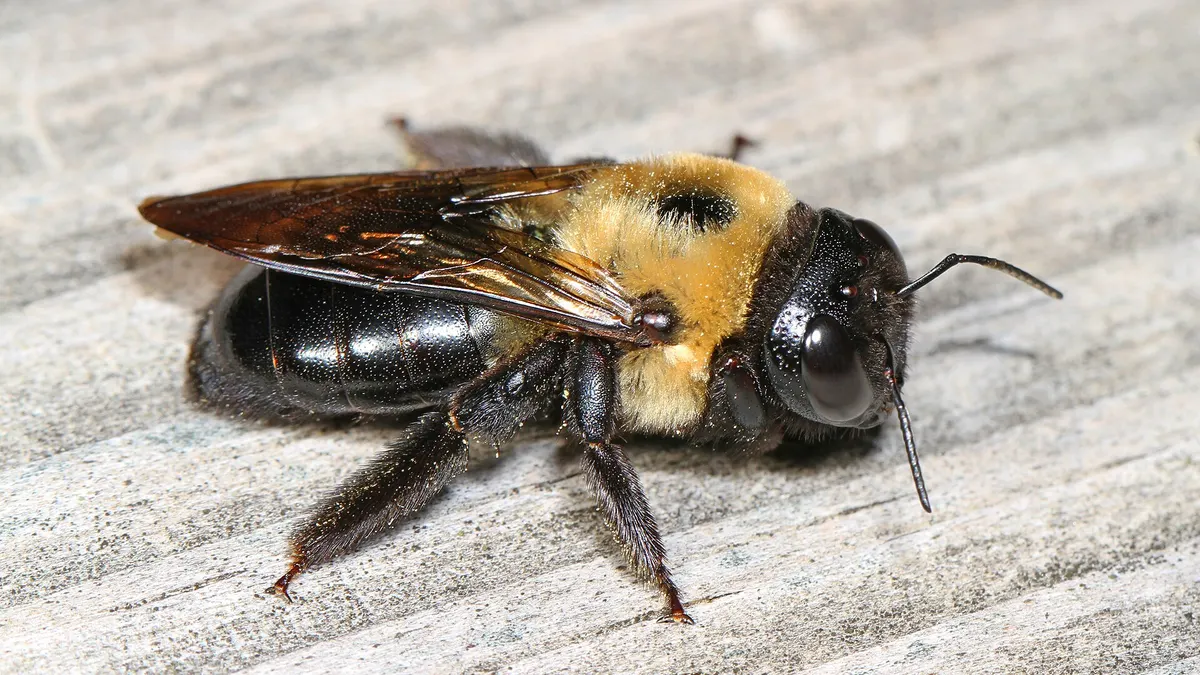
Most big, shiny black bees in the US are large carpenter bees (Xylocopa). Females have an all-dark face, while males have a pale face patch and cannot sting. Smaller black bees are usually small carpenter bees, mason bees or leafcutter bees. A black, hairless honey bee is often sick or a robber.
Educational information only, not medical or pest-control advice. Emergency: trouble breathing, a swelling throat or tongue, or dizziness after any sting means calling 911.
Key Takeaways
- Of 175,442 research-grade US iNaturalist carpenter bee records we pulled, 75.6% were the eastern carpenter bee.
- A fuzzy thorax over a bare, shiny black abdomen points to a carpenter bee. A hairy abdomen points to a bumble bee.
- Male carpenter bees hover at people but have no stinger. Females rarely sting unless handled.
- Truly all-black carpenter bees are southern and western species, not the eastern one.
- A hairless, trembling honey bee may have chronic bee paralysis virus.
- The great black wasp, blue mud dauber and some robber flies are common look-alikes.
Table of Contents
- What a “Black Bee” Usually Is
- Black Bee Identification Table
- Large Carpenter Bees
- Dark Bumble Bees
- Small Black and Blue-Black Bees
- Black Honey Bees
- Black Look-Alikes That Are Not Bees
- Frequently Asked Questions
- The Bottom Line
What a “Black Bee” Usually Is
“Black bee” is not one species. It covers large carpenter bees, a few dark bumble bees, small solitary bees and dark or bald honey bees, plus wasps and flies that are not bees at all. Our guide to the types of bees in the US covers every group; this page starts from the color.
Five checks narrow it down fast:
- Size. Around 3/4 inch or more suggests a large carpenter bee or a bumble bee queen, the biggest US native bees. Under 3/8 inch suggests a small carpenter bee.
- Abdomen hair. Penn State Extension notes a bumble bee’s abdomen is fully clothed in hair; a carpenter bee’s is bare and shiny.
- Face. A pale face patch on a big black-and-yellow bee marks a male eastern carpenter bee.
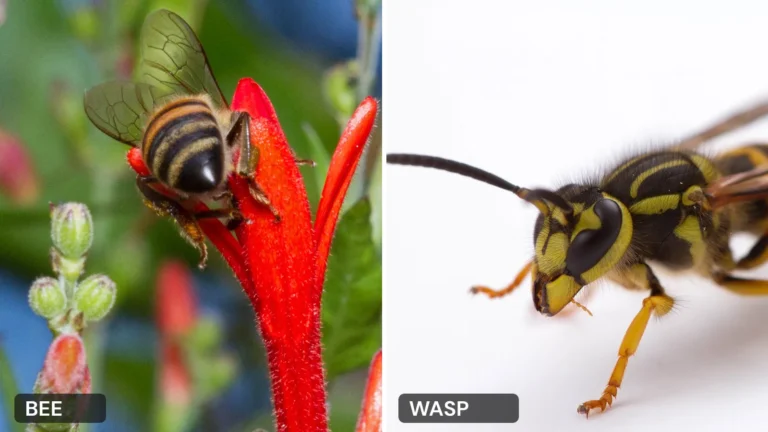
- Waist and wings. A thread-thin waist means a wasp. One pair of wings, huge eyes and short antennae mean a fly.
- Nest. Holes in bare wood, the ground, hollow stems or a hive each point to a different insect.
Backyard Ecology’s 14-minute video covers the most common black bee, the eastern carpenter bee. Its chapters explain how to tell it from a bumble bee, why males fly at you, how females tunnel into wood and how paint or stain prevents damage.
Black Bee Identification Table
Sting risk assumes you are not grabbing the insect or disturbing its nest.
| Species or group | Size | Key marks | Nest site | Sting risk | Source |
|---|---|---|---|---|---|
| Eastern carpenter bee, female (Xylocopa virginica) | About 3/4 in | Yellow-haired thorax, black, nearly bare abdomen, dark face | Round holes in bare wood | Low; stings if handled | LSU AgCenter, UKY |
| Eastern carpenter bee, male | About 3/4 in | As above, plus a pale face patch | Hovers near nest wood | None; no stinger | LSU AgCenter, UKY |
| Southern, valley and western carpenter bees, female | 5/8 to 1 in (western species) | Shiny black, sometimes with blue reflections | Bare wood | Low; stings if handled | LSU AgCenter, UC IPM |
| Yellow-faced and obscure bumble bees (Bombus vosnesenskii, B. caliginosus) | 1/2 to 1 in | Yellow face and front of thorax, black abdomen with one yellow band, hairy all over | Underground | Moderate if the nest is disturbed | USFS, PSU, MDC |
| Small carpenter bees (Ceratina) | Up to 3/8 in | Black with a blue or blue-green sheen, swollen rear end | Broken stems of weeds and roses | Very low; no nest guarding | NCSU, VAL |
| Blue orchard bee (Osmia lignaria) | About honey bee size | Dark metallic blue, no stripes | Existing holes, sealed with mud | Very low, even when handled | USFS, SARE |
| Honey bee, dark or hairless (Apis mellifera) | 1/2 to 5/8 in | Dark-bodied strain, or bald and shiny if sick or robbing | Hive or tree cavity | Moderate near the hive; barbed sting | MDC, Budge et al. |
| Great black wasp (Sphex pensylvanicus) | 1 to nearly 1 1/2 in | Satiny matte black, thread waist, smoky wings with blue sheen | Hole in the ground | Low; females only, if mistreated | MDC |
| Blue mud dauber (Chalybion californicum) | 1/2 to 1 in | Metallic blue, thread waist | Reuses other daubers’ mud nests | Low; females only, if mishandled | MDC |
| Bee-mimic robber flies (Laphria) | Most robber flies 1/2 to 3/4 in | Fuzzy body, one pair of wings, huge eyes, short antennae | None; a fly | Bites if mishandled | MDC |
Large Carpenter Bees
Big, loud and shiny black behind the wings? Start here. LSU AgCenter describes the eastern carpenter bee as “around 3/4 of an inch,” with a yellow-haired thorax and a black, relatively hairless abdomen. Our full guide to carpenter bees and wood damage goes deeper.
Male or female?
Look at the face. LSU AgCenter notes that males “may have a white or yellow spot on the face.” Females are dark-faced and drill the holes. The bee hovering in front of you near a deck is usually a male guarding his patch.
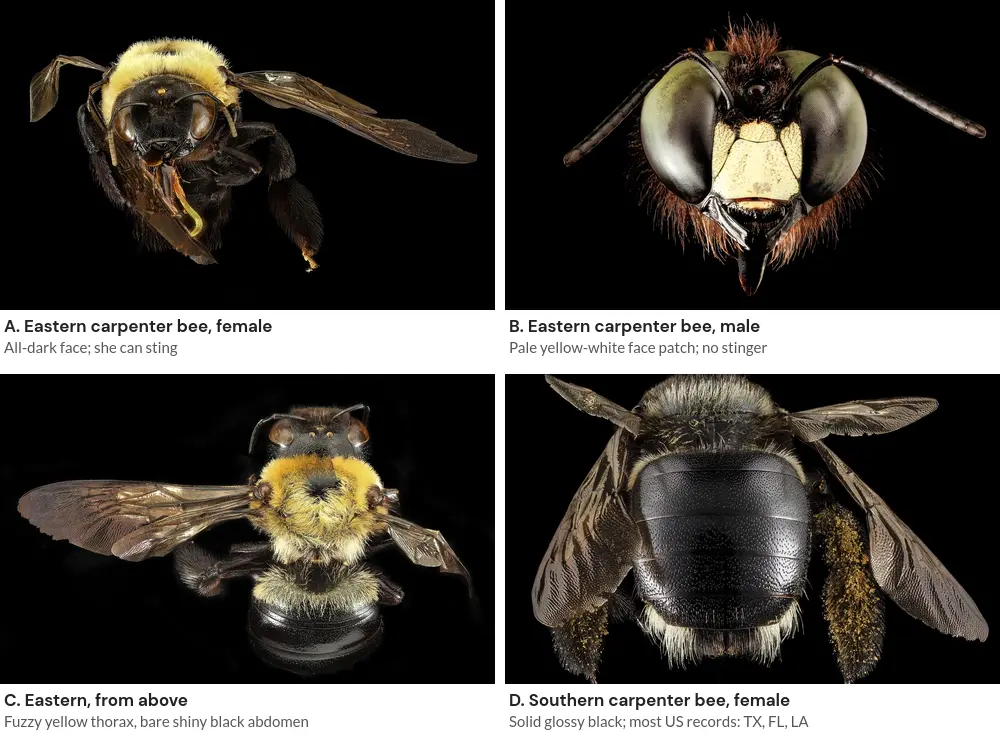
“Male carpenter bees can be especially intimidating, hovering in front of people who are around nesting sites. The males are harmless, however, since they lack the ability to sting. Female carpenter bees can inflict a painful sting but will seldom do so — unless they are handled or bothered by people.”
The all-black species
A carpenter bee with no yellow is probably not the eastern species. LSU AgCenter says southern carpenter bee adults are “solid, glossy black.” In California, UC IPM says females are shiny black or show metallic blue reflections, while males usually have pale thorax hair; the male valley carpenter bee is golden brown.
Which one lives near you
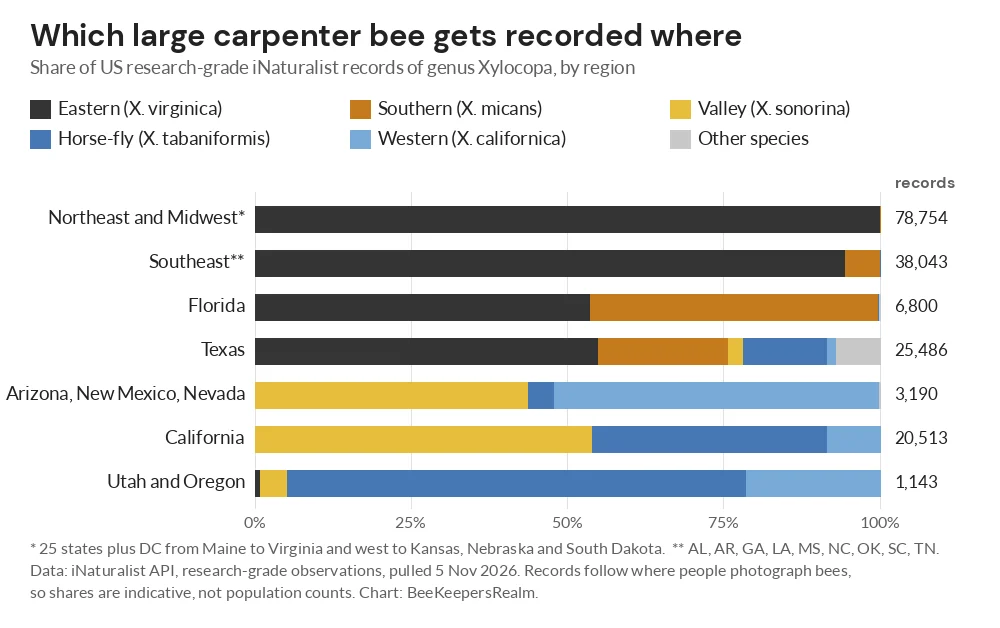
We pulled every research-grade US Xylocopa record from iNaturalist on 5 November 2026 and grouped them by region. The eastern carpenter bee made up 99.9% of records in the Northeast and Midwest and 94.4% in the rest of the Southeast. In Florida, the southern carpenter bee made up 46%. In California, the valley carpenter bee led with 54%, ahead of the horse-fly carpenter bee at 37.6%. In Arizona, New Mexico and Nevada, the western carpenter bee led with 51.9%.
Eastern carpenter bee records climb from March, dip in early summer and peak in September (25,631 records), which fits Penn State’s note that new adults emerge in August. For active holes, see how to stop carpenter bee holes in wood.
Dark Bumble Bees
Some western bumble bees look black from a distance. The US Forest Service field guide Bumble Bees of the Western United States describes the yellow-faced bumble bee, Bombus vosnesenskii, as yellow on the face and front of the thorax, with a black abdomen except for one yellow band near the tip. It rates the species “Very common, possibly increasing in abundance” in coastal California, Oregon and Washington. The obscure bumble bee, B. caliginosus, looks alike but is uncommon.
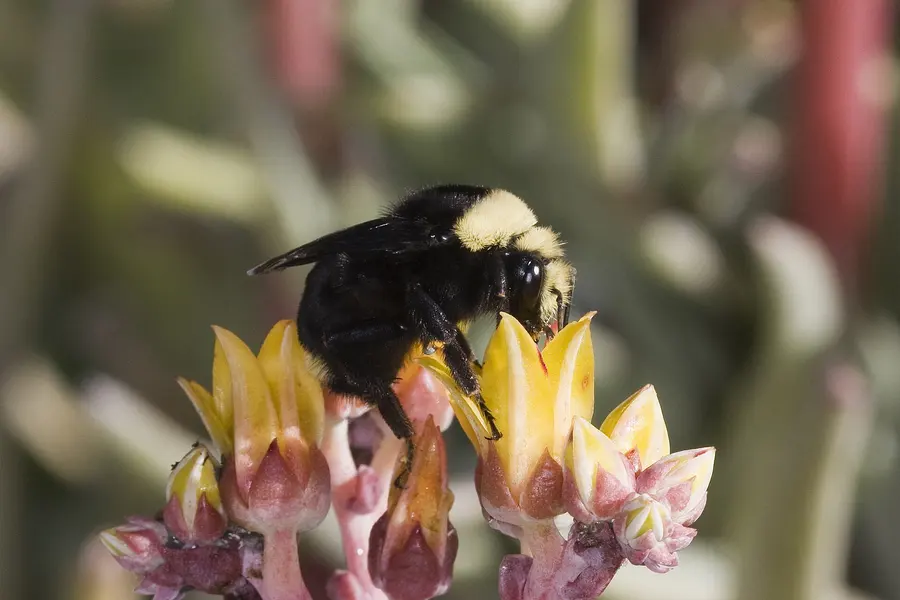
Penn State notes bumble bees nest underground. Our bumble bee identification guide covers the rest of the US species.
Small Black and Blue-Black Bees
A black bee no bigger than a honey bee is usually a solitary native bee:
- Small carpenter bees (Ceratina). NC State Extension says they are no more than 3/8 inch long, black with bluish green or blue highlights, and nest in the broken stems of weeds and roses.
- Mason bees (Osmia). The US Forest Service says the blue orchard bee is about honey bee size but “dark metallic blue, not striped brown and orange like the honeybee.” They fly in early spring and wall their nests with mud. To host them, see our mason bee house guide.
- The black leafcutter (Megachile xylocopoides). Discover Life gives the female as 14 to 15 mm and entirely black, found from Louisiana and Florida north to Maryland from March to November.
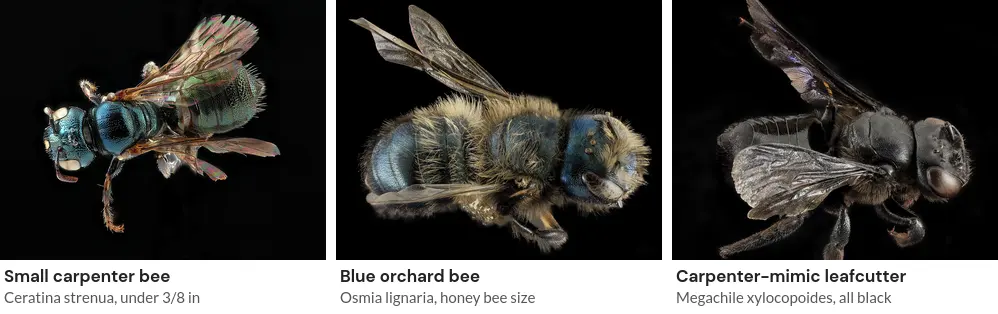
NC State notes small carpenter bees lack a nest-guarding instinct, and a Sustainable Agriculture Research and Education (SARE) handbook says female mason bees “rarely sting, even when handled.” Males have no stinger.
Black Honey Bees
Honey bees vary in color. The USGS bee lab photographed dark-bodied and light-bodied workers from one research apiary in Maryland, and some strains run dark, such as the German dark bee. Color says little about temperament; our guide to identifying Africanized bees explains why.
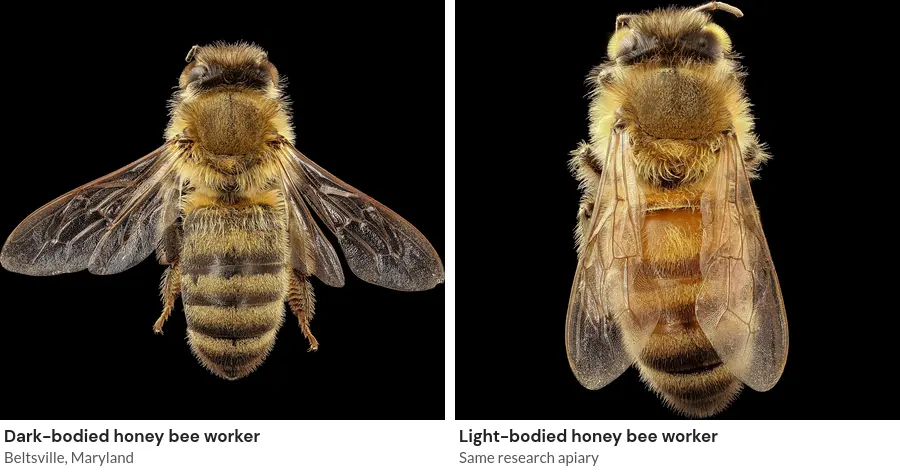
A shiny black, nearly bald honey bee is different. That is a classic sign of chronic bee paralysis virus (CBPV).
“a rare but severe chronic paralysis disease in honey bees, with very characteristic symptoms including abnormal trembling, flightlessness and shiny, hairless abdomens”
The paper adds that symptomatic bees die within a week. If trembling, hairless bees pile up at your hive entrance, read our page on trembling bees and chronic bee paralysis.
Not every bald honey bee is sick. A 2025 review in Insects by Wang and colleagues notes that robber bees often lose most of their body hair, “revealing dark, glossy abdomens.” Our guide to spotting robbing behavior early explains the signs.
Black Look-Alikes That Are Not Bees
Three insects cause most false alarms:
- Great black wasp. The Missouri Department of Conservation (MDC) describes it as “satiny matte black,” 1 to nearly 1 1/2 inches long, with a thread waist and smoky black wings with blue iridescence. Females dig a hole in the ground and stock it with a katydid or grasshopper. See our great black wasp profile.
- Blue mud dauber. MDC calls it “pretty metallic blue,” 1/2 to 1 inch long; it refurbishes other mud daubers’ nests and stocks them with black widow spiders. More in our mud dauber identification guide.
- Robber flies. These are predatory flies, and some are fuzzy bumble bee mimics.
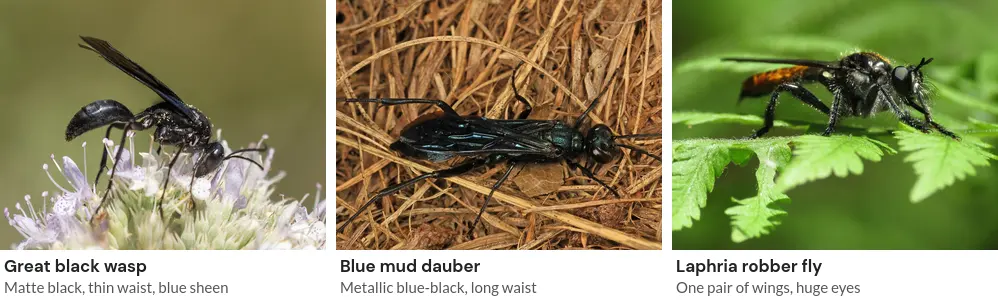
“Some robber flies in the genus Laphria look almost exactly like bumblebees, complete with yellow fuzzy patches on their rather pudgy bodies. But true flies always have the same characteristics: only one pair of wings (bees and wasps have two pairs)”
Frequently Asked Questions
What kind of bees are completely black?
In the US: southern carpenter bee adults, valley and western carpenter bee females, and the black leafcutter Megachile xylocopoides. Small carpenter bees look black but show a blue sheen up close.
Why am I seeing black bees?
Carpenter bees are active in spring, when they mate and build nests, and again from late summer, when new adults emerge. Bare, unpainted wood nearby is a common draw.
Do black bees sting you?
Rarely. Male carpenter bees and male mason bees have no stinger, and the females sting mainly when handled. Bumble bees sting mainly if their nest is threatened, MDC says. For care after any sting, follow our bee and wasp sting first aid guide.
How do I get rid of black bees?
For carpenter bees, the University of Kentucky notes they usually will not tunnel into painted wood, so painting bare wood is the more permanent fix. Small native bees in stems or soil are best left alone.
Are black honey bees aggressive?
Color alone does not tell you. Dark and light workers can come from the same apiary, and USDA ARS says even Africanized and European honey bees mostly cannot be told apart by eye. Judge a colony by its behavior, not its shade.
The Bottom Line
A big black bee with a shiny rear is a carpenter bee, and a pale-faced one cannot sting. A small black bee is likely a gentle native solitary bee. A bald, trembling honey bee needs a beekeeper’s attention. And before calling anything a bee, check for a thread waist or a single pair of wings.
Image credits: Featured photo: Judy Gallagher, via Wikimedia Commons, CC BY 2.0, cropped. Chart uses iNaturalist research-grade observations pulled 5 November 2026.