Last Updated September 15, 2026
Despite sharing a name with the large, wood-boring bee already covered on this site, small carpenter bees are a genuinely different insect with an entirely different, far less concerning nesting habit: rather than drilling into solid house siding or deck beams, they hollow out the soft pith inside broken or pruned plant stems. At barely a quarter-inch long, these tiny, often metallically colored bees are among the most overlooked native pollinators in North American gardens, easily mistaken for a fly or simply missed entirely. This guide covers what small carpenter bees actually are, exactly how their nesting habit differs from the large carpenter bees people usually worry about, their genuinely valuable pollination role, and the simple gardening practice that directly supports them.
Table of Contents
- Key Takeaways
- What Small Carpenter Bees Actually Are
- Not the Same as Large Carpenter Bees: A Genuine Distinction
- Nesting in Plant Pith, Not Wood
- A Genuinely Interesting In-Between Social Behavior
- Pollination Role and Plant Preferences
- Why “Leaving the Stems” Matters for This Species
- Which Garden Plants Provide the Best Nesting Stems
- Small Carpenter Bees vs. Large Carpenter Bees
- How Small Carpenter Bees Compare to Other Stem- and Cavity-Nesting Bees
- How Small Carpenter Bees Survive Winter
- Why Ceratina Draws Genuine Research Attention
- Common Mistakes
- Frequently Asked Questions
Key Takeaways
- Small carpenter bees (genus Ceratina) are unrelated in behavior to large carpenter bees (Xylocopa) despite the shared common name — they nest in soft plant pith, never in solid wood, and pose no structural risk to homes.
- They’re among the smallest native bees in North America, often under a quarter-inch long and dark, subtly metallic in color, which is why they’re commonly mistaken for a fly or missed entirely.
- Research on the genus has documented facultative subsociality — some nests have a mother bee remaining alongside overlapping adult offspring — making Ceratina a genuinely useful study system for how social behavior may have evolved in bees.
- The single most effective way to support them in a garden is leaving pruned or broken pithy stems (raspberry, elderberry, sumac, rose canes) standing through an entire year rather than clearing them at the first fall cleanup, since adults also overwinter inside those same stems.
- They’re broad generalist pollinators, not tied to one plant family, and their small size lets them work certain tightly structured flowers less efficiently foraged by larger bees.
What Small Carpenter Bees Actually Are
Small carpenter bees belong specifically to the genus Ceratina, part of the broader family Apidae, and are found widely across North America, typically measuring under a quarter-inch in length, small enough that they’re frequently overlooked entirely or mistaken for a fly rather than recognized as a bee at all. Most species are a dark, often subtly metallic blue-black or greenish color, sometimes with small pale yellow or white facial markings, a genuinely different look from the fuzzy, robust appearance most people associate with bees. At a quick glance they’re occasionally confused with small parasitic wasps, but a small carpenter bee’s slightly fuzzier body and pollen-collecting hairs still generally distinguish it from a wasp’s more slender, hairless build once seen up close.

Not the Same as Large Carpenter Bees: A Genuine Distinction
It’s worth being direct about this upfront, since the shared “carpenter bee” name causes real, understandable confusion: small carpenter bees (Ceratina) are an entirely different genus from the large carpenter bees (Xylocopa) covered elsewhere on this site, and critically, they don’t bore into solid wood the way large carpenter bees do. Where large carpenter bees can raise genuine, if often overstated, concerns about damage to deck rails, eaves, and siding, small carpenter bees pose essentially no comparable risk to wooden structures at all, since their nesting behavior targets a completely different material. Genuine wood-boring behavior comparable to large carpenter bees isn’t a realistic concern even in edge cases — their mandibles and excavation behavior are adapted specifically to soft pith rather than solid wood fiber.
Nesting in Plant Pith, Not Wood
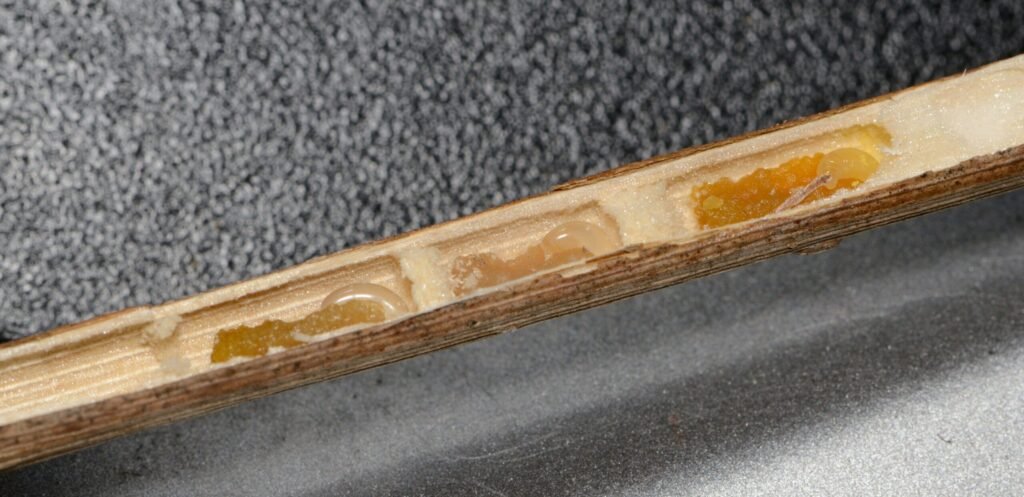
Female small carpenter bees excavate their nests inside the soft, spongy pith found at the center of broken, cut, or naturally hollow plant stems, favoring species like raspberry and blackberry canes, elderberry, sumac, rose stems, and various other pithy-stemmed plants common in gardens and wild edges. Using her mandibles, she hollows out a narrow tunnel through the stem’s center, then creates a linear series of individual cells along that tunnel, each provisioned with a mixture of pollen and nectar and separated by a thin partition, before sealing the entrance once the nest is complete. The number of cells varies by species and stem length, but a single hollowed stem commonly contains anywhere from a handful up to around a dozen cells arranged in a line, each holding one egg with its own dedicated pollen-and-nectar provision.
A Genuinely Interesting In-Between Social Behavior
Small carpenter bees occupy a genuinely interesting middle ground between fully solitary and fully social behavior that’s worth calling out honestly rather than oversimplifying: while each female provisions her own nest independently, research on several Ceratina species has documented cases of facultative subsociality, where a mother bee remains near her nest and the adult offspring overlap generationally for a period, sometimes with the mother appearing to guard the nest entrance during that overlap. In some studied nests of Ceratina calcarata, researchers have even documented a division of labor between the mother and her eldest daughter, who remains at the nest to help feed younger siblings rather than dispersing to found her own nest that season. This isn’t the organized, permanent caste-based social structure seen in honeybees or bumblebees, but it’s also not the strictly independent, no-overlap pattern typical of most other solitary bees covered on this site, making Ceratina a genuinely useful example in broader scientific discussions of how social behavior may have evolved gradually in bees. Even in these documented cases, though, there’s no shared colony structure, worker caste, or queen the way true social bees have — it’s better understood as an extended maternal presence during a transitional period than any form of true colonial organization.
Pollination Role and Plant Preferences
Small carpenter bees are genuinely valuable, if easily overlooked, pollinators, visiting a wide range of small to medium-sized flowers across gardens, meadows, and wild edges throughout their active season, generally spring through fall depending on region. Their small body size actually gives them access to certain small, tightly structured flowers that larger bees sometimes struggle to forage efficiently, giving them a genuinely complementary pollination role alongside larger native bees and honeybees rather than simply overlapping with them. They’re broad generalist foragers rather than specialists tied to one plant family — a meaningfully different strategy than the narrow plant specialization documented in specialist native bees like squash bees.
Why “Leaving the Stems” Matters for This Species
Because small carpenter bees depend specifically on broken or cut pithy stems for nesting, the increasingly popular “leave the stems” approach to pollinator gardening, deliberately leaving dead perennial stems standing through fall and winter rather than cutting them back immediately, directly benefits this species by preserving exactly the nesting material it needs. This is a genuinely low-effort, practical action gardeners can take, and it complements similar habitat-friendly practices already covered on this site for other cavity- and stem-nesting bees, offering nesting continuity across an entire gardening season rather than removing potential habitat at the first fall cleanup.
Which Garden Plants Provide the Best Nesting Stems
Beyond wild raspberry, blackberry, and elderberry, several common garden and landscape plants provide genuinely suitable pithy stems for small carpenter bee nesting, including sumac, forsythia, rose canes, and various ornamental grasses with hollow or pithy stem structures once they die back for the season. Gardeners specifically interested in supporting this species don’t necessarily need to plant anything new; simply choosing to prune stems to a partial height, leaving twelve to eighteen inches of standing stem rather than cutting plants flush to the ground, and leaving that material in place through at least one full growing season is often enough to provide meaningful nesting opportunity using plants already present in a typical garden.
Small Carpenter Bees vs. Large Carpenter Bees
| Trait | Small Carpenter Bee (Ceratina) | Large Carpenter Bee (Xylocopa) |
|---|---|---|
| Size | Under 1/4 inch | Up to 1 inch |
| Nests in | Soft plant pith (broken/cut stems) | Solid wood (bores tunnels) |
| Structural concern to homes | None | Minor, often overstated |
| Appearance | Dark, often subtly metallic | Large, fuzzy, often confused with bumblebees |
How Small Carpenter Bees Compare to Other Stem- and Cavity-Nesting Bees
Small carpenter bees join a genuinely diverse group of cavity- and stem-nesting native bees covered on this site, each with a distinct approach to finding or creating nesting space: mason bees and leafcutter bees typically use pre-existing hollow cavities, lining or partitioning them with mud or cut leaf pieces respectively, rather than excavating the nesting material themselves. Small carpenter bees are somewhat unusual within this group in that they actively hollow out their own tunnel through solid plant pith rather than simply occupying an already-open cavity, a genuinely more labor-intensive excavation process despite the bee’s tiny size.
How Small Carpenter Bees Survive Winter
Unlike many solitary bees that overwinter as developing larvae or pupae inside a sealed nest cell, adult small carpenter bees themselves commonly overwinter, sheltering inside a hollow stem, sometimes the same one they nested in, until temperatures warm again the following spring. This adult overwintering strategy is part of why leaving dead stems standing through the entire winter, rather than just through the nesting season, genuinely matters for this species specifically, since removing stems too early can eliminate the sheltering adults directly rather than just future nesting opportunities. It’s generally better to delay cutting back suspected nesting stems until well into the following spring or even early summer, since adult bees may still be sheltering inside — disposing of stems too early in a winter cleanup risks discarding living bees along with the plant material.
Why Ceratina Draws Genuine Research Attention
Beyond their garden value, Ceratina species have become a genuinely useful study system for researchers investigating the evolutionary origins of social behavior in bees, precisely because their documented facultative subsociality sits at an intermediate point between strictly solitary and fully social lifestyles. Comparative genetic and behavioral studies on small carpenter bees — including recent published work on Ceratina calcarata in North America and Ceratina teunisseni, a species endemic to Crete — have contributed meaningfully to broader scientific understanding of how cooperative brood care and colony-level organization may have gradually evolved from simpler solitary origins across the bee family tree, making this tiny, easily overlooked insect considerably more scientifically significant than its size or obscurity would suggest.
Common Mistakes
The most common mistake is assuming any bee referred to as a “carpenter bee” poses the same wood-damage concern, when small carpenter bees are ecologically and behaviorally distinct from large carpenter bees despite the shared common name. Another mistake is failing to recognize small carpenter bees as bees at all given their tiny size and fly-like appearance, leading to their genuine pollination contribution going unnoticed. People also sometimes cut back and dispose of all dead garden stems immediately each fall without realizing doing so removes active or overwintering small carpenter bee nests along with the plant debris.
Sources
For further reading, see the University of Maryland Extension’s guide to social wasps (useful for distinguishing small carpenter bees from superficially similar wasps), and the peer-reviewed research on Ceratina sociality published in Apidologie and Insectes Sociaux.
Frequently Asked Questions
Can small carpenter bees sting?
Females are physically capable of stinging but are considered extremely unlikely to do so, and their tiny size combined with a generally docile temperament makes documented stings genuinely rare, even less common than with many other solitary bees already covered on this site.
Do small carpenter bees ever nest in dead wood the way large carpenter bees do, even occasionally?
Very rarely, if ever, under normal circumstances; their mandibles and excavation behavior are adapted specifically to soft pith rather than solid wood fiber, so genuine wood-boring behavior comparable to large carpenter bees isn’t a realistic concern even in edge cases, reinforcing that the two “carpenter bee” groups remain behaviorally distinct despite the shared name.
Do small carpenter bees reuse the same stem year after year?
Yes, this is a genuinely common pattern; a hollowed-out stem often gets reused by subsequent generations or other individuals in following seasons, which is part of why leaving old stems standing rather than removing them each year provides ongoing, cumulative nesting value rather than a one-time benefit.
Does the partial “subsocial” behavior mean small carpenter bees can form anything resembling a colony?
No, even in documented cases of a mother remaining near her offspring, there’s no shared colony structure, worker caste, or queen the way true social bees have; it’s better understood as an extended maternal presence during a transitional period rather than any form of true colonial organization.
Are small carpenter bees found throughout the entire United States?
Ceratina species are widespread across most of North America, with different species adapted to different regional climates and available pithy-stemmed plants, making small carpenter bees a genuinely common, if under-recognized, presence in gardens across a broad geographic range.
How can gardeners tell if a hollow stem currently has an active nest inside?
A sealed or partially chewed-open stem tip, sometimes with tiny amounts of pith debris nearby, is a reasonable sign of nesting activity, though confirming an active nest without disturbing it typically requires simply leaving the stem undisturbed and observing for adult bee activity around the entrance during the growing season.