Last Updated September 15, 2026
Few native bees have a nesting behavior quite as genuinely unusual as plasterer bees, which line the inside of their underground nest cells with a smooth, waterproof secretion that dries into something scientists have literally compared to plastic wrap or cellophane. That waterproofing trick, produced entirely by the female bee’s own body chemistry, is why this group is also commonly called polyester bees or cellophane bees, a genuinely rare example of an insect effectively manufacturing its own synthetic-like material. This guide covers what plasterer bees actually are, exactly how their cellophane-like nest lining works and why it matters, their ground-nesting aggregation behavior, and why some species are among the last native bees active each year.
Table of Contents
- Key Takeaways
- What Plasterer Bees Actually Are
- The Cellophane Lining: A Genuinely Unusual Adaptation
- Why Waterproofing a Nest Cell Actually Matters
- Ground-Nesting in Dense Aggregations
- Seasonal Timing: Some Species Are Genuinely Late Bloomers
- Identification
- How Plasterer Bees Compare to Other Ground-Nesters on This Site
- Why Materials Scientists Have Studied Colletes Nest Linings
- A Genuinely Widespread Genus Beyond North America
- Life Cycle and Development Inside the Sealed Cell
- How the Female Actually Applies the Lining
- Common Mistakes
- Frequently Asked Questions
Key Takeaways
- Plasterer bees (genus Colletes) line their underground nest cells with a self-secreted, cellophane-like film — a natural material with genuine structural similarities to synthetic polyester, which is where the “polyester bee” name comes from.
- That waterproof lining protects developing larvae and their food stores from moisture, flooding, and mold in what is otherwise a damp underground environment.
- They nest in dense ground aggregations, but each burrow is an entirely independent, individually provisioned nest — there’s no shared colony structure.
- Several Colletes species are notably fall-active, emerging specifically to coincide with goldenrod and aster bloom after most other native bees have finished for the year.
- The cellophane-like secretion has drawn real interest from materials scientists studying naturally-produced biopolymers as inspiration for waterproof, biodegradable synthetic materials.
What Plasterer Bees Actually Are
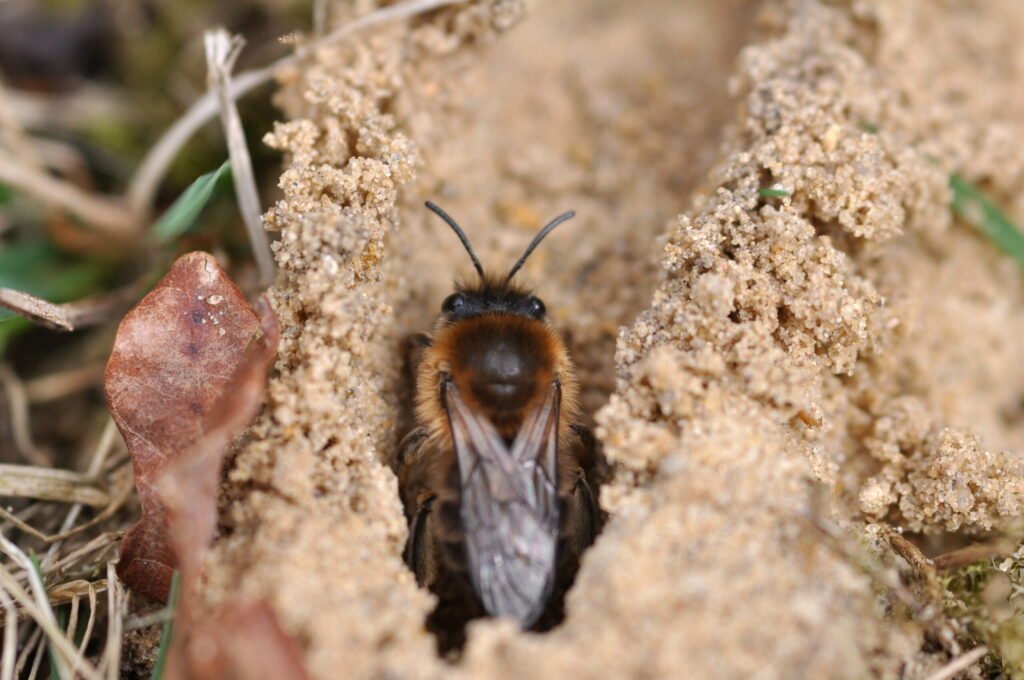
Plasterer bees belong specifically to the genus Colletes, part of the broader family Colletidae, a group considered among the more evolutionarily ancestral lineages within the bee family tree. Dozens of Colletes species are found across North America, and like every other native bee genus covered on this site, they’re entirely solitary, with each female independently digging, lining, and provisioning her own nest without any shared colony structure or worker caste.
The Cellophane Lining: A Genuinely Unusual Adaptation
The trait that earns plasterer bees their common names, polyester bee and cellophane bee, is genuinely distinctive even among the diverse nesting strategies already covered on this site: a female secretes a substance from a specialized gland and applies it with her mouthparts to the inside walls of each underground nest cell, where it dries into a thin, smooth, translucent membrane with properties researchers have directly compared to cellophane or a thin polyester film. This isn’t a loose comparison; the secretion is understood to be a true natural polyester, chemically distinct from petroleum-based plastic despite the resemblance, since it’s a biological secretion built by the bee’s own body rather than a synthetic polymer — making Colletes nest-lining one of the more scientifically interesting examples of a naturally produced material with genuinely plastic-like properties. Every North American Colletes species studied shares this same basic lining behavior; it’s considered a defining trait of the genus as a whole rather than something limited to a handful of species.
Why Waterproofing a Nest Cell Actually Matters
The cellophane-like lining serves a genuinely practical protective function: it creates a waterproof barrier around each nest cell, protecting the developing larva and its stored pollen-nectar provisions from moisture, flooding, and fungal growth in what is otherwise a naturally damp underground environment. This is a particularly valuable adaptation for species nesting in areas prone to periodic wet conditions, and it likely represents a meaningful survival advantage that’s allowed Colletes species to successfully occupy a wide range of soil types and moisture conditions across their range.
Ground-Nesting in Dense Aggregations
Like several other ground-nesting native bees covered on this site, plasterer bees frequently nest in dense aggregations, with many individual females digging separate burrows in close proximity within the same favorable patch of bare, well-drained soil. Despite the crowded, sometimes highly visible appearance of an active aggregation, each nest remains an entirely independent, individually provisioned structure, a pattern consistent with the solitary nesting behavior already documented for mining bees and digger bees elsewhere on this site. Established aggregations frequently persist in the same favorable location year after year, sometimes for many consecutive seasons, since a site that has already proven suitable in terms of soil type, drainage, and sun exposure continues attracting new females to nest there even as individual bees complete their life cycles and are replaced by subsequent generations. No documented evidence links plasterer bees to any threat against managed honeybee colonies nested nearby; the two groups don’t compete for nesting resources since plasterer bees nest in bare ground rather than cavities, and their foraging overlap is limited to sharing some of the same flowers as an incidental rather than competitive relationship.

Seasonal Timing: Some Species Are Genuinely Late Bloomers
While many native bees covered on this site are most active in spring, several Colletes species are genuinely notable for late-season activity, with some emerging specifically in autumn to coincide with fall-blooming plants like goldenrod and aster, a bloom window most other native bees have already finished exploiting for the year. This late-season specialization makes certain plasterer bee species a genuinely valuable, easily overlooked pollination resource for fall-blooming plants: since honeybee and many native bee activity levels naturally decline as temperatures drop, these late-emerging specialists can represent a disproportionately important pollination source during a window with genuinely fewer alternative pollinators available.
Identification
Plasterer bees are generally medium-sized, often with a robust, somewhat fuzzy appearance and pale horizontal banding across the abdomen that can superficially resemble a small honeybee or sweat bee at a glance. Close inspection of an active nesting aggregation, along with the characteristic timing of emergence for the specific local species, tends to be a more reliable identification approach than color pattern alone, since banding patterns vary meaningfully across the many different Colletes species found across North America. Distinguishing a plasterer bee aggregation from a mining bee or digger bee aggregation by surface appearance alone is genuinely difficult, since bare-ground burrow entrances can look broadly similar across several ground-nesting genera — timing offers the most useful practical clue, since an aggregation active specifically in fall around goldenrod or aster bloom is more likely to be a late-season plasterer bee species than the earlier-active mining or digger bees covered elsewhere on this site.
How Plasterer Bees Compare to Other Ground-Nesters on This Site
| Bee | Genus | Distinctive Nest Feature | Typical Active Season |
|---|---|---|---|
| Plasterer bee (this article) | Colletes | Cellophane-like waterproof cell lining | Varies by species, some notably fall-active |
| Mining bee | Andrena | Small volcano-shaped soil mounds | Early spring |
| Digger bee | Anthophora | Some species build mud chimneys | Spring-early summer |
Why Materials Scientists Have Studied Colletes Nest Linings
The cellophane-like secretion produced by plasterer bees has drawn genuine interest beyond entomology specifically, including from researchers studying naturally occurring biopolymers for potential biomimetic applications — the broader field of designing synthetic materials inspired by biological ones. The secretion is produced by a specialized gland and cures from a liquid into its final waterproof film after exposure to air; understanding exactly how a bee produces a durable, waterproof, plastic-like film using entirely biological processes offers a genuinely interesting real-world example of natural material engineering that predates and operates independently of human polymer chemistry. Biomimicry researchers have specifically pointed to this trait as a potential model for green, biodegradable waterproof coatings, an application area distinct from but inspired by the bee’s own nest-building chemistry, making Colletes nest linings a small but genuinely noteworthy case study occasionally referenced in that broader research context.
A Genuinely Widespread Genus Beyond North America
Colletes is not limited to North America; plasterer bee species are found across much of the world, including Europe, Asia, and other regions, with the shared cellophane-lining trait documented consistently across the genus regardless of geographic location. This wide distribution and behavioral consistency has made Colletes a useful comparative subject for researchers studying how a single distinctive nesting adaptation can remain stable across many different species occupying a genuinely broad range of climates and habitats worldwide.
Life Cycle and Development Inside the Sealed Cell
Once a female plasterer bee finishes lining and provisioning a nest cell with pollen and nectar, she lays a single egg and seals the cell before moving on to construct the next one in the same burrow. The egg hatches within days, and the larva feeds on the stored provisions over the following weeks, protected throughout by the waterproof cellophane-like lining, before pupating and eventually overwintering as a fully developed but dormant adult inside the sealed, weatherproof cell until conditions trigger emergence the following season. This overwintering-as-adult pattern, combined with the cell’s waterproof protection, gives plasterer bee offspring a genuinely resilient defense against both moisture damage and temperature swings during the long dormant period between active seasons. As with most other solitary ground-nesters on this site, plasterer bee nests also draw cleptoparasitic attention: several cuckoo bee species specifically target Colletes nests, following the same nest-parasitism strategy covered in more depth in this site’s guide to cuckoo bees, sneaking into an unattended cell to lay their own egg rather than provisioning independently.
How the Female Actually Applies the Lining
The application process itself is genuinely worth describing in some detail: after excavating a nest cell, the female uses her short, forked tongue to paint the secretion onto the cell walls in thin layers, working it into a smooth, continuous coating rather than a single thick application. The material is initially applied as a liquid or semi-liquid substance that cures and hardens into its final waterproof form after exposure to air, a curing process broadly analogous, though biologically distinct, from how certain synthetic coatings and sealants cure once applied. This careful, methodical application behavior, repeated for every single cell in a nest, represents a genuinely significant time and energy investment for the female relative to the simpler cell preparation seen in many other solitary bees.
Common Mistakes
The most common mistake is assuming a dense plasterer bee nesting aggregation represents a single shared colony, when it’s actually many entirely independent solitary nests clustered in the same favorable ground. Another mistake is treating fall-active plasterer bee species as unusual or out of season simply because most other bee activity has already declined by that point, when late-season emergence is a normal, well-documented trait for several species within this genus specifically. People also sometimes assume the smooth cellophane-like cell lining is a defect or contamination if a nest is accidentally exposed, when it’s actually a completely normal, functional part of the bee’s protective nest architecture.
Sources
For additional authoritative detail, see the Xerces Society’s Pollinator Conservation Program and AskNature’s summary of the waterproof-secretion biological strategy plasterer bees use, referenced in biomimicry research.
Frequently Asked Questions
Are plasterer bees aggressive toward people near a nesting aggregation?
No. Like nearly every solitary bee covered on this site, plasterer bees are generally docile and pose very low sting risk — females are physically capable of stinging but documented stings are rare and generally only occur with direct handling, since there’s no shared colony to defend and little evolutionary incentive to behave defensively toward someone simply walking near an active aggregation.
Can homeowners intentionally attract plasterer bees to a yard?
Maintaining bare, undisturbed, well-drained soil patches, similar to the habitat recommendation for other ground-nesting native bees on this site, along with fall-blooming native plants like goldenrod and aster for late-season species specifically, are the most practical, genuinely effective ways to support plasterer bee populations.
Do plasterer bees produce honey the way honeybees do?
No. Like every solitary bee covered on this site, plasterer bees don’t produce or store surplus honey; each female collects only enough pollen and nectar to provision her own individual nest cells.
Is the term “polyester bee” used interchangeably with “plasterer bee” in scientific literature?
Yes. Both common names, along with “cellophane bee,” refer to the same genus and the same cellophane-like nest-lining behavior, with regional and publication preference generally determining which specific common name gets used.
Do plasterer bee aggregations move to a new location each year, or return to the same spot repeatedly?
Established aggregations frequently persist in the same favorable location for many consecutive seasons, since a site already proven suitable in soil type, drainage, and sun exposure keeps attracting new females even as individual bees complete their life cycles and are replaced by later generations.
Is the cellophane-like lining actually made of anything resembling plastic chemically?
Not literally synthetic plastic, since it’s a naturally secreted biological substance rather than a petroleum-based polymer — but it shares real structural similarities with synthetic polyesters, which is precisely where the “polyester bee” common name comes from rather than being purely descriptive shorthand.