
Reviewed by Michael R. · How we review
The main types of wasps in the United States fall into three working groups: social wasps (yellowjackets, paper wasps and hornets), solitary hunters (mud daubers, potter and mason wasps, cicada killers, spider wasps) and parasitic or plant-feeding wasps (ichneumons, braconids, cuckoo wasps, gall wasps, fig wasps and horntails). Only the social group lives in a colony and defends a nest. Check the nest and the behavior first, then color, size and waist.
Educational information, not medical or pest-control advice. After a sting, see our sting first aid guide; call 911 for trouble breathing or a swelling face, tongue or throat.
Key Takeaways
- Oregon State University Extension counts about 107,000 described wasp species worldwide. Yellowjackets and hornets are only about 1% of them.
- Most wasps are loners that do not defend a nest. The ones to give space are the colony builders: yellowjackets, paper wasps, bald-faced hornets and European hornets.
- The nest identifies a wasp faster than its color: an open umbrella is a paper wasp, a gray paper ball in the open is a bald-faced hornet, a hole with traffic is a yellowjacket, mud tubes are a mud dauber.
- Only females sting. Horntails cannot sting, and cuckoo wasps have a greatly reduced sting that is harmless to people.
- Only one true hornet, the European hornet, is established in the U.S. The bald-faced hornet is a yellowjacket.
Table of Contents
- How Many Types of Wasps Are There?
- A Photo Key: Which Wasp Is It?
- Types of Wasps at a Glance
- Social Wasps: Yellowjackets, Paper Wasps and Hornets
- Solitary Hunting Wasps
- Parasitic, Gall, Fig and Wood Wasps
- How Big Is Each Wasp?
- What Wasps Do for Us
- Which Wasps Threaten Honey Bees?
- Bee or Wasp? A Quick Table
- Stings and Nests: Where to Go Next
- Frequently Asked Questions
- The Bottom Line
How Many Types of Wasps Are There?
Scientists have described about 107,000 wasp species, according to the 2024 Oregon State University Extension wasp guide. Illinois Extension gives about 103,000 and says roughly 33,000 are stinging wasps, of which only about 1,000 are social. University of Maryland Extension says Maryland alone is home to over a thousand wasp species, and very few are social.
“A huge majority of the 107,000 described wasp species cannot sting.”
So “types of wasps” has two honest answers. By family tree there are dozens of families, most of them tiny and unnoticed. By lifestyle, which is what you can see in a yard, there are four types:
- Social wasps build a paper nest and raise young together. A queen starts the colony each spring, and the colony dies off in winter.
- Solitary hunters work alone, paralyze prey and seal it in a burrow or mud cell with one egg. Most are not defensive.
- Parasitoids lay an egg on or in one host insect or spider, which the larva eats. Oregon State separates “stinging” parasitoids from true parasitoids with a long egg-laying tube.
- Plant feeders: gall wasps, fig wasps and the sawfly and horntail group.
The wasps people argue about are in the first group, and that is a small slice. Hornets are wasps too; see hornet vs wasp for how the names differ.
A Photo Key: Which Wasp Is It?
This key starts with what you can see without getting close: a nest and what the wasps are doing. Work down the steps; each card lists the cue that separates that wasp from its lookalikes.
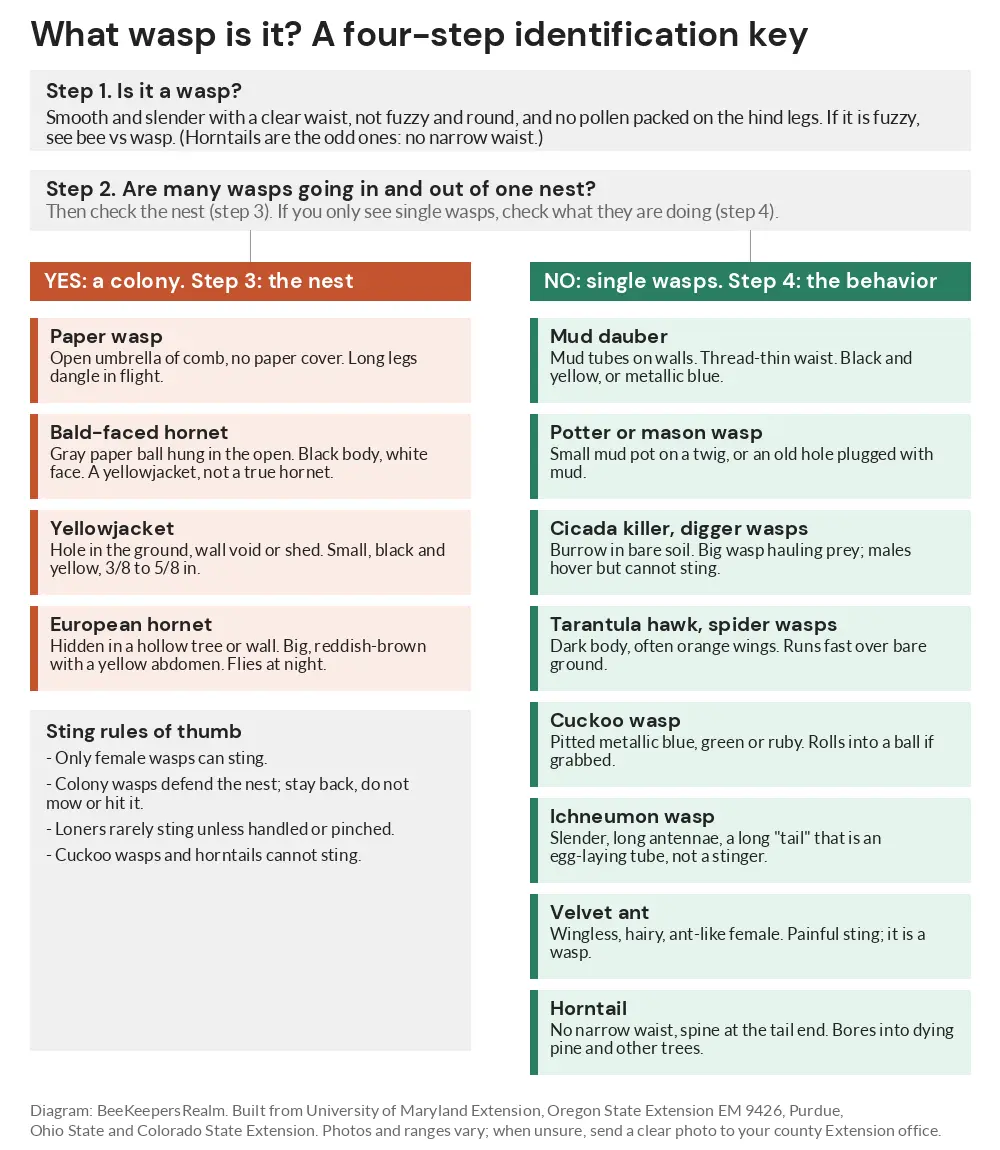
Color alone misleads. Mud daubers, potter wasps and paper wasps can all be yellow and black, and Oregon State notes that mud daubers can look like paper wasps and often nest in the same places. Behavior is the tiebreaker: Oregon State says mud daubers are solitary, do not guard their nests and will not sting people walking by. If you cannot tell, take a clear photo from a distance and send it to your county Extension office.
Types of Wasps at a Glance
The table lists the wasps a U.S. reader is most likely to meet, with a link to our full guide wherever one is published and indexed.
| Wasp | Looks like | Nest | Temperament | Our guide |
|---|---|---|---|---|
| Social wasps: nest defenders | ||||
| Yellowjackets | 3/8 to 5/8 in; black and yellow; much less hairy than a honey bee | Enclosed paper nest in ground burrows, wall voids, sheds or dense shrubs; thousands of workers in large nests | Easily agitated; defends the nest hard | Yellow jackets and beehives |
| Paper wasps | 5/8 to nearly 1 in; yellow, reddish-brown or near-black; long legs | One open umbrella comb; about 20 to 75 members | Less defensive than yellowjackets; may bump an intruder first | Paper wasps |
| European paper wasp | Yellowjacket-like, but antennae mostly orange | Open umbrella comb | Like other paper wasps | European paper wasp |
| Bald-faced hornet | 5/8 to 3/4 in workers; black and white with a white face | Gray paper ball in the open, 3 to 60+ ft up | Defends its nest | Bald-faced hornet |
| European hornet | 3/4 to 1 3/8 in; reddish-brown, golden-yellow abdomen, teardrop marks | Fragile tan nest hidden in hollow trees, barns or wall voids; 200 to 400 workers | Flies day and night; drawn to lights | European hornet |
| Yellow-legged hornet | 3/4 to 1 1/4 in queens; yellow face, yellow lower legs | Open, hanging from a tree branch; egg-shaped later nest | Hunts honey bees at the hive | Yellow-legged hornet |
| Northern giant hornet | 1 1/2 to 2 in workers; yellow head | Usually underground, in old rodent burrows | Not aggressive to people unless handled or defending | Northern giant hornet |
| Solitary hunters: usually harmless | ||||
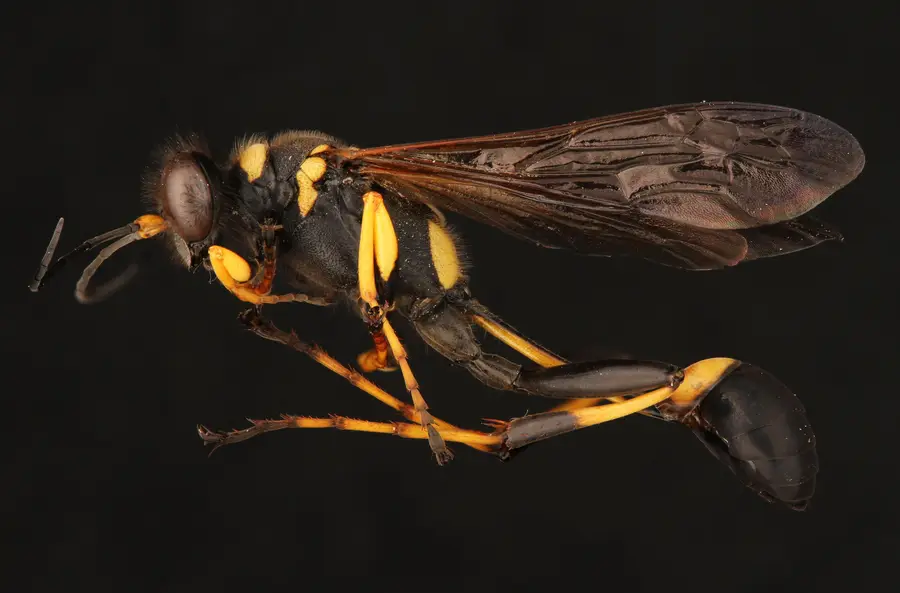
| Mud daubers | 20 to 30 mm; thread-thin waist; black and yellow or metallic blue | Mud tubes or cells on buildings, stocked with spiders | Will not sting passersby | Mud daubers |
| Potter and mason wasps | 10 to 20 mm; yellow-and-black or white-and-black stripes; wings folded in half at rest | Potter: small pot of mud. Mason: an old cavity plugged with mud | Rarely aggressive | Potter wasps |
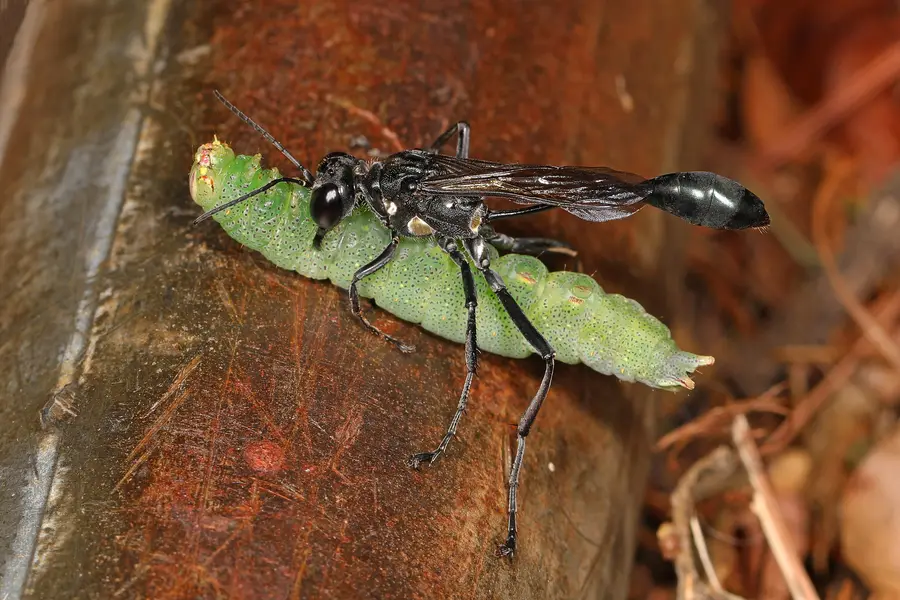
| Thread-waisted, digger and sand wasps | Slim waisted hunters of caterpillars, katydids, crickets and flies | Burrows in soil | Not defensive | Thread-waisted, great golden digger, great black, sand wasps |
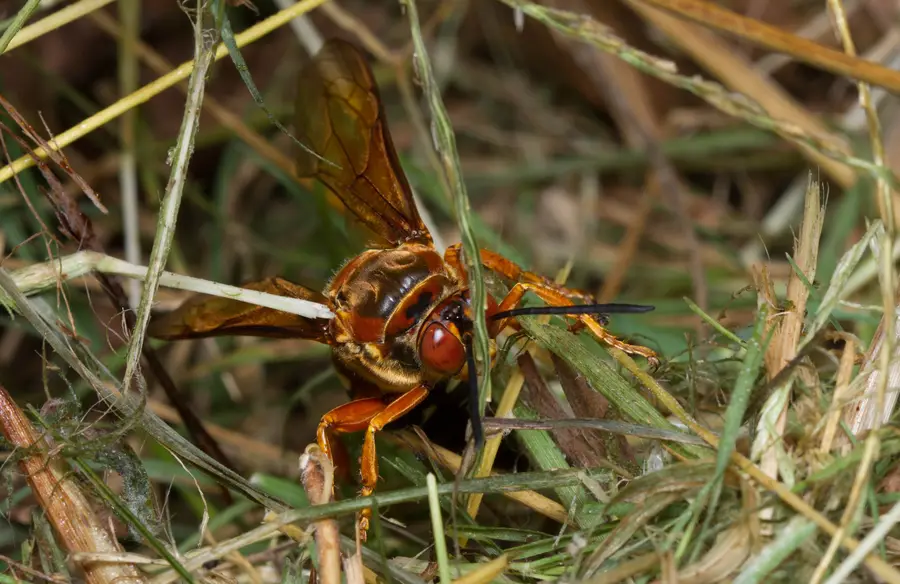
| Cicada killer | 1 1/8 to 1 5/8 in; black with yellow to white stripes, dark red head and thorax | Burrow 6 to 10 in deep with a soil mound | Males harmless; females sting only if handled roughly | None yet |
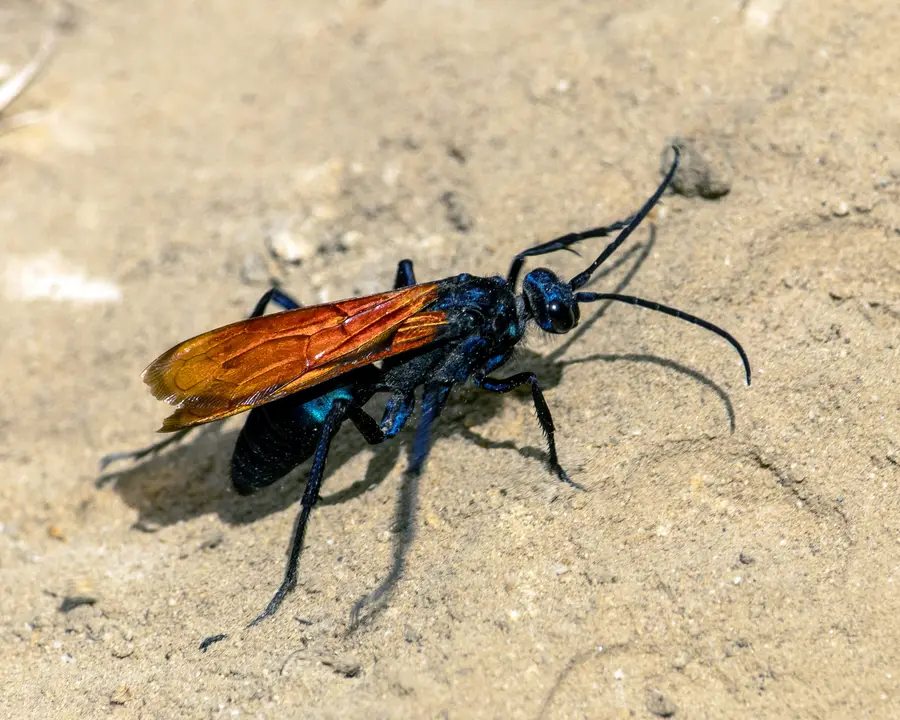
| Spider wasps, tarantula hawk | Dark; long curled antennae; spiny hind legs. Tarantula hawks reach 2 in, with orange or black wings | Burrow or mud tube holding one spider | Docile; females can deliver a very painful sting | Tarantula hawks |
| Blue-winged (scoliid) wasps | Dark wasp with blue-tinged wings | Digs down to beetle grubs | Not aggressive | Scoliid wasps |
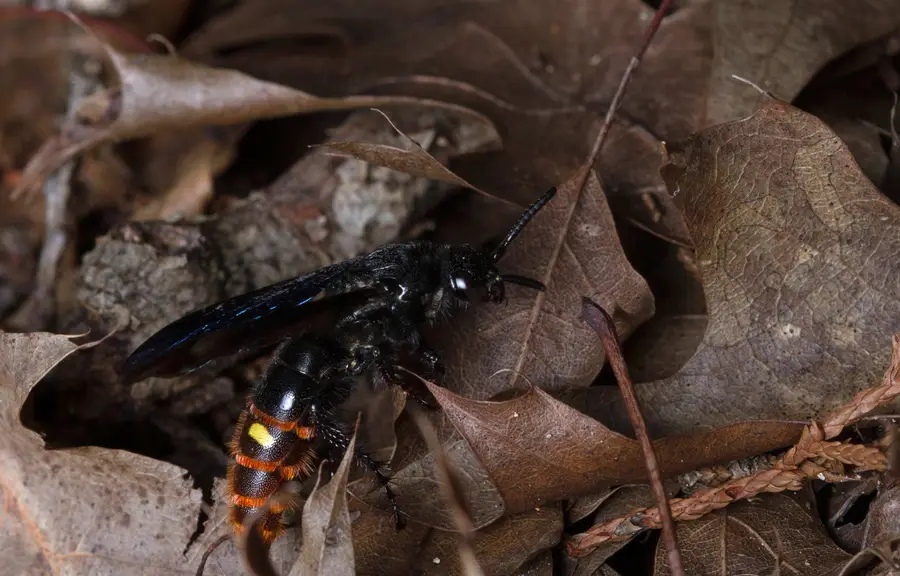
| Velvet ants | 6 to 20 mm; females wingless, hairy, ant-like; males winged | None; larvae develop in other bees’ and wasps’ nests | Painful but low-toxicity sting | Velvet ants |
| Parasitic, gall, fig and wood wasps | ||||
| Ichneumon wasps | Slender; long antennae; female has a long egg-laying tube; up to 1 1/2 in | None; eggs go into caterpillars, grubs and pupae | Most are harmless | Ichneumon wasps |
| Braconid wasps | Mostly tiny; their white cocoons ride on hornworms | None | Do not sting people | Braconid wasps |
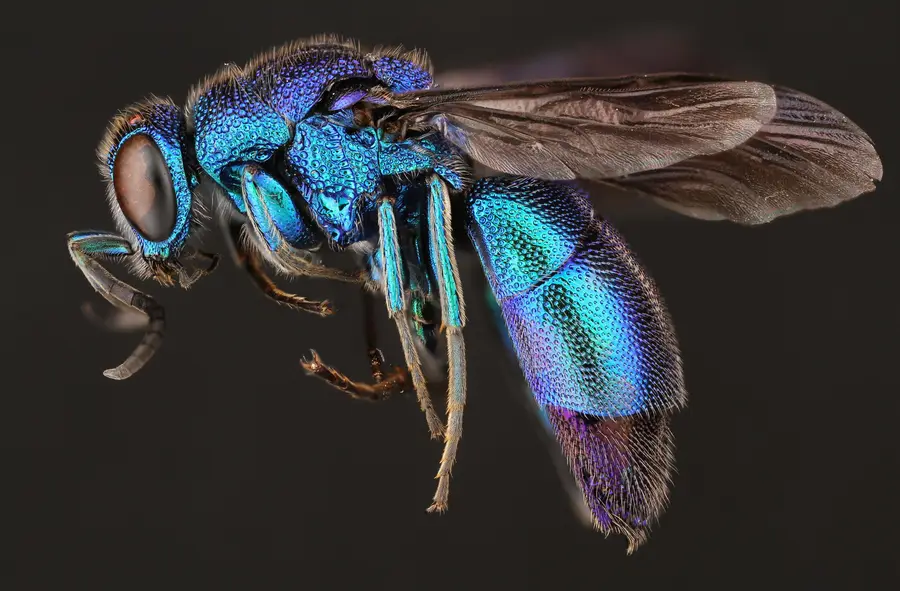
| Cuckoo wasps | 3 to 12 mm; pitted metallic ruby, green or blue | None; lays eggs in other wasps’ and bees’ nests | Cannot sting | None yet |
| Gall wasps | 1 to 8 mm; often dark and “humpbacked” | A plant gall, mostly on oak and rose | Do not sting people | None yet |
| Fig wasps | Tiny; live inside figs | Inside the fig | Not a yard wasp | None yet |
| Horntails (wood wasps) | No narrow waist; a spine at the abdomen tip | Larvae tunnel in dying trees | Stingless | None yet |
Sources: University of Maryland Extension (social wasps, parasitoid wasps); Oregon State University Extension EM 9426; Ohio State University Extension ENT-63 (cicada killer); University of Arkansas Division of Agriculture (tarantula hawk); Purdue, Illinois, Colorado State and Virginia Tech Extension. Ranges are as published; individual wasps vary.
Social Wasps: Yellowjackets, Paper Wasps and Hornets
University of Maryland Extension says social wasps live in a single nest with dozens or thousands of members that build it, find food, raise young and defend it together. Colonies last one year; the old nest is not reused, and only fertilized queens overwinter. They sting when a nest is threatened or when a worker is protecting itself or its food. The same source says individual wasps can sting repeatedly, unlike honey bees. Colonies are smallest in spring and largest by late summer or early autumn, when the social order can begin to break down and workers may be more easily agitated.
Yellowjackets and paper wasps
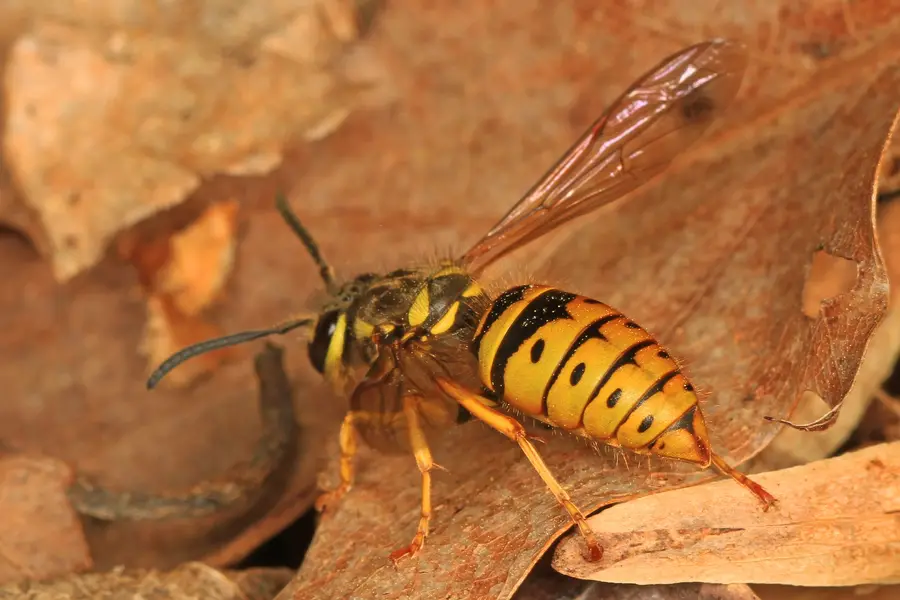
These are the two groups behind most stings. University of California IPM calls yellowjackets “by far the most troublesome group” of social wasps, especially ground- and cavity-nesting species that defend the nest vigorously. Maryland Extension adds that yellowjackets can seem to sting without cause, release an alarm pheromone, and can be set off by vibrations from a mower or hedge clippers. Paper wasps are the milder cousins: less yellow, longer legs, an exposed single comb. The European paper wasp, introduced from Eurasia, is the one with mostly orange antennae.
Hornets: which ones are really here
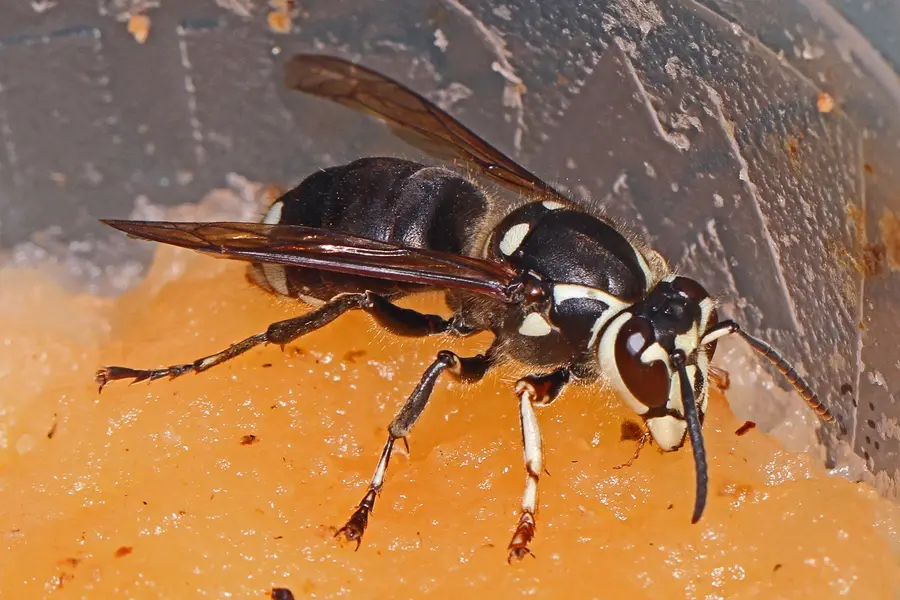
Hornets are wasps of the genus Vespa. Maryland Extension calls the European hornet the only true hornet established in the U.S.; it has lived in North America for over a hundred years. The bald-faced hornet is an aerial yellowjacket, native and widespread.
Two more hornets make the news. The yellow-legged hornet was first detected in the U.S. near Savannah, Georgia, in August 2023. Clemson University’s Regulatory Services reported in July 2026 that its honey bee protection program, backed by USDA APHIS, is still surveying for it in South Carolina, and South Carolina Public Radio reported on September 8, 2026 that crews were still destroying nests in South Carolina and Georgia. The northern giant hornet, once called the “murder hornet,” is not a current yard problem: the Washington State Department of Agriculture says it and USDA declared the species eradicated from Washington and the United States. Report a suspected sighting of either to your state agriculture department.
Solitary Hunting Wasps
A solitary wasp has no colony to guard. The female hunts, paralyzes prey with a sting, stocks a cell and leaves. Purdue Extension sums up the result:
“However, solitary wasps very rarely sting, and then only if mishandled.”
Mud daubers, potter wasps and mason wasps
Mud daubers are 20 to 30 mm long with a very thin waist. The black-and-yellow mud dauber builds a clump of parallel mud cells, the organ-pipe mud dauber builds mud tubes, and the metallic blue one reuses old nests. Each cell holds paralyzed spiders and one egg. Potter wasps build the small mud pots and mason wasps use existing cavities; both stock caterpillars.
Digger, thread-waisted and sand wasps
Illinois Extension notes that great golden digger wasps and great black wasps paralyze katydids, grasshoppers and crickets for their young. Oregon State places the caterpillar-hunting Ammophila with the thread-waisted group. Sand wasps, which Oregon State groups with the digger wasps, stock their burrows with flies; all four have guides in the table above.
Cicada killers
Ohio State University Extension calls the cicada killer one of the largest wasps in North America, 1 1/8 to 1 5/8 inches long, black with yellow to white stripes and a dark red head and thorax. Males are territorial and will approach people and animals, but they cannot sting. Females may sting if handled roughly and usually fly away. Each female digs a burrow 6 to 10 inches deep and stocks it with paralyzed cicadas. The wasps appear from about early July and live roughly 60 to 75 days. Ohio State has a full cicada killer fact sheet.
Spider wasps and tarantula hawks
Oregon State says spider wasps (Pompilidae) run from 5 to 40 mm, are usually dark, and have long, often curled antennae and spiny hind legs. They use one spider per egg. The tarantula hawk is the giant of the family: the University of Arkansas Division of Agriculture says some reach two inches and calls tarantula hawks the largest stinging insects in Arkansas. The same source calls them docile, notes only females sting, and says the late Justin Schmidt, creator of the sting pain index, considered the sting the most painful in North America.
Blue-winged wasps and velvet ants
Illinois Extension notes that blue-winged wasps dig into the ground to paralyze beetle grubs, such as green June beetle grubs, and lay eggs on them. Velvet ants are wasps even though the wingless females look like fuzzy ants. Oregon State says their sting is painful but their venom among the least toxic of the stinging wasps.
Parasitic, Gall, Fig and Wood Wasps
This is the largest and least-seen part of the wasp family. University of Maryland Extension says parasitoid wasps are very diverse, from a fleck of pepper to nearly 3 inches long, and do not sting people because they are not interested in humans.
Ichneumon and braconid wasps
The Missouri Department of Conservation describes ichneumons as slender, long-antennaed wasps whose females often carry a dramatic egg-laying tube longer than the body. The tube is not a stinger, and most ichneumons are harmless. Braconids are mostly tiny. Rutgers Extension explains that braconid larvae feed inside a hornworm, then form white cocoons on the outside of its body, and advises not killing a cocoon-covered hornworm because the new wasps will go on to parasitize other hornworms. The long-tailed pelecinid wasp is a related parasitoid with a very long abdomen.
Cuckoo wasps
Oregon State describes cuckoo wasps as 3 to 12 mm, brilliantly ruby, green or blue, with a pitted body that looks shiny and metallic. A female slips into another wasp’s or bee’s nest and lays an egg on the stored food. If caught, she can roll into a ball like a pill bug. Their sting is greatly reduced and harmless to people; our cuckoo wasp guide covers hosts and identification. Washington State University’s Hortsense counts more than 200 North American species, most in the West.
Gall wasps, fig wasps and horntails
Gall wasps are 1 to 8 mm and are usually noticed by the galls they trigger, mostly on oak and rose. Virginia Tech Extension says the wasps that emerge do not sting humans, and most galls are harmless to the plant; the exceptions are horned and gouty oak galls from Callirhytis wasps, which can kill a tree if left unchecked. Fig wasps live inside figs: Colorado State University says roughly 1,000 fig species can only be pollinated by fig wasps. They are not a backyard wasp in most of the U.S.
Horntails are the oddity. Colorado State Extension calls them stingless, with a hornlike spine at the tip of the abdomen and no constricted waist. Their larvae bore in declining trees, and the invasive Sirex noctilio, first found in North America in 2004, is the only horntail known to kill healthy trees. Colorado State adds that horntails emerging from infested timber indoors can be noisy but are harmless.
How Big Is Each Wasp?
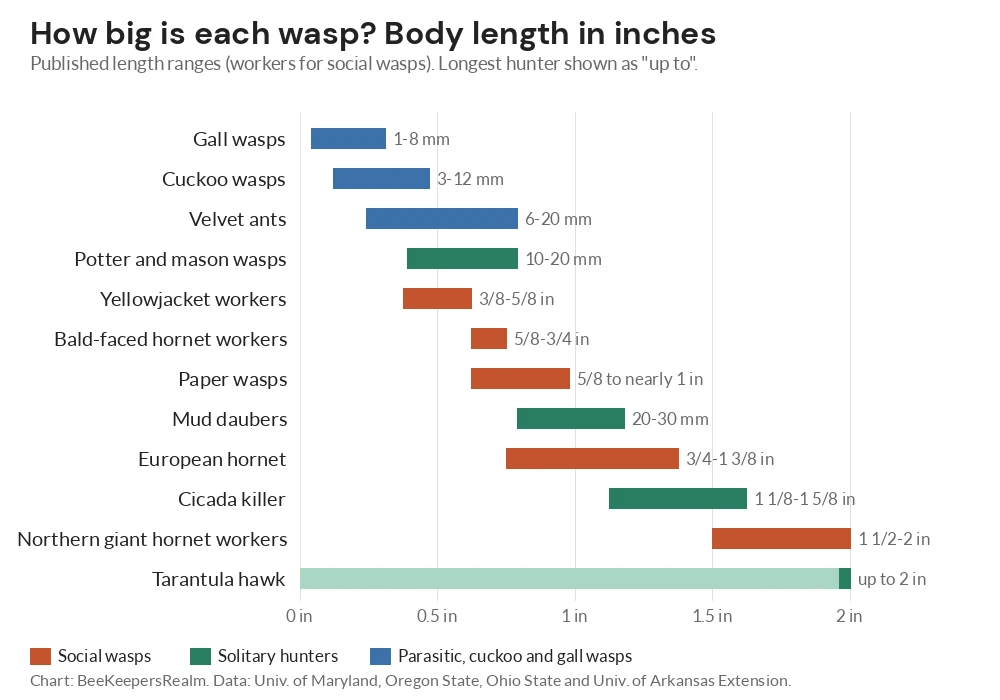
Size misleads in both directions: the giants are mostly loners, while the small yellowjacket is the social wasp UC IPM calls the most troublesome. Published length ranges:
What Wasps Do for Us
Oregon State Extension says wasps are beneficial because they regulate pests, serve as food for other wildlife, help clean up dead animals and pollinate some plants. Specifics from extension sources:
- Pest control. Maryland Extension says parasitoid wasps may be the single most important biological control method gardeners have, and that Trichogramma wasps are the most widely released biological control agents in North America. Oregon State says paper wasps prefer caterpillars, and some growers place nest sheds in fields to boost predation on crop pests.
- Pollination. Illinois Extension says wasps can be as efficient as bees in some cases. Colorado State says they are generally less efficient than bees, yet are the primary pollinators in some plant systems, including at least 100 orchid species.
- Food web. Illinois Extension lists crows, orioles, bluebirds and other birds, plus bears and skunks digging up yellowjacket nests, as wasp predators.
That does not make every nest welcome. Maryland Extension says to leave nests alone when possible, but that a nest in a busy spot can be treated or removed.
Which Wasps Threaten Honey Bees?
For a beekeeper, only a few wasps matter. Maryland Extension says the European hornet is often seen preying on bees and other pollinators around flowering plants, and its prey also includes other wasps. It says the yellow-legged hornet uses “bee hawking,” hunting around pollinator-attracting flowers and near honey bee hives. The northern giant hornet attacks hives in three phases, hunting, slaughter and occupation, but it is not currently in the United States. Yellowjackets also raid colonies late in the season; see how to protect beehives from yellow jackets. The other wasps in this guide are not described as colony threats in the extension sources we used.
Bee or Wasp? A Quick Table
| Feature | Bees | Wasps |
|---|---|---|
| Waist | Robust body; waist hard to see | Elongated body with a visible narrow waist |
| Hair | Fuzzier; hairs are branched | Less hairy; hairs are simple, not branched (microscope needed) |
| Pollen | Most carry it in hairs or baskets on the hind legs | No pollen baskets; rare pollen wasps carry it in the crop |
| Larvae eat | Pollen and nectar | Mostly insects or spiders |
| Sting | Honey bees cannot sting repeatedly | Individual wasps can sting repeatedly |
Sources: NDSU Extension, “Insects That Look Like Bees”; Oregon State Extension EM 9426; Illinois Extension; University of Maryland Extension.
For the full comparison, see bee vs wasp and bees vs wasps vs hornets. For the other side of the family tree, see types of bees.
Stings and Nests: Where to Go Next
Social wasps defend nests; solitary wasps defend little. If you have been stung, how to treat a bee or wasp sting covers first aid and warning signs, and bee sting vs wasp sting compares the two. If you have found a nest, wasp nest removal shows how to identify it and when to call a pro. Our predatory wasp comparison chart lists every species guide on this site by behavior.
Frequently Asked Questions
How many types of wasps are there?
About 107,000 described species worldwide, per Oregon State Extension. In practice, think of four lifestyles: social, solitary, parasitoid and plant-feeding.
What are the main types of wasps in the U.S.?
Social wasps (yellowjackets, paper wasps, bald-faced and European hornets), solitary hunters (mud daubers, potter and mason wasps, cicada killers, spider wasps) and parasitic wasps (ichneumons, braconids, cuckoo wasps).
What is the most aggressive wasp?
Yellowjackets have that reputation. Maryland Extension says they are easily agitated and may appear to sting without provocation, and UC IPM calls them the most troublesome social wasps. Both describe nest defense, not hunting people.
What are the most common wasps around homes?
Maryland Extension lists yellowjackets, paper wasps, bald-faced hornets and European hornets as its social wasps. Utah State Extension lists mud daubers, potter wasps and mason wasps as the mud-nesting wasps found on buildings.
Do all wasps sting?
No. Only females can sting, and Oregon State says most wasp species cannot sting at all. Cuckoo wasps, gall wasps, horntails and most parasitoid wasps are harmless to people.
Are hornets wasps?
Yes. Hornets are wasps of the genus Vespa, and the bald-faced hornet is a yellowjacket. Our hornet guide, linked earlier, shows how to tell them apart.
What is the biggest wasp in the U.S.?
Among U.S. wasps, tarantula hawks reach about 2 inches (University of Arkansas) and cicada killers 1 1/8 to 1 5/8 inches (Ohio State). The northern giant hornet, the largest hornet in the world, is declared eradicated from the country.
When are wasps most active?
Colonies are smallest in spring and largest by late summer or early autumn, per Maryland Extension. Illinois Extension adds that in fall, with fewer blooms and nests of thousands, yellowjackets go after sweet food such as soda, juice and fruit.
Are wasps good for anything?
Yes: pest control, some pollination and food for wildlife. Leave nests that are out of the way; if one is in a busy spot, use the nest guide linked above.
The Bottom Line
Start with the nest and the behavior, then size and color. Treat colony nests with respect, enjoy the solitary hunters from a distance, and send a photo to your county Extension office when you cannot tell.
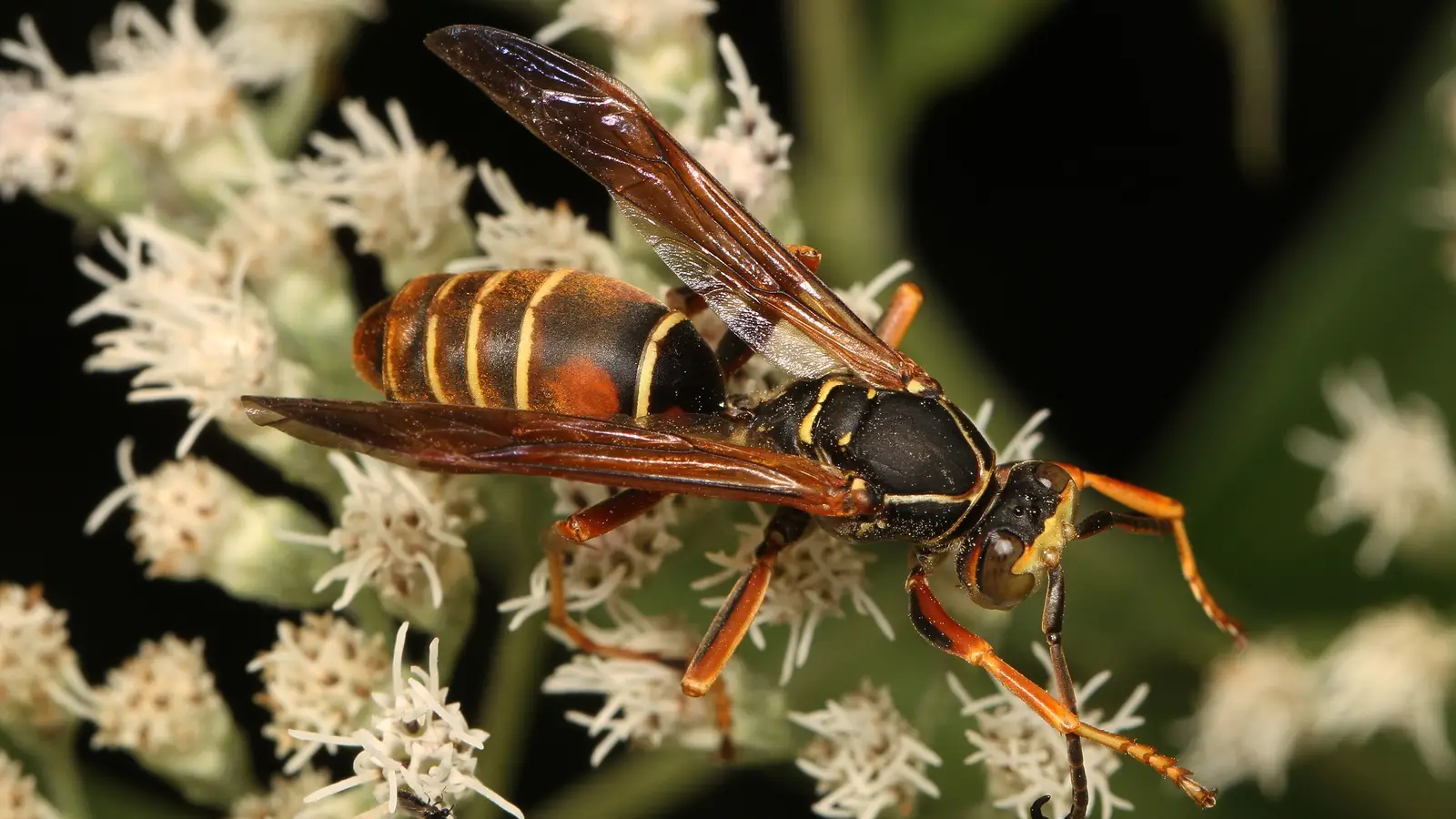
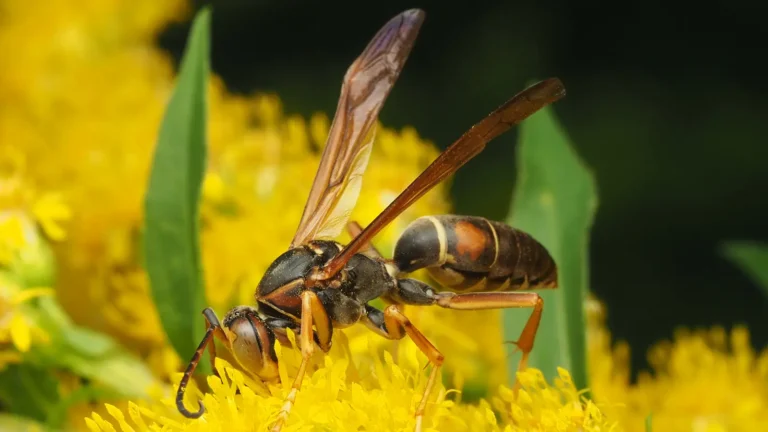
Featured image: a northern paper wasp (Polistes fuscatus) on flowers at Meadowood Farm, Mason Neck, Virginia. Photo: Judy Gallagher, via Wikimedia Commons, CC BY 2.0, cropped.


)_(36164276721).jpg)


