
Reviewed by Thomas B. · How we review
A horsefly (also written horse fly) is a large, stout biting fly in the family Tabanidae. Only the females bite. They slice the skin with blade-like mouthparts and drink the blood that pools, which is why the bite hurts at once. Deer flies are smaller members of the same family. Most bites settle in a day or two with soap, water and a cold pack. Watch for infection and for signs of an allergic reaction. Repellents work poorly against these flies, so clothing, timing and dark traps do more of the work.
This guide draws on US extension services, the CDC and medical centers, linked where we use them, plus our own count of iNaturalist records. We make no claim of personal field experience with these flies. It is general information, not medical advice.
Key Takeaways
- Horse flies (Tabanus, Hybomitra) and deer flies (Chrysops) are true flies in the family Tabanidae. Purdue Extension counts about 335 species in the continental US.
- Only females take blood, to make eggs. Males feed on nectar and have eyes that touch at the top of the head.
- The bite is a cut, not a sting. Wash it, cool it and leave it alone. Get emergency help for swelling of the lips, tongue or throat or trouble breathing.
- Deer flies spread tularemia to people in the western US, according to the CDC. In horses and cattle, tabanids spread equine infectious anemia and anaplasmosis.
- Repellents give little protection. Rutgers reports that three to five dark box traps nearly ended greenhead attacks around isolated homes in Delaware.
- In our count of 21,435 US iNaturalist records, deer fly sightings peak in July and horse fly sightings in August.
Table of Contents
- What Is a Horse Fly?
- Horse Fly vs Deer Fly
- Horse Fly Look-Alikes
- Greenhead Flies
- Horse Fly Life Cycle
- When Horse Flies Are Worst
- What Attracts Horse Flies
- Why a Horse Fly Bite Hurts
- Horse Fly Bite Treatment
- Do Horse Flies Spread Disease?
- How to Keep Horse Flies Away
- Horse Fly Traps That Research Supports
- Protecting Horses and Livestock
- Horse Flies, Pollinators and Your Bees
- Frequently Asked Questions
What Is a Horse Fly?
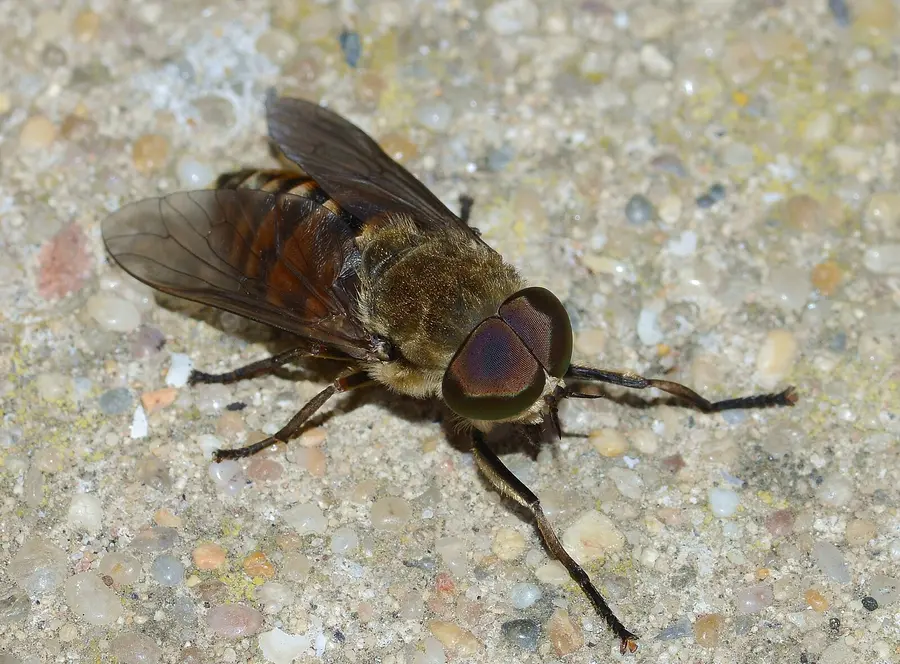
Horse flies and deer flies are true flies (order Diptera) in the family Tabanidae, so entomologists often call them tabanids. Penn State Extension puts it simply: horse flies belong to the genera Tabanus or Hybomitra, and deer flies belong to Chrysops. Regional names include gadflies and green-headed flies.
Counts differ by source. Purdue Extension lists about 4,300 species worldwide and about 335 in the continental US: more than 160 horse flies and more than 110 deer flies. The Missouri Department of Conservation (MDC) counts about 350 north of Mexico, and NC State University says fewer than 400 occur in the US. Purdue gives a size range of 1/4 to 1 1/4 inches. Wisconsin Extension says some species, such as the black horse fly, reach 2 inches.
Only the females drink blood, which they need to develop most of their eggs. Males feed on nectar, honeydew and plant sap, according to Britannica. MDC notes that the eyes tell the sexes apart: the female has a gap between her eyes, while the male’s eyes nearly touch. One subfamily, the Pangoniinae, rarely if ever drinks blood. Its members visit flowers, and several species mimic bees.
Horse Fly vs Deer Fly
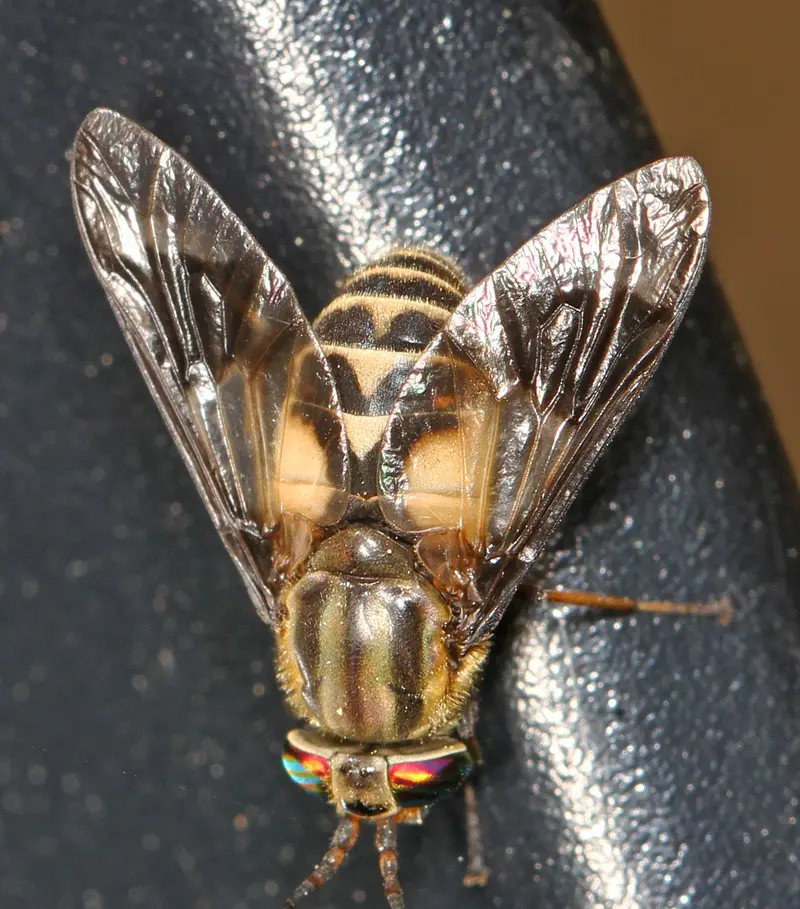
The quickest field marks are size and wings. Deer flies are smaller and usually have dark bands or patches on clear wings. Horse flies are bigger, and their wings are clear or evenly cloudy. The University of Florida (UF/IFAS) adds a close-up mark: deer flies have spurs at the tips of the hind shins, and horse flies do not.
| Trait | Horse flies | Deer flies |
|---|---|---|
| Size | 1/2 to 1 1/4 in | 1/4 to 1/3 in |
| Antennae | Shorter than the head | Longer than the head |
| Wings | Clear or evenly cloudy | Dark bands or patches |
| Bite people? | Most species do not | Most species do |
| Where they bite | Legs and body | Head and shoulders |
| Preferred target | Animals standing still | Animals on the move |
Source: Purdue Extension E-246, Table 1. Other extension sheets give slightly different sizes; UF/IFAS lists deer flies at 7 to 10 mm and horse flies at 10 to 25 mm.
Behavior gives deer flies away too. Wisconsin Extension says they “commonly fly around a person’s head” until they get a chance to bite. Purdue notes that neither group enters buildings.
Horse Fly Look-Alikes
Many large summer flies get called horse flies. Only some of them bite, and none of them sting. The table covers the usual mix-ups.
| Fly | Size | Key marks | Bites people? | Where/when | Source |
|---|---|---|---|---|---|
| Horse fly | 1/2 to 1 1/4 in | Stout body, huge eyes, short antennae, clear or evenly cloudy wings | Females of some species | Sunny areas near water and woods; summer days | Purdue, MDC |
| Deer fly | 1/4 to 1/3 in | Dark wing bands, antennae longer than the head, circles your head | Yes, females | Near water and woods; June and July in Wisconsin | Purdue, Wisconsin |
| Greenhead | About house fly size | Bright green eyes; smaller than most horse flies | Yes, females, persistently | Eastern coastal marshes; late June into September | Rutgers, Wikipedia |
| Stable fly | About 1/4 in | Gray, four dark stripes on the thorax, pointed beak sticking forward | Yes, both sexes, often the ankles | Late summer and fall | Illinois DPH, Oklahoma State |
| Bee fly | 1/4 to 1 3/4 in | Fuzzy, often a long straight beak, hovers at flowers | No | Flowers in fields, prairies and gardens | MDC |
| Hover fly | 1/8 to 1 in | Bee or wasp colors, one pair of wings, hovers in place | No | Flowers, gardens | UC IPM |
| Robber fly | Mostly 1/2 to 3/4 in; some 1 1/4 in | Bearded face, long tapering body, catches insects in flight | Only if mishandled, and painfully | Open, sunny places such as fields and pond edges | MDC |
| Horsefly-like carpenter bee (a bee) | 12 to 18 mm | Black bee; males have yellow hair on the thorax | No; it is a bee, not a fly | North, Central and South America | Wikipedia |
Sizes are body length as each source gives them.
We cover hover flies, the harmless bee mimics, and robber flies, which hunt bees and wasps, in their own guides. The confusion runs the other way too: Xylocopa tabaniformis is a bee named for looking like a horse fly (see our carpenter bee guide). Britannica says horse flies can be “as large as a bumble bee,” so big ones pass for bumblebees at a glance. Count the wings: bees have four, flies two. For stinging insects, see our predatory wasp and insect comparison chart.
Greenhead Flies
On the Atlantic coast, “greenhead” usually means the salt marsh greenhead, Tabanus nigrovittatus. Its larvae live in coastal marsh mud. Rutgers entomologists report up to 70 larvae per square yard in good habitat. Populations peak in July and run from late June into September. Rutgers writes, “We have collected in traps over 1000 greenhead flies per hour all seeking a blood meal.”
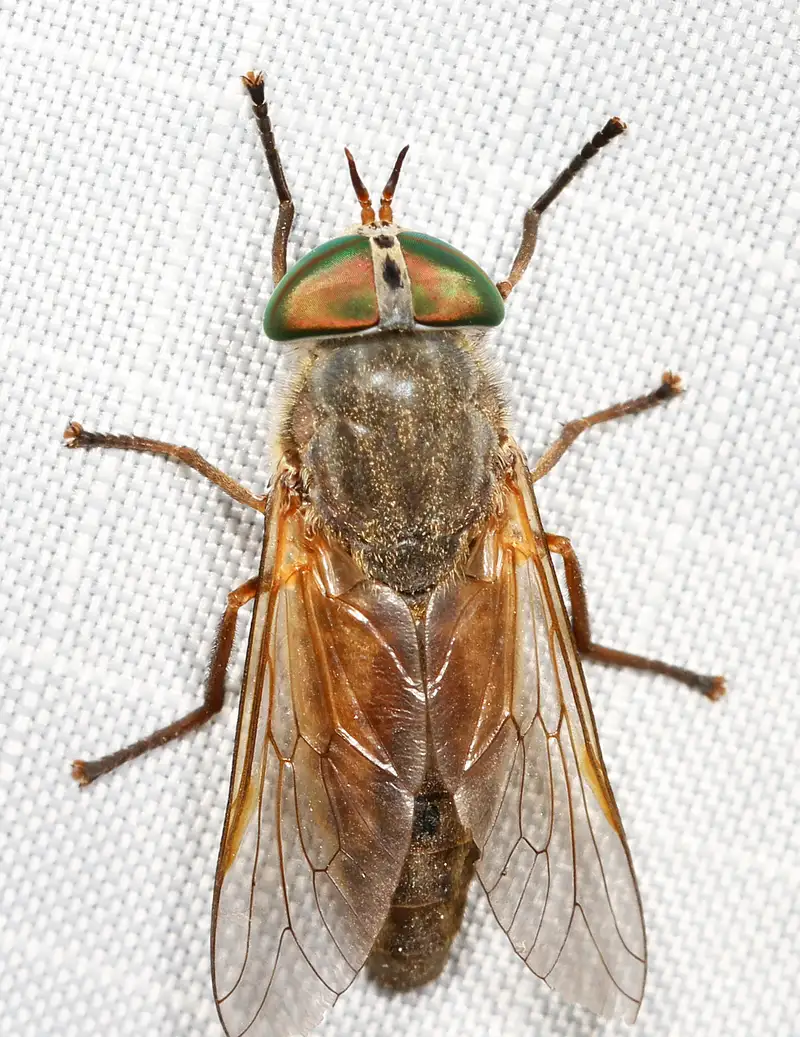
A female greenhead can lay her first batch of 100 to 200 eggs without any blood. Later batches need a blood meal, and she lives three to four weeks. The name is not exclusive: Britannica uses “green head” for the striped horse fly, Tabanus lineola.
Horse Fly Life Cycle
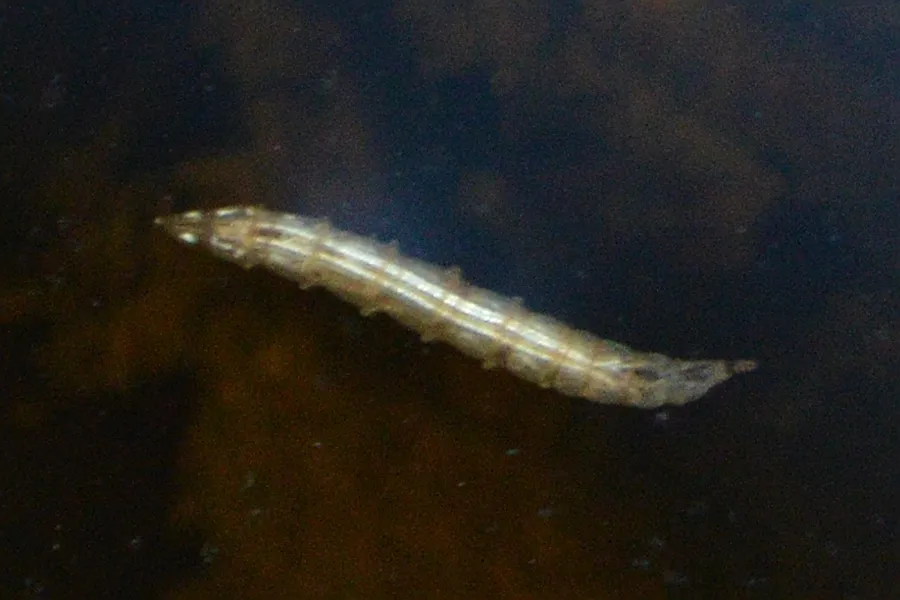
Females lay egg masses on plants or objects above water or wet soil. Sources give different clutch sizes: Purdue says 100 to 800 eggs, Kentucky says 25 to 1,000, and UF says 100 to 1,000. MDC describes the larvae as tan to whitish, wormlike maggots that live in water and mud. Purdue says they eat insect larvae and worms, and the larvae of some large horse flies feed on tadpoles, frogs and toads, apparently helped by a toxin in their saliva. The Merck Veterinary Manual adds that larvae can nip the toes of people wading in the water.
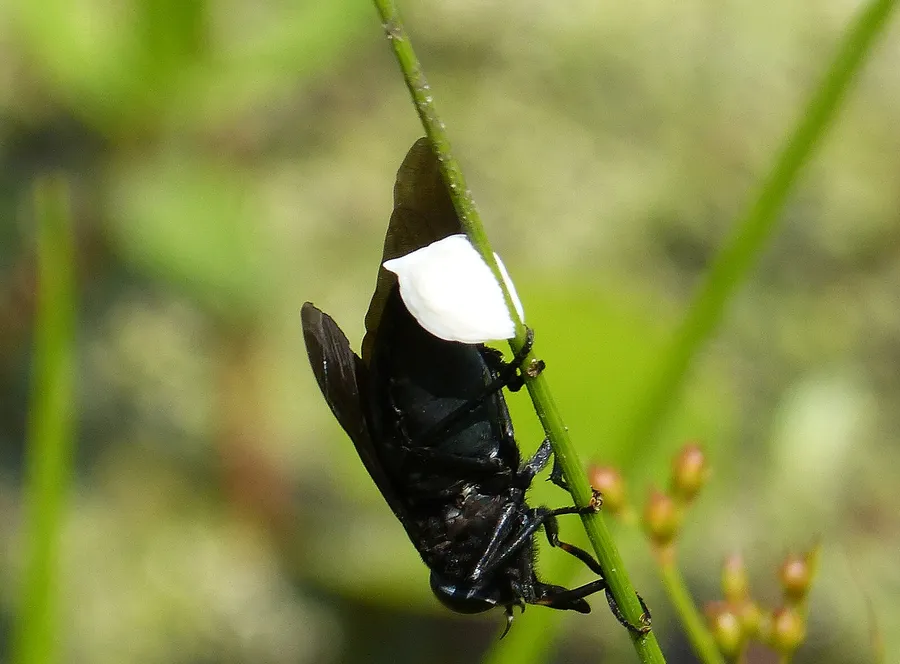
Most species have one generation a year, Purdue says, but small deer flies can have two or three a year and large horse flies can take two or three years each. Adults live 30 to 60 days, according to UF.
When Horse Flies Are Worst
Season depends on where you live. UF and Wisconsin both give May through September. In South Dakota, horse flies emerge in June and July and stay active six to eight weeks, according to SDSU Extension. Sources also disagree on deer flies: Illinois Department of Public Health says they are most common in spring, while Wisconsin says June and July.
Time of day matters too. UF reports one attack peak from sunrise for about three hours and a second starting about two hours before sunset. Attacks drop on overcast days and when it is below 71.6°F or above 89.6°F.
For a national picture, we counted US research-grade observations on iNaturalist, where people post wildlife photos that others confirm. The counts show when people photograph the flies, not how many flies there are.
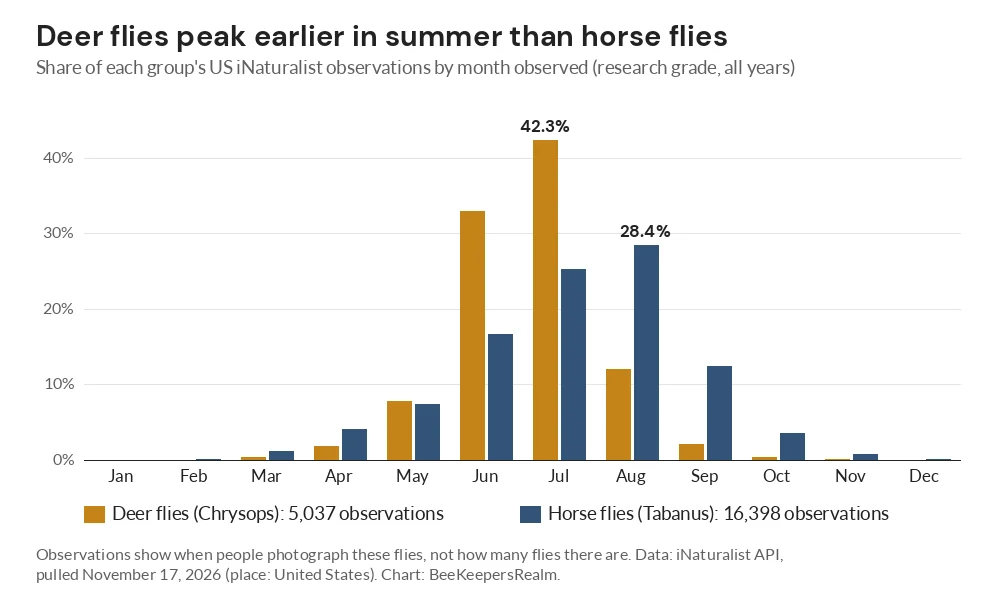
Of the 5,037 deer fly (Chrysops) observations, 42.3% fall in July and 32.9% in June. The 16,398 horse fly (Tabanus) observations peak later, with 28.4% in August, and they taper more slowly into September. State totals show how much latitude matters:
| Area | Tabanid observations | Peak month | Share June to August | Shortest run of months with 80%+ |
|---|---|---|---|---|
| United States | 25,657 | July (29.1%) | 73.1% | May to August (82.7%) |
| Florida | 3,051 | May (25.5%) | 34.8% | April to September (87.3%) |
| Texas | 2,606 | July (17.1%) | 48.7% | April to September (87.2%) |
| California | 1,275 | July (20.9%) | 57.5% | April to August (83.4%) |
| New Jersey | 682 | July (40.9%) | 92.5% | June to August (92.5%) |
| Minnesota | 508 | July (42.3%) | 96.5% | June to August (96.5%) |
Source: iNaturalist API, family Tabanidae, research-grade observations, all years, pulled November 17, 2026. Shares are of each area’s total.
In the north, the season is a short summer burst; in Florida it peaks in May and runs about six months. The most-recorded US species is the black horse fly, Tabanus atratus, with 10,219 observations, or 40% of all US tabanid records.
What Attracts Horse Flies
UF says sight is the main way tabanids find a host, with carbon dioxide and odor helping. MDC explains what that means in practice:
“Female horse and deer flies are attracted to large, moving, dark objects, which in nature could easily lead them to a deer, horse, or other large mammal. But it can also cause them to be attracted to cars and other vehicles (or you).”
University of Kentucky entomologists list movement, shiny surfaces, carbon dioxide and warmth. They also note that swimming pools can be a problem, and that the flies favor sunny spots and tend to stay out of barns. Penn State reports that zebra-striped fly sheets reduce bites on horses, because of how these flies perceive color. Sources disagree on swatting. Wisconsin Extension warns that swatting or running attracts more flies, while NC State entomologists say your best defense is to swat them.
Why a Horse Fly Bite Hurts
A female tabanid cuts rather than pierces. UF describes mandibles and maxillae that cut in a scissor-like action, plus saliva with anticoagulants that keeps the blood flowing while she feeds. The Merck Veterinary Manual puts a single meal at 0.1 to 0.3 mL of blood. The NHS describes horsefly bites as large and painful, says they may bleed and notes that they often become infected.
A bite is not a sting. Horse flies have no stinger. Bees and wasps sting, and our bee vs wasp identification guide covers telling those two apart. Fire ants do both: they bite to grip, then sting. The feeling can be similar, though. University of Maine Extension says many people find the bite feels like a bee sting, and significant allergic reactions are possible. If a bee or wasp stung you instead, follow our bee and wasp sting treatment steps and our guide to how long bee sting swelling lasts.
Horse Fly Bite Treatment
Kentucky says the irritation and swelling usually disappear in a day or so. Cleveland Clinic’s horsefly bite advice is the most complete:
- Wash the bite with soap and water to lower the chance of infection.
- Hold an ice pack wrapped in a cloth on it for at least 20 minutes to help the swelling. MedlinePlus suggests 10 minutes on and 10 minutes off.
- Keep the area raised if you can.
- Take an over-the-counter pain reliever, such as an NSAID, if it hurts, following the label.
- Take an antihistamine for itching, following the label.
- Do not pick at or scratch the bite. Kentucky warns that secondary infections come from scratching.
See a doctor if
Call 911 if there is swelling of the lips, tongue or throat, shortness of breath, wheezing, dizziness or fainting. Cleveland Clinic lists these as signs of anaphylaxis. MedlinePlus says to use the person’s epinephrine auto-injector if they carry one. See a healthcare provider if you have signs of infection, such as fever and chills, swelling, red streaking, a fluid-filled blister or warmth around the bite. See one too if symptoms last longer than a few days, or if you get a fever and a sore at the bite after time in deer fly country, which can be tularemia.
Do Horse Flies Spread Disease?
For people in the US, the main concern is tularemia, a bacterial disease. The CDC states it directly:
“Deer flies (Chrysops spp.) have been shown to transmit tularemia in the western United States.”
The CDC says infections from deer fly bites usually take the ulceroglandular or glandular form, with fever that can reach 104°F. Cases are rare: a CDC report on Wyoming found 11 in 2001 to 2003, six of them most likely from deer fly or other horse fly bites. Illinois Department of Public Health calls deer flies “one of the few types of flies that transmit disease to people in the United States.” Purdue notes that no other human disease has been conclusively linked to US tabanids.
Animals carry more of the risk. The Merck Veterinary Manual calls tabanids mechanical transmitters: they carry germs on the body from one animal to the next, and oozing bites draw in other flies. NC State Extension names equine infectious anemia (EIA) in horses and anaplasmosis in cattle. Texas A&M calls EIA “swamp fever” and says anaplasmosis has a 50% mortality rate in adult cattle. UF and the Merck Veterinary Manual add anthrax.
How to Keep Horse Flies Away
Do not expect much from repellents. Purdue says female horse and deer flies are deterred very little by repellents, including DEET. Wisconsin calls standard repellents only marginally effective, and NC State says they work less well than against mosquitoes. Kentucky and UF are more positive: DEET can give several hours of protection, best with long sleeves, though the flies may keep swarming. Cleveland Clinic also lists picaridin and oil of lemon eucalyptus. Permethrin products are for clothing only, Kentucky notes. Follow the label. What helps more:
- Cover up. Purdue suggests long sleeves, thick pants and a heavy hat. Kentucky and Cleveland Clinic recommend light colors, which fits MDC’s point that dark objects draw them.
- Pick your hours. Avoid the morning and late-afternoon peaks UF describes, especially on sunny days.
- Pick your places. Cleveland Clinic advises avoiding marshlands and open areas next to woods in fly season.
- Wear a sticky patch. See the hat-patch study in the trap section below.
Horse Fly Traps That Research Supports
Traps cannot clear a whole landscape, and Purdue calls them of limited value. NC State says box traps apparently help in small areas such as yards and campgrounds. Most designs mimic a large, dark animal.
Box traps. The Rutgers design is an open-bottomed box with sides about 16 by 32 inches and a screen top, standing on legs so the bottom is about 2 feet above the marsh. Flies enter from below and move up into traps on top. NC State specifies four shiny black sides of the same size, raised 24 inches. Rutgers advises setting traps out from mid to late June through August, along marsh edges and the “fly-paths” the insects follow. The results can be striking:
“In Delaware, the use of three to five traps near isolated human dwellings has resulted in almost complete reduction in greenhead attacks.”

In a 2017 study in Northeastern Naturalist, a single two-tier box trap in Addison, Vermont collected more than 29,000 tabanids of 44 species over three seasons.
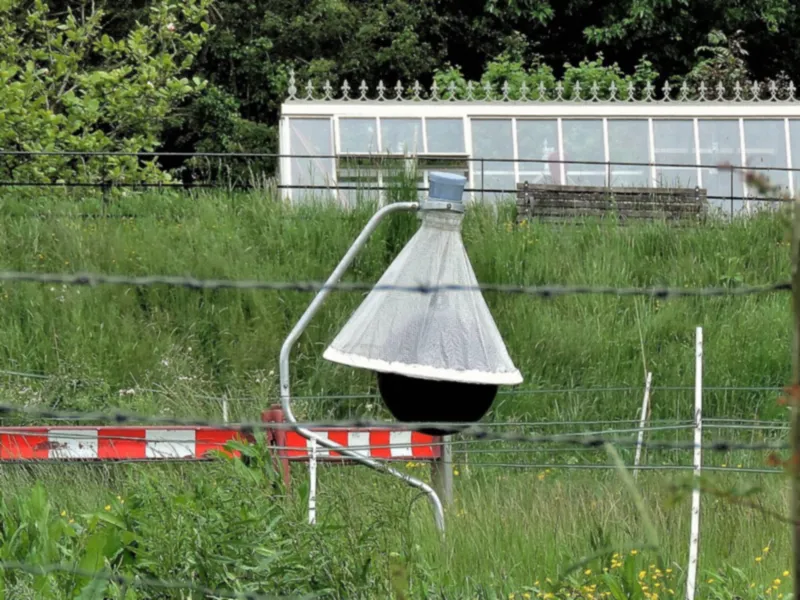
Canopy traps. University of Missouri Extension describes a pyramid canopy about 4 feet high over a 16- to 20-inch black ball, with a jar at the top to collect the flies. It traces the design to tests by Jim Huggans in the late 1970s and says it gives “measurable control for a few cattle or horses.” Penn State says one trap can cover about 2 acres if placed properly, in the sun rather than the shade.
Sticky patches and blue targets for deer flies. In a 2000 study in Florida Entomologist, sticky patches on caps caught about 26% of host-seeking deer flies, compared with sweeping by net. Patches on the back of the cap caught more than patches on the front. Cap color made no difference. NC State suggests blue cups or buckets coated in glue, and UF says sticky blue cylinders on slow-moving objects, such as a riding mower, or on top of a cap reduce these flies. Penn State warns that jug traps, scatter baits and stable fly sticky traps will not work for horse and deer flies.
Protecting Horses and Livestock
The losses add up. UF cites a 1976 estimate of $40 million in US livestock losses. It adds that 20 to 30 flies feeding for six hours can take 100 cc (3.4 fl oz) of blood. The University of Georgia warns that tormented horses may toss their heads and kick, putting riders at risk. Texas A&M says topical pesticides are ineffective, because each fly stays on an animal only a few minutes. Penn State’s advice for horses:
- Turn horses out at night, since horse and deer flies bite in the daytime.
- Give them run-in shelters or shade trees set away from wooded edges.
- Use zebra-pattern fly sheets.
- Apply pyrethroid repellents over the whole body.
- Add traps placed in the sun.
Horse Flies, Pollinators and Your Bees
Horse flies are not only pests. MDC notes that “the adults of some species are important pollinators,” and NC State also calls them pollinators. They are prey, too: birds, dragonflies and frogs eat them, according to University of Maine Extension. The horse guard wasp, Stictia carolina, is one of the eastern US sand wasps. It preys mainly on horse flies, stinging them and feeding them to its larvae.
We found no extension or research source reporting that horse flies bite honey bees or harm colonies. For beekeepers, they are a problem for the person, not the hive, especially at apiaries near ponds, marsh edges or woods in midsummer. Kentucky’s advice to wear light colors matches the light-colored suits many beekeepers already wear.
Frequently Asked Questions
What happens if a horsefly bites you?
You feel a sharp pain right away, because the fly cuts the skin rather than piercing it. A red, swollen and itchy lump follows, and it may bleed a little. Most bites settle in a day or so. Wash the bite, cool it and avoid scratching. Get medical help for signs of infection or an allergic reaction.
Why are horsefly bites so bad?
The female’s mouthparts work like scissors. They cut a small wound, and her saliva keeps the blood from clotting while she drinks. The open wound is also why scratched bites can become infected.
Is a horsefly aggressive?
Only the females bite, and only to get blood for eggs. Purdue notes that most horse fly species do not bite people and prefer large animals, while most deer fly species do bite people, usually on the head and shoulders.
What attracts horse flies to you?
Movement, dark colors, carbon dioxide from your breath, warmth and shiny surfaces. They hunt mainly by sight, so a moving, dark shape near water or woods on a sunny day draws them in.
Why are deer flies so aggressive?
The ones circling you are females looking for the blood meal most of them need to make eggs. They target moving hosts and keep circling the head until they find a chance to land.
What repels horse flies and deer flies?
Nothing works very well. DEET and other repellents give limited, short protection against these flies. Covering up in light-colored clothing, a sticky patch on the back of a hat and dark traps placed in the sun work better.
What months are horse flies the worst?
In most of the US, June through August, with deer flies peaking in July and horse flies a little later. In the far north the season is short, while in Florida it runs from about April or May to September.
Why do I suddenly have horse flies?
The larvae grow in wet soil and water, and adults emerge over a few early-summer weeks. A nearby marsh, pond or stream can produce a sudden wave, and sunny days bring out more biting than overcast ones.
The Bottom Line
A horsefly is a female tabanid looking for the blood she needs to make eggs. The bite is painful but usually minor. Wash it, cool it, leave it alone and watch for infection or allergy. Repellents help little. Clothing, timing and well-placed dark traps help much more. For people in the US, the known disease risk is tularemia, linked mainly to deer flies in the West.
Sources
- Hill, C. and MacDonald, J. “Horse Flies and Deer Flies,” Purdue Extension E-246, 2019.
- Squitier, J. “Deer Flies, Yellow Flies and Horse Flies,” UF/IFAS EENY-028/IN155.
- Townsend, L. “Horse Flies and Deer Flies,” University of Kentucky ENTFACT-511.
- Pellitteri, P. “Deer Flies and Horse Flies,” University of Wisconsin Extension.
- Waldvogel, M. and Apperson, C. “Horse Flies and Deer Flies,” NC State Extension.
- Shipman, M. “Horse Fly Bites,” NC State University News, 2025.
- Machtinger, E. “Protecting Horses From Horse and Deer Fly Bites,” Penn State Extension, 2022.
- Missouri Department of Conservation, “Horse and Deer Flies (Tabanids),” “Bee Flies” and “Robber Flies.”
- Hansens, E. and Race, S. “The Greenheads and You,” Rutgers Department of Entomology.
- Freeman, J.V. 2017. “Seasonal Abundance of Tabanus calens and other Tabanidae (Diptera) near Snake Mountain, Addison County, Vermont,” Northeastern Naturalist 24(2): 137-151.
- Cilek, J. 2000. Field test of sticky deer fly patches worn on caps, Florida Entomologist 83(4).
- University of Missouri Extension, “Protecting Cattle From Horse Flies,” G7013 (archived copy).
- Texas A&M AgriLife, “Horse Fly,” Livestock Veterinary Entomology.
- South Dakota State University Extension, “Horse Flies and Deer Flies Becoming Abundant.”
- University of Maine Cooperative Extension, “Horse Flies.”
- University of Georgia, “Tabanid Flies.”
- Merck Veterinary Manual, “Horse Flies and Deer Flies.”
- CDC, “How Tularemia Spreads” and Tularemia Transmitted by Insect Bites, Wyoming, 2001-2003, MMWR 54(07).
- Illinois Department of Public Health, “Biting Flies.”
- Oklahoma State University Extension, “Stable Flies.”
- UC IPM, “Syrphids.”
- Cleveland Clinic, “Horsefly Bite.”
- MedlinePlus, “Insect bites and stings.”
- NHS, “Insect bites and stings.”
- Britannica, “Horse fly.”
- Wikipedia, “Xylocopa tabaniformis” and “Horse guard wasp.”
- iNaturalist API, research-grade observations for Tabanidae (taxon 47821), Tabanus (49704) and Chrysops (49703), place United States, pulled November 17, 2026.
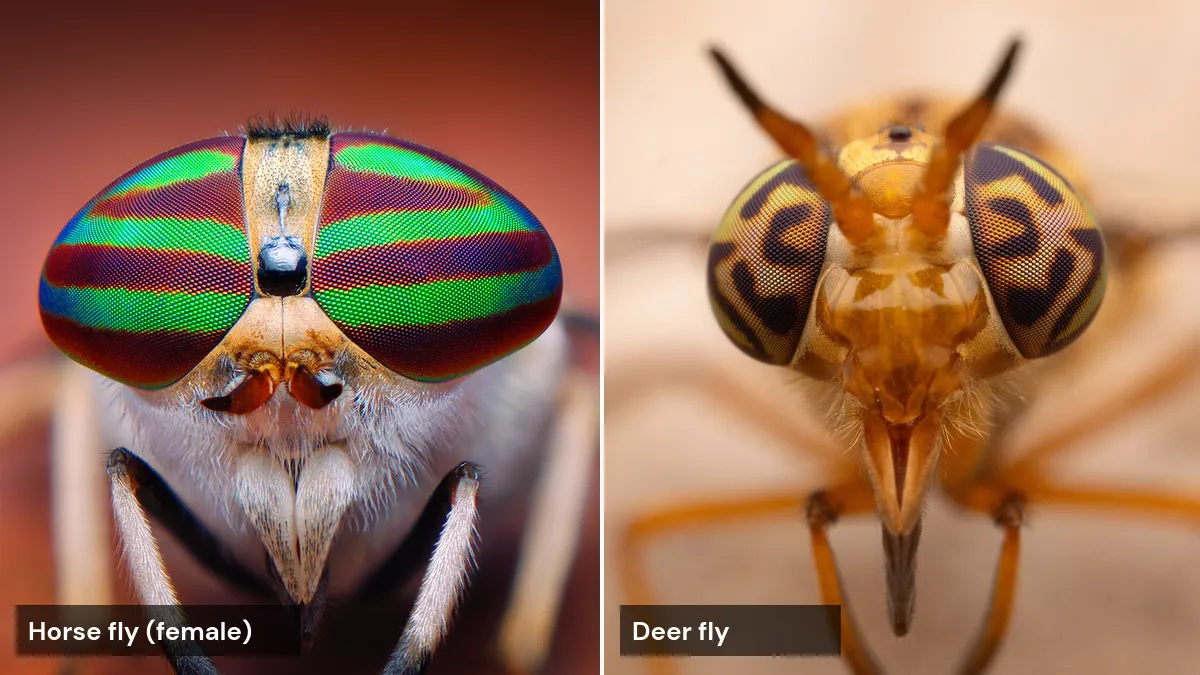
Image credits: Featured image combines a female striped horse fly (Tabanus lineola) by Thomas Shahan via Wikimedia Commons, CC BY 2.0, and a deer fly (Chrysops flavidus) by Thomas Shahan via Wikimedia Commons, CC BY 4.0, both cropped and labeled. Other photos are credited in their captions.


_Wellfleet_Bay_Wildlife_Sanctuary,_August_8,_2010.jpg)


