Reviewed by Thomas B. · Last Updated September 23, 2026 · How we review
How soon a new queen starts laying depends on what kind of new queen you have. A mated queen introduced in a cage usually lays within a day or two of being released, so eggs typically appear about a week after you install her. A virgin queen that emerges in your hive has to mature and mate first, so first eggs usually appear 10 to 14 days after she emerges, or up to about three weeks in poor weather. A colony raising its own replacement from scratch, such as a walkaway split, usually has eggs again about three and a half to four and a half weeks after it lost its queen.
This page gives the expected timeline for each situation and how to check for eggs without disrupting a new queen. What happens on the mating flights themselves, and the weather that delays them, is covered in our virgin queen mating flight timeline. If you are already past the expected date with no eggs, go to why your new queen isn’t laying eggs yet.
Key Takeaways
- Mated queen in a cage: usually laying within a day or two of release, so eggs roughly 5 to 10 days after you install the cage.
- Virgin queen: first eggs usually 10 to 14 days after she emerges; a spell of bad weather can push that past three weeks.
- Capped queen cell: add about a week for the queen to emerge, so eggs roughly 17 to 22 days after installing a freshly capped cell.
- Walkaway split or emergency queen: roughly 24 to 33 days from queen loss to first eggs.
- The first new workers emerge about 21 days after the first eggs, so a colony keeps shrinking for a while even after the new queen starts laying.
Table of Contents
New Queen Laying Timelines at a Glance
Always count from a fixed date you have written down: the day you installed the cage, the day the virgin emerged, or the day the colony lost its queen. The ranges below assume normal colony strength and weather good enough for mating flights.
| Situation | Count from | First eggs usually | Look into it if no eggs by |
|---|---|---|---|
| Mated queen introduced in a cage | Day you install the cage | About 5 to 10 days | About 2 weeks after she is released |
| Package with a mated queen | Installation day | About 5 to 10 days | About 2 weeks after she is released |
| Virgin queen emerges in the hive | Day she emerges | 10 to 14 days (up to about 21 in bad weather) | About 4 weeks after emergence |
| Capped queen cell installed | Day you install the cell | About 17 to 22 days | About 5 weeks |
| Walkaway split or queenless colony rearing its own queen | Day of queen loss | About 24 to 33 days | About 5 weeks |
| Parent colony after a prime swarm | Day the swarm left | About 2.5 to 4 weeks | About 5 weeks |
Mated Queens and Packages
A queen that has already mated only has to be accepted and released. Most introduction cages release her through a candy plug over about three to five days, or you release her by hand once the workers stop biting at the cage. A queen who was laying well before she was caged usually starts again within a day or two of release. One who has been in a shipping cage for several days may take a little longer while her ovaries build back up.
- Check for eggs about five to seven days after she is released, not the day after. Opening the hive too soon after release is a common cause of a new queen being balled.
- Look for eggs, not for the queen. Eggs in the center of the brood nest are all the proof you need.
- Package queens follow the same pattern. Our guide to when package bees start laying eggs covers the package-specific details, and how to introduce a new queen bee covers the release itself.
Virgin Queens
A virgin queen has three steps to get through before she lays. She needs about five to six days after emergence to mature, then one or more mating flights on warm, calm afternoons, then about two to three days after her last flight while sperm moves into her spermatheca. In a German RFID study that logged 64 queens, they averaged about five flights spread over 2.2 flying days (Heidinger et al., Insects, 2014), which is why the whole process usually fits into the second week of her life.
Put together, first eggs from a virgin usually appear 10 to 14 days after emergence. Rusty Burlew of Honey Bee Suite works through the same arithmetic: about 8 days at the very fastest, about 12 days in a typical case, and 19 days or more if a week of rain interrupts mating, which is why many beekeepers use two to three weeks as a rough rule (Honey Bee Suite). Bad weather simply pauses the clock. The day-by-day detail of maturing, orientation and mating flights is in our mating flight timeline, including the deadline after which an unmated virgin is unlikely to mate at all.
Queen Cells
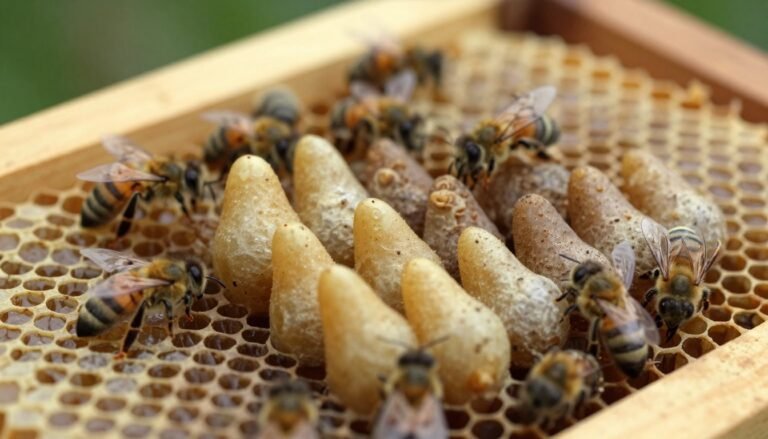
If you install a queen cell or leave one in a split, add the time until she emerges. A queen emerges about 16 days after her egg was laid and her cell is capped at around day 8 or 9, so a freshly capped cell produces a queen about a week later. A ripe cell, one with a thin, papery tip that is a day or two from emergence, shortens that. Our queen cell timing guide shows how to tell how old a cell is.
From the day she emerges, the virgin timeline above applies, so a freshly capped cell usually leads to eggs about 17 to 22 days after you install it.
Walkaway Splits and Emergency Queens
A colony that loses its queen, or a split made without one, raises an emergency queen from young worker larvae. The bees choose larvae that are only a day or two old, so the resulting queens emerge roughly 11 to 13 days after the queen loss. Add the virgin timeline and first eggs usually appear about 24 to 33 days after the colony became queenless. The Apiarist’s guide to brood development timing walks through the same arithmetic.
That is why the usual advice is to leave a walkaway split alone for about four weeks before looking for eggs. Opening it repeatedly in the third week, when a virgin is likely to be flying, risks the very queen you are waiting for. If you reach about five weeks with no eggs, the troubleshooting steps in why a new queen is not laying yet apply.
After a Swarm
When a colony swarms, the old queen leaves with the prime swarm, usually around the time the first queen cells are capped. The first virgin in the parent colony emerges about a week later. If the colony throws further swarms, called afterswarms, each one takes a virgin with it and the one that finally stays may emerge a little later still. First eggs in the parent colony usually appear about two and a half to four weeks after the prime swarm left.
Resist the urge to check every few days. If you want to know what to look for before a colony swarms in the first place, see how to tell if your hive is preparing to swarm.
How to Check for Eggs Without Disturbing Her
- Pick the right time. Check on a warm, calm day, and for a colony with a virgin, check in the morning rather than in the early afternoon when mating flights usually happen.
- Go straight to the center of the brood nest. Eggs appear first in the cells the workers have cleaned and polished for her, usually on the central frames.
- Use the light. Hold the frame with the sun behind you and tilt it so light falls into the cells. Eggs are tiny, white and about the size of a comma.
- Read what you see. One egg per cell, standing upright at the base, means a laying queen. A newly mated queen sometimes puts two eggs in a few cells for her first days, which usually sorts itself out within a week. Several eggs per cell, eggs stuck to the cell walls, or eggs scattered randomly across the frame point to laying workers instead.
- Close up quickly. Once you have seen eggs, you have your answer. There is no need to find the queen.
What Her First Brood Tells You
Worker brood follows a fixed schedule, so once you know when the first eggs were laid, you can predict everything after it.
| Days after the first eggs | What you should see |
|---|---|
| 0 to 3 | Eggs standing in cells |
| 3 to 9 | Young, then older, larvae in milky royal jelly and brood food |
| About 9 | First capped worker brood with flat, even cappings |
| About 21 | First new workers emerge |
Two things follow from this. First, the colony keeps losing bees until those new workers emerge. From queen loss to the first new workers in a walkaway split is often six to seven weeks, so do not take honey or bees from it in that time. Second, the first capped brood is your quality check. Flat cappings in worker cells mean fertilized worker brood. Domed, bullet-shaped cappings in worker cells mean drone brood from a queen that failed to mate properly; see what to do about a drone-laying queen. Give a new queen about two weeks of laying before judging her brood pattern, since the first few frames are often patchier than what follows.
For how laying timelines differ between mated queens, queen cells and walk-away splits, see when and how to split a hive.
Frequently Asked Questions
How long after mating does a queen start laying?
Usually two to three days after her last mating flight. The sperm she collects has to move from her oviducts into her spermatheca first, which takes around a day and a half.
How long after releasing a mated queen will she lay?
Usually within a day or two, sometimes almost immediately. A queen who spent several days in a shipping cage may take a few days longer. Check for eggs about five to seven days after release.
When should I check a walkaway split for eggs?
About four weeks after you made the split. Checking earlier rarely shows eggs and risks disturbing a virgin queen during her mating flights.
Why are there two eggs in some cells from my new queen?
Newly mated queens sometimes lay two eggs in a cell for their first few days. If the eggs are at the base of the cells and the pattern settles within a week, it is normal. Many eggs per cell, especially on the cell walls, suggest laying workers.
How long before a new queen’s first workers emerge?
About 21 days after she lays the first eggs. Capped worker brood appears around day 9, which is the first chance to confirm she is producing worker brood rather than drones.
How long should I wait before deciding a new queen has failed?
It depends on the situation: about two weeks after release for a mated queen, and about four weeks after emergence for a virgin. Past those points, work through the causes in our guide to why a new queen is not laying eggs yet before you requeen.
The Bottom Line
Write down the starting date, whether it is the day you installed a mated queen, the day a virgin emerged or the day the colony lost its queen, and use the timelines above before you open the hive to look. Expect eggs about a week after installing a mated queen, 10 to 14 days after a virgin emerges, and roughly four weeks after a colony starts raising its own queen.