
Reviewed by Michael R. · Last Updated October 14, 2026 · How we review
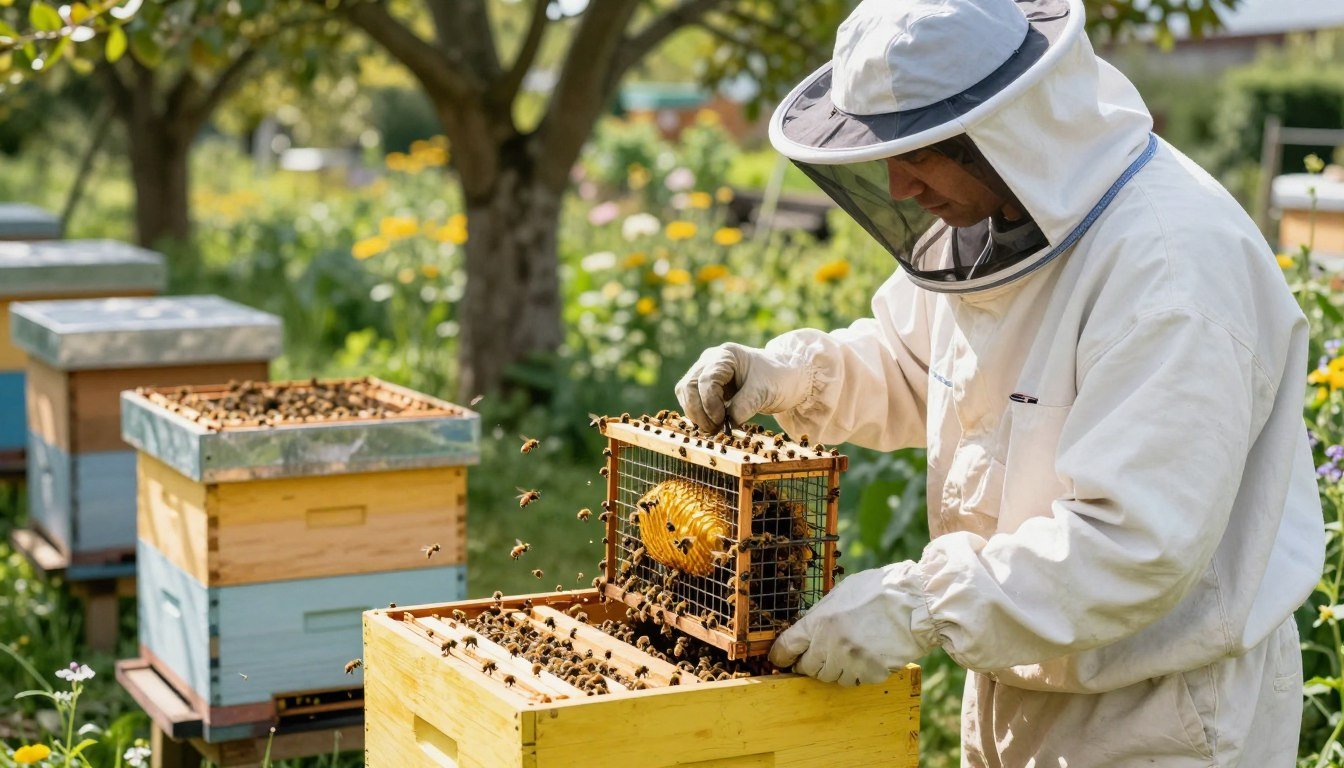
The Hopkins method is a graft-free way to raise queen cells: you lay a frame of eggs and just-hatched larvae flat, cell side down, a bee space above the brood nest of a queenless colony, and the nurse bees choose which larvae to draw out as queen cells. It needs a shim and a hive tool instead of grafting gear, but it is not push-button: the larvae must be very young, the comb must be thinned, and the evidence for queen quality is mostly anecdotal.
This guide runs from Isaac Hopkins’s 1911 text to modern practice. For the wider picture, see our queen rearing basics for U.S. beekeepers.
Key Takeaways
- Isaac Hopkins described the method in the 1911 edition of his Australasian Bee Manual and credited an unnamed Austrian beekeeper. In the United States it is also called the Case method.
- In 1911 Hopkins cut away every fourth row of cells, scooped out the three rows between, and killed two of every three larvae in the rows left standing. Modern guides leave roughly one cell in three.
- Cells are sealed about 8 to 9 days after the egg is laid and queens emerge on day 16, so the frame must go in while larvae are very young. Sources put harvest at 9 to 12 days after placing the frame.
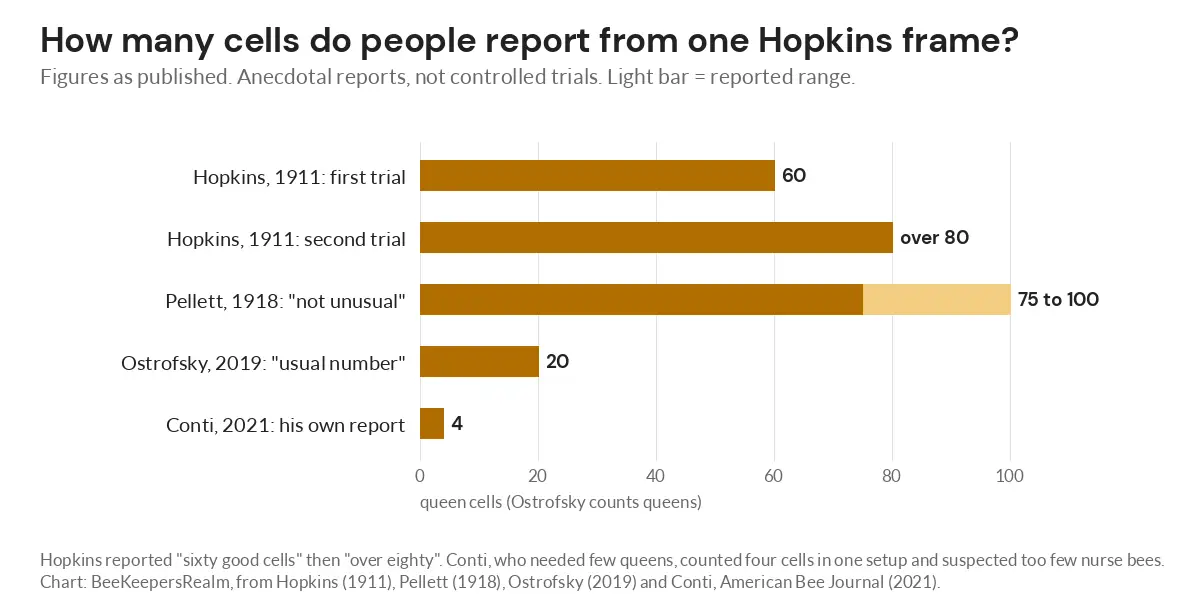
- Reported yields run from 4 cells to 75 to 100, all from individual beekeepers. We found no controlled trial against grafting.
- Pure wax comb can sag in the heat above the brood nest. Hopkins saw it in 1911; use a wired or plastic-foundation frame.
Table of Contents
- What the Hopkins Method Is and Where It Came From
- How Hopkins Described It in 1911
- The Method Step by Step
- The Shim, the Gap and the Frame
- Timing: Why the Clock Matters
- How Many Cells to Expect
- What Is Known About Queen Quality
- Hopkins Compared With Miller, Doolittle, Alley and a Queenless Nuc
- Harvesting and Placing the Cells
- Common Problems and Fixes
- Frequently Asked Questions
- The Bottom Line
What the Hopkins Method Is and Where It Came From
The method presents queen larvae to a queenless colony on a whole frame of comb instead of one grafted larva at a time. The bees pick the larvae they want to raise, which is why people who dislike grafting like it. As The Apiarist, a Scottish beekeeping blog, puts it, the key difference from simply giving a queenless colony a frame of young brood is that the frame is held horizontally above the brood box, with space below for the cells to hang.
The name comes from Isaac Hopkins (1837 to 1925), a New Zealand beekeeper, whose 1911 fifth edition of the Australasian Bee Manual describes it under the heading “Another Method of Raising Cells.” He wrote that it was first tried and described by an Austrian beekeeper, and that he was the first to try it in his part of the world. A modern transcription of the passage is on Michael Bush’s site. In the United States it is often called the Case method, after H. L. Case, who presented it to a New York beekeepers’ meeting in January 1912. Jerry Hayes revived it in the American Bee Journal in 1984 and 1991, and Joe Conti in 2021.
Michael Bush’s history of queen-rearing method names argues Hopkins’s method is essentially the Alley method with new comb. That is one beekeeper’s view, not settled fact.
How Hopkins Described It in 1911
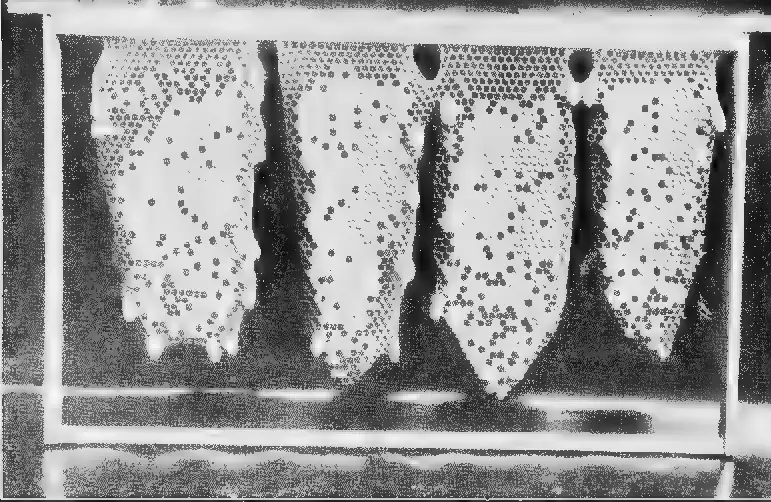
Hopkins put a new wired comb from the previous season into a breeding queen’s hive. When it was fairly full of eggs and newly hatched larvae he laid it flat on a bench and ran a thin knife along each side of every fourth row of cells, down to the mid-rib only. He scooped out the three rows between with a broad bradawl, so every fourth row stood. He also killed two of every three eggs or larvae in the standing rows, as in the Alley plan, and left the other side of the comb untouched.
For the builder he prepared a strong two-story colony, set an empty half-story over the brood chamber, laid an empty frame flat on the brood frames, and laid the prepared comb on it, prepared side down, under a light mat. His first trial gave sixty good cells and his second over eighty. He added a warning that has aged well.
“The comb lying flat over the brood chamber is subject to considerable heat, and we found in one case part of the comb had sagged down owing to the softening of the comb, and weight of the bees.”
His fix was to wire around the frames between the standing rows, or use thin wooden splints, and to give plenty of ventilation.
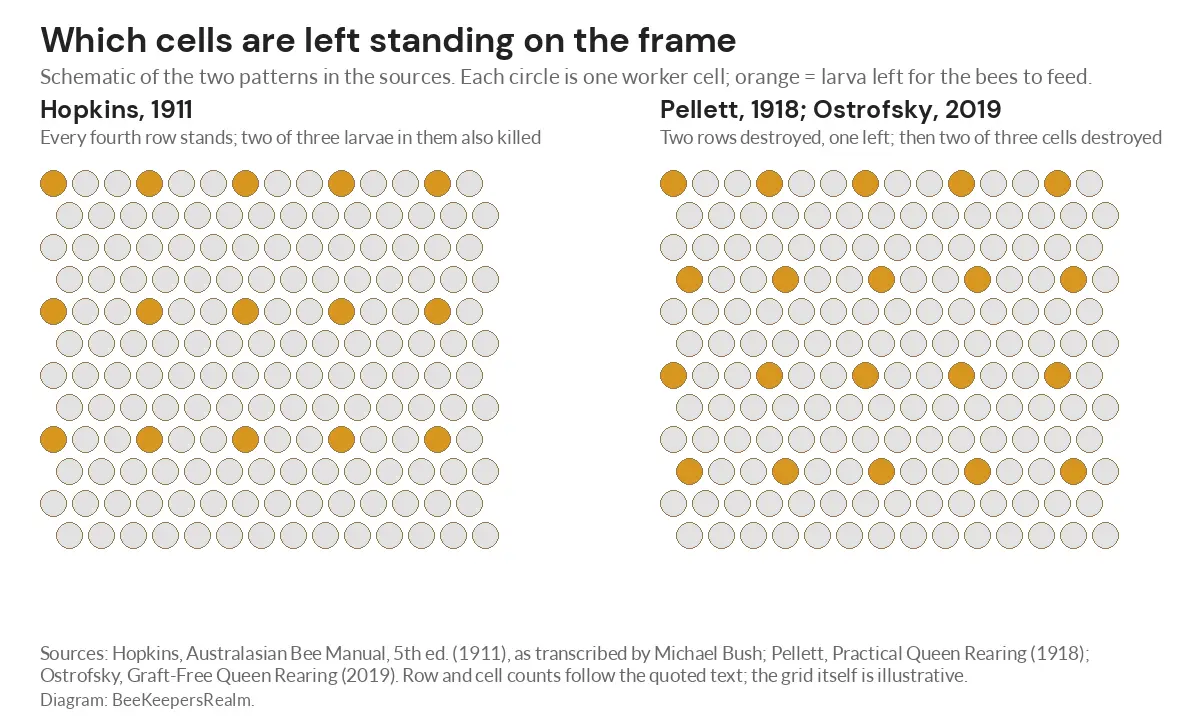
Later writers simplified the pattern. Frank Pellett’s 1918 Practical Queen Rearing destroys two rows and leaves one, then destroys two cells and leaves one in each standing row. Morris Ostrofsky’s graft-free guide for the Radicalize the Hive handbook (UMass Amherst) gives the same one-in-three layout using a hive tool. That differs from the “every fourth row” of 1911.
The Method Step by Step
- Choose the breeder. Pick your best colony; Conti suggests a strong, gentle, hygienic one with a good laying pattern.
- Prepare fresh comb. Pellett gave the breeder a new comb and left it until it held eggs and just-hatching larvae, about four days after laying began. Ostrofsky checks for larvae 24 to 36 hours old. The Apiarist used a frame with sealed brood in the centre, which he admits was not ideal.
- Make the builder queenless. Ostrofsky removes the queen one day before the frame goes in. Pellett suggests about seven days queenless, or removing all unsealed brood, so no larvae too old remain for the bees to use.
- Thin the comb. Scrape rows and cells down to the mid-rib using the patterns above, somewhere warm, bright and out of direct sun, which Ostrofsky notes would kill larvae.
- Place the frame. Lay it flat, cell side down, on a shim above the top bars, with a cover that holds the cluster’s heat. Ostrofsky also adds protein patty and a syrup feeder.
- Wait, then harvest. See the timing and harvest sections below.
The Shim, the Gap and the Frame
Conti built a shim 16 1/4 inches wide, about 20 inches long and 2 1/2 inches tall, with a notch on each side 1 1/4 inches deep for the frame’s top bar ends. That left roughly 1 1/2 to 1 3/4 inches between the comb face and the top bars below, enough for large cells. The Apiarist used a gap of 40 to 50 mm, more than enough for the largest cell, and a week later found a carpet of bees about 3 cm deep under the frame.
The frame matters. Conti warns against pure wax comb, which can sag under heat and the weight of bees, and recommends a wire-reinforced frame or, better, plastic foundation. That matches Hopkins’s sagging comb in 1911. Pellett added a cloth tucked around the comb to hold the cluster’s heat.
Timing: Why the Clock Matters
A queen takes 16 days from egg to emergence, and the schedule cannot be shifted to suit the beekeeper. The University of Arkansas Cooperative Extension’s queen-rearing bulletin MP518 lists the sequence from the day the breeder lays: eggs hatch on day 3, larvae are ready to graft on day 4, cells are sealed on days 8 to 9, cells go to mating nucs on days 12 to 14, and queens emerge on day 16.
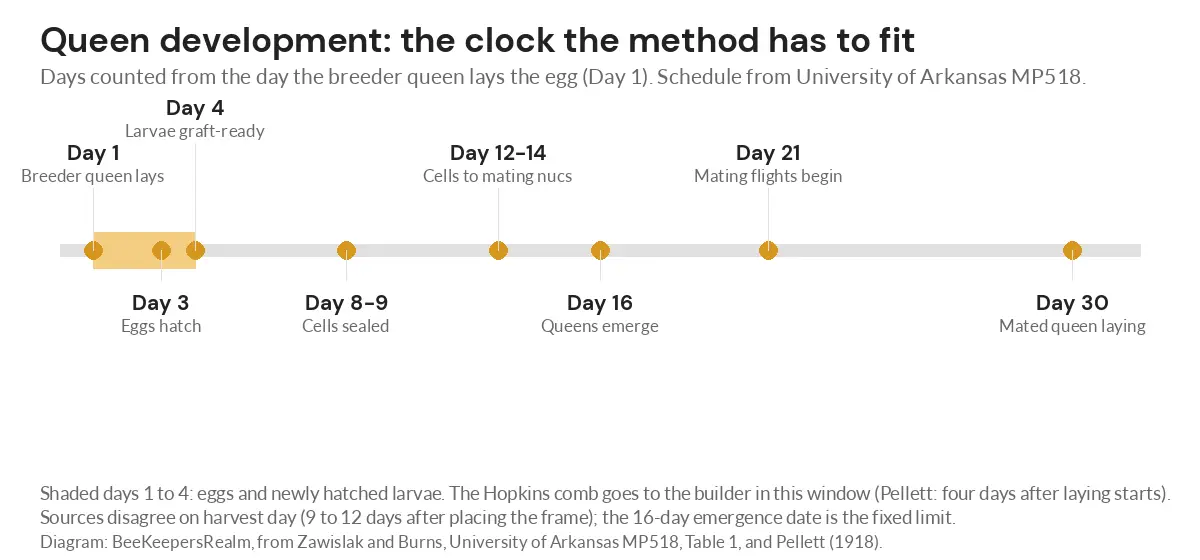
Sources disagree on when to harvest a Hopkins frame. Conti says about 10 days until capped cells appear, Ostrofsky cuts cells nine days after placing the frame, and H. L. Case in 1912 said the cells were ready on the eleventh and not later than the twelfth day. The spread partly reflects larvae of different ages. In our reading of the sources, count from the day the eggs were laid, not the day the frame went in, because the 16-day emergence date is the hard limit.
The age of the larvae also matters. The University of Florida’s queen cell guide says to graft larvae 12 to 24 hours old, and a research paper on emergency queen rearing notes that older larvae are not reliable. On a Hopkins frame the bees choose, so you control age mainly by using fresh comb and removing older brood from the builder.
How Many Cells to Expect
Published numbers vary widely, and all of them are individual reports. Hopkins counted sixty good cells, then over eighty. Pellett wrote that 75 to 100 fine cells were not unusual. Ostrofsky gives about 20 queens as the usual number. Conti got four cells in one setup, which he suggested might reflect too few nurse bees; he only needed a few queens.
More is not always better. The Apiarist found rather too many cells crowded together, and thinned by destroying two-thirds of the cells or by plugging chosen cells with cotton buds and dusting the rest with icing sugar. Count your mating capacity first: Conti notes that twenty queens need hundreds of drones; see drone congregation areas.
What Is Known About Queen Quality
Hayes (1991) and Conti (2021) both report good queens from the method. We did not find a controlled study comparing queens from Hopkins frames with grafted queens, so treat these as practitioners’ reports, not measured results.
The case for the method is that the bees select the larvae. The Apiarist notes that colonies prefer well-nourished larvae and favor the rarest patrilines, unlike hand-picking. He also lists the trade-off.
“However, they may also result in the exclusion of larvae that the bees would have preferentially selected as the ‘best’ from which to rear new queens.”
The weaker points are practical. Larvae on the frame may span several ages, cells are clustered and harder to excise, and The Apiarist says the cells probably have to be used as soon as they are ready. For repeatable queen quality, grafting young larvae is the better-documented route.
Hopkins Compared With Miller, Doolittle, Alley and a Queenless Nuc
The table keeps to what each source says.
| Method | What you handle | Equipment named | Reported output | Limits and notes |
|---|---|---|---|---|
| Hopkins (frame flat above a queenless colony) | Scrape cells on one comb face; bees choose larvae | Shim, hive tool, wired or plastic frame (Conti; Ostrofsky) | 4 to 100 cells, by report (Hopkins; Pellett; Conti) | Cells cluster; sag in heat; no controlled quality data. Hayes: “least” manipulation. |
| Miller (foundation triangles drawn out) | Trim comb back to larvae 24 to 36 hours old; frame stays vertical | Unwired frame with foundation pieces (Ostrofsky) | About nine queens (Ostrofsky) | Bush says it is really Albert Cook’s 1876 method, popularized by Miller, now used by hobbyists. |
| Doolittle (grafting) | Move individual larvae into cups | Grafting tool, cups, cell bar, protectors, starter and finisher colonies (Arkansas MP518) | Used by queen breeders (Hayes) | Hayes calls it labor intensive but yielding reasonably good queens; larvae are easily damaged. |
| Alley (cut comb) | Cut worker comb; attach below existing comb | Old brood comb, queenless starter hive (Bush) | No figure found | Bush knows of no commercial user. Hopkins said his method was similar. |
| Queenless nuc (walk-away) | None; a frame of eggs or 24-hour larvae goes into a queenless nuc | Five-frame nuc box (Ostrofsky) | One queen and a new hive (Ostrofsky) | Easiest, fewest steps; wait at least a month to check. |
For the other methods, see our guides to the Miller method, the Doolittle method, the Cloake board, and Jenter and Nicot kits. If you only want a few queens for your own hives, splitting a hive may be all you need.
“No grafting, no specialized tools, no cell bars and little chance of the beekeeper making accidental errors.”
Harvesting and Placing the Cells
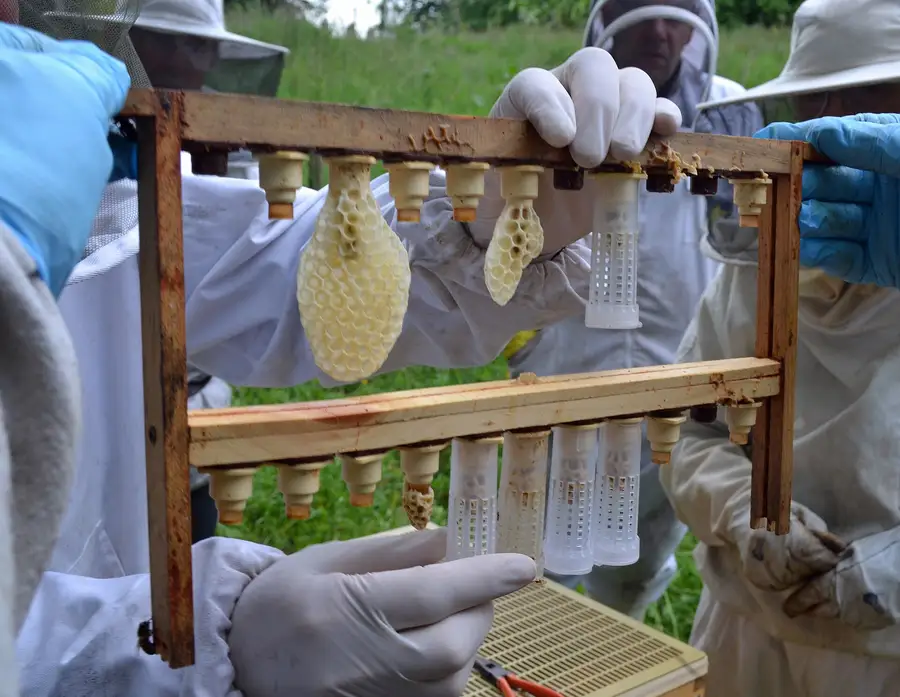
Stand the frame on its bottom bar and cut round each capped cell with a sharp, wet knife, leaving a border of comb about half an inch wide (Ostrofsky). Conti uses a sharp, curved tool and warns not to puncture the base, to keep cells warm and not to pinch them, and to give each new colony at least two cells. Press the border into a cavity in the comb of a mating nuc or queenless colony, without pressing on the cell itself.
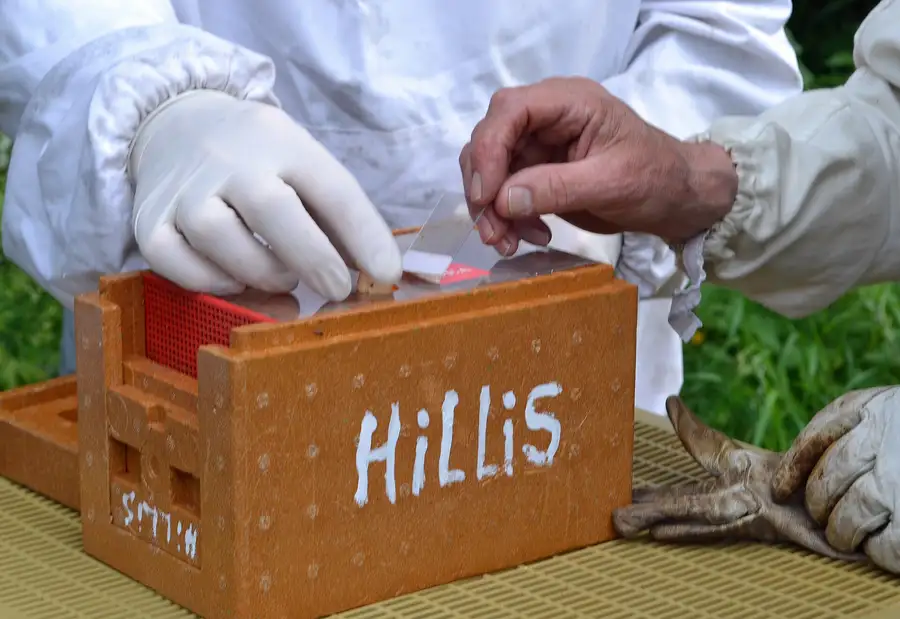
Plan the nucs first; our guides to Kieler and Mini Plus mating nucs cover setup, and the queen cell lifecycle shows how a ripe cell develops.
Common Problems and Fixes
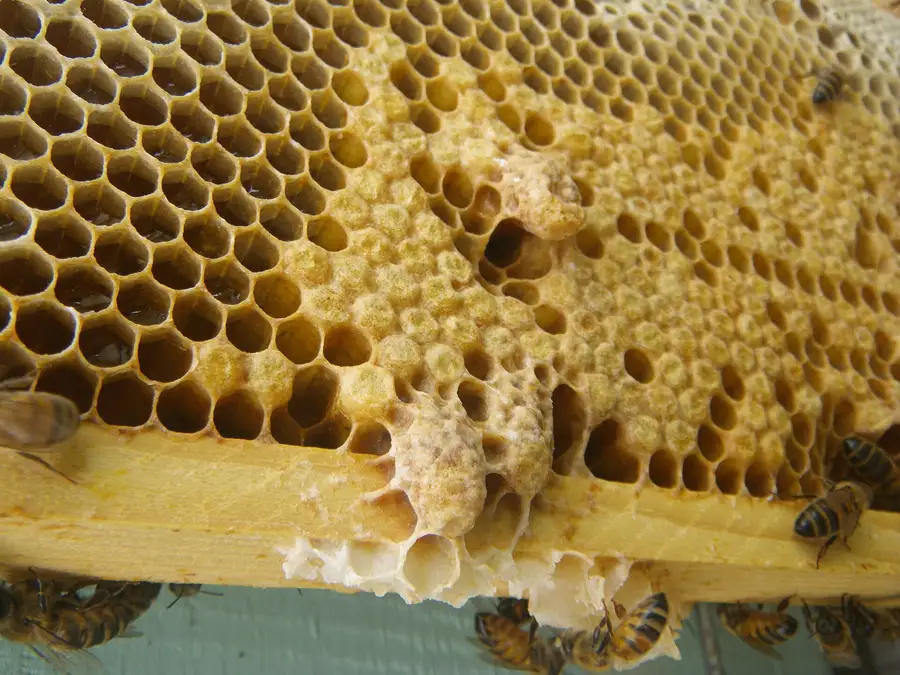
- Sagging comb. Use wire or plastic foundation, and support the frame (Hopkins; Conti).
- Cells crowded together. Thin harder before placing, with the one-in-three pattern or the icing-sugar trick (The Apiarist).
- Few or poor cells. Use a strong builder with plenty of nurse bees (Conti; Pellett).
- Old larvae on the frame. Use fresh comb and remove older brood from the builder (Pellett; The Apiarist).
- A virgin emerges early. Arkansas MP518 warns that one early-emerging queen can destroy weeks of effort. Place cells before day 16.
Frequently Asked Questions
What is the Hopkins method for queen rearing?
A graft-free method in which a frame of eggs and young larvae is thinned and laid flat above a queenless colony, so the bees raise queen cells from the larvae they select.
How long does the Hopkins method take?
Sources put harvest at 9 to 12 days after the frame is placed, and queens emerge on day 16 from the egg. Arkansas MP518 has a mated queen laying around day 30.
Do you have to destroy cells on the frame?
Not strictly. Pellett wrote that Emma Wilson got very good results without mutilating the comb, but probably fewer cells. Without thinning, cells can crowd.
How many queens will I get from one frame?
Reports range from 4 cells to 75 to 100. Ostrofsky gives about 20 as usual.
Is the Hopkins method better than grafting?
It is simpler and needs less equipment. We found no controlled comparison of queen quality, and grafting is better documented for repeatable results.
How is it different from the Miller method?
Ostrofsky writes that the main difference is the orientation of the frame: horizontal for Hopkins, vertical for Miller.
The Bottom Line
Try it once with one strong builder and a wired frame, and count your mating nucs before you start. If you need many queens of known quality, learn grafting too.
Sources are named and linked where used: Hopkins (1911), Pellett (1918), Hayes (1991), Conti (2021), Ostrofsky, The Apiarist and University of Arkansas MP518. This is educational information based on published beekeeping sources.
.jpg)
.jpg)
