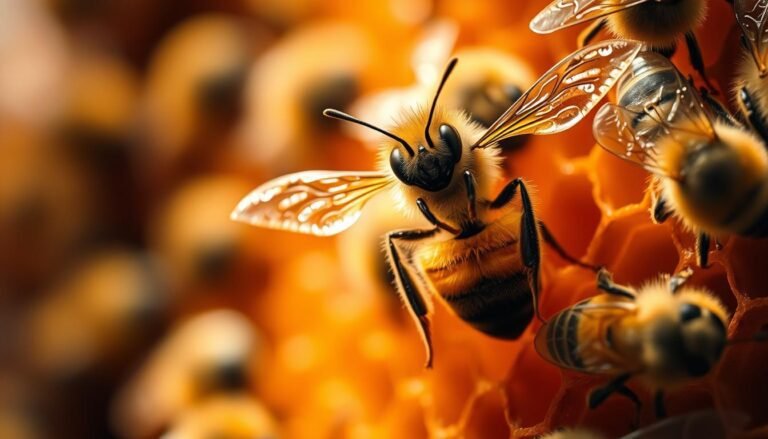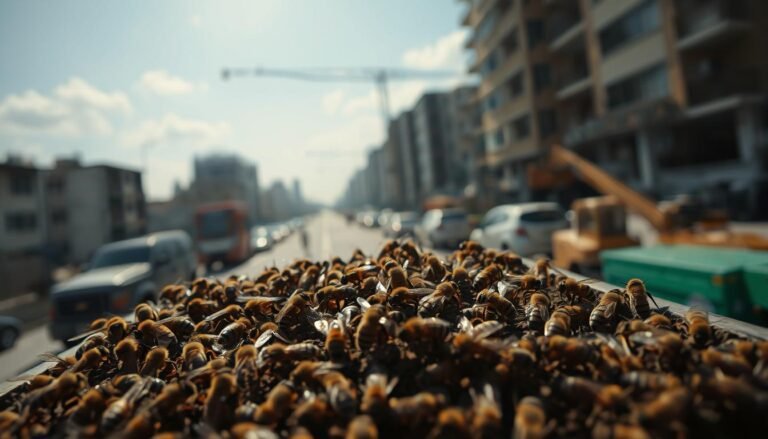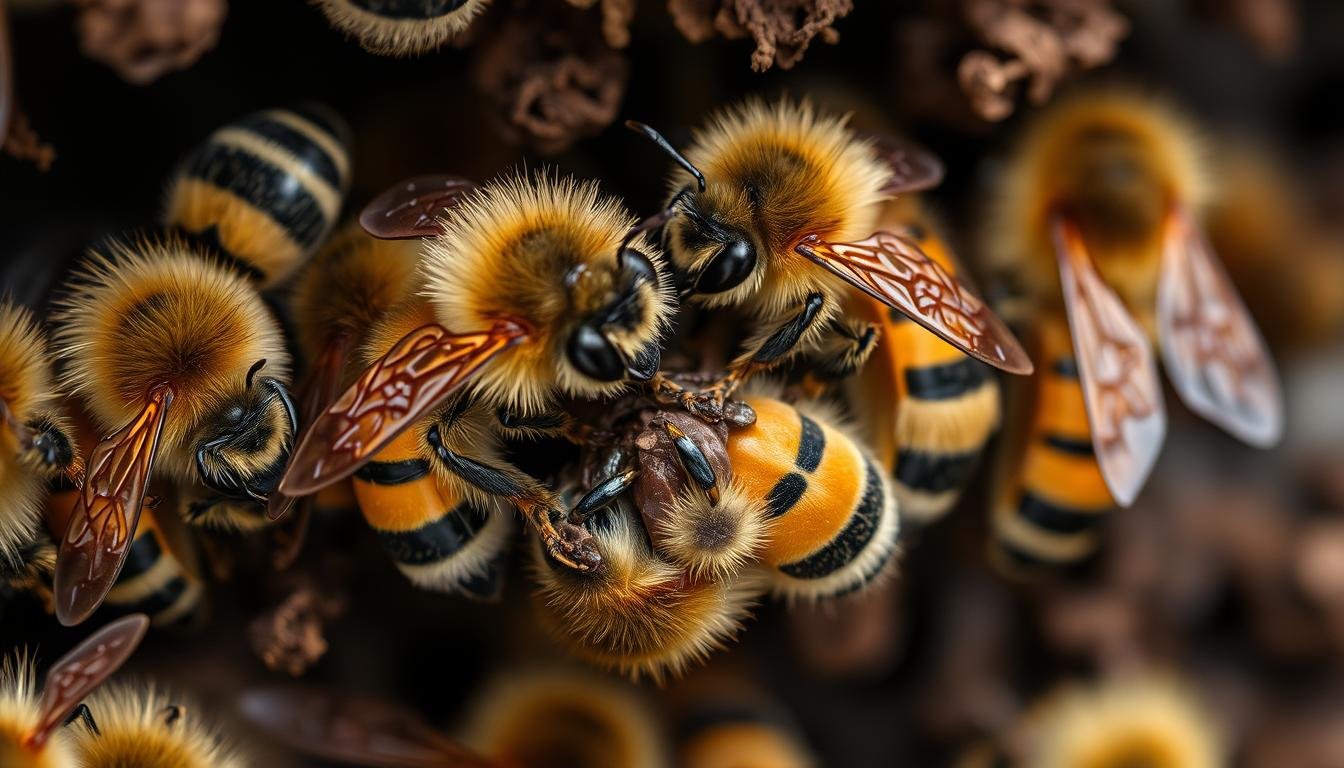
Undertaker bees form a small, specialized group inside a honey bee hive. They remove each corpse fast to keep a colony clean and reduce disease risk. Visscher (1983) found corpse removal can be up to 70 times faster than similar debris removal, showing clear priority.
Necrophoresis is this corpse removal behaviour. It acts as social immunity, limiting pathogen spread before microbes multiply. Trumbo et al. (1997) reported about 25% of workers perform such tasks at some life stage, though few work at once.
Specialist hygienic workers do a large share of cleansing. Perez & Johnson (2019) and Wen (2020/2023) link recognition to chemical changes on cooled bodies. Seasonal stress raises internal death, so timely removal protects honey stores and keeps a colony productive.
Key Takeaways
- Undertaker bees perform rapid corpse removal to limit disease in hives.
- Necrophoresis acts as a form of social immunity in honey bee colonies.
- A small fraction of workers have outsized impact on hive hygiene.
- Chemical cues on cooled bodies help specialists identify corpses.
- Seasonal shifts make prompt removal more vital for colony stability.
Overview: Why corpse removal matters for honey bee colonies today
Swift corpse removal keeps infections from spreading inside a packed hive. In a confined colony, a single corpse can raise disease risk quickly, so rapid removal dead activity protects brood and honey stores. Visscher (1983) documented that hives prioritize corpse clearing over similar tasks, showing clear adaptive benefit.
When bad weather forces foragers to stay inside, more workers die at home rather than away. This compresses time for cleanup and raises pressure on housekeeping. Trumbo et al. (1997) noted specialists sometimes switch to debris clearing when demand shifts.
Undertaking happens without recruitment signals, letting individuals act fast in crowded areas. Only a few workers do this at once, but the activity scales as conditions change. Modern hive hardware, such as open mesh floors, can alter cooling and affect how quickly corpses are recognized and removed.
- Quick action stops microbes before they spread.
- Individual-driven behaviour keeps work efficient in tight spaces.
- Clean lower areas improve airflow and reduce moisture stress.
What undertaker bees are and how they work inside the hive
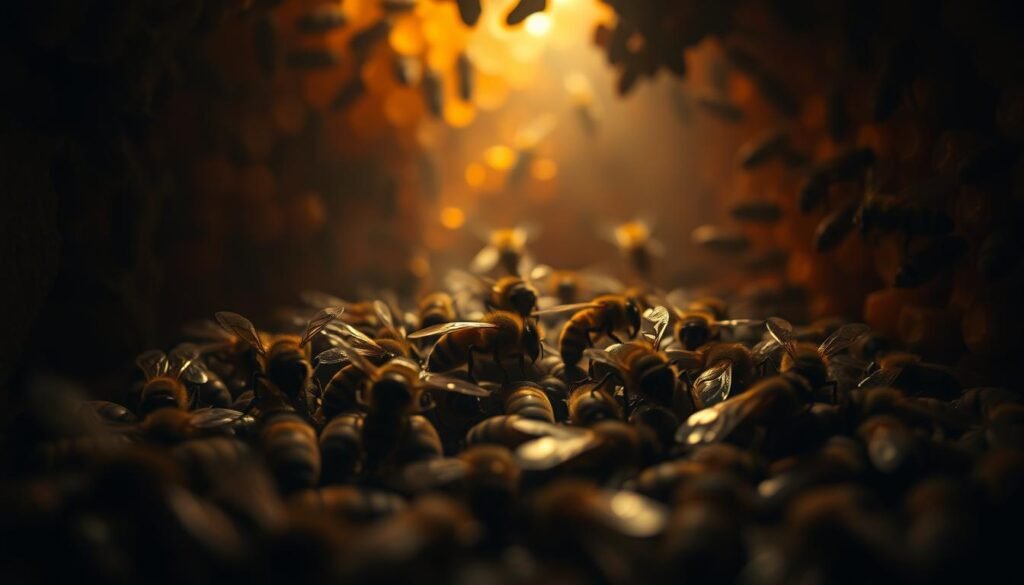
A small cohort of middle-aged workers patrols lower frames and entrances, hunting bodies and stray debris.
Core tasks include locating a body, gripping it firmly, and hauling it through crowded lanes toward the entrance. This removal behaviour is fast; corpses exit far quicker than similar waste. Undertakers also pick up bits of wax, propolis, or dead brood they meet along the route, helping overall hygiene.
They concentrate on lower combs, bottom boards, and doorways where gravity and traffic cause matter to collect. A single worker finds a body by touch and scent, repositions for a sure hold, then navigates light and airflow to leave the hive.
Why it matters: this activity cuts microbial load on surfaces used by nurses, the queen, and developing brood. Workers act alone, avoiding recruitment calls that would cause jams. Simple handling technique saves energy so each worker can complete many removals during high demand.
Colony health and disease prevention through necrophoresis
Removing dead workers fast prevents microbes from gaining a foothold in colony spaces. Visscher (1983) found many corpses exit within 30 minutes, which sharply lowers exposure before decomposition spreads microbes or odors.
Necrophoresis is the targeted behaviour that clears dead bees to reduce pathogen load. Quick removal interrupts infection chains and protects nurse workers and brood from contact with contaminated surfaces.
This action complements hygienic brood removal. Together, both behaviours keep capped cells and open surfaces safer for growth and for honey storage.
- Fast removal prevents buildup of decay-related chemicals that can disturb ventilation and odor signals.
- High-turnover periods such as storms or cold snaps make rapid cleanup critical inside the hive.
- Stable microenvironment supports brood rearing and reduces risks like mold near frames and stores.
| Benefit | How it helps | Impact on colony |
|---|---|---|
| Reduced pathogen load | Removes sources before microbes multiply | Fewer disease flare-ups |
| Cleaner brood area | Limits contact between nurses and contaminated matter | More consistent brood development |
| Protected stores | Prevents honey and wax contamination | Preserves vital resources |
| Social immunity | Individual actions scale to colony defense | Greater resilience in crowded conditions |
The role of undertaker bees
Middle-aged workers often enter a brief window when their main activity is corpse clearing and local floor hygiene.
Who does the job
Small specialist cohorts handle most removals. At any moment about 1–5% of workers are active, though up to 25% may serve that task at some life stage.
How fast it happens
Carrying a body is prioritized. Studies show corpse removal can be up to 70 times faster than similar debris clearing, which limits pathogen exposure and keeps traffic moving.
From entrance to outside
A carrier grips a body, navigates to an exit, flies a short to moderate distance (often 50–100 m), and drops the load well away from flight lanes and water. This prevents scavenger clustering near the hive and protects brood zones and honey stores.
“Quick, solitary action by a few individuals preserves colony hygiene and visible vigor.”
| Step | Typical measure | Colony benefit |
|---|---|---|
| Active workers | 1–5% at a time | Efficient, low traffic disruption |
| Lifetime involvement | Up to 25% serve briefly | Flexible workforce |
| Drop distance | 50–100 m | Reduces scavenger attraction |
Chemical cues behind corpse removal: from cuticular hydrocarbons to the “scent of death”
Surface chemicals guide rapid recognition. Early work found that solvent-washed or paraffin-coated bodies were cleared much more slowly, linking cues to compounds on the cuticle rather than shape alone.

Early evidence from solvent and wax tests
Visscher’s experiments showed masking chemicals alters removal timing. Paraffin or hexane washes lowered signals and delayed action, proving chemical cues matter.
Key hydrocarbons in apis cerana
Wen identified drops in heptacosane (C27) and nonacosane (C29) as bodies cool. That loss creates a temperature-dependent scent pattern that singles out a corpse.
Warm versus cool bodies and brood contrasts
Warming a dead worker to near 44°C restores a live profile and slows removal. By contrast, brood signals use a different combo: β-ocimene plus oleic acid trigger hygienic brood removal in assays.
Compounds act at short range and do not recruit helpers; production, diffusion, temperature, and airflow at entrances shape how fast a lone worker decides to remove a corpse.
These patterns explain why hive design and ambient temperature shift removal timing and why further study across species remains important. For more detail see research on scent cues and removal.
Hygienic behavior vs. necrophoresis: related defenses, different targets
Two sanitation systems work in parallel: one clears compromised brood inside cells, while another removes adult bodies from hive lanes. Both cut disease risk, but each uses different signals and tactics.
Brood signals versus adult cues
Brood removal relies on volatile and contact compounds. McAfee et al. (2018) found that ocimene combined with oleic acid triggers quick uncapping and exit of sick brood. This ocimene oleic acid mix works at short range inside cells.
Specialist overlap and task switching
Perez & Johnson (2019) report that specialist hygienic workers handle about half of brood cleaning and roughly a quarter of corpse hauling. That overlap boosts throughput when demand rises.
Adult corpse detection, by contrast, tracks shifts in cuticular hydrocarbons. Visscher and Wen show cooling alters surface profiles, which prompts necrophoresis and removal dead actions along floors and entrances.
Practical cue: sudden uncapping with quick brood exit or steady outward traffic carrying bodies both signal healthy colony sanitation.
Age-based division of labor: when workers become undertakers
Middle weeks in a worker’s life often signal a switch to sanitation duties before long flights begin. Around 2–3 weeks old, many workers take on hauling and removal tasks. Gene Robinson’s observations show some serve for a day, then move to foraging as conditions change.
Temporal polyethism: transitioning through hive duties
Temporal polyethism means workers progress from nursing to guarding, then to undertaking, and finally to foraging as physiology and colony needs evolve.
Time spent in this sanitation activity varies. If internal mortality rises, more workers shift to removal duties. That reassignment keeps nursing and guard coverage steady.
“Brief service periods reduce burnout and let many workers share hygiene work over a season.”
- Age-linked strength and responsiveness match the demands of dragging and flying with corpses.
- Short stints preserve brood care and maintain honey gathering output.
- Beekeepers can infer labour balance by watching steady removal traffic at the entrance.
Seasonal dynamics and environmental factors influencing undertaking activity
As autumn tightens, mortality inside hives rises and sanitation demands climb fast.
Autumn-to-winter turnover raises cleanup pressure
Colony composition shifts from short-lived summer workers to long-lived winter stock. More workers die inside during storms and cold, so removal rates must rise to keep disease risk down.
Beekeeper observations often note heavier traffic at the entrance in fall and early winter. Visible carriers and scattered dead bees signal higher necrophoresis demand and steady hygiene work.
Floor design, temperature, and recognition cues
Open mesh floors speed cooling and help bodies fall away from brood levels, which assists quick removal and flight access. Heavy insulation can slow cooling and delay detection by a few vital minutes.
Research on apis cerana links cooling to reduced hydrocarbons on cuticles, which sharpens recognition and speeds removal. Faster cooling often shortens the time pathogens have to spread and lowers disease pressure inside a hive.
Practical note: maintain dry airflow and balanced insulation. Proper ventilation and moderate insulation preserve honey stores, keep movement lanes clear, and help the colony match labour to seasonal need.
Practical takeaways for U.S. beekeepers
Watch hive exits for steady traffic carrying small loads away; that activity shows sanitation at work.
What to look for: signs of healthy corpse removal at the entrance
Look for brief waves of workers lifting and flying off with dead bodies, then dropping them well away from the stand. This pattern means effective corpse removal and low disease risk near landing boards.
If you see piles on the bottom board or bodies lingering at the entrance, check airflow and weather. Poor cooling or cluttered boards slow recognition and removal tasks.
Hive management tips that support colony hygiene without over-intervention
- Promote airflow: open mesh floors can help cooling and speed scent changes used by specialist workers.
- Balance insulation: avoid trapping warmth under the cluster; ventilation below with insulation above works well.
- Select stock: choose for hygienic behaviour—this trait often links with better removal and brood care.
- Limit disturbance: avoid heavy inspections in cool weather so carriers keep clear lanes to the exit.
- Keep entrances clear: remove feeders or clutter that block removal routes and reduce handling delays.
- Use chemicals cautiously: follow label directions to avoid disrupting odor cues and normal behaviour.
“Steady, quick removal at the entrance is a simple, visible sign that a hive maintains cleanliness and resilience.”
Conclusion
,A fast, individual response to a body helps preserve brood and honey stores while cutting disease risk in honey bee colonies.
Necrophoresis and targeted brood hygiene form a dual defence. β-ocimene plus oleic acid trigger uncapping and brood removal, while cooling-driven changes to cuticular hydrocarbon profiles guide adult corpse removal.
Middle-aged workers and a few specialist hygienic helpers carry most sanitation tasks. Quick corpse removal beats similar debris clearing in speed, so prompt action keeps hive scent signals clear and resources safe.
Practical steps for U.S. beekeepers: favor stock that shows hygienic traits, use open mesh floors with balanced insulation, and watch entrance traffic for signs of healthy removal. Consistent attention supports colony resilience across seasons.
FAQ
What is the importance of undertaker bees in a colony?
Undertaker workers perform corpse removal and debris clearing to maintain hive hygiene. By removing dead bees quickly, they reduce pathogen load and slow decomposition, protecting brood and adult workers from disease.
Why does corpse removal matter for modern honey bee colonies?
Rapid removal limits pathogen spread and supports colony resilience. In crowded or stressed hives, delayed cleaning raises infection risk, weakens colonies, and can lower honey production and overwinter survival.
What tasks do these workers perform inside the hive?
Core tasks include locating corpses, carrying them out, clearing debris from comb, and keeping entrance areas open. Their activity preserves brood health and maintains airflow and cleanliness on bottom boards and comb surfaces.
Where do they usually operate within the hive?
Most activity concentrates on lower combs, bottom boards, and entrances. Workers patrol these zones to find warm or cool corpses and remove them away from brood nests.
How does necrophoresis help prevent disease in the colony?
Necrophoresis reduces pathogen reservoirs by removing dead bodies before microbes proliferate. This behavior lowers contact between decomposing tissue and living bees, limiting transmission of bacteria, fungi, and viruses.
Who performs corpse removal and when do they start?
Middle-aged workers typically take on this duty, often within a specialist cohort. Temporal polyethism governs the shift: workers transition from nursing to guarding to undertaking, then to foraging as they age.
How quickly are corpses removed compared to other debris?
Corpses are removed rapidly—usually within hours—while inert debris may linger longer. Speed depends on colony size, season, and the number of available undertakers on duty.
How are dead bees carried and where are they dropped?
Workers seize corpses, fly them to a safe distance, and drop them away from the hive or place them in refuse sites. This reduces attraction of scavengers and minimizes contamination near entrances.
Which chemical cues trigger corpse removal?
Recognition relies on shifts in cuticular hydrocarbons (CHCs) and other volatiles. Studies show compounds such as heptacosane and nonacosane act as adult corpse signals, while ocimene and oleic acid play roles in brood and some adult cues.
What did early experiments reveal about corpse detection?
Classic work using solvent washes and paraffin models demonstrated that chemical cues, not just sight or texture, provoke removal. Removing surface hydrocarbons often reduces detection, highlighting CHCs as key signals.
How do temperature and body state affect recognition timing?
Warm, recently dead bodies retain CHC patterns and may delay detection. As bodies cool and CHC levels change, undertakers detect altered chemical profiles and remove the corpse faster.
How do ocimene and oleic acid differ in signaling death?
β-ocimene often signals brood stress or development; oleic acid acts as a conserved necromone in many insects. In honey bees, a blend can flag dead brood, while adult corpse recognition relies more on CHC shifts, with ocimene/oleic acid contributing contextually.
How does hygienic behavior compare to necrophoresis?
Both defend colony health but target different threats. Hygienic bees remove diseased brood, often triggered by β-ocimene plus oleic acid, whereas necrophoresis focuses on adult corpse removal driven mainly by CHC changes.
Do hygienic specialists overlap with undertaker duties?
Some overlap exists: specialist hygienic workers can perform multiple cleaning roles. Still, distinct cohorts often specialize in brood uncapping and removal versus adult corpse transport.
When do workers typically become undertakers under temporal polyethism?
After a nursing period, workers usually shift to guarding and then to undertaking during middle age. Exact timing varies with colony needs and environmental conditions but commonly occurs before full foraging onset.
How do seasons and environment change removal activity?
Autumn and winter bring higher in-hive mortality and greater removal demand. Cooler temperatures slow decomposition but also affect CHC volatility, altering detection speed. Hive ventilation, insulation, and floor design can change activity levels.
How does floor design influence corpse removal?
Open mesh floors and well-ventilated lower boards help drop or expel corpses and reduce humidity. Insulated or solid floors may retain heat, affecting decomposition rate and chemical cue release, which can slow or speed removal.
What signs indicate healthy corpse removal at the entrance?
Clear entrances, few dead bees inside, and regular outward transport activity signal effective hygiene. Small daily removals are normal; large accumulations or foul odor suggest a problem.
What practical hive management tips support colony hygiene?
Maintain adequate ventilation, avoid overcrowding, monitor for excess mortality, and inspect bottom boards regularly. Minimize chemical residues that could mask CHCs and support colony nutrition to keep worker cohorts robust.
Which keywords are relevant for further research on this topic?
Useful search terms include necrophoresis, cuticular hydrocarbons, ocimene, oleic acid, Apis cerana, Apis mellifera, middle-aged workers, corpse removal, colony hygiene, and CHC signalling.