Reviewed by Michael R. · Last Updated September 23, 2026 · How we review
Honey bees detect hive intruders mainly by smell. Guard bees at the entrance touch each arriving bee with their antennae and compare the waxy chemicals on her body, called cuticular hydrocarbons, against a learned template of their colony’s odor. A close enough match gets in. A mismatch is grabbed, bitten or stung. The system is fast but imperfect, because odors from neighboring colonies overlap. So guards shift their strictness with conditions: relaxed during a strong nectar flow, strict when robbers are about. Wasps smell so different that guards reject them every time.
What follows is what the research shows about each step, including the numbers, and what it means for how you manage your entrances.
Key Takeaways
- Recognition is based on smell, not sight. In one study, guards rejected wasps and distinguished bees just as well in the dark as in daylight.
- Only about 10 to 15% of workers ever guard, typically starting between 7 and 22 days old. Most guard for less than a day.
- Guards trade off two kinds of error. When they get stricter, they turn away more nestmates along with more intruders.
- Wax comb and the gut microbiome both help shape a colony’s odor, so swapping comb between hives can change what guards accept.
- For beekeepers, rising fights at the entrance are an early warning of dearth and robbing. Entrance reducers help guards cope.
Table of Contents
Who the Guards Are
Guarding is a short, specialized job taken on by middle-aged workers. In a classic study of individually marked bees, Moore, Breed and Moor (1987, Animal Behaviour) found that only about 10 to 15% of workers ever guarded. Those that did started between 7 and 22 days of age, with colony averages of about 14 to 16 days. Most guarded for less than a day. A few stayed on duty for up to six consecutive days before moving on, usually to foraging.
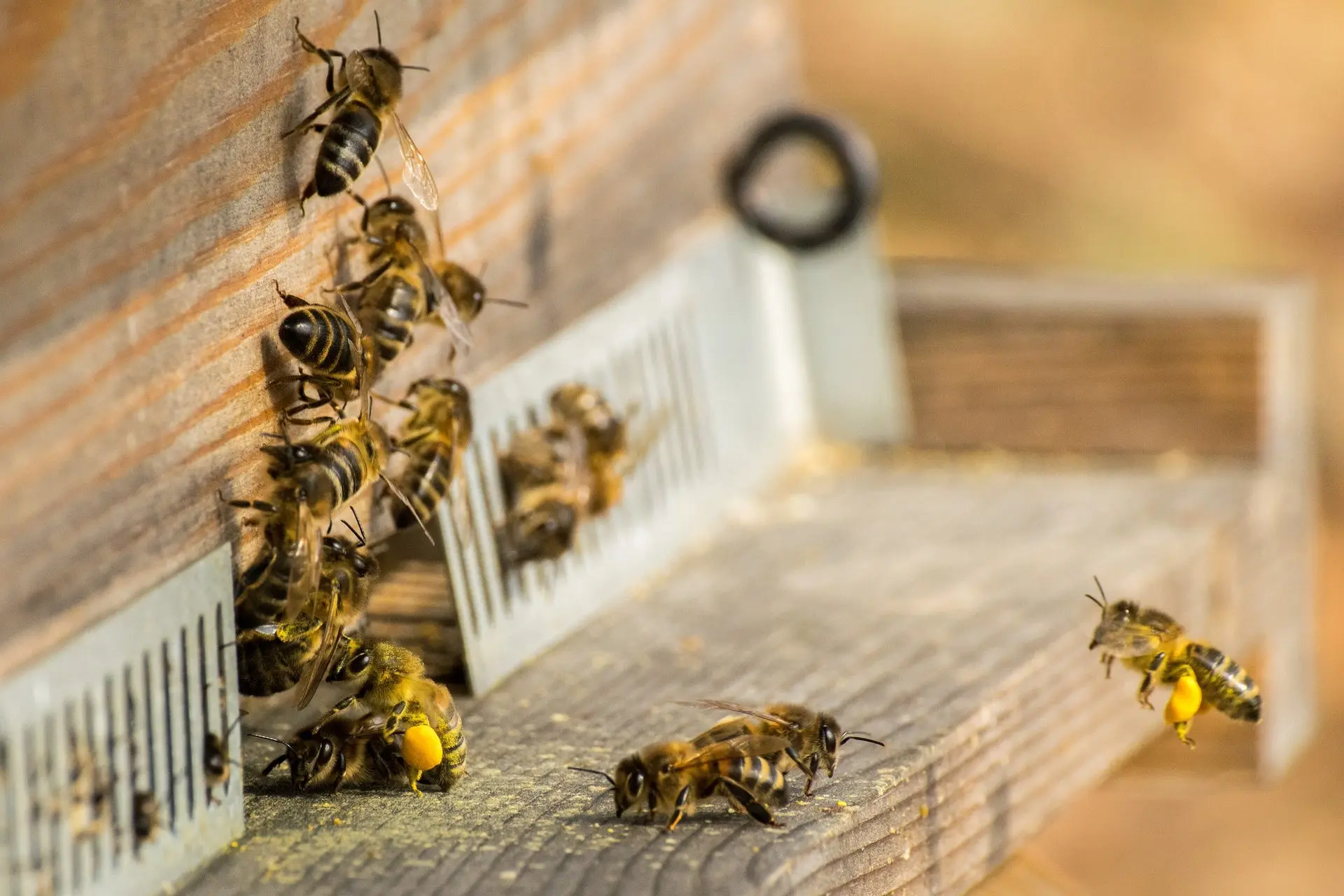
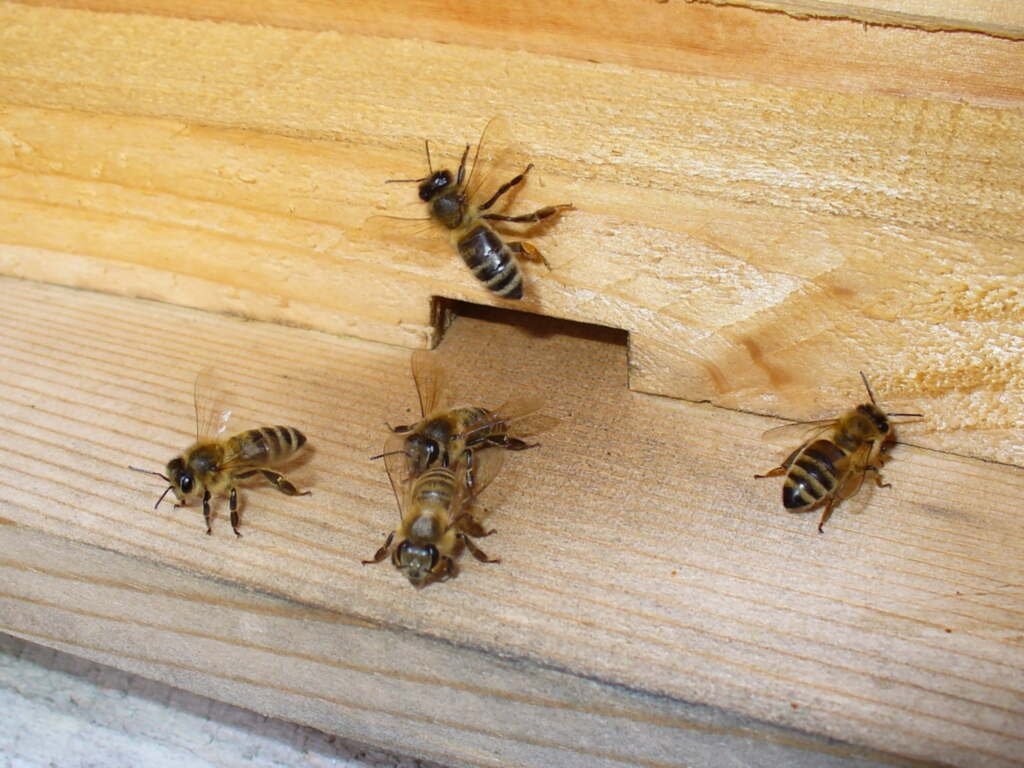
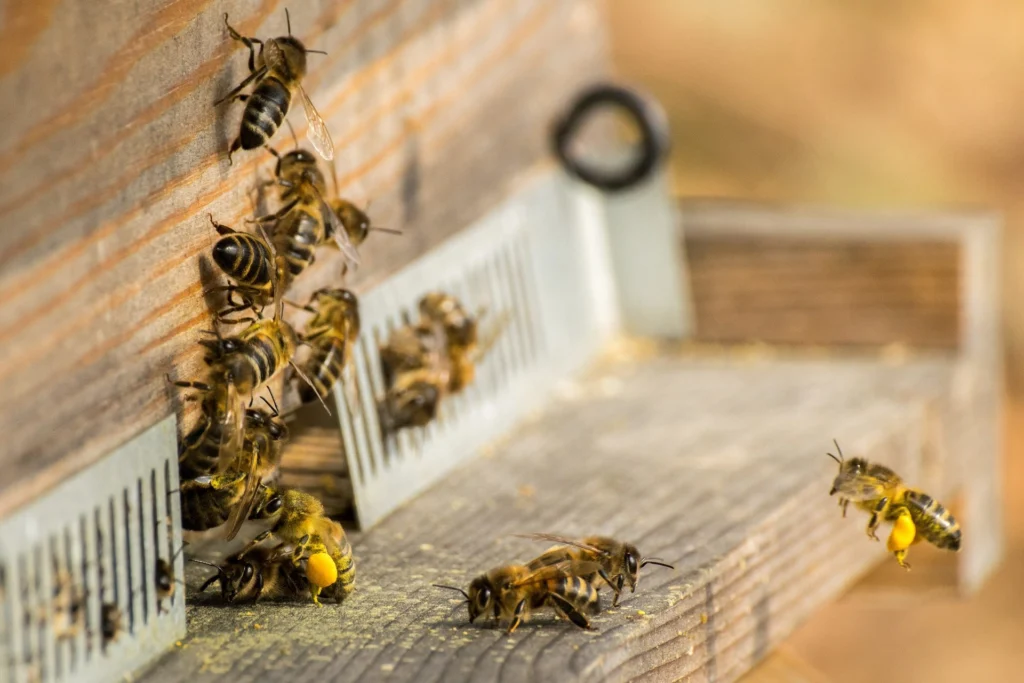
You can spot guards on the landing board. They stand with their front legs raised and antennae forward, facing incoming traffic, and they turn to meet each arriving bee. The number of guards isn’t fixed. It rises when threats rise, which is one of the most useful things a beekeeper can learn to read. For how guarding fits into a worker’s life, see our overview of worker bee roles.
The Check at the Entrance
A guard inspects an arriving bee by antennation, a quick drumming and sweeping of the antennae over the newcomer’s body. The antennae carry odor receptors that read the blend of cuticular hydrocarbons (CHCs) coating the insect’s exoskeleton. CHCs first evolved to waterproof insects. Social insects have repurposed them as an identity badge.
The decision is chemical, not visual. Couvillon, Roy and Ratnieks tested guards in light and darkness. Guards rejected 100% of the wasps they were presented with in both conditions, and their ability to tell nestmate bees from non-nestmates didn’t change in the dark either (Journal of Apicultural Research, 2009).
What happens next depends on the match. A familiar-smelling bee walks in. An unfamiliar one is held, bitten, dragged or stung, and other guards often join in. Researchers describe this with an acceptance threshold: each guard carries a template of “what we smell like,” and accepts anyone whose odor falls close enough to it.
Where Colony Odor Comes From
Where the colony’s shared odor comes from is still an active research question, and the findings add up to a layered picture.
Each bee makes her own blend, and it matures with age
In a 2019 eLife study, Vernier and colleagues at Washington University in St. Louis found that each worker’s CHC profile changes through a predictable age sequence. It reaches a mature, colony-specific signature only when she becomes a forager. The profiles appear to be made by each bee rather than shared by rubbing against nestmates. The study also suggests that rejecting non-nestmates happens mainly between guards and arriving foragers at the entrance. That helps explain why young bees from another colony often aren’t treated as intruders.
Comb wax shapes the guards’ template
Comb wax absorbs hydrocarbons and odors, and it seems to affect the guards’ side of the comparison. In a 2007 Biology Letters experiment, Couvillon and colleagues moved wax comb from one hive into another. Guards in the receiving hive became more accepting of bees from the donor hive: rejection fell from 70% to 47%. The donor hive’s guards didn’t change. The authors concluded that the comb changed the guards’ template rather than the visitors’ odor.
The gut microbiome contributes too
A 2020 follow-up by the same Washington University group, published in Science Advances, linked colony odor to gut bacteria. Newly emerged bees treated with antibiotics developed altered CHC profiles. Sister bees inoculated with different gut communities, or with different strains of the gut symbiont Gilliamella apicola, developed distinct profiles, and in laboratory tests could tell each other apart. Because young bees pick up their gut bacteria from older nestmates, a shared microbiome is one way a colony’s members end up smelling alike. These were controlled lab assays, not observations of guards at a hive entrance, so how much this matters in the field is still an open question.
The queen’s pheromones play a big role in colony cohesion, as our guide to bee communication explains. For entrance recognition, though, the evidence points mainly to worker CHCs, comb wax and the environment.
Why Guards Make Mistakes, and Why That’s Adaptive
Because neighboring colonies eat from the same flowers and live in similar boxes, their odors overlap. That means a guard can’t be perfect. If she sets her threshold strictly, she’ll reject some of her own sisters. If she sets it loosely, some intruders will get in.
Couvillon’s team measured this trade-off directly, introducing 760 non-nestmate bees, 380 nestmates and 380 wasps to guarded entrances over a season. The two kinds of error were negatively correlated (Spearman rs = −0.595, p = 0.007). On days when guards were more likely to reject their own nestmates, they were less likely to let a stranger in, and vice versa. Even a colony’s own foragers are sometimes turned away, and some strangers always get through.
Guards move their threshold to suit conditions, which is what the acceptance threshold model predicts. Downs and Ratnieks (2000, Behavioral Ecology) found that during a nectar dearth, guards accepted about 80% of introduced nestmates and only 25% of non-nestmates. As forage improved, they became progressively more lenient, until almost everyone was let in. When nectar is plentiful, robbing isn’t worth much, and a strict guard would mostly be delaying her own foragers. A 2008 Animal Behaviour study by Couvillon and colleagues found the shift can happen quickly, triggered by a surge of intruding bees at the entrance. In the 2009 study, conspecific fights at the entrance rose from about 1.33 per hour in late July to 10.67 per hour by late September and October, as forage dried up and robbing pressure grew.
“Our results strongly support that overlapping cue distributions occur, resulting in errors”
— Couvillon, Roy and Ratnieks, Journal of Apicultural Research, 2009
Wasps vs. Robber Bees
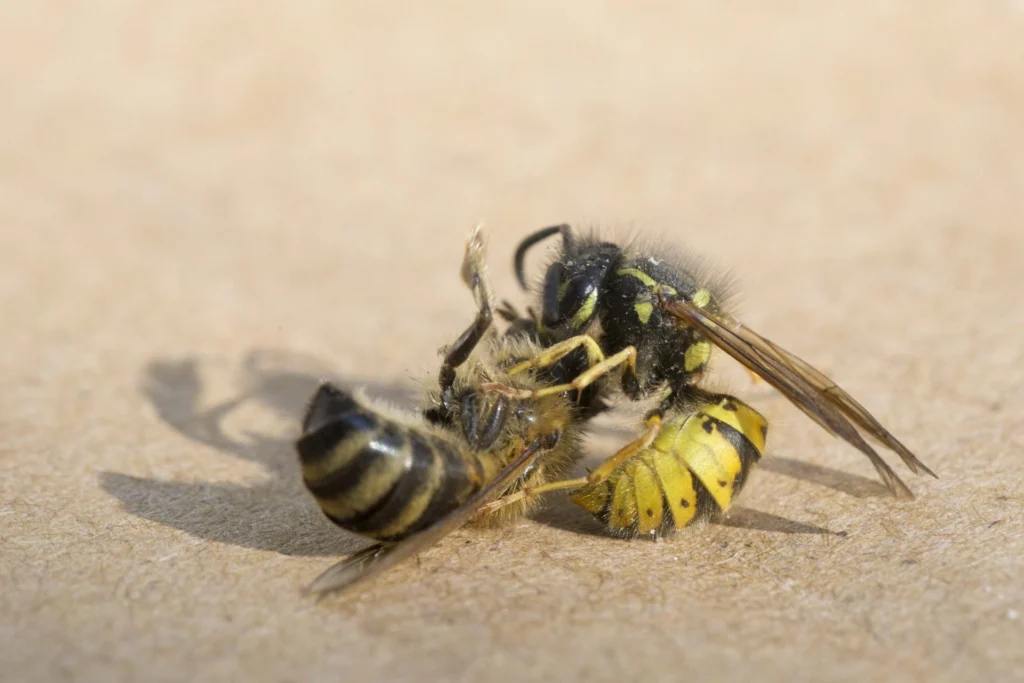
The same study found a striking contrast. Guards’ accuracy with bees changed with conditions, but their rejection of wasps didn’t. Across the experiment, all 380 introduced common wasps (Vespula vulgaris) were rejected, and wasp rejection didn’t correlate with how strict guards were being with bees. Wasps’ chemical cues are so different from any bee’s that there’s no overlap to cause errors.
In practice, a wasp or yellowjacket rarely fools the guards. It wins by numbers, or by targeting a colony too weak to staff its entrance. Robber bees are harder: they smell similar enough to slip through when guards are permissive, which is why robbing escalates so quickly once it starts. If you’re not sure which insect is at your entrance, see yellowjackets vs. honey bees.
The Key Studies at a Glance
| Study | What it tested | Key finding |
|---|---|---|
| Moore, Breed & Moor, 1987 (Animal Behaviour) | Who guards and for how long | About 10 to 15% of workers guard, starting at 7 to 22 days; most for less than a day |
| Downs & Ratnieks, 2000 (Behavioral Ecology) | Guard strictness vs. forage conditions | In dearth, guards accepted about 80% of nestmates and 25% of non-nestmates; in strong flows, nearly all bees |
| Couvillon et al., 2007 (Biology Letters) | Transferring wax comb between hives | Receiving hive’s rejection of donor bees fell from 70% to 47% |
| Couvillon et al., 2008 (Animal Behaviour) | What triggers stricter guarding | A surge of intruders at the entrance prompts a rapid shift |
| Couvillon, Roy & Ratnieks, 2009 (J. Apicultural Research) | Errors with bees vs. wasps, light vs. dark | Bee errors trade off; 380 of 380 wasps rejected; smell, not sight |
| Vernier et al., 2019 (eLife) | How CHC profiles develop | Colony-specific profile matures in foragers; made by each bee |
| Vernier et al., 2020 (Science Advances) | Gut bacteria and odor | Gut microbiome shapes CHC profiles and lab recognition |
What It Means for Your Apiary
Understanding guards changes how you read an entrance and when you step in.
- Watch for rising guard numbers and fights. In the Red River Valley, the late-summer dearth after the main flows is when entrances get tense, and yellowjackets build up at the same time. More guards facing out, grappling pairs and bodies on the landing board mean guards have tightened up because pressure is rising. Our guide to identifying robbing early shows what to look for.
- Make the entrance defensible. A guard force that holds a small opening can be overwhelmed at a full-width one. Reduce entrances on weak colonies and nucs during dearth. See entrance reducer sizes and robbing screens.
- Don’t feed in a way that recruits robbers. Open feeding and spilled syrup bring in foragers from other colonies, and guards can’t stop every one that smells close enough. See feeding without causing robbing.
- Think before swapping comb. Because wax shifts the guards’ template, moving combs between colonies may blur the odor difference between them. That’s a reasonable inference from the 2007 study, not a tested field result. It’s one more reason to limit comb movement, on top of disease risk.
- Reduce drift with layout. Drifting young bees are often accepted, which is how mites and viruses travel between hives. Different colors, landmarks and entrance directions help. See how to prevent drifting between hives.
For the wider set of defenses bees use, from alarm pheromone to heat-balling, see honeybee defense mechanisms.
Frequently Asked Questions
How do guard bees know who belongs to the hive?
By smell. Guards touch arriving bees with their antennae and compare the hydrocarbon blend on the bee’s body with a template of their colony’s odor. A close match is let in. A mismatch is challenged.
Can guard bees see intruders?
Vision plays little part in the decision. In experiments, guards discriminated nestmates from non-nestmates and rejected wasps just as well in darkness as in light.
How old are guard bees?
Typically around two weeks. In one study, guards began guarding between 7 and 22 days of age, and most guarded for less than a day before moving on to other tasks, usually foraging.
Why do robber bees get past the guards?
Their odor overlaps with the colony’s own, especially during a nectar flow when guards are permissive. Robbers also come in numbers, overwhelming a small guard force on a weak colony or at a wide entrance.
Do bees from another hive always get attacked?
No. Young drifting bees and bees arriving during a strong nectar flow are often accepted. Rejection is strongest against forager-age non-nestmates during dearth.
Why are wasps always rejected?
Their chemical cues are completely different from any honey bee’s, so there’s no overlap to confuse guards. In one study, all 380 wasps introduced to hive entrances were rejected.
The Bottom Line
Guard bees are a small, short-term team running a smell test at the door. Their strictness moves with the season, and their occasional mistakes are a trade-off rather than a failure. Read your entrances for rising tension, give weak colonies a small door to defend, and avoid handing robbers a reason to try.