Last Updated September 15, 2026
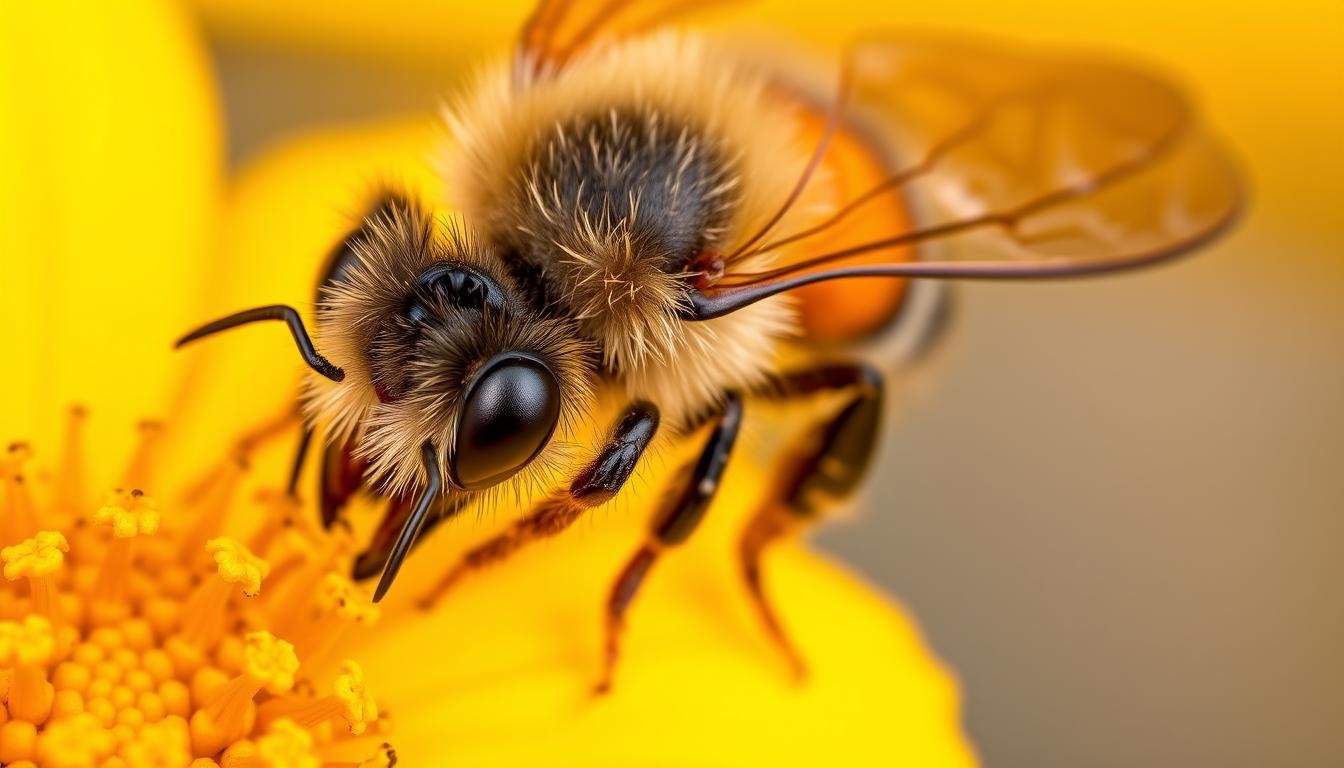
Before a honeybee ever unfurls its proboscis to drink, it has often already tasted what it landed on – through its feet. Honeybees carry contact chemoreceptors on their tarsi, the terminal leg segments that touch down first on a flower, capable of detecting sugar concentration and other chemical cues on contact, entirely separate from the taste receptors located on their mouthparts. It’s a genuinely underappreciated piece of bee sensory biology, mentioned only in a single passing sentence in our existing honeybee anatomy guide (“taste receptors located on their mouthparts and front feet”) without further explanation of how the system works or why it matters.
This article goes considerably deeper: the actual biology of tarsal contact chemoreception, why it matters for real-time foraging decisions, its surprising role as a standard tool in bee neuroscience and pesticide research, and how it compares to the well-known foot-tasting ability of butterflies and flies.
Key Takeaways
- Honeybees carry contact chemoreceptors on their tarsi (feet) that are entirely separate from the taste receptors on their mouthparts, letting them evaluate a flower the instant they land, before ever extending the proboscis.
- A detailed 2014 study in Frontiers in Behavioral Neuroscience mapped this system precisely: receptor cells on the tarsomeres are highly sensitive to salt at very low concentrations, while separate receptor cells on the claws respond strongly to sucrose – two distinct chemoreceptor populations doing different jobs on the same foot.
- Tarsal taste underlies the proboscis extension reflex (PER), a decades-old, still-standard laboratory tool for studying bee learning, memory, and pesticide effects.
- Bees are not unique – butterflies and flies are also well documented tasting through their feet, and a bee’s salt-sensitive feet have even been floated as a partial explanation for why bees are drawn to chlorinated swimming pools.
- The system is a fast preliminary screen, not a full taste profile – detailed feedback on sugar concentration and composition still comes from the mouthparts once the bee commits to feeding.
Table of Contents
- What Is Tarsal Contact Chemoreception?
- How It Differs From Mouthpart Taste
- Why It Matters for Foraging Decisions
- The Proboscis Extension Reflex: A Standard Research Tool
- Foot-Taste and Pesticide Research
- Butterflies, Flies, and Other Foot-Tasters
- How This Was Discovered
- Where This Fits in Bee Sensory Biology
- Tarsal Taste vs. Mouthpart Taste
- Common Misconceptions
- FAQ
What Is Tarsal Contact Chemoreception?
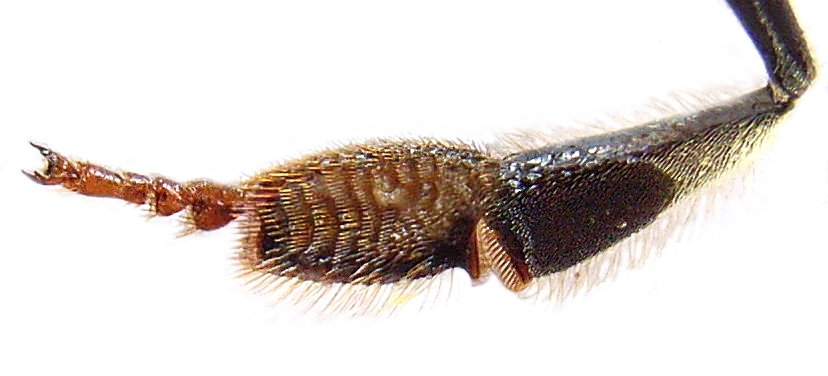
Honeybee legs carry hair-like sensory structures called sensilla on the tarsi – the leg segments closest to the foot – equipped with chemoreceptor cells capable of detecting sugars and other chemical compounds on direct contact with a surface. This system operates independently of the antennae, covered in our guide to bee antennae sensory receptors, and independently of the taste receptors on the mouthparts, giving a foraging bee a genuinely separate, additional sensory channel for evaluating a potential food source the instant it lands, before committing to the more deliberate act of extending its proboscis.
A detailed behavioral and electrophysiological study by de Brito Sanchez and colleagues, published in Frontiers in Behavioral Neuroscience in 2014, mapped this system directly: receptor cells in the sensilla of the tarsomeres (the middle leg segments) turned out to be highly sensitive to salt solutions even at very low concentrations, while separate receptor cells in the sensilla of the claws responded strongly to sucrose – two functionally distinct chemoreceptor populations on the same foot, rather than one uniform “foot taste” sense. The study also found no dedicated bitter-taste receptors at the tarsal level, though bitter compounds could indirectly suppress the claws’ sucrose response when the two were presented together.
How It Differs From Mouthpart Taste
Mouthpart taste receptors, located on the proboscis and associated structures, are what a bee uses once it has committed to actually drinking, giving detailed ongoing feedback about a nectar source’s sugar concentration and composition during feeding itself. Tarsal taste, by contrast, functions more as an initial screening system – a quick contact assessment made the moment the bee’s feet touch a flower surface, before the proboscis is even extended, allowing the bee to make a faster preliminary judgment about whether a landing site is worth further investigation at all. The two systems work together rather than duplicating each other, giving the bee a genuinely staged evaluation process rather than a single all-at-once taste assessment.

Why It Matters for Foraging Decisions
This staged system has real behavioral significance covered in more depth in our honeybee foraging behavior guide: a foraging bee visits an enormous number of flowers in a single trip, and the ability to make a fast, low-cost tarsal assessment before committing to the more time-consuming act of proboscis extension and drinking gives bees a genuine efficiency advantage. A flower offering low or no nectar reward can, in principle, be identified and rejected via tarsal contact alone, without the bee needing to fully commit to feeding first – a meaningful foraging-efficiency mechanism that a single mouthpart-only taste system would not provide on its own.
The Proboscis Extension Reflex: A Standard Research Tool
Tarsal contact chemoreception underlies the proboscis extension reflex (PER), a well-established laboratory paradigm in which touching a restrained bee’s tarsi (or antennae) with a sucrose solution reliably triggers automatic proboscis extension, a reflex response researchers have used for decades as a standard tool for studying bee learning, memory, and sensory responsiveness. PER-based experiments have become a foundational technique in bee neuroscience specifically because the reflex is so reliable and easy to measure, giving researchers a genuinely quantifiable window into bee sensory and cognitive function that would be far harder to obtain through direct behavioral observation of free-flying bees alone.
Foot-Taste and Pesticide Research
Because PER and tarsal sucrose responsiveness are so standardized and measurable, they have become a real, actively used tool in pesticide-effects research, including studies examining whether sublethal pesticide exposure – doses too low to kill a bee outright – measurably impairs sucrose responsiveness or learning performance. It is worth being precise about the current state of this research: findings vary by pesticide class, dose, and study design, and this article is not asserting a single universal conclusion about any specific pesticide’s effect on tarsal taste function, only that the tarsal contact chemoreception system has become a genuinely important, actively used measurement tool within this broader and still-developing area of pesticide-impact research.
Butterflies, Flies, and Other Foot-Tasters
Honeybees are far from alone in this ability – butterflies and flies are both well known in entomological research for tasting through contact chemoreceptors on their feet, in some cases with even more thoroughly documented sensory sensitivity than has been established for honeybees specifically. This is best understood as a broadly shared trait across multiple insect lineages rather than something unique to bees, and it is honest to note that the specific evolutionary relationship between these different insects’ tarsal taste systems – whether they represent a shared ancestral trait or independently evolved solutions to a similar sensory problem – is a question this article does not resolve, since it falls outside what a beekeeping-focused overview can responsibly claim to settle.
The salt-sensitivity side of tarsal taste has even been floated as a partial explanation for a familiar backyard nuisance: bees showing up at chlorinated swimming pools. Because a bee’s feet are so attuned to detecting dissolved salts and minerals at low concentrations, treated pool water may register as a plausible mineral-water source worth investigating, according to reporting on this research by Live Science – a real-world illustration of the same tarsal chemoreception system covered throughout this article, not a separate phenomenon.
How This Was Discovered
Insect tarsal contact chemoreception has been studied by entomologists for well over a century, with early foundational research on the phenomenon conducted in flies and butterflies before honeybee-specific tarsal taste research developed its own dedicated body of work within apicultural and neuroscience literature. The proboscis extension reflex itself has been used as a formal experimental paradigm in bee research for decades, refined over that time into the standardized laboratory tool it remains today, rather than being a recent discovery – part of why it has had enough time to become genuinely foundational to multiple separate lines of bee cognition and toxicology research rather than a novel or unproven technique.
Where This Fits in Bee Sensory Biology
Tarsal taste is one part of a genuinely elaborate overall sensory system covered more broadly in our honeybee sensory organs guide, which spans vision, smell, hearing-adjacent vibration sensing, and touch alongside taste. What makes tarsal taste worth its own dedicated treatment, rather than folding it into a single generic “bees can taste” statement, is that it is functionally and anatomically distinct from mouthpart taste – a separate contact-based system serving a genuinely different behavioral purpose (fast preliminary screening) from the mouthpart system’s role (detailed feedback during active feeding), which is exactly the kind of specific mechanistic detail a brief general sensory-organs overview cannot fully unpack for every individual sense.
Tarsal Taste vs. Mouthpart Taste
| Aspect | Tarsal (Foot) Taste | Mouthpart Taste |
|---|---|---|
| Location | Sensilla on the tarsi (feet/legs) | Proboscis and associated mouthparts |
| Timing in feeding | Instant, on contact/landing | During active feeding |
| Primary role | Fast preliminary screening | Detailed ongoing feedback while drinking |
| Research use | Basis of the proboscis extension reflex (PER) | Less commonly used as a standardized lab assay |
Common Misconceptions
- “Bees only taste with their mouths, like most animals.” Honeybees carry a genuinely separate contact chemoreceptor system on their tarsi, allowing them to detect sugars and other chemicals through their feet before ever extending the proboscis.
- “Tasting with feet is a unique honeybee trait.” It is a broadly shared ability across multiple insect groups, including butterflies and flies, not something unique to bees.
- “The proboscis extension reflex is just a lab curiosity with no real research value.” PER is a standard, actively used tool in bee neuroscience and pesticide-effects research specifically because tarsal sucrose responsiveness is so reliably measurable.
Frequently Asked Questions
Do bees actually taste with their feet?
Yes. Honeybees carry contact chemoreceptors on their tarsi capable of detecting sugars and other chemical cues on contact, functioning as a separate sensory system from the taste receptors located on their mouthparts.
Why would a bee need to taste with its feet if it already tastes with its mouth?
Tarsal taste allows a fast preliminary assessment the instant a bee lands, before it commits to the more time-consuming act of extending its proboscis – a real foraging-efficiency advantage across the large number of flowers a bee visits per trip.
What is the proboscis extension reflex?
A reliable reflex in which touching a bee’s tarsi or antennae with a sucrose solution triggers automatic proboscis extension, used as a standard laboratory tool for decades to study bee learning, memory, and sensory responsiveness.
Is tarsal taste used in pesticide research?
Yes, sucrose responsiveness measured via tarsal contact chemoreception is an actively used tool in studies examining whether sublethal pesticide exposure affects bee sensory or learning function, though specific findings vary by pesticide, dose, and study design.
Do other insects besides bees taste with their feet?
Yes, butterflies and flies are both well documented in entomological research for tasting through contact chemoreceptors on their feet, making this a broadly shared trait across multiple insect groups rather than something unique to honeybees.
Can tarsal taste detect anything besides sugar?
Tarsal contact chemoreceptors are understood to respond to a range of chemical stimuli beyond simple sugar concentration, though sucrose responsiveness is the most thoroughly studied and most commonly measured response in research settings specifically because it is so reliable and easy to quantify via the proboscis extension reflex. This article focuses on sugar detection as the best-documented function while acknowledging that the system’s full chemical sensitivity range is broader than sugar detection alone.
Where exactly are a bee’s taste receptors located on its feet?
On the tarsi, the terminal leg segments that make first contact with a flower surface, which carry hair-like sensilla equipped with chemoreceptor cells separate from the taste receptors found on the mouthparts.
For more on this topic, see a scientific overview of insect taste receptors.
Image credits: Photo: Wikimedia Commons user 26D, CC BY-SA 4.0.