Last Updated September 15, 2026
Few insects have carried as much symbolic weight across as many unrelated cultures as the honeybee. From ancient Greek priestesses who took their very name from bees, to a Pope who filled his family chapel with them, to an emperor who chose the bee over the lily as the emblem of his entire empire, bees have repeatedly been reached for as a symbol of industry, immortality, royalty, and divine order in cultures that had no contact with one another. This article looks specifically at that pattern – genuine, well-documented bee symbolism across several distinct cultural traditions – deliberately setting aside ancient Egyptian bee symbolism, since that specific tradition is already covered in real depth in our existing beekeeping in ancient Egypt article, including the pharaonic “Bee King” title and the bees-born-from-Ra’s-tears myth.
What follows instead is a tour through bee symbolism in ancient Greek religion, Christian and papal iconography, Napoleonic and Merovingian French history, 19th-century American Mormon culture, and Hindu tradition – five genuinely distinct threads that, taken together, make the honeybee one of the most symbolically reused creatures in recorded human history.
Key Takeaways
- Ancient Greek “Melissae” (bee-priestesses) served Demeter and Artemis; the classical writer Porphyry specifically records that the ancients called Artemis herself “Melissa.”
- Pope Urban VIII (born Maffeo Barberini, 1623-1644) used three bees as his family emblem – they still appear carved into Bernini’s baldachin inside St. Peter’s Basilica. See our full Barberini Bees deep-dive for the complete story.
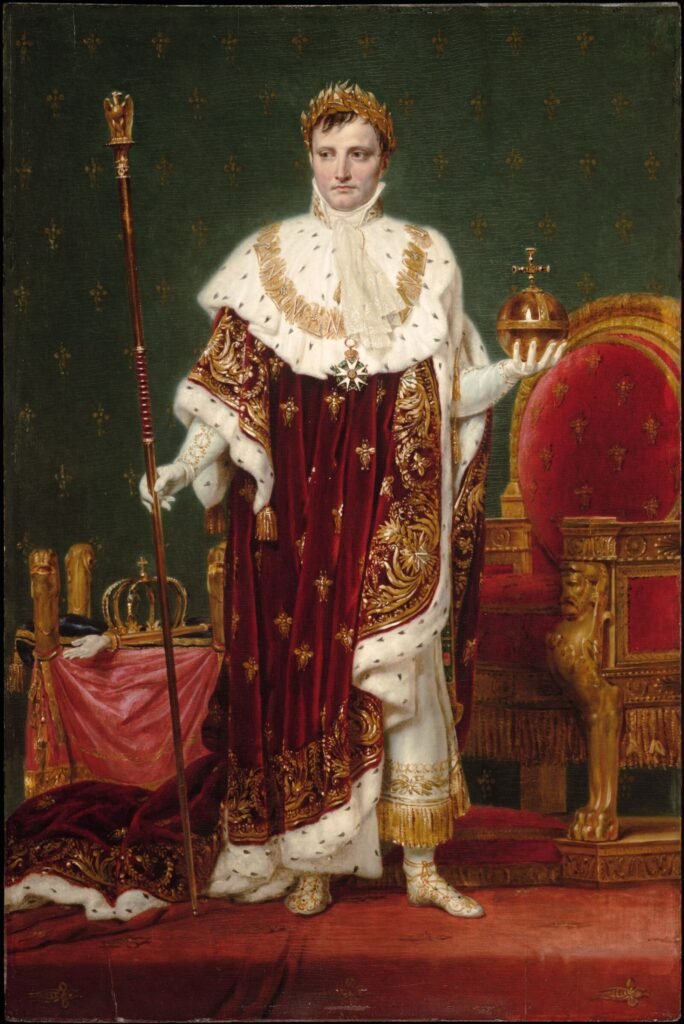
- Napoleon adopted the bee as his imperial emblem after gold bee ornaments were excavated from the 1653 tomb of Merovingian king Childeric I – his 1804 coronation robe was embroidered with 300 gold bees.
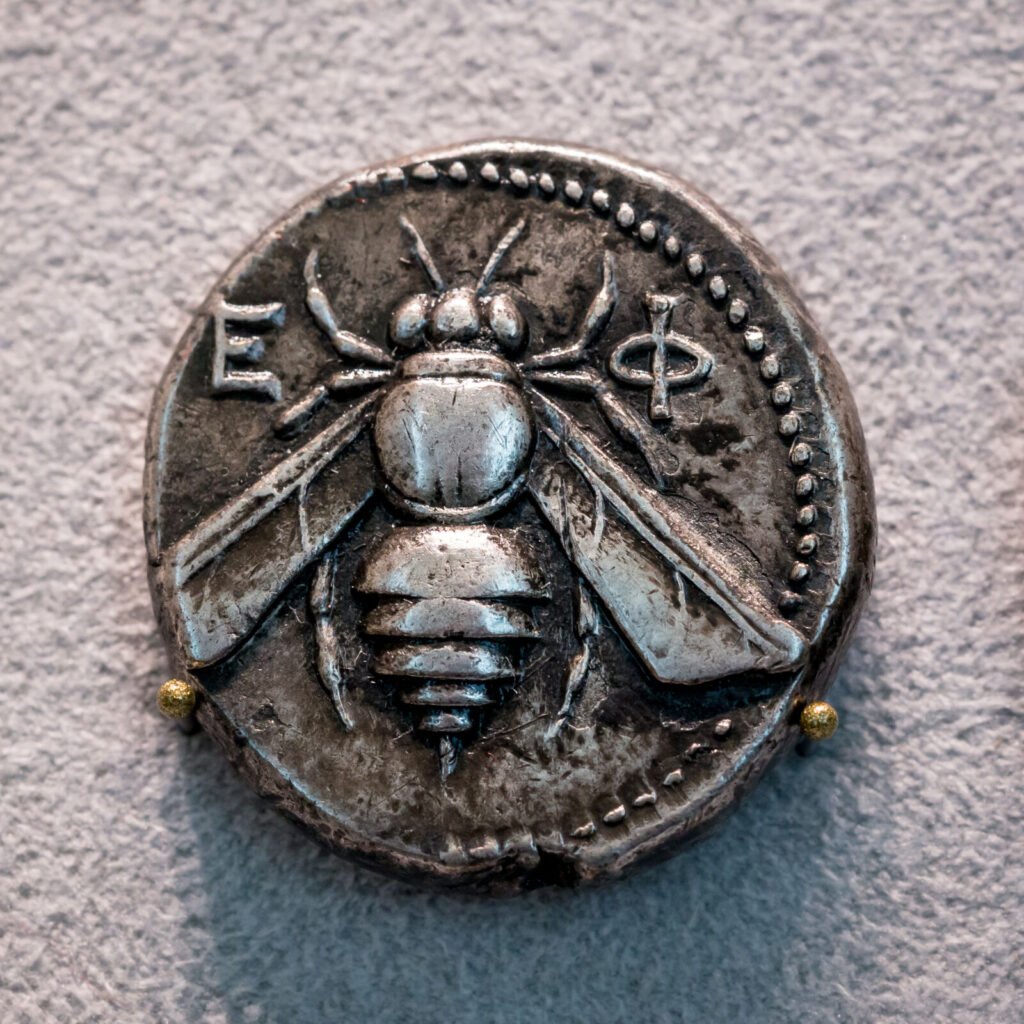
- The Ephesus bee – stamped on that Greek city’s coinage as early as the 6th century BC – is one of the oldest surviving examples of bee-as-civic-symbol anywhere; see our dedicated Bee of Ephesus article.
- The recurring thread across every unrelated tradition covered here is the same: bees’ visibly organized, cooperative social structure made the hive a ready-made metaphor for well-ordered human institutions.
Table of Contents
- The Melissae: Bee-Priestesses of Ancient Greece
- The Barberini Bees: A Pope’s Family Emblem
- Napoleon’s Bees and the Merovingian Tomb
- Deseret: The Mormon Beehive Symbol
- Bhramari Devi and Bees in Hindu Tradition
- The Beehive in Freemasonry
- Why Bees, Specifically?
- Symbolism in Practice: Folk Custom
- Bee Symbolism Across Traditions
- Common Misconceptions
- FAQ
The Melissae: Bee-Priestesses of Ancient Greece
In ancient Greek religion, “Melissae” (from “melissa,” Greek for bee) referred to priestesses associated with several goddesses, including Demeter and Artemis, and the term also appears connected to the Oracle at Delphi in some ancient sources. The bee held genuine symbolic weight in Greek thought beyond this priestly title, often associated with purity, industriousness, and in some traditions a connection to the soul or the divine – a symbolic thread distinct from, though related to, the more scientific and observational treatment of actual bee behavior described in our article on Aristotle’s bees. It’s worth being precise about the historical record here: exact ritual details and the full scope of the Melissae title’s use vary across ancient sources, and this article treats the core association as well documented while avoiding overly specific claims about ritual practice that ancient sources don’t consistently support.
“The priestesses of Ceres, also, as being initiated into the mysteries of the terrene Goddess, were called by the ancients bees… The moon, likewise, who presides over generation, was called by them a bee, and also a bull.”
The Ephesus bee is a related, and even older, thread: the Greek city of Ephesus stamped a honeybee onto its coinage as early as the 6th century BC, since the bee was sacred to Artemis and the city’s priesthood was known as the “king bee.” We cover that coinage in full in our dedicated Bee of Ephesus article.
The Barberini Bees: A Pope’s Family Emblem
Pope Urban VIII, born Maffeo Barberini and head of the Catholic Church from 1623 to 1644, used three bees as his family’s heraldic emblem, and those bees appear throughout Rome on buildings, fountains, and artworks associated with his papacy, including prominently on Gian Lorenzo Bernini’s baldachin inside St. Peter’s Basilica. The bee’s association with industriousness, order, and a well-organized hierarchical community made it a fitting emblem for a family whose head led the Catholic Church’s own hierarchical institutional structure, and the Barberini bees remain one of the most visually documented and widely recognized instances of bee symbolism in Western art and architecture specifically because they are still physically present, carved into stone, across central Rome today.
This is a brief summary – for the full story of the Barberini bees, including how they came to appear on Bernini’s baldachin specifically, see our dedicated Barberini Bees article.
Napoleon’s Bees and the Merovingian Tomb
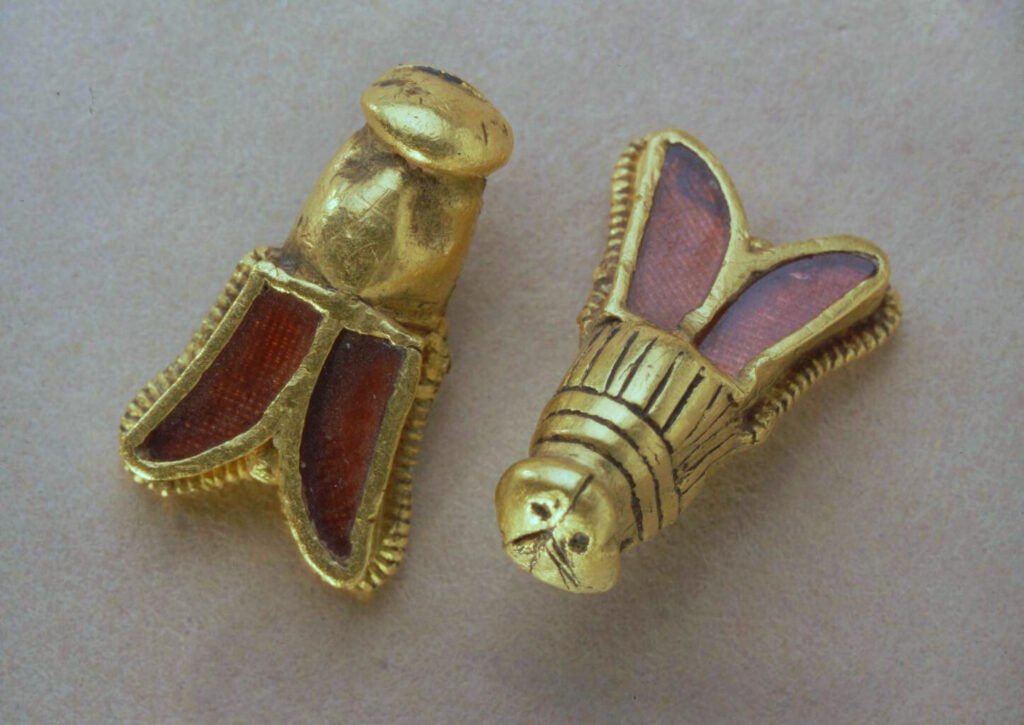
Napoleon Bonaparte adopted the bee as an imperial emblem, reportedly connected to golden bee ornaments discovered in the 1653 excavation of the tomb of Childeric I, a 5th-century Merovingian king, which Napoleon’s court took as evidence of an ancient French royal symbol he could legitimately claim continuity with. Napoleonic bee imagery appears extensively on imperial regalia, textiles, and architecture from his reign, deliberately chosen in part as an alternative to the fleur-de-lis, which carried Bourbon monarchy associations Napoleon wanted to distance his new imperial identity from. This is a genuinely well-documented case of a political leader consciously selecting bee symbolism for its associations with industriousness and a well-ordered “kingdom,” while also using it to construct a claimed historical lineage – worth noting honestly as a case where symbolism served real political utility, not merely aesthetic preference.
The scale of the original find is easy to understate: excavators recovered more than 300 gold, garnet-winged bees from Childeric’s tomb in Tournai in 1653. Napoleon had 300 gold bees embroidered onto his own coronation robe in 1804, deliberately echoing that number. Most of the originals were later melted down after an 1831 theft from the Bibliotheque nationale de France – only two of the original Merovingian bees survive today, still held in the Bibliotheque nationale de France’s collection.
Deseret: The Mormon Beehive Symbol
The beehive became a significant symbol in 19th-century Latter-day Saint culture, tied to the term “Deseret,” used in the Book of Mormon to mean “honeybee” and adopted as the name proposed for an early state in the Utah territory. The beehive symbol was explicitly understood to represent industry, cooperation, and collective effort, values considered central to the Mormon pioneer settlement experience, and it remains Utah’s official state symbol and state emblem today, appearing on the Utah state flag and seal – a rare example of bee symbolism transitioning directly from religious and cultural meaning into official modern government iconography still in active use.
Bhramari Devi and Bees in Hindu Tradition
In Hindu tradition, Bhramari Devi is a goddess associated with bees, her name derived from “bhramar,” a Sanskrit word for black bee, and she is described in some traditions as having called upon swarms of bees, wasps, and hornets to overcome a demon. Bees and bee-like imagery also appear more broadly in Hindu iconography in connection with certain deities, reflecting a distinct symbolic tradition from the European and Middle Eastern threads covered elsewhere in this article, developed independently within its own religious and cultural context rather than sharing any common origin with Greek, Christian, or French symbolic traditions.
The Beehive in Freemasonry
The beehive is a recognized symbol within Freemasonry, generally understood to represent industry and cooperative effort among members working toward a shared purpose, echoing the same “well-ordered collective” symbolism that recurs across several of the other traditions covered in this article. Freemasonry’s beehive symbolism draws on the same widely shared human observation – that a hive represents organized, purposeful collective labor – that also motivated its adoption in Mormon Deseret iconography and Barberini papal imagery, even though these traditions developed the symbol independently for their own distinct institutional purposes.
Why Bees, Specifically?
The recurring thread across these otherwise unrelated traditions is bees’ visibly organized, cooperative, hierarchical social structure – a genuinely unusual trait among insects that made the hive a ready-made metaphor for well-ordered human institutions, whether religious, political, or civic. This is a case where the underlying biological reality (a real, observable social structure, however differently each era understood its internal workings) plausibly explains why so many unrelated cultures independently reached for the same symbol, rather than one culture’s bee symbolism spreading to and influencing the others – a point this article treats as a reasonable, well-supported interpretation rather than a definitively proven single causal explanation.
Symbolism in Practice: Folk Custom
This kind of elevated symbolic status did not stay confined to religion, heraldry, and state iconography – it also shaped how ordinary households related to their own bees. The English, Welsh, and German folk custom of “telling the bees” of a household death reflects the same underlying idea found throughout this article: that bees, because of their visible social order, were treated as more than simple livestock, worthy of inclusion in matters that mattered to the humans who kept them. Where papal, imperial, and state symbolism used the bee to represent abstract institutional order, this household-level custom applied a strikingly similar logic – bees as quasi-aware participants in a well-ordered community – at the intimate scale of a single family’s daily life.
Bee Symbolism Across Traditions
| Tradition | Core Symbolic Meaning | Best-Known Example |
|---|---|---|
| Ancient Greek | Purity, the soul, priestly service | Melissae priestesses of Demeter/Artemis |
| Catholic/Papal | Industry, hierarchical order | Barberini bees under Pope Urban VIII |
| Napoleonic France | Imperial legitimacy, industriousness | Napoleon’s imperial bee emblem |
| Mormon/Utah | Cooperation, pioneer industry | “Deseret” beehive, Utah’s state symbol |
| Hindu | Divine power, protective force | Bhramari Devi |
Common Misconceptions
- “Bee symbolism is mainly an ancient Egyptian phenomenon.” Egypt is one well-documented tradition among many genuinely independent ones, including Greek, Christian, French imperial, American Mormon, and Hindu traditions covered in this article.
- “Napoleon invented bee-as-royal-symbol imagery.” He adopted and popularized it for his own imperial identity, but drew on earlier associations, including golden bee ornaments from the much older Merovingian royal tomb of Childeric I.
- “The beehive as a symbol of industry is a uniquely Western idea.” Bee and beehive symbolism, including industry- and order-related meaning, appears independently across Western, Middle Eastern, and South Asian traditions covered in this article.
Frequently Asked Questions
Is the beehive still used symbolically in modern branding and design?
Yes, well beyond the historical traditions covered in this article – modern businesses, organizations, and civic branding still reach for beehive and bee imagery to signal industriousness, cooperation, and productivity, a direct continuation of the same underlying symbolic logic that motivated the Barberini, Napoleonic, Mormon, and Masonic uses of the bee centuries earlier.
Why did Pope Urban VIII use bees as his emblem?
Three bees were the Barberini family’s heraldic emblem, adopted before Maffeo Barberini became Pope Urban VIII, and they subsequently appeared throughout his papal commissions across Rome, including Bernini’s baldachin in St. Peter’s Basilica.
Why did Napoleon choose the bee as his imperial symbol?
Napoleon adopted the bee partly for its association with industriousness and order, and partly to construct a claimed historical lineage to ancient French royalty via golden bee ornaments discovered in the 5th-century tomb of Merovingian king Childeric I, deliberately distancing his imagery from the Bourbon fleur-de-lis.
What does the beehive symbol mean in Utah and Mormon culture?
The beehive, tied to the term “Deseret” meaning honeybee, represents industry and cooperative effort central to the Mormon pioneer settlement experience, and it remains Utah’s official state symbol, appearing on the state flag and seal today.
Does the honeybee’s real biology support the “well-ordered kingdom” symbolism?
Only loosely, and it is worth being precise about this. Historical symbolic traditions often described hives as ruled by a “king” bee, a belief later corrected as understanding of actual colony biology – a single reproductive queen supported by a female worker caste – improved over time, including through the more rigorous observational work described in our Aristotle’s bees article. The symbolism captures something real about hive organization and division of labor, but the specific “monarchy” framing many traditions used reflects historical belief more than precise modern biological understanding.
Is bee symbolism found in Hindu tradition?
Yes, most notably through Bhramari Devi, a goddess associated with bees whose name derives from the Sanskrit word for black bee, described in some traditions as commanding swarms of bees, wasps, and hornets.
Does bee symbolism appear in Maya or other indigenous American cultures?
Yes, though through an entirely separate symbolic and religious tradition from the ones covered in this article – the bee deity Ah-Muzen-Cab and associated ritual practice in Maya meliponiculture represents a genuinely independent thread of bee reverence, developed with no contact with the Old World traditions discussed here, reinforcing the broader pattern that culturally significant bee symbolism has emerged repeatedly and independently around the world rather than spreading from one common source.
Image credits: Photo: ArchaiOptix, Wikimedia Commons, CC BY-SA 4.0 (coin: Berlin Munzkabinett).