Reviewed by Daniel M. · Last Updated October 14, 2026 · How we review
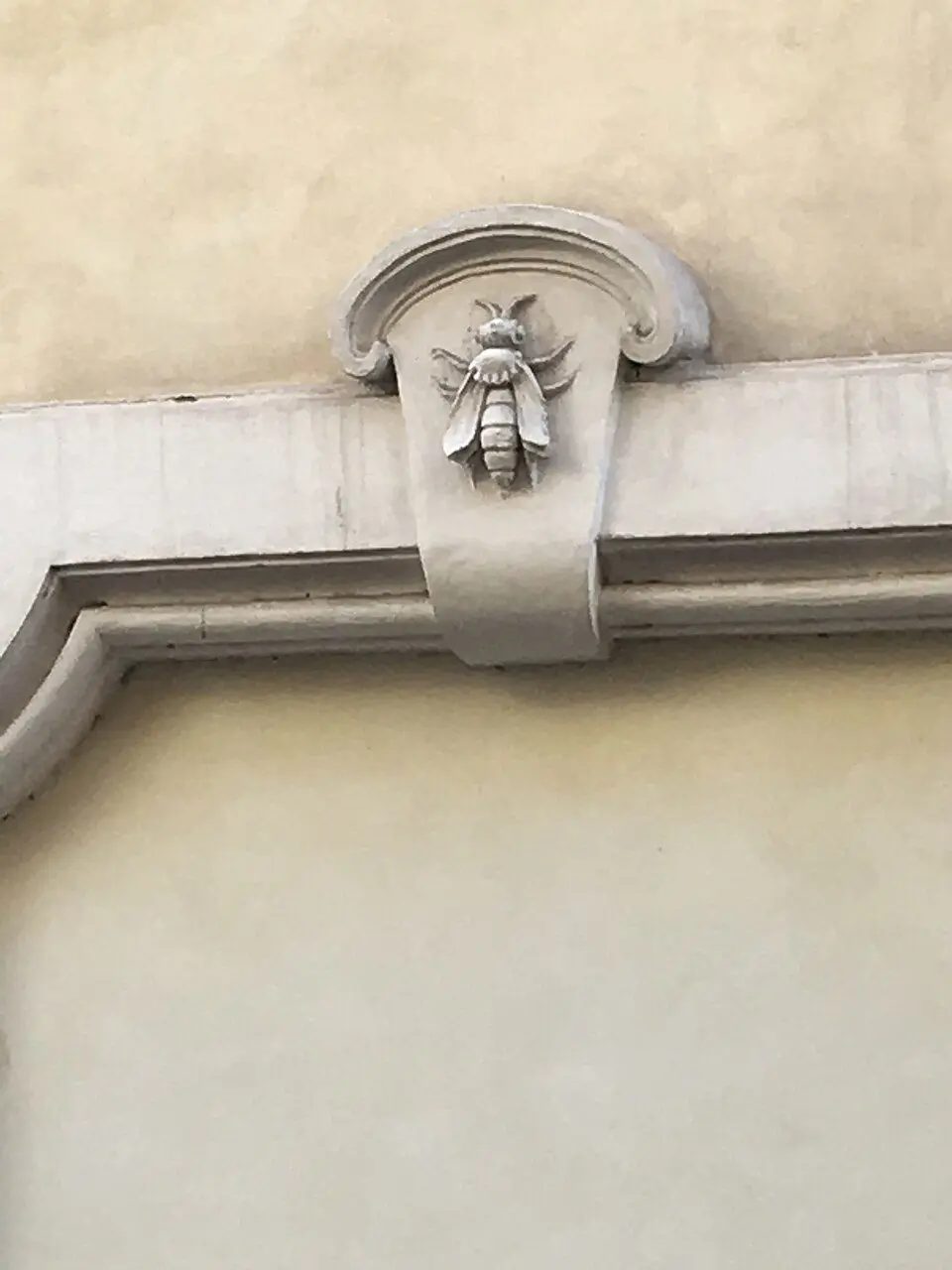
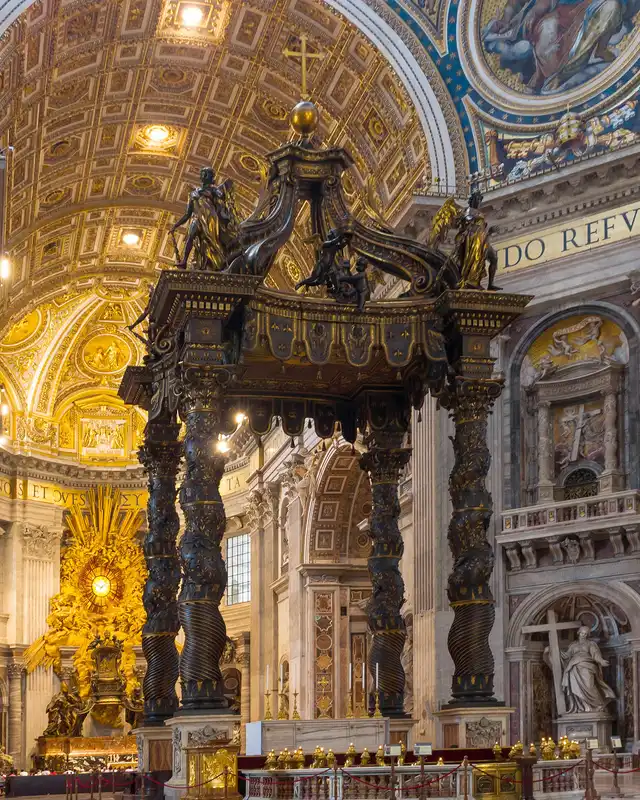
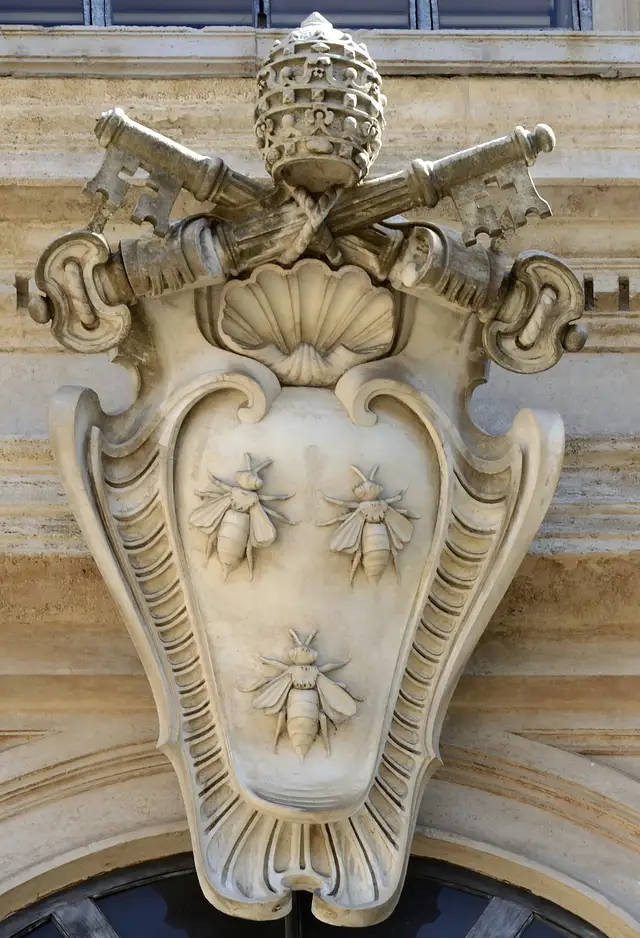
The bees on Bernini’s baldachin in St. Peter’s Basilica are the coat of arms of the Barberini family: Pope Urban VIII, who commissioned the bronze canopy over the high altar, was born Maffeo Barberini, and his family’s emblem is three bees.
Key Takeaways
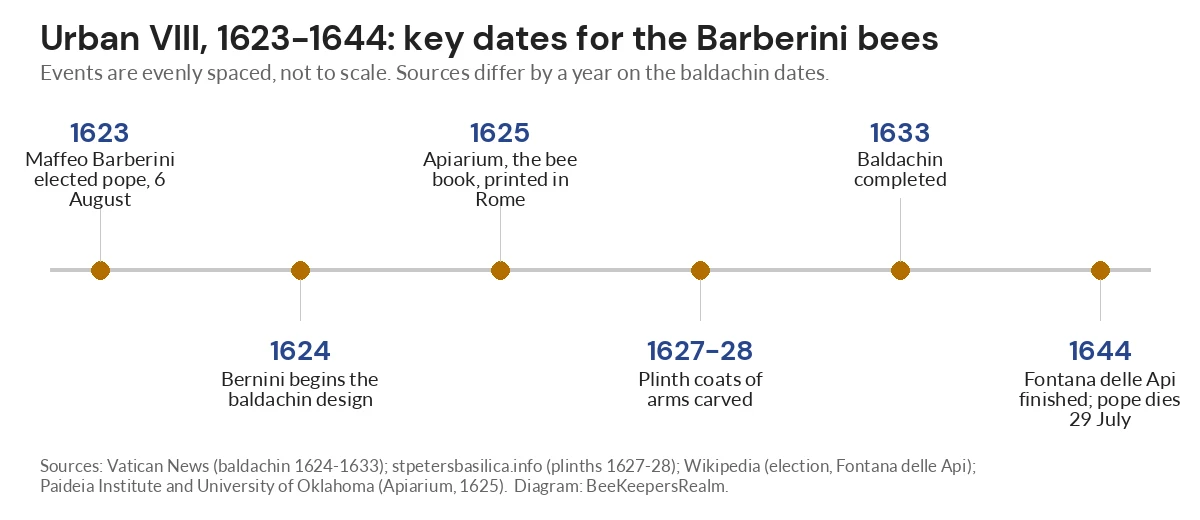
- The bees are the Barberini arms: three bees under the papal tiara and crossed keys. Urban VIII reigned from 6 August 1623 to 29 July 1644.
- The arms were not always bees. A heraldry reference records earlier arms with three horseflies, matching the family’s original name, Tafani. Why the family switched is debated.
- On the baldachin the bees appear on eight plinth shields and among gilded bay leaves on the columns.
- Whether the baldachin’s bronze came from the Pantheon is unsettled. Popular accounts say yes; a reading of the pope’s accounts says most Pantheon bronze became cannon.
- Real bees entered the story in 1625, when the Lincean Academy printed the Apiarium, a bee-anatomy plate carrying the Barberini arms.
From Horseflies to Bees: Where the Crest Came From
The family came from Barberino Val d’Elsa near Florence and was originally called Tafani da Barberino; tafani is Italian for horseflies, according to Walks in Rome. Heraldica.org, a heraldry reference, records the earlier shield:
“Their arms were gules three horse-flies or, the arms canting (tafani=horse-flies).”
Why the horseflies became bees is not settled. The Frame Blog says the family adopted a more attractive insect as the bee stood for moral virtue; Walks in Rome says bees had a better heraldic pedigree; Context Travel says the bee’s links to Christ suited a papal family. None of the sources I reviewed documents when or why the switch happened, so treat these as interpretations.
Where the Bees Sit on Bernini’s Baldachin
Vatican News says Bernini designed the baldachin in 1624 and finished it in 1633; Wikipedia gives 1623 to 1634. Figures differ too: Wikipedia lists 28.74 m, Inside the Vatican says nearly 30 meters and about 63 tons, and EWTN says about 93 tons.
The plinths. The two outer sides of each of the four marble plinths carry the Barberini arms, eight shields in all. stpetersbasilica.info dates them to 1627-28. Each has a woman’s head above and a satyr’s head below, and her expression changes from shield to shield until a baby’s face appears on the last. The meaning is contested: that site quotes art historian Irving Lavin reading it as the Church’s labor in bringing salvation, while a popular guide story points to a niece of Urban VIII.
The columns and canopy. The Frame Blog describes the upper column sections as sprays of gilded bay leaves where putti play and bees flutter.
Where to Spot the Barberini Bees in Rome
| Location | What to look for | Source |
|---|---|---|
| St. Peter’s baldachin, plinths | Eight shields with three bees each, on the outer faces of the four plinths | stpetersbasilica.info |
| St. Peter’s baldachin, columns | Bees among gilded bay-leaf sprays on the upper column sections | The Frame Blog |
| Tomb of Urban VIII, St. Peter’s | Bees scattered across the monument | University of Washington Rome project |
| Palazzo Barberini | Bees carved or painted almost everywhere; the palace now houses the national gallery of ancient art | Turismo Roma; Wikipedia |
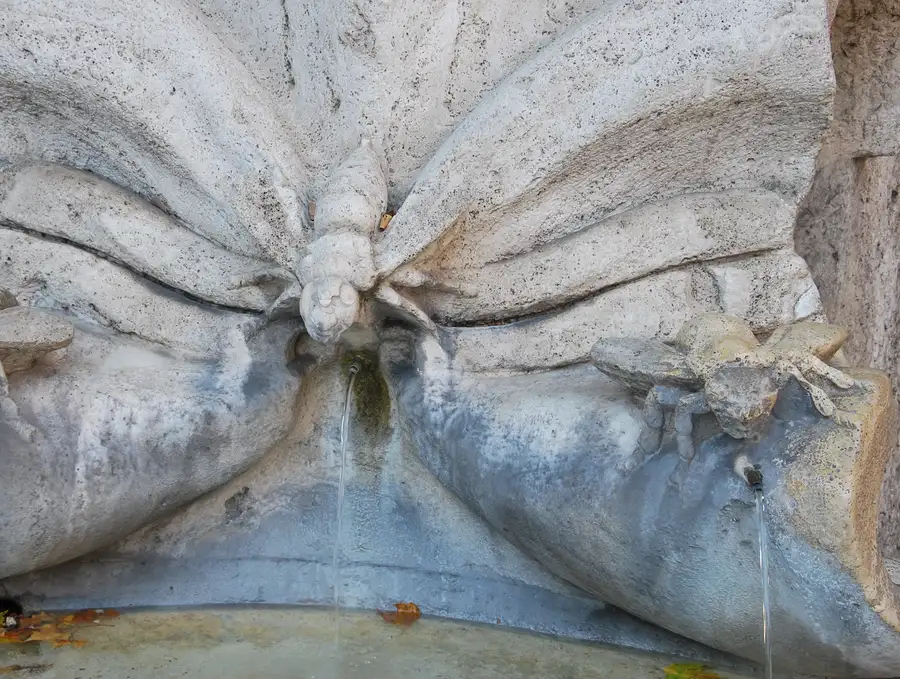
| Fontana delle Api, Piazza Barberini | Three stone bees on a shell; Bernini, 1644. The present fountain is a 1916 copy | Wikipedia |
| Pantheon portico | A bee on the capital of the granite column Urban VIII restored at the northeast corner | Wikipedia |
| Santa Maria in Aracoeli | A stained-glass window with bees, plus gilded stucco bees on the west wall | The Frame Blog |
| Palazzo di Propaganda Fide | A plaque over the doorway with Urban VIII’s arms; a bee on the library ceiling | Wikipedia |
The Pantheon Bronze: What the Sources Do and Don’t Say
A famous Roman jibe accused the family of stripping the Pantheon. Wikipedia reports it as a lampoon left on the statue of Pasquino:
“What the barbarians did not do, the Barberini did.”
EWTN states the baldachin bronze “is believed to have come from the Pantheon.” Wikipedia’s Pantheon article disagrees: Urban VIII removed the bronze trusses of the portico, most of it went to bombards for Castel Sant’Angelo, and archaeologist Carlo Fea found in the pope’s accounts that about 90% went to cannon while the baldachin’s bronze came from Venice. The baldachin article tags the Venice claim as needing a citation, and I could not find Fea’s original text, so the question is open. The jibe survives either way.
The Bees Scientists Really Studied: The 1625 Apiarium
The emblem has one genuine link to bee science. The University of Oklahoma’s history of science collection describes the Apiarium as a first publication of observations made with a microscope, in which Federico Cesi and Francesco Stelluti studied bee anatomy; its title area shows the Barberini crest with three bees. Marco Romani Mistretta of the Paideia Institute notes it described stingers, antennae and compound eyes in new detail, and that its epigram honors the new pope:
“Behold, in the Barberini emblem, the Bee, more distinguished than anything else in all of Nature”
Bees had been studied since Aristotle (see Aristotle’s bee observations); to see what the Lincei were looking at, read our guides to honeybee anatomy and bee antennae. Live bees later returned to the family palace: Turismo Roma lists two hives in the Palazzo Barberini garden from 15 June to 30 September 2021, a project of the FAI Rome Delegation.
Frequently Asked Questions
Why are there bees on the baldachin in St. Peter’s Basilica?
They are the Barberini coat of arms. Urban VIII, born Maffeo Barberini, commissioned the baldachin, and the family emblem appears on its plinths, columns and canopy.
What do the Barberini bees symbolize?
Writers offer interpretations rather than documented intent: moral virtue and industry (The Frame Blog) or links to Christ (Context Travel). The family’s own earlier emblem was a horsefly, so the bees were also a status upgrade.
Did the baldachin’s bronze really come from the Pantheon?
Sources disagree. Popular accounts say yes, while Wikipedia cites the pope’s accounts for about 90% of the Pantheon bronze going to cannon and the baldachin’s bronze coming from Venice. That second claim lacks a primary citation, so it is unresolved.
Does the Barberini family still exist?
Yes. Wikipedia’s Barberini family article says the family is represented by Benedetto Francesco Barberini, Prince of Palestrina, born in 1961.
Did the Barberini family keep bees?
None of the sources I reviewed says so. The bees were heraldry; the beekeeping connection is the 1625 Apiarium and, much later, the 2021 hives.
Where to Go Next
For other bee emblems, see bee symbolism across cultures, the bee of Ephesus, the Manchester bee and the Malia pendant.